
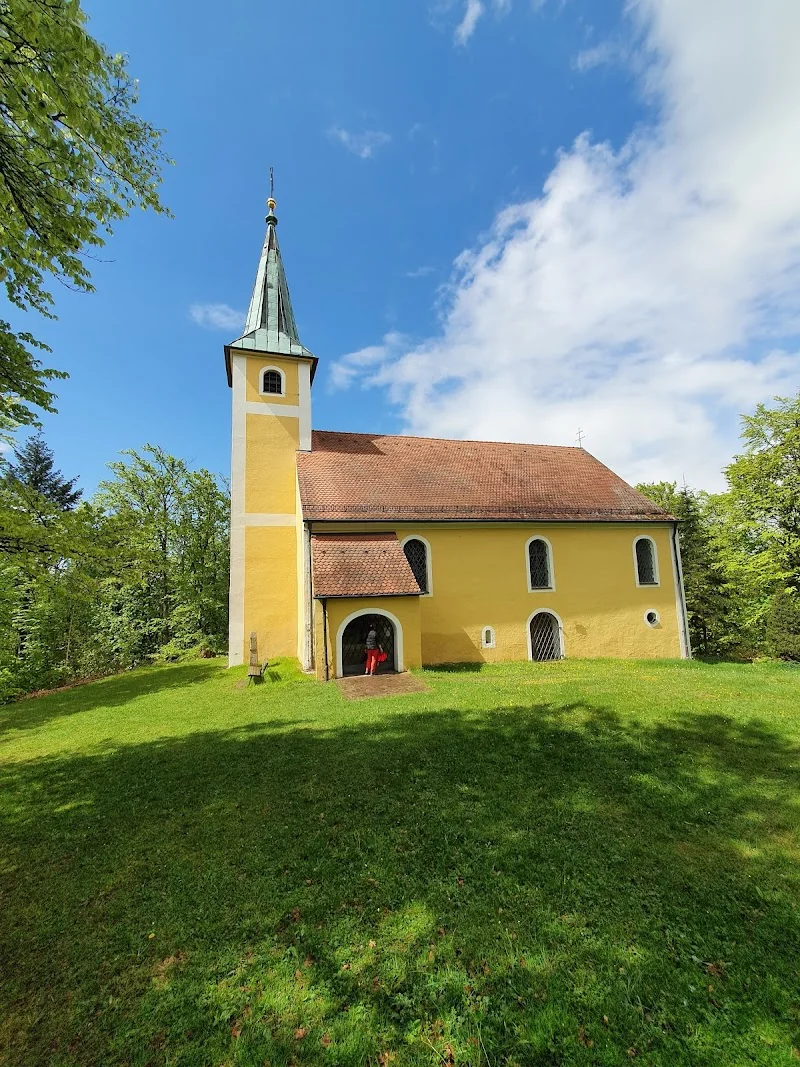
Johannisbergstraße, Freudenberg
Johannisbergstraße, 92272 Freudenberg, Germany
Pilgrimage Church Johannisberg | History & Access
The Pilgrimage Church Johannisberg near Freudenberg is one of those places where landscape, faith, and regional identity come together very directly. It stands high above the valley on the 605-meter-high Johannisberg, which is described as the westernmost foothill of the Upper Palatinate Forest. For the parish community of Johannisberg, this mountain is so defining that it names itself after it. Therefore, anyone searching for the Pilgrimage Church Johannisberg Freudenberg will find not just a single place of worship, but a historic pilgrimage site, a popular starting point for hikes, and a prominent landmark in the region. The combination of height, forest location, and centuries-old piety makes this destination particularly appealing. The church is closely linked to the annual cycle, especially with the patronage on June 24, the Stations of the Cross, and the summer services that have kept the place religiously vibrant for a long time. At the same time, the Johannisberg Church is also interesting for those seeking images, viewpoints, or quiet paths, as its location is as impressive as its history. ([pfarreiengemeinschaft-johannisberg.de](https://www.pfarreiengemeinschaft-johannisberg.de/ueber-uns/kirchen/))
History of the Pilgrimage Church Johannisberg
The history of the Pilgrimage Church Johannisberg goes back a long way and is closely linked to the character of the mountain. The Diocese of Regensburg describes the church as a pilgrimage church on Johannisberg near Freudenberg, whose location at the edge of a prehistoric ring wall suggests that a sacred site may have existed here even before Christianization. This connection between ancient settlement and cult landscape and later Christian use makes Johannisberg so fascinating. According to tradition, the church was blown up in 1597 by the Calvinist Elector. This was followed by reconstruction in 1652, before the church received its current size in 1712. The parish community summarizes the present form as a building from 1711, highlighting the close temporal proximity of the Baroque renewal. For visitors, this means: The church, as experienced today, is the result of a long history of destruction, reconstruction, and careful expansion. It exemplifies many pilgrimage sites in the Upper Palatinate, where faith and history are inseparable. ([bistum-regensburg.de](https://bistum-regensburg.de/mitmachen/wallfahrten-im-bistum/wallfahrtsorte-im-bistum))
The classification within the local church landscape is also important. The parish community of Johannisberg was formed on September 1, 2018, from the parishes of Lintach, Pursruck, and Wutschdorf, along with the subsidiary Etsdorf. That it bears the name of the mountain shows the symbolic power the pilgrimage church holds for the surrounding area. Johannisberg is not just a backdrop but the center of a spiritual and cultural space that revolves around the mountain. The church itself is officially named St. Johann and is referred to as the Pilgrimage Church St. Johann by the community and the diocese. This also makes it clear that the search for Pilgrimage Church St. Johann or Pilgrimage Church St. John the Baptist is essentially aimed at the same place. For the region, this church is an anchor of identity: it stands atop the mountain, is visible from afar, and connects the present-day town of Freudenberg with a very old religious tradition. Those interested in history, sacred architecture, or regional cultural sites will find a particularly dense and well-documented connection here. ([pfarreiengemeinschaft-johannisberg.de](https://www.pfarreiengemeinschaft-johannisberg.de/))
Johannisberg Festival, Stations of the Cross, and Summer Services
The religious highlight of the year is the Johannisberg Festival on June 24, the feast of the birth of John the Baptist. The Diocese of Regensburg and the community of Freudenberg emphasize that this festival has a long tradition and is complemented on the nearest Sunday by foot pilgrimages from the surrounding towns and parishes. This is what makes the place so lively: Johannisberg is not only a destination for individual visitors but a communal pilgrimage site where path, liturgy, and village community meet. On the mountain, the festive service takes place outdoors, giving the celebration an open, almost scenic character. This fits well with the church's location high above Freudenberg and explains why the Johannisberg Festival continues to have a strong attraction. Those searching for Johannisberg Festival, Pilgrimage Church Johannisberg Freudenberg, or Johannisberg Church often seek precisely this interplay of lived tradition and regional public life. The place is not museum-like but is actually used throughout the year, and these uses are firmly anchored in the church calendar. ([gemeinde-freudenberg.de](https://www.gemeinde-freudenberg.de/leben-in-der-gemeinde/pfarreien))
Other fixed religious references include the Stations of the Cross and the summer services. The diocese reports that on Palm Sunday, the Stations of the Cross are prayed up the Johannisberg. Additionally, from Pentecost Monday to the Exaltation of the Cross, there are approximately biweekly Sunday services on Johannisberg. The community adds that services on the mountain only take place during the summer months, and the exact dates can be found in the parish newsletter. This is practically important for visitors, as the place is seasonally influenced: in summer, it plays a regular liturgical role, while in the rest of the year, it serves more as a pilgrimage and hiking destination. This mix is one of the reasons why search queries related to Pilgrimage Church St. Johann, services, programs, and pilgrimages often coincide. Therefore, anyone planning a visit should check the parish newsletter, not only for service times but also because holidays and feast days can significantly alter the visit experience. Thus, Johannisberg remains a place where tradition is not only remembered but is actually lived throughout the year. ([gemeinde-freudenberg.de](https://www.gemeinde-freudenberg.de/leben-in-der-gemeinde/pfarreien))
Access, Parking, and the Footpath to Johannisberg
The access to the Pilgrimage Church Johannisberg is closely linked to its character as a pilgrimage site. The Diocese of Regensburg explicitly states that the church is usually only accessible on foot. This means: The visit typically does not begin directly at the portal but with an ascent through the landscape of Johannisberg. This path is part of the experience. For the Johannisberg Festival, parking spaces are arranged closer to the church, but in everyday life, the footpath remains the actual form of access. Therefore, anyone looking to park at Johannisberg or access Johannisberg should know that the mountain visit is intentionally designed as a small pilgrimage route. This distinguishes the place from many easily accessible excursion destinations. Here, the path itself is already part of the devotion and perception of the place. Those who come on foot approach the church slowly, perceive the forest more intensely, and experience the location on the ridge much more directly. This fits well with the character of the pilgrimage church and explains why visitors repeatedly speak of a special atmosphere as soon as the path reveals the view of the church. ([bistum-regensburg.de](https://bistum-regensburg.de/mitmachen/wallfahrten-im-bistum/wallfahrtsorte-im-bistum))
A particularly well-documented access is the hiking trail The Blue Arrow of the community of Freudenberg. From the hiking parking lot at Hammermühle, the path leads uphill to a trail on the sunlit west side of Johannisberg. The route offers wide views of the Upper Palatinate Jura, leads after about a kilometer to the middle circular path, and continues past the waterhole and the remains of the approximately 3000-year-old Celtic ring wall. According to the official sheet, the total length is 6.7 kilometers, the elevation difference is 220 meters, and the walking time is about 1.5 hours; the difficulty is described as moderate. This information is very helpful for hikers, as it shows that the visit is manageable but not completely flat. Those targeting the Pilgrimage Church Johannisberg as a hiking destination receive not only a religious site but also a compact tour with views, forest paths, and an archaeological environment. This is a significant advantage for the combination of nature and history. Search queries like images of Pilgrimage Church Johannisberg Freudenberg often arise from such impressions, as the path already provides motifs before one even arrives at the church. ([gemeinde-freudenberg.de](https://www.gemeinde-freudenberg.de/fileadmin/Dateiverzeichnis/Gemeinde_Freudenberg/Wander-und_Radwege/Wanderweg_DER_BLAUE_PFEIL.pdf))
Images, Architecture, and the Special Location Above Freudenberg
Those searching for images of the Pilgrimage Church Johannisberg encounter a building that offers strong motifs both inside and outside. The Diocese of Regensburg describes a Baroque high altar with four columns adorned with acanthus decorations. The altar painting depicts John the Baptist, flanked by figures of his parents Zacharias and Elisabeth; outside stand the apostles John and James. This constellation already makes it clear how clearly the church is theologically oriented towards its patron. For photography and visual perception, not only the altar is important, but also the gallery and the ceiling. The official image description mentions a richly decorated double gallery with a wooden coffered ceiling. On the upper gallery, the four evangelists are depicted, outside the four Western Church Fathers, while the lower gallery shows nine images of scenes from the life of John the Baptist. Therefore, those searching for images of Pilgrimage Church Johannisberg Freudenberg are actually seeking a church with an unusually rich internal impact that goes far beyond the mere view of the place. The imagery inside supports the pilgrimage and makes the church attractive even for art-interested visitors. ([bistum-regensburg.de](https://bistum-regensburg.de/mitmachen/wallfahrten-im-bistum/wallfahrtsorte-im-bistum))
The exterior also possesses distinctive elements. The diocese mentions the Johannisberg Church from the outside with an external chapel adorned with an original acanthus altar and bandwork. This creates an image that appears typically Baroque yet remains unique. Because the church stands high on the mountain, it is also very present in the landscape. The parish community describes it as a greeting church on the summit of Johannisberg, and the community of Freudenberg locates the mountain as the western foothill of the Upper Palatinate Forest. This combination of architecture and topography is particularly appealing for images: The building does not stand isolated but in an open relationship with forest, sky, and slope. This also explains why the Pilgrimage Church Johannisberg is repeatedly perceived as a photographic motif, viewpoint, and resting place. Therefore, those visiting the site should not only pay attention to the actual church portal but also to the path back into the valley, to the mountain ridge, to the sight lines between forest and settlement, and to the effect of the building as the culmination of the ascent. The special charm of this place lies precisely in this: It is not only beautiful but beautifully embedded. ([pfarreiengemeinschaft-johannisberg.de](https://www.pfarreiengemeinschaft-johannisberg.de/))
Renovation, Visit Planning, and Practical Tips
For current visit planning, it is important to note that renovation work has begun at the Johannisberg Church. The parish newsletter states that the restoration work started on May 6, 2024, and the first construction phase is expected to last until the end of October 2024. Mentioned are restoration, exterior renovation, pest control, and the securing of the coffered ceiling. The parish newsletter also notes that the use of the Johannisberg Church was not possible during this period. On the contact page of the parish community, a donation account for the renovation of the Johannisberg Church is also maintained. This means for visitors: The place is clearly described historically and geographically, but the specific accessibility should always be checked against the current parish newsletter before a visit. This is especially advisable for Pilgrimage Church Johannisberg Freudenberg, as seasonal service times, feast days, and construction work can alter the visit process. Those interested in religion may want to attend a service; those coming for the architecture may want to see the interior; and those hiking may want to plan the mountain path carefully. For all three groups, checking the current notices from the parish is worthwhile. ([gemeinde-freudenberg.de](https://www.gemeinde-freudenberg.de/fileadmin/Dateiverzeichnis/Gemeinde_Freudenberg/Pfarreien/Pfarrbrief-05-2024-online.pdf))
The surroundings of Johannisberg also make planning pleasant. The community of Freudenberg describes the region as rich in forests, granite rocks, spring streams, and a vibrant customs and cultural life. Thus, the mountain is not only a church destination but part of a larger landscape area suitable for walks, hikes, and quiet breaks. Those looking to incorporate the site into a day plan can combine the Pilgrimage Church with a circular path, a rest stop, or a descent via the forest path. For keyword searches, therefore, not only Pilgrimage Church St. Johann is relevant, but also terms like access, parking, Stations of the Cross, history, images, and hiking trail. This mix reflects the real use of the place. One does not come for a single offering but for the overall experience of history, location, and liturgy. When the church is open, it is worthwhile to pay attention to the Baroque furnishings inside and to consciously perceive the elevation outside. If it is closed, the mountain remains a worthwhile destination, as the path, the view, and the historical presence of the building make the visit no less valuable. Thus, the Pilgrimage Church Johannisberg remains a place that offers more than just a quick stop in the best sense: It is a destination for slow viewing, walking, and understanding. ([gemeinde-freudenberg.de](https://www.gemeinde-freudenberg.de/?utm_source=openai))
Sources:
Mehr anzeigenWeniger anzeigen
Pilgrimage Church Johannisberg | History & Access
The Pilgrimage Church Johannisberg near Freudenberg is one of those places where landscape, faith, and regional identity come together very directly. It stands high above the valley on the 605-meter-high Johannisberg, which is described as the westernmost foothill of the Upper Palatinate Forest. For the parish community of Johannisberg, this mountain is so defining that it names itself after it. Therefore, anyone searching for the Pilgrimage Church Johannisberg Freudenberg will find not just a single place of worship, but a historic pilgrimage site, a popular starting point for hikes, and a prominent landmark in the region. The combination of height, forest location, and centuries-old piety makes this destination particularly appealing. The church is closely linked to the annual cycle, especially with the patronage on June 24, the Stations of the Cross, and the summer services that have kept the place religiously vibrant for a long time. At the same time, the Johannisberg Church is also interesting for those seeking images, viewpoints, or quiet paths, as its location is as impressive as its history. ([pfarreiengemeinschaft-johannisberg.de](https://www.pfarreiengemeinschaft-johannisberg.de/ueber-uns/kirchen/))
History of the Pilgrimage Church Johannisberg
The history of the Pilgrimage Church Johannisberg goes back a long way and is closely linked to the character of the mountain. The Diocese of Regensburg describes the church as a pilgrimage church on Johannisberg near Freudenberg, whose location at the edge of a prehistoric ring wall suggests that a sacred site may have existed here even before Christianization. This connection between ancient settlement and cult landscape and later Christian use makes Johannisberg so fascinating. According to tradition, the church was blown up in 1597 by the Calvinist Elector. This was followed by reconstruction in 1652, before the church received its current size in 1712. The parish community summarizes the present form as a building from 1711, highlighting the close temporal proximity of the Baroque renewal. For visitors, this means: The church, as experienced today, is the result of a long history of destruction, reconstruction, and careful expansion. It exemplifies many pilgrimage sites in the Upper Palatinate, where faith and history are inseparable. ([bistum-regensburg.de](https://bistum-regensburg.de/mitmachen/wallfahrten-im-bistum/wallfahrtsorte-im-bistum))
The classification within the local church landscape is also important. The parish community of Johannisberg was formed on September 1, 2018, from the parishes of Lintach, Pursruck, and Wutschdorf, along with the subsidiary Etsdorf. That it bears the name of the mountain shows the symbolic power the pilgrimage church holds for the surrounding area. Johannisberg is not just a backdrop but the center of a spiritual and cultural space that revolves around the mountain. The church itself is officially named St. Johann and is referred to as the Pilgrimage Church St. Johann by the community and the diocese. This also makes it clear that the search for Pilgrimage Church St. Johann or Pilgrimage Church St. John the Baptist is essentially aimed at the same place. For the region, this church is an anchor of identity: it stands atop the mountain, is visible from afar, and connects the present-day town of Freudenberg with a very old religious tradition. Those interested in history, sacred architecture, or regional cultural sites will find a particularly dense and well-documented connection here. ([pfarreiengemeinschaft-johannisberg.de](https://www.pfarreiengemeinschaft-johannisberg.de/))
Johannisberg Festival, Stations of the Cross, and Summer Services
The religious highlight of the year is the Johannisberg Festival on June 24, the feast of the birth of John the Baptist. The Diocese of Regensburg and the community of Freudenberg emphasize that this festival has a long tradition and is complemented on the nearest Sunday by foot pilgrimages from the surrounding towns and parishes. This is what makes the place so lively: Johannisberg is not only a destination for individual visitors but a communal pilgrimage site where path, liturgy, and village community meet. On the mountain, the festive service takes place outdoors, giving the celebration an open, almost scenic character. This fits well with the church's location high above Freudenberg and explains why the Johannisberg Festival continues to have a strong attraction. Those searching for Johannisberg Festival, Pilgrimage Church Johannisberg Freudenberg, or Johannisberg Church often seek precisely this interplay of lived tradition and regional public life. The place is not museum-like but is actually used throughout the year, and these uses are firmly anchored in the church calendar. ([gemeinde-freudenberg.de](https://www.gemeinde-freudenberg.de/leben-in-der-gemeinde/pfarreien))
Other fixed religious references include the Stations of the Cross and the summer services. The diocese reports that on Palm Sunday, the Stations of the Cross are prayed up the Johannisberg. Additionally, from Pentecost Monday to the Exaltation of the Cross, there are approximately biweekly Sunday services on Johannisberg. The community adds that services on the mountain only take place during the summer months, and the exact dates can be found in the parish newsletter. This is practically important for visitors, as the place is seasonally influenced: in summer, it plays a regular liturgical role, while in the rest of the year, it serves more as a pilgrimage and hiking destination. This mix is one of the reasons why search queries related to Pilgrimage Church St. Johann, services, programs, and pilgrimages often coincide. Therefore, anyone planning a visit should check the parish newsletter, not only for service times but also because holidays and feast days can significantly alter the visit experience. Thus, Johannisberg remains a place where tradition is not only remembered but is actually lived throughout the year. ([gemeinde-freudenberg.de](https://www.gemeinde-freudenberg.de/leben-in-der-gemeinde/pfarreien))
Access, Parking, and the Footpath to Johannisberg
The access to the Pilgrimage Church Johannisberg is closely linked to its character as a pilgrimage site. The Diocese of Regensburg explicitly states that the church is usually only accessible on foot. This means: The visit typically does not begin directly at the portal but with an ascent through the landscape of Johannisberg. This path is part of the experience. For the Johannisberg Festival, parking spaces are arranged closer to the church, but in everyday life, the footpath remains the actual form of access. Therefore, anyone looking to park at Johannisberg or access Johannisberg should know that the mountain visit is intentionally designed as a small pilgrimage route. This distinguishes the place from many easily accessible excursion destinations. Here, the path itself is already part of the devotion and perception of the place. Those who come on foot approach the church slowly, perceive the forest more intensely, and experience the location on the ridge much more directly. This fits well with the character of the pilgrimage church and explains why visitors repeatedly speak of a special atmosphere as soon as the path reveals the view of the church. ([bistum-regensburg.de](https://bistum-regensburg.de/mitmachen/wallfahrten-im-bistum/wallfahrtsorte-im-bistum))
A particularly well-documented access is the hiking trail The Blue Arrow of the community of Freudenberg. From the hiking parking lot at Hammermühle, the path leads uphill to a trail on the sunlit west side of Johannisberg. The route offers wide views of the Upper Palatinate Jura, leads after about a kilometer to the middle circular path, and continues past the waterhole and the remains of the approximately 3000-year-old Celtic ring wall. According to the official sheet, the total length is 6.7 kilometers, the elevation difference is 220 meters, and the walking time is about 1.5 hours; the difficulty is described as moderate. This information is very helpful for hikers, as it shows that the visit is manageable but not completely flat. Those targeting the Pilgrimage Church Johannisberg as a hiking destination receive not only a religious site but also a compact tour with views, forest paths, and an archaeological environment. This is a significant advantage for the combination of nature and history. Search queries like images of Pilgrimage Church Johannisberg Freudenberg often arise from such impressions, as the path already provides motifs before one even arrives at the church. ([gemeinde-freudenberg.de](https://www.gemeinde-freudenberg.de/fileadmin/Dateiverzeichnis/Gemeinde_Freudenberg/Wander-und_Radwege/Wanderweg_DER_BLAUE_PFEIL.pdf))
Images, Architecture, and the Special Location Above Freudenberg
Those searching for images of the Pilgrimage Church Johannisberg encounter a building that offers strong motifs both inside and outside. The Diocese of Regensburg describes a Baroque high altar with four columns adorned with acanthus decorations. The altar painting depicts John the Baptist, flanked by figures of his parents Zacharias and Elisabeth; outside stand the apostles John and James. This constellation already makes it clear how clearly the church is theologically oriented towards its patron. For photography and visual perception, not only the altar is important, but also the gallery and the ceiling. The official image description mentions a richly decorated double gallery with a wooden coffered ceiling. On the upper gallery, the four evangelists are depicted, outside the four Western Church Fathers, while the lower gallery shows nine images of scenes from the life of John the Baptist. Therefore, those searching for images of Pilgrimage Church Johannisberg Freudenberg are actually seeking a church with an unusually rich internal impact that goes far beyond the mere view of the place. The imagery inside supports the pilgrimage and makes the church attractive even for art-interested visitors. ([bistum-regensburg.de](https://bistum-regensburg.de/mitmachen/wallfahrten-im-bistum/wallfahrtsorte-im-bistum))
The exterior also possesses distinctive elements. The diocese mentions the Johannisberg Church from the outside with an external chapel adorned with an original acanthus altar and bandwork. This creates an image that appears typically Baroque yet remains unique. Because the church stands high on the mountain, it is also very present in the landscape. The parish community describes it as a greeting church on the summit of Johannisberg, and the community of Freudenberg locates the mountain as the western foothill of the Upper Palatinate Forest. This combination of architecture and topography is particularly appealing for images: The building does not stand isolated but in an open relationship with forest, sky, and slope. This also explains why the Pilgrimage Church Johannisberg is repeatedly perceived as a photographic motif, viewpoint, and resting place. Therefore, those visiting the site should not only pay attention to the actual church portal but also to the path back into the valley, to the mountain ridge, to the sight lines between forest and settlement, and to the effect of the building as the culmination of the ascent. The special charm of this place lies precisely in this: It is not only beautiful but beautifully embedded. ([pfarreiengemeinschaft-johannisberg.de](https://www.pfarreiengemeinschaft-johannisberg.de/))
Renovation, Visit Planning, and Practical Tips
For current visit planning, it is important to note that renovation work has begun at the Johannisberg Church. The parish newsletter states that the restoration work started on May 6, 2024, and the first construction phase is expected to last until the end of October 2024. Mentioned are restoration, exterior renovation, pest control, and the securing of the coffered ceiling. The parish newsletter also notes that the use of the Johannisberg Church was not possible during this period. On the contact page of the parish community, a donation account for the renovation of the Johannisberg Church is also maintained. This means for visitors: The place is clearly described historically and geographically, but the specific accessibility should always be checked against the current parish newsletter before a visit. This is especially advisable for Pilgrimage Church Johannisberg Freudenberg, as seasonal service times, feast days, and construction work can alter the visit process. Those interested in religion may want to attend a service; those coming for the architecture may want to see the interior; and those hiking may want to plan the mountain path carefully. For all three groups, checking the current notices from the parish is worthwhile. ([gemeinde-freudenberg.de](https://www.gemeinde-freudenberg.de/fileadmin/Dateiverzeichnis/Gemeinde_Freudenberg/Pfarreien/Pfarrbrief-05-2024-online.pdf))
The surroundings of Johannisberg also make planning pleasant. The community of Freudenberg describes the region as rich in forests, granite rocks, spring streams, and a vibrant customs and cultural life. Thus, the mountain is not only a church destination but part of a larger landscape area suitable for walks, hikes, and quiet breaks. Those looking to incorporate the site into a day plan can combine the Pilgrimage Church with a circular path, a rest stop, or a descent via the forest path. For keyword searches, therefore, not only Pilgrimage Church St. Johann is relevant, but also terms like access, parking, Stations of the Cross, history, images, and hiking trail. This mix reflects the real use of the place. One does not come for a single offering but for the overall experience of history, location, and liturgy. When the church is open, it is worthwhile to pay attention to the Baroque furnishings inside and to consciously perceive the elevation outside. If it is closed, the mountain remains a worthwhile destination, as the path, the view, and the historical presence of the building make the visit no less valuable. Thus, the Pilgrimage Church Johannisberg remains a place that offers more than just a quick stop in the best sense: It is a destination for slow viewing, walking, and understanding. ([gemeinde-freudenberg.de](https://www.gemeinde-freudenberg.de/?utm_source=openai))
Sources:
Pilgrimage Church Johannisberg | History & Access
The Pilgrimage Church Johannisberg near Freudenberg is one of those places where landscape, faith, and regional identity come together very directly. It stands high above the valley on the 605-meter-high Johannisberg, which is described as the westernmost foothill of the Upper Palatinate Forest. For the parish community of Johannisberg, this mountain is so defining that it names itself after it. Therefore, anyone searching for the Pilgrimage Church Johannisberg Freudenberg will find not just a single place of worship, but a historic pilgrimage site, a popular starting point for hikes, and a prominent landmark in the region. The combination of height, forest location, and centuries-old piety makes this destination particularly appealing. The church is closely linked to the annual cycle, especially with the patronage on June 24, the Stations of the Cross, and the summer services that have kept the place religiously vibrant for a long time. At the same time, the Johannisberg Church is also interesting for those seeking images, viewpoints, or quiet paths, as its location is as impressive as its history. ([pfarreiengemeinschaft-johannisberg.de](https://www.pfarreiengemeinschaft-johannisberg.de/ueber-uns/kirchen/))
History of the Pilgrimage Church Johannisberg
The history of the Pilgrimage Church Johannisberg goes back a long way and is closely linked to the character of the mountain. The Diocese of Regensburg describes the church as a pilgrimage church on Johannisberg near Freudenberg, whose location at the edge of a prehistoric ring wall suggests that a sacred site may have existed here even before Christianization. This connection between ancient settlement and cult landscape and later Christian use makes Johannisberg so fascinating. According to tradition, the church was blown up in 1597 by the Calvinist Elector. This was followed by reconstruction in 1652, before the church received its current size in 1712. The parish community summarizes the present form as a building from 1711, highlighting the close temporal proximity of the Baroque renewal. For visitors, this means: The church, as experienced today, is the result of a long history of destruction, reconstruction, and careful expansion. It exemplifies many pilgrimage sites in the Upper Palatinate, where faith and history are inseparable. ([bistum-regensburg.de](https://bistum-regensburg.de/mitmachen/wallfahrten-im-bistum/wallfahrtsorte-im-bistum))
The classification within the local church landscape is also important. The parish community of Johannisberg was formed on September 1, 2018, from the parishes of Lintach, Pursruck, and Wutschdorf, along with the subsidiary Etsdorf. That it bears the name of the mountain shows the symbolic power the pilgrimage church holds for the surrounding area. Johannisberg is not just a backdrop but the center of a spiritual and cultural space that revolves around the mountain. The church itself is officially named St. Johann and is referred to as the Pilgrimage Church St. Johann by the community and the diocese. This also makes it clear that the search for Pilgrimage Church St. Johann or Pilgrimage Church St. John the Baptist is essentially aimed at the same place. For the region, this church is an anchor of identity: it stands atop the mountain, is visible from afar, and connects the present-day town of Freudenberg with a very old religious tradition. Those interested in history, sacred architecture, or regional cultural sites will find a particularly dense and well-documented connection here. ([pfarreiengemeinschaft-johannisberg.de](https://www.pfarreiengemeinschaft-johannisberg.de/))
Johannisberg Festival, Stations of the Cross, and Summer Services
The religious highlight of the year is the Johannisberg Festival on June 24, the feast of the birth of John the Baptist. The Diocese of Regensburg and the community of Freudenberg emphasize that this festival has a long tradition and is complemented on the nearest Sunday by foot pilgrimages from the surrounding towns and parishes. This is what makes the place so lively: Johannisberg is not only a destination for individual visitors but a communal pilgrimage site where path, liturgy, and village community meet. On the mountain, the festive service takes place outdoors, giving the celebration an open, almost scenic character. This fits well with the church's location high above Freudenberg and explains why the Johannisberg Festival continues to have a strong attraction. Those searching for Johannisberg Festival, Pilgrimage Church Johannisberg Freudenberg, or Johannisberg Church often seek precisely this interplay of lived tradition and regional public life. The place is not museum-like but is actually used throughout the year, and these uses are firmly anchored in the church calendar. ([gemeinde-freudenberg.de](https://www.gemeinde-freudenberg.de/leben-in-der-gemeinde/pfarreien))
Other fixed religious references include the Stations of the Cross and the summer services. The diocese reports that on Palm Sunday, the Stations of the Cross are prayed up the Johannisberg. Additionally, from Pentecost Monday to the Exaltation of the Cross, there are approximately biweekly Sunday services on Johannisberg. The community adds that services on the mountain only take place during the summer months, and the exact dates can be found in the parish newsletter. This is practically important for visitors, as the place is seasonally influenced: in summer, it plays a regular liturgical role, while in the rest of the year, it serves more as a pilgrimage and hiking destination. This mix is one of the reasons why search queries related to Pilgrimage Church St. Johann, services, programs, and pilgrimages often coincide. Therefore, anyone planning a visit should check the parish newsletter, not only for service times but also because holidays and feast days can significantly alter the visit experience. Thus, Johannisberg remains a place where tradition is not only remembered but is actually lived throughout the year. ([gemeinde-freudenberg.de](https://www.gemeinde-freudenberg.de/leben-in-der-gemeinde/pfarreien))
Access, Parking, and the Footpath to Johannisberg
The access to the Pilgrimage Church Johannisberg is closely linked to its character as a pilgrimage site. The Diocese of Regensburg explicitly states that the church is usually only accessible on foot. This means: The visit typically does not begin directly at the portal but with an ascent through the landscape of Johannisberg. This path is part of the experience. For the Johannisberg Festival, parking spaces are arranged closer to the church, but in everyday life, the footpath remains the actual form of access. Therefore, anyone looking to park at Johannisberg or access Johannisberg should know that the mountain visit is intentionally designed as a small pilgrimage route. This distinguishes the place from many easily accessible excursion destinations. Here, the path itself is already part of the devotion and perception of the place. Those who come on foot approach the church slowly, perceive the forest more intensely, and experience the location on the ridge much more directly. This fits well with the character of the pilgrimage church and explains why visitors repeatedly speak of a special atmosphere as soon as the path reveals the view of the church. ([bistum-regensburg.de](https://bistum-regensburg.de/mitmachen/wallfahrten-im-bistum/wallfahrtsorte-im-bistum))
A particularly well-documented access is the hiking trail The Blue Arrow of the community of Freudenberg. From the hiking parking lot at Hammermühle, the path leads uphill to a trail on the sunlit west side of Johannisberg. The route offers wide views of the Upper Palatinate Jura, leads after about a kilometer to the middle circular path, and continues past the waterhole and the remains of the approximately 3000-year-old Celtic ring wall. According to the official sheet, the total length is 6.7 kilometers, the elevation difference is 220 meters, and the walking time is about 1.5 hours; the difficulty is described as moderate. This information is very helpful for hikers, as it shows that the visit is manageable but not completely flat. Those targeting the Pilgrimage Church Johannisberg as a hiking destination receive not only a religious site but also a compact tour with views, forest paths, and an archaeological environment. This is a significant advantage for the combination of nature and history. Search queries like images of Pilgrimage Church Johannisberg Freudenberg often arise from such impressions, as the path already provides motifs before one even arrives at the church. ([gemeinde-freudenberg.de](https://www.gemeinde-freudenberg.de/fileadmin/Dateiverzeichnis/Gemeinde_Freudenberg/Wander-und_Radwege/Wanderweg_DER_BLAUE_PFEIL.pdf))
Images, Architecture, and the Special Location Above Freudenberg
Those searching for images of the Pilgrimage Church Johannisberg encounter a building that offers strong motifs both inside and outside. The Diocese of Regensburg describes a Baroque high altar with four columns adorned with acanthus decorations. The altar painting depicts John the Baptist, flanked by figures of his parents Zacharias and Elisabeth; outside stand the apostles John and James. This constellation already makes it clear how clearly the church is theologically oriented towards its patron. For photography and visual perception, not only the altar is important, but also the gallery and the ceiling. The official image description mentions a richly decorated double gallery with a wooden coffered ceiling. On the upper gallery, the four evangelists are depicted, outside the four Western Church Fathers, while the lower gallery shows nine images of scenes from the life of John the Baptist. Therefore, those searching for images of Pilgrimage Church Johannisberg Freudenberg are actually seeking a church with an unusually rich internal impact that goes far beyond the mere view of the place. The imagery inside supports the pilgrimage and makes the church attractive even for art-interested visitors. ([bistum-regensburg.de](https://bistum-regensburg.de/mitmachen/wallfahrten-im-bistum/wallfahrtsorte-im-bistum))
The exterior also possesses distinctive elements. The diocese mentions the Johannisberg Church from the outside with an external chapel adorned with an original acanthus altar and bandwork. This creates an image that appears typically Baroque yet remains unique. Because the church stands high on the mountain, it is also very present in the landscape. The parish community describes it as a greeting church on the summit of Johannisberg, and the community of Freudenberg locates the mountain as the western foothill of the Upper Palatinate Forest. This combination of architecture and topography is particularly appealing for images: The building does not stand isolated but in an open relationship with forest, sky, and slope. This also explains why the Pilgrimage Church Johannisberg is repeatedly perceived as a photographic motif, viewpoint, and resting place. Therefore, those visiting the site should not only pay attention to the actual church portal but also to the path back into the valley, to the mountain ridge, to the sight lines between forest and settlement, and to the effect of the building as the culmination of the ascent. The special charm of this place lies precisely in this: It is not only beautiful but beautifully embedded. ([pfarreiengemeinschaft-johannisberg.de](https://www.pfarreiengemeinschaft-johannisberg.de/))
Renovation, Visit Planning, and Practical Tips
For current visit planning, it is important to note that renovation work has begun at the Johannisberg Church. The parish newsletter states that the restoration work started on May 6, 2024, and the first construction phase is expected to last until the end of October 2024. Mentioned are restoration, exterior renovation, pest control, and the securing of the coffered ceiling. The parish newsletter also notes that the use of the Johannisberg Church was not possible during this period. On the contact page of the parish community, a donation account for the renovation of the Johannisberg Church is also maintained. This means for visitors: The place is clearly described historically and geographically, but the specific accessibility should always be checked against the current parish newsletter before a visit. This is especially advisable for Pilgrimage Church Johannisberg Freudenberg, as seasonal service times, feast days, and construction work can alter the visit process. Those interested in religion may want to attend a service; those coming for the architecture may want to see the interior; and those hiking may want to plan the mountain path carefully. For all three groups, checking the current notices from the parish is worthwhile. ([gemeinde-freudenberg.de](https://www.gemeinde-freudenberg.de/fileadmin/Dateiverzeichnis/Gemeinde_Freudenberg/Pfarreien/Pfarrbrief-05-2024-online.pdf))
The surroundings of Johannisberg also make planning pleasant. The community of Freudenberg describes the region as rich in forests, granite rocks, spring streams, and a vibrant customs and cultural life. Thus, the mountain is not only a church destination but part of a larger landscape area suitable for walks, hikes, and quiet breaks. Those looking to incorporate the site into a day plan can combine the Pilgrimage Church with a circular path, a rest stop, or a descent via the forest path. For keyword searches, therefore, not only Pilgrimage Church St. Johann is relevant, but also terms like access, parking, Stations of the Cross, history, images, and hiking trail. This mix reflects the real use of the place. One does not come for a single offering but for the overall experience of history, location, and liturgy. When the church is open, it is worthwhile to pay attention to the Baroque furnishings inside and to consciously perceive the elevation outside. If it is closed, the mountain remains a worthwhile destination, as the path, the view, and the historical presence of the building make the visit no less valuable. Thus, the Pilgrimage Church Johannisberg remains a place that offers more than just a quick stop in the best sense: It is a destination for slow viewing, walking, and understanding. ([gemeinde-freudenberg.de](https://www.gemeinde-freudenberg.de/?utm_source=openai))
Sources:
Upcoming Events
No events found
Frequently Asked Questions
Reviews
Alfred Birner
26. June 2022
Amen, cheers, and enjoy your meal at the Johannisberg Festival 2022. The Church of St. John on the Johannisberg dates back to 1711 in its current form. The Johannisberg Festival on June 24th (name day of John the Baptist) enjoys a long tradition.
Frischholz Berny
5. October 2025
We walked along the Way of the Cross from the alm, unfortunately the church was closed, because it is being renovated at the moment. It is beautifully situated in the forest with many hiking trails.
David Graf
23. April 2023
A super nice rest stop for mountain bike tours. PS: The lift, which isn't used in summer, could be used to transport mountain bikes, and perhaps one or two official downhill trails could be integrated (in addition to the countless "illegal" ones ;-) This would potentially disturb wildlife and hikers less, and it would also boost the economy. Make something of this beautiful place!
Tobi Engelbrecht
31. August 2024
This is where the mid-season party always takes place. It's not very big, but still great. We'll be back next year.
Roland Schrems
25. June 2019
Midsummer festival, this year held outdoors. Beer will be served after the service. Many homemade cakes, tarts, and pastries will be available.