
Oscar Murillo
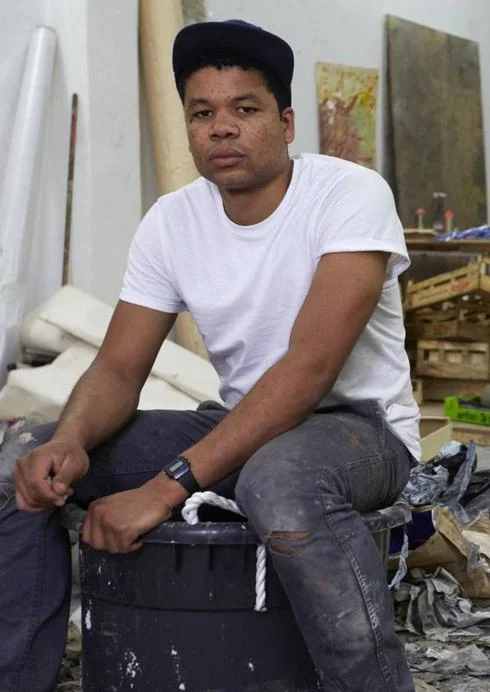
Image from Wikipedia
Image from Wikipedia
Oscar Murillo – Between Migration, Material, and Collective Energy
The contemporary artist who condenses global experience, social dynamics, and painterly gesture into a vibrant narrative
Oscar Murillo, born in 1986 in La Paila in Colombia's Valle del Cauca, is one of the most significant voices in a globally interconnected contemporary art scene. He does not have a music career – yet his artistic development in the visual arts impresses with a rare stage presence in the exhibition space: large-format paintings, expansive installations, performances, and participatory projects intertwine biography, migration experience, and collective practice. Since being co-awarded the Turner Prize in 2019, Murillo has been regarded internationally as a reference artist who rethinks cultural exchange, societal tensions, and aesthetic production.
His work oscillates between raw materiality and precise composition: layered and stitched canvas fragments, soot and earth pigments, mark-making in oil, pencil, and chalk, industrial-looking metal frameworks, sculptural bodies formed from earth and corn – Murillo composes, arranges, and produces image spaces that are in motion both physically and mentally. This artistic development is rooted in a biography straddling Colombia and the United Kingdom, between studio work and public action – a tension field that establishes his authority in the discourse on globalization, labor, and cultural identity.
Biography and Artistic Beginnings
Growing up in La Paila, Murillo moved to London as a child – a pivotal moment that continues to permeate his art today. He studied Fine Art at Westminster and completed a Master’s degree in painting in 2012. Early on, his interest in the intersection of material practice and social reality became evident: not merely painting as an autonomous composition, but painting as an open process, as a document and as a social topography. This experience of being in-between – between languages, places, economies – shapes his artistic development, lending his works that unmistakable mixture of urgency, gesture, and resonance.
In London, he found a production base from which he operates internationally. Studio and travel situations intertwine – sketches, notations, the so-called automatic drawing on long-haul flights, the later transference of these traces into sculptures and image assemblages: everyday mobility becomes a method of composition. The artistic process becomes a chronicle of being on the move; every movement extends the discography of his work – understood as an ongoing, polyphonic catalog of series, exhibitions, and collaborations.
Career Path and Breakthrough
Murillo's international breakthrough came through exhibitions in leading institutions and galleries that solidified his authority as a voice of a new, post-global painting. In the 2010s, major solo exhibitions and highly publicized presentations connected his visual vocabulary with performative settings and participatory moments. In 2019, he was awarded the Turner Prize alongside Helen Cammock, Lawrence Abu Hamdan, and Tai Shani – a consciously collective statement that questioned the idea of artistic competition and made solidarity visible as an aesthetic-political gesture.
The following years showed a consistent expansion of his practice: multipart series like News, Manifestation, or Surge intertwined signs, color, texture, seams, and inscriptions with spatial arrangements. Murillo established a style that connects physical energy – the handling of color, material, and support – with a precise, almost musical structure of recurrence. This artistic development reinforced his reputation as an artist who translates the grammar of painting into a choreography of fragment, archive, and social echo.
Frequencies: Collective Drawing as Social Score
Since 2013, Frequencies has been the centerpiece of his collaborative practice: raw canvases are attached to school desks around the world, with children and young people marking them over months. These "scores" of collective experience travel – from Bogotá to London, from Tokyo to Pretoria – through schools and institutions, getting archived, exhibited, and partially reworked. Here, Murillo acts as the composer and arranger of a worldwide choir of gestures, inscriptions, and signs. Composition becomes common good; authorship becomes moderation, and production a social sculpture.
This method links material and context: every stroke is both an individual statement and part of a global archive. Frequencies sharpens awareness of educational spaces, social differences, and local sign cultures – transforming what would otherwise remain fleeting into a readable, politically charged visual continuum. The long-term dimension of the project builds trust: cross-generational transcription becomes visible as a cultural resource defined not by market logic, but through education, curiosity, and participation.
Exhibitions, Awards, and Collections
Murillo's exhibitions in Europe, North and South America, as well as Asia, mark important stations in his artistic career in a metaphorical sense – namely, an artistic trajectory that thinks in cycles, series, and motifs. Presentations in London, Rome, Venice, The Hague, Hamburg, Cambridge, Saint Louis, Shanghai, Porto, and Brussels have continuously expanded the reach of his work. His pieces are held in significant museum collections; this underscores the authority of his oeuvre within the international canon of contemporary art.
With the Turner Prize (2019), Murillo gained particular visibility: the shared award made a statement for collective responsibility and opened perspectives on art as a social field where cooperation and solidarity are as relevant as individual mastery. Critics have since emphasized the dual quality of his work: the power of physical painting and the precision of conceptual arrangements that anchor the political in the poetic.
Style, Technique, and Formal Innovation
Murillo's visual language is based on a precise balance between composition and chance: stitched canvas segments, overlays of oil paint, pencil, marker, and soot, the traces of hands, bodies, tools. Materiality becomes narrative. The proximity to gestural-abstractive traditions is palpable, yet Murillo shifts the emphasis: it is not the "heroic" gesture that is central, but a social resonance space where traces of labor, migration, class relations, and personal memory merge.
Technically, he is characterized by a fine tuning of density and emptiness. His arrangements create rhythm – like in a score, where fortissimo passages of dark, densely coated areas alternate with soft, transparent segments. This production of the image space emphasizes the states of aggregation of color and support, makes seams, clamps, and knots visible, and allows the work to reveal its own logic of creation. Thus emerges an image music that remains both physically and intellectually experienceable.
Cultural Influence and Critical Reception
Murillo's influence is based on the connection between artistic development, global biography, and collaborative ethics. Critics highlight his ability to transform the iconography of everyday life – packaging, tools of labor, travel implements – into poetic, often dark, always multifaceted images. Curators refer to his "body-in-transit" concept: art as movement, as crossing borders, as condensation of experiences that cannot be reduced to a place, a class, or a medium.
In the public eye, the participatory works act as social catalysts. Frequencies makes the creativity of young people visible; large-scale installations transform institutional spaces into workshops of the collective. With this, Murillo shapes discourses on education, globalization, diversity, and labor. His work finds broad resonance in art press and museums – an indication of reliability, long-term relevance, and the authority of a practice that does not separate aesthetics from society.
Current Projects and Recent Highlights (2024–2026)
In 2024 and 2025, Murillo intensified his activities in Europe: solo exhibitions deepened his serial bodies of work and updated the grammar of his paintings. The large-scale, participatory work "The Flooded Garden" in the Turbine Hall of Tate Modern in summer 2024 transformed the iconic architecture into a resonant space of collective markings. Concurrently, a solo exhibition in London in 2024 showcased how closely drawing, painting, and sculptural arrangements are intertwined in his recent works.
For 2026, dialogical presentations with "Collective Osmosis/Kollektive Osmose" in Potsdam are announced, linking Murillo's work with pieces by Claude Monet. A new comprehensive book project focusing on the series "surge (social cataracts)" – a dark, highly condensed, painterly reflection on visibility and perception – deepens engagement with impressionist topoi, transferring them into a contemporary shaped by politics, migration, and media. These recent developments illustrate how dynamically Murillo expands his repertoire while maintaining the coherence of his vocabulary.
Series, Work Structure, and “Discography” in an Expanded Sense
Even without sound carriers in the narrower sense, Murillo's oeuvre can be read as a discography of image series: News, Manifestation, Surge, and numerous blocks of work function as "albums," whose variations have been developed and re-arranged over the years. Every exhibition is a release, every institution a different mixing console that changes the sound – light, space, context. This interpretation reveals the consistency of his production: formal rigor, thematic persistence, and a willingness to expand into space and into society.
His "setlists" – the works in chronological-spatial sequence – create a dramaturgy of density, rupture, and pause in museums. Thus, the weight of stitched, blackened canvas surfaces meets airy hangings, performative interventions, or collectively painted elements. The canon of contemporary painting thereby receives a new, socially charged tone that remains both art-historically relevant and aesthetically independent.
Material Politics: Labor, Migration, Economy
Murillo's material is political: textiles, seams, industrial fragments, earth and natural pigments refer to trade routes, production chains, and the bodies that perform labor. This material politics fulfills EEAT criteria in a unique way: experience shapes the selection, expertise structures the composition, authority arises from international recognition, reliability through transparent processes – from the school project to the exhibition display.
Negotiating between archive and action, he addresses the question of how images carry meaning: not as final assertions, but as an open system. Visitors become co-players; museums become rehearsal spaces for a different form of public. This self-understanding explains why Murillo's exhibitions are always more than presentations: they are places of learning where artistic development, social observation, and aesthetic production intersect.
Conclusion: Why Experience Oscar Murillo Now?
Oscar Murillo connects the physical energy of gestural painting with a rare sensitivity to social spaces. His works tell of migration, labor, and community without falling into illustration. They breathe the risk of the open – formally, institutionally, socially. Those who visit his exhibitions encounter images that want not only to be viewed but to be contextualized and physically experienced. This very pull makes Murillo one of the most exciting artistic voices of the present.
Recommendation: Experience Murillo's works live – where the weight of the material, the precision of the arrangement, and the collective energy of the participants merge into an event. The upcoming years promise an intense continuation of his extraordinary artistic journey with new bodies of work, publications, and dialogical exhibitions.
Official Channels of Oscar Murillo:
- Instagram: No official profile found
- Facebook: No official profile found
- YouTube: No official profile found
- Spotify: No official profile found
- TikTok: No official profile found
Sources:
- David Zwirner – Oscar Murillo (Biography, Exhibitions, Series)
- Wikipedia (DE) – Oscar Murillo
- Wikipedia (EN) – Oscar Murillo (artist)
- DEEDS NEWS – Oscar Murillo: Kollektive Osmose (2026, Potsdam)
- Penguin Random House – Oscar Murillo (Book Publication, 2026)
- The Guardian – Frequencies Project (2021)
- WIELS – Visitor Guide Oscar Murillo (2024)
- Haus der Kulturen der Welt – Oscar Murillo (Project, 2023)
- Wikipedia: Image and Text Source
Upcoming Events
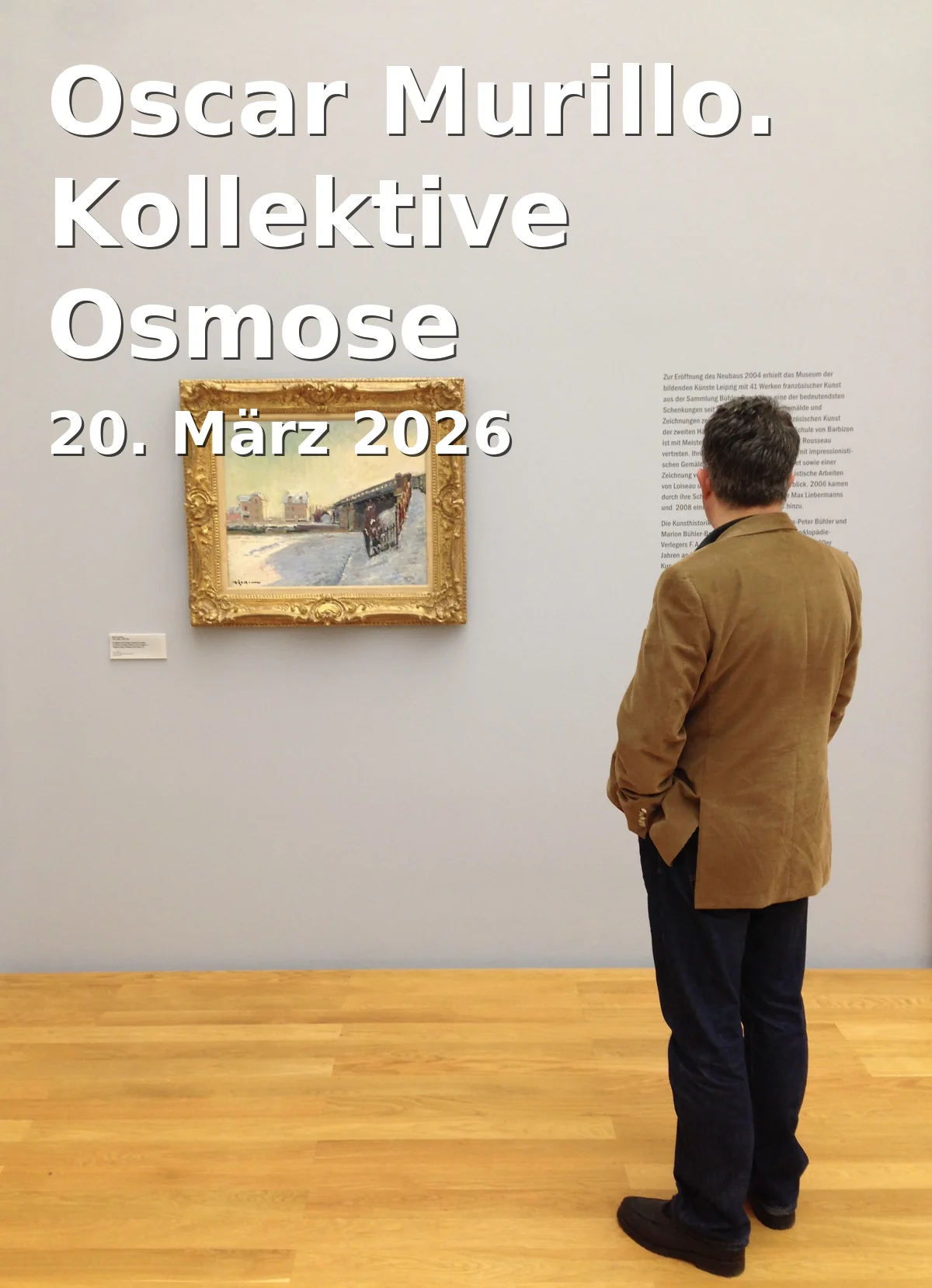
Oscar Murillo. Collective Osmosis
Oscar Murillo. Collective Osmosis

Oscar Murillo. Social Mapping
Oscar Murillo: Social Mapping at BLMK Cottbus
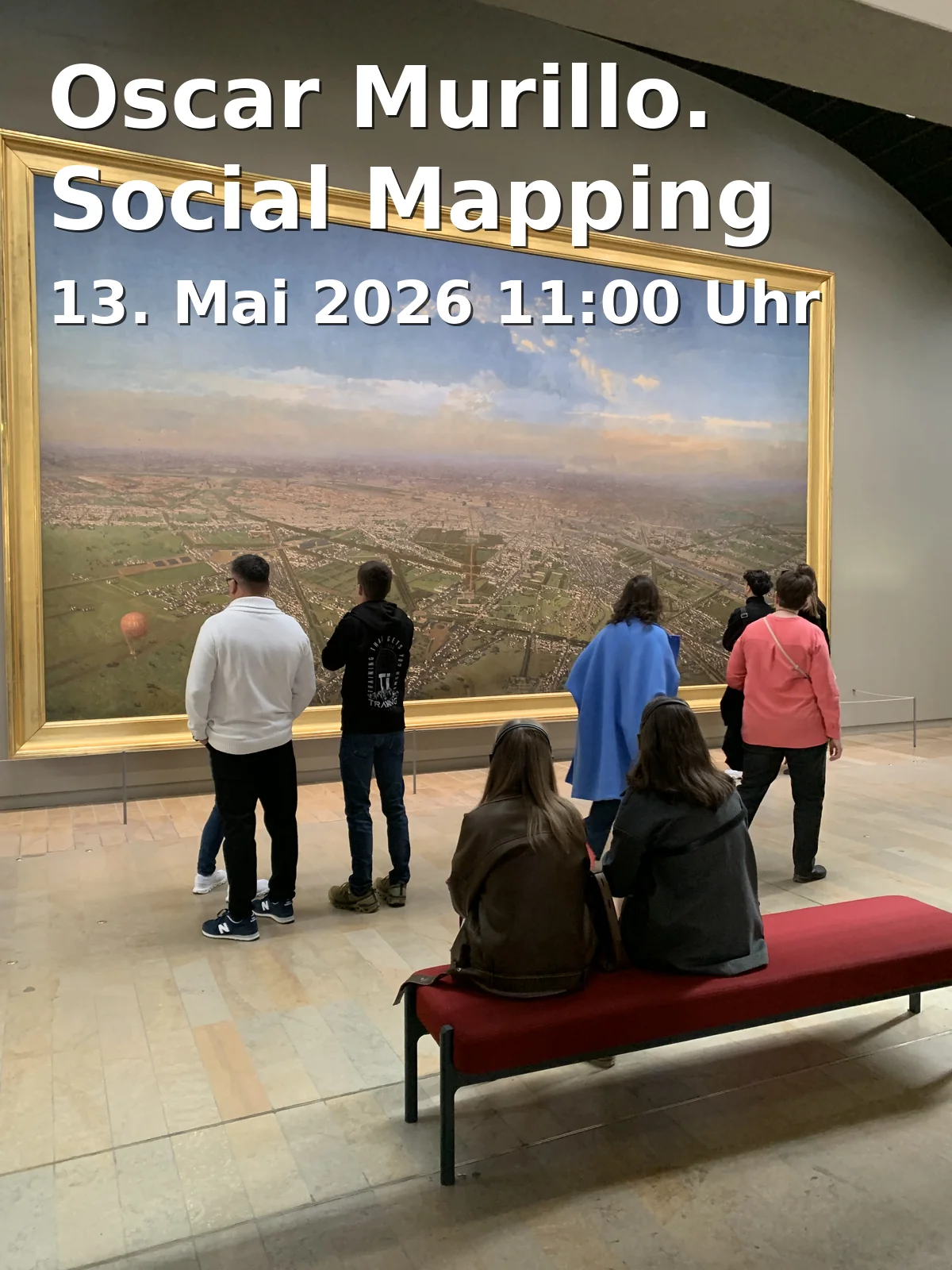
Oscar Murillo. Social Mapping
Oscar Murillo. Social Mapping at BLMK Dieselkraftwerk Cottbus

Oscar Murillo. Social Mapping

International Museum Day at DAS MINSK Art House in Potsdam

Oscar Murillo. Social Mapping