
Marcel Beyer
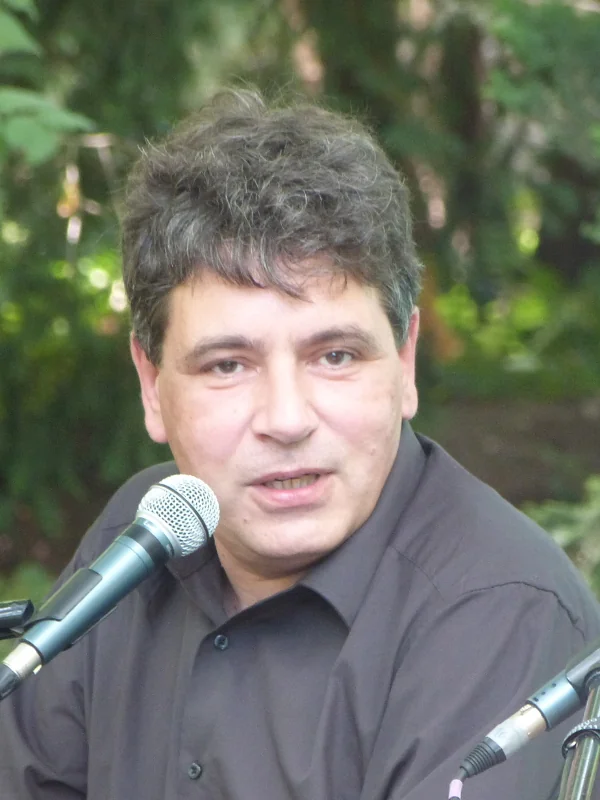
Image from Wikipedia
Image from Wikipedia
Marcel Beyer: Language as Stage, Memory as Art Form
An Author Between Poetry, Novel, and Literary Perception
Marcel Beyer is one of the most prominent voices in contemporary German-language literature. Born on November 23, 1965, in Tailfingen and raised in Kiel and Neuss, he early on developed a body of work that navigates with exceptional precision between poetry, novels, essays, and editorial duties. His literary path is characterized by intellectual curiosity, a willingness to take formal risks, and a distinctive perspective on history, memory, and language. ([de.wikipedia.org](https://de.wikipedia.org/wiki/Marcel_Beyer))
Biographical Foundations: Studies, Scene, and Literary Influences
Beyer studied German studies, English studies, and literary science at the University of Siegen, completing his master's degree with a thesis on Friederike Mayröcker. During these years, he was already part of a creatively productive environment that combined scientific precision with artistic openness. He worked as an editor, proofreader, and journalist, among other roles in the series "Forgotten Authors of Modernity," at "experimentelle texte," and for the music magazine SPEX. This blend of theory, practice, and pop-cultural openness continues to shape the artistic development of his work today. ([liton.nrw](https://liton.nrw/person/beyer-marcel))
From an early age, Beyer showed an interest in performative and interdisciplinary forms. Since 1987, he has performed in literary performance projects alongside Norbert Hummelt; until 1992, both operated under the name "Postmodern Talking." The establishment of the Friederike Mayröcker Archive in 1988 also points to his strong sense of literary heritage, archival work, and poetic precision. Thus, Beyer's career has from the very beginning been more than just a classical author biography: it is the story of a language artist who perceives literature as a living realm of thought. ([liton.nrw](https://liton.nrw/person/beyer-marcel))
The Breakthrough with Novels that Combine Historical Depth with Formal Boldness
His debut novel "Das Menschenfleisch" received excellent reviews and several awards. However, the real breakthrough came with "Flughunde," a novel that was translated into twelve languages, making Beyer internationally visible as an author. Critics early on emphasized the unique way he intertwines historical connections, scientific systems, and aesthetic questions into a dense literary cosmos. Beyer's texts do not rely on simple narration but operate through layering, resonance, and precise observation. ([liton.nrw](https://liton.nrw/person/beyer-marcel))
Later novels such as "Kaltenburg," "Spione," and other prose books solidified his status as a writer of exceptional independence. Literary criticism repeatedly highlights in his work that he does not provide linear narratives but instead uncovers the dark connections between science, art, and politics in the history of the 20th century. It is precisely this combination of intellectual engagement and narrative tension that makes Beyer's prose enduringly relevant. ([deutschlandfunkkultur.de](https://www.deutschlandfunkkultur.de/literatur-marcel-beyer-erhaelt-kleist-preis-100.html))
Poetry as Musical Condensation and Linguistic Expedition
In addition to prose, Beyer's poetry stands as an independent and highly condensed body of work. He has published several volumes of poetry, showcasing a remarkable sensitivity to sound, rhythm, and semantic shifts. Titles like "Walkmännin," "Brauwolke," and "Rede an die Sprache" already suggest that his poetry works not decoratively but experimentally and insightfully. For him, language is not merely a medium but an object of investigation and an artistic surface. ([hellerau.org](https://www.hellerau.org/2025-26/feature-ring-marcel-beyer))
In his poems, Beyer's interest in memory, wildness, nature, and historical sedimentation unfolds with great concentration. The jury of the Georg Büchner Prize recognized in 2016 his ability to combine epic breadth with poetic microscopy. This reveals a central characteristic of his oeuvre: Beyer can make the great manifest in the small, the historical in linguistic detail, and the political in poetic imagery. His poetry belongs to the works that are not only read but also heard in the rhythm of language. ([suhrkamp.de](https://www.suhrkamp.de/rights/nachricht/marcel-beyer-awarded-georg-buechner-prize-2016-b-2221?utm_source=openai))
Essays, Translations, and the Work on Literary Memory
Marcel Beyer is not only a poet and novelist but also an essayist and translator. He has translated works from English and into English as well as from Estonian, working on texts by authors such as William S. Burroughs, Gertrude Stein, Kurt Schwitters, E. E. Cummings, and Max Ernst. This work illustrates how deeply Beyer's own writing is influenced by intertextuality, linguistic awareness, and the joy of literary translation. For him, translating means not just transferring words but engaging in aesthetic concentration. ([liton.nrw](https://liton.nrw/person/beyer-marcel))
His essays and afterword contributions also exemplify a conception of work that interlinks literary history, poetic theory, and contemporary discourse. Beyer writes not from a distance but from an ongoing dialogue with literary models, archives, and thought figures. His authority emerges from a visible understanding of tradition, form, and the fragile economy of literary language. ([suhrkamp.de](https://www.suhrkamp.de/buch/friederike-mayroecker-gesammelte-prosa-t-9783518069110?utm_source=openai))
Awards, Recognition, and Literary Authority
The list of awards and honors is extensive, underscoring Beyer's stature in German-language literature. His most important accolades include the Heinrich Böll Prize, the Friedrich Hölderlin Prize, the Kleist Prize, the Joseph Breitbach Prize, the Peter Huchel Prize, and the Georg Büchner Prize. These awards not only acknowledge individual books but also celebrate a complete works that has consistently evolved over decades. ([de.wikipedia.org](https://de.wikipedia.org/wiki/Marcel_Beyer))
Additionally, his roles as a city writer, poetics lecturer, and visiting professor highlight his influence on literary discourse. Beyer has served as city writer for Bergen-Enkheim and has later been involved in academic poetics contexts. Such positions demonstrate that he is read not only as an author but also as a thinker of language, whose work resonates equally in literary practice, scholarship, and criticism. ([de.wikipedia.org](https://de.wikipedia.org/wiki/Marcel_Beyer))
Current Presence: Readings, Events, and New Contexts
Even in recent times, Beyer remains active through events and public appearances. For 2025, HELLERAU announced a feature ring with Marcel Beyer, describing him as a researcher of language and an author who works on history, memory, and sound. Such formats illustrate that his work not only exists in book form but also gains new impact on stage, in conversation, and in performative constellations. ([hellerau.org](https://www.hellerau.org/2025-26/feature-ring-marcel-beyer))
Suhrkamp continues to highlight new contexts around Beyer's work, including new publications, translations, and literary events. For 2024 and 2025, a continued presence of his oeuvre in publishing and event schedules can be observed, even though the author's true strength lies not in fleeting media events but in the enduring power of his texts. This is what makes his literary presence so stable: Beyer remains relevant because his books gain depth with every new reading. ([suhrkamp.de](https://www.suhrkamp.de/rights/just-published/just-published-suhrkamp-authors-around-the-world-october-2024-issue-2-b-4587?utm_source=openai))
Style, Impact, and Cultural Influence
Beyer's style combines analytical sharpness with poetic density. His prose operates through shifts in perspective, historical resonances, and a highly concentrated perception of language, while his poetry brings sound, imagery, and reflection into concise form. Critics repeatedly commend his ability to narrate German history not as a museum piece but as an open, present-day experience. ([deutschlandfunkkultur.de](https://www.deutschlandfunkkultur.de/literatur-marcel-beyer-erhaelt-kleist-preis-100.html))
His cultural impact lies precisely in this consistency. Beyer represents a literature that does not settle for surface appearances but intertwines archives, memory, pop culture, and aesthetic experimentation. In this way, he has influenced generations of readers and many younger authors who recognize in his work a model for sophisticated, open, and form-conscious contemporary literature. ([literaturfestival.com](https://literaturfestival.com/authors/marcel-beyer/))
Conclusion: An Author Who Transforms Language into Experience
Marcel Beyer is fascinating because he understands literature as a form of knowledge and as an art of precise transformation. His novels, poems, and essays combine historical intensity with linguistic elegance and intellectual alertness. Those who engage with his work discover an author who has shaped German literature for decades with an unmistakable voice and continues to measure it anew. His readings and public appearances are particularly rewarding because his texts gain a profound, compelling presence on stage. ([hellerau.org](https://www.hellerau.org/2025-26/feature-ring-marcel-beyer))
Official Channels of Marcel Beyer:
- Instagram: No official profile found
- Facebook: No official profile found
- YouTube: No official profile found
- Spotify: No official profile found
- TikTok: No official profile found
Sources:
- Wikipedia – Marcel Beyer
- Suhrkamp – Marcel Beyer
- Suhrkamp – Marcel Beyer awarded Georg Büchner Prize 2016
- Suhrkamp – Marcel Beyer receives the Friedrich Hölderlin Prize 2021
- liton.nrw – Profile of Marcel Beyer
- Literaturhaus Basel – Portrait of Marcel Beyer
- Deutschlandfunk Kultur – Marcel Beyer receives Kleist Prize
- University of Siegen – Marcel Beyer
- Critical Lexicon of Contemporary German Literature – Marcel Beyer
Upcoming Events
Eyesight – Reading and Conversation with Marcel Beyer