
Karl Christian Klasen
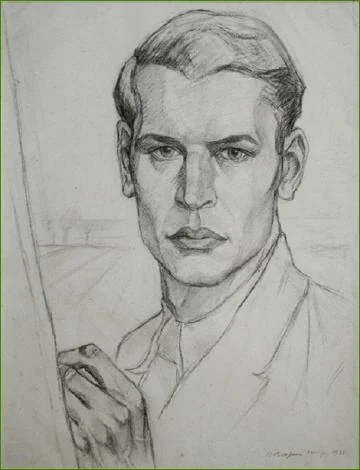
Image from Wikipedia
Image from Wikipedia
Karl Christian Klasen – The Island Painter of Poel: Life, Work, and Luminous Landscapes
An Artist's Life Between Baltic Light and Tragic Interruption
Karl Christian Theodor Klasen shaped the image of the island of Poel and its people as a painter and graphic artist. Born on November 19, 1911, in Güstrow, he quickly developed an artistic handwriting that captured the unique light of Northern Germany. His scenes of fishermen, harbors, and expansive skies tell of a stubborn yet profoundly regional artistic evolution. Despite his early death on February 21, 1945, in Königsberg, Klasen left behind a body of work of around 450 pieces – an impressive panorama of Mecklenburgian landscapes and life worlds that continue to fascinate in changing exhibitions today.
The musicality of his colors – the rhythmic interplay of brightness, lines, and nuances – lends an inner tension to his paintings, reminiscent of a finely balanced composition. Klasen's presence in the exhibition space is nourished by painterly clarity, narrative density, and a sharp sense of atmosphere. These qualities continue to contribute to his cultural significance in Mecklenburg-Vorpommern.
Early Years in Güstrow: Talent, Tragedy, and Artistic Breakthrough
Growing up as the son of a timber merchant in Güstrow, Klasen's drawing talent was fostered at the Realgymnasium – notably supported by his art teacher Friedrich Schult, a friend of Ernst Barlach. The Great Depression hit the family hard: after the loss of his father's business and its subsequent suicide, young Klasen had to leave school in 1931. An apprenticeship with an art carpenter in Bützow opened his eyes to material, structure, and craftsmanship – foundations that later strengthened his precise linework and detailed surface treatment.
Crucial for his artistic development was the early encounter with the island of Poel: in 1932 Klasen began his first painting stays, and a year later he moved to Kirchdorf. His closeness to the coastal landscape gave rise to a canon of themes that would shape his entire career in the visual arts – in the sense of a lifelong engagement with motive, form, and light.
Academic Influence and Stylistic Maturation: Düsseldorf and Berlin
In 1935, Klasen received a scholarship from the Boldt Foundation for Mecklenburg artists. This brought him to the Kunstakademie Düsseldorf and subsequently to the Berlin Academy, where he studied under Franz Lenk and Adolf Strübe, among others. These years consolidated his visual vocabulary: from the spontaneous approach of self-taught artistry, a controlled realism emerged with clear composition, careful arrangement, and lucid spatial organization.
The academic school sharpened his understanding of form, proportion, and perspective. His productions henceforth exhibit a balancing act between atmospheric color and structured drawing. Klasen's paintings appear learned yet vibrant – as if the fresh breeze from the Kirchdorf harbor enters the canvas through precisely placed light-dark contrasts and delicately modulated color fields.
Poel as an Artistic Center: Fishermen, Harbor, Vastness
Poel became the center of Klasen's life and work. He went out with fishermen, observing work and everyday life, sensitively capturing the graphic appeal of nets, masts, and huts. Works such as "Poeler Eisfischer" or views of Kirchdorf and Wismar are iconic testimonies to a painting that not only depicts the topography of the North but also opens emotional spaces. In this closeness to the subject lies Klasen's authority: he paints what he lives – and he lives what he paints.
The choice of motifs is characterized by narrative density: tranquil, almost meditative winter landscapes; good weather that brightens the painting like a chord; and again and again the northern light that gently models contours. Thus, a tonality emerges that resembles a finely orchestrated sentence – with brightly glowing themes and subdued, harmonious counterpoints.
Recognition, Exhibitions, and Awards: The Career of a Young Realist
As early as the 1930s, Klasen gained regional recognition. In 1938, he received the painter's award from the Foundation for the Promotion of Low German Artistic Creation in Rostock, and in 1939, the John-Brinckman Prize. His works were featured in the exhibition "Contemporary Mecklenburg Painters" at the State Museum Schwerin in 1939; in 1940, he was represented with "Poeler Eisfischer" at the Munich House of German Art. These milestones mark a steep career trajectory – a swift rise from a regionally rooted self-taught artist to an acknowledged representative of Northern German landscape painting.
Simultaneously, his artistic handwriting became more concentrated. The organization of the images followed clear compositional axes; the brushstrokes remained disciplined, and the handling of light was pointed. It is this combination of realistic accuracy and poetic clarity that critics still describe today as the signature of the "Island Painter."
Private Life, War, and Early Death
In 1940, Klasen married the dancer and choreographer Rita Bütow in Rostock. During World War II, he served as a soldier but continued to paint. In 1943, he was wounded; this was followed by stays in military hospitals. On February 21, 1945, he died from the effects of a severe injury outside Königsberg and was buried in the cathedral cemetery. His estate consists of approximately 450 works – remarkably abundant for such a brief artist's life.
The early death interrupted a mature phase in which his compositions began to breathe more freely while simultaneously finding an almost musical balance between surface, light, and line. The reception of his works mainly resumed after 1945, gaining lasting significance in Güstrow, Wismar, and Poel.
Catalog of Works and Exhibition Presence: From Schwerin to Poel
Approximately 450 works are verifiably documented, including oil paintings, watercolors, drawings, linocuts, and charcoal pieces. In 1982, the Mecklenburg Foundation took over more than 100 works; the Karl Christian Klasen Society e.V. manages a significant part of the collection as a permanent loan. Since 2005, the Island Museum Poel has regularly hosted thematic exhibitions – from portraiture to landscapes, from everyday work to atmospheric weather studies.
This curatorial continuity establishes Klasen as a reference artist in Northern German landscape representation. His paintings remain present because they fix not only topographical locations but also offer emotional experiential spaces – with a light-dark choreography that unfolds its effect beyond regional contexts.
Style and Technique: Light Direction, Composition, "Northern German Tonality"
Klasen's visual language employs a clever manipulation of light that directs the viewer's gaze, gives volume a plastic quality, and creates atmosphere. In his compositions, he favors clear horizon lines, rhythmic gradations of land, water, and sky, as well as an economical relationship between detail and surface. The production reflects a confident hand and deliberate preparation; sketches and studies indicate a process where visual impression, formal thinking, and patient elaboration merge.
Characteristic is the spectrum of muted but vibrantly bright color chords: earthy browns, mossy greens, cool blue and gray gradients, flickering lights in the white of the surf or in the window of a fisherman's house. This "Northern German tonality" imparts a quiet tension to the paintings – an aesthetic pulse reminiscent of a finely orchestrated adagio.
Cultural Influence and Regional Embedding
As the "Island Painter," Klasen is part of Poel's cultural identity. His motifs – from the ferry house to the harbor, from agricultural work to coastal weather – serve as a visual chronicle of the 1930s and early 1940s. The ongoing exhibition work of the Island Museum Poel and the Karl Christian Klasen Society not only keeps his work alive but also strengthens the regional memory culture between Güstrow, Wismar, and the Baltic Sea.
Moreover, the paintings foster local ties to the homeland: audiences recognize familiar horizons in them – and with them the story of a landscape that has found its unmistakable sound in Klasen's painting. The fact that the reception today extends beyond the museum space is demonstrated by publications, special exhibitions, and contributions from regional media that continually contextualize his work anew.
Reception and Preservation: Prizes, Collections, Society
The recognition from the 1930s had already solidified Klasen's position. Later, museums, foundations, and an engaged society ensured the preservation of his oeuvre: permanent loans, thematic displays, editions, and educational offerings (such as audio guides) vividly illustrate the artistic development. Individual losses – such as the theft of two works in 2005 – painfully highlighted the fragility of cultural heritage; at the same time, they intensified the commitment to provenance assurance, documentation, and public relations.
This has led to the creation of a "living archive" over decades: a sustainable, publicly visible care of the work that brings Klasen to the present and makes his painterly vocabulary accessible across generations.
Family and Artistic Networks
Klasen's familial connections point to an artistic environment: his wife Rita Bütow was a dancer and choreographer, and their daughter Antje Rita Klasen-Freidank later worked as a graphic artist. The sculptor, photographer, and painter Peter Klasen is his nephew. This constellation underscores the continuity of a design ethos that unfolds across media and generations.
Content-wise, Klasen's work also connects to traditions of realistic landscape and genre painting. Reference points include – beyond direct teacher-student relationships – Northern German nature observation, precise drawing, and a light dramaturgy that intertwines atmospheric narration and formal rigor.
Conclusion: Why Karl Christian Klasen Resonates Today
Karl Christian Klasen is one of those artists who derive a universal visual language from a concentration on a particular terrain – the island of Poel, Wismar, Güstrow. He composes a visual soundscape from horizon, weather, work, and everyday life that still speaks directly today. His artistic contribution lies in the synthesis of realistic accuracy, poetic light, and a calm yet compelling dramaturgy of color.
Those who wish to encounter Klasen will find a continuous invitation to reconnect at the Island Museum Poel: changing themes, new dialogues, and old acquaintances. It is worth experiencing these paintings in their original form – for their luminosity, their quietness, and their craftsmanship. Klasen's work shows how great art arises from closeness. His appeal to us today: Look, see, remember – and let the coast resonate in your mind.
Official Channels of Karl Christian Klasen:
- Instagram: No official profile found
- Facebook: No official profile found
- YouTube: No official profile found
- Spotify: No official profile found
- TikTok: No official profile found
Sources:
- Wikipedia – Karl Christian Klasen
- Karl Christian Klasen Society e.V. – News
- Island Museum Island Poel – Information about the Klasen Gallery
- Cultural Museum Kirchdorf – Permanent exhibition on Karl Christian Klasen
- Mecklenburg Foundation – Exhibition announcement "Favorite Pieces" (2026)
- Wismar-TV – "Art Preservation for 25 Years: KCK Society"
- Wikipedia: Image and text source
Upcoming Events
Favorite Pieces – Karl Christian Klasen on Poel
„Favorite Pieces“ – Karl Christian Klasen on Poel
EXTENDED "Favorite Pieces" – Karl Christian Klasen on Poel