
Francis Ford Coppola
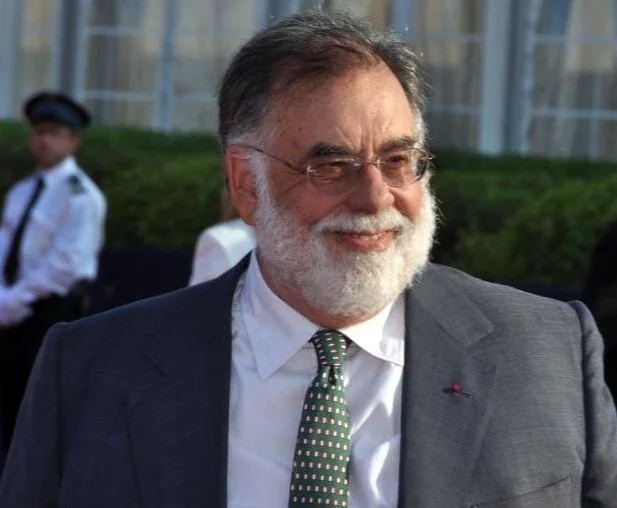
Image from Wikipedia
Image from Wikipedia
Francis Ford Coppola – Visionary of New Hollywood and Tireless Innovator of Cinema
Epic Images, Radical Ideas: Why Francis Ford Coppola Influences Generations of Filmmakers
Francis Ford Coppola, born on April 7, 1939, in Detroit, is one of the key architects of New Hollywood. His music career never took place on stages, but his presence as a director shaped the screen like a grand score: carefully composed images, pointed dialogues, and a passion for detail in production. With classics like the Godfather trilogy and Apocalypse Now, he set standards in dramaturgy, composition, and cinematic arrangement. As a screenwriter, producer, and studio founder, Coppola combined artistic development with entrepreneurial independence – a bold stance that continues to shape the self-understanding of creative authors in cinema to this day.
Coming from a family of musicians – his father Carmine was a composer – Coppola developed a keen ear for rhythm, dynamics, and sound dramaturgy early on, which noticeably influenced his visual language. His career ranged from low-budget works in the Roger Corman circle to internationally acclaimed works, multiple Oscars, and two Palme d'Or awards. At the same time, he questioned the studio system: in 1969, he founded American Zoetrope to enable artistically freer productions. This artistic independence is reflected in his latest late work, Megalopolis, which feels like a symphonic balance between tradition and modernity.
Biography: From Film Apprenticeship to the Rhythm Driver of New Hollywood
Francis Ford Coppola underwent his artistic training at UCLA among others and developed a comprehensive craft through directing assistantships, editing, and screenwriting. Early stops at American International Pictures and Roger Corman sharpened his sense for economical production, precise storytelling, and innovative solutions on set. This experience, paired with an insatiable curiosity, paved the way for him to imprint large narratives with a personal touch. In the 1970s, Coppola achieved international breakthrough; his name became synonymous with author-driven direction with a distinct signature.
The artistic development of this director can be read like a score: motifs recur, themes are varied, and tonal colors – in this case, light, color, and sound – are modulated. In The Conversation, he perfected the relationship between sound dramaturgy and image composition; in Apocalypse Now, he explored cinematic extremes – narratively, atmospherically, and acoustically. This radical consistency forged an authority that found sustainable recognition in the industry, press, and audience.
Career Highlights: Achieving Icon Status through Masterpieces
With The Godfather (1972) and The Godfather Part II (1974), Coppola condensed genre, social portrait, and family epic into a cinematic total experience. He won top awards as a director and writer; The Godfather Part II made Oscar history. The Conversation (1974) and Apocalypse Now (1979) were honored with the Palme d'Or at Cannes – rare double successes that solidified his authority in world cinema. These films influenced production aesthetics as well as the discursive engagement with power, morality, and modernity in American cinema.
In parallel, Coppola built American Zoetrope as a production home for advanced author cinema. There, George Lucas's debut was produced early on; independent and risk-taking, Zoetrope positioned itself as a laboratory for narrative and technical innovation. Coppola's musical direction – precise tempos, distinctive motifs, orchestrated ensemble scenes – remained his trademark, even as he balanced personal projects and economically calculated commissions in later phases.
American Zoetrope: Independence as a Creative Principle
American Zoetrope, founded in 1969 by Coppola and Lucas in San Francisco, early on focused on artistically curated production, technical renewal, and the promotion of new voices. This studio enabled formally daring films away from classical studio hierarchies. The ethos – independence, taking responsibility, willingness to take risks – permeates Coppola's entire music career in a figurative sense: he thinks of film as a score-like production, where dramaturgy, visual design, and soundtrack are integratively composed.
Zoetrope serves as a workshop for handwriting. Rather than reproducing trends, Coppola defined standards that influenced subsequent generations – from independent directing to the streaming era. The studio continues to represent a school of artistic entrepreneurship that connects creative freedom with professional production.
Late Works and the Present: Megalopolis as a Manifesto of Autonomy
With Megalopolis, Coppola realized a long-cherished project in 2024. Following its premiere at Cannes, it was released in theaters in North America; the work sparked wide-ranging discussions – ranging from enthusiastic admiration to controversial criticism. The crucial statement is that Megalopolis relies on bold form, political allegorical play, and a deliberately artificial visual language conceived as a symphonic architecture. The project underscores Coppola's relentless artistic development.
In 2025, the American Film Institute honored Coppola's life work with the AFI Life Achievement Award – an accolade that confirms the historical significance of his filmography. Subsequently, Coppola announced he would continue working on the material: an alternative, "wilder" cut of Megalopolis and a companion documentary providing insights into its creation and production ethos were publicly discussed. This ongoing production activity showcases the director as an indefatigable creator who continually re-arranges his oeuvre.
Filmography Highlights (Selection and Classification)
The discography of a film artist reads like a filmography – a sequence of "sentences" with varying tempos, tonal colors, and motifs. Among his artistic masterpieces are The Godfather (1972), The Conversation (1974), The Godfather Part II (1974), and Apocalypse Now (1979). Each work marks a level in composition and arrangement: ensemble leadership, long takes, sound design, symbolic imagery. Later works – such as One from the Heart, Rumble Fish, Peggy Sue Got Married, or Bram Stoker’s Dracula – demonstrate stylistic experimentation between operatic qualities, youth drama, and gothic romance.
In the 21st century, Coppola oscillated between minimalist, independent projects and long-planned grand designs. Megalopolis bundles his recurring themes – power, vision, utopia – into a theatrical fable, whose aesthetic strategy (stage-like, artificiality, architecture as dramaturgy) productively polarizes. The critical reception emphasizes this idiosyncrasy as the signature of an artist who values freedom over convention.
Style, Technique, Influence: The "Composing" Director
Coppola's signature is both acoustic and visual. In production, he works with clear motifs: family bonds and betrayal, ideological systems that shape the individual, and the price of power. His composition utilizes counterpoints between silence and noise, intimate scenes and mass tableaux. In visual design, he prefers high-contrast lighting, symbol-laden color dramaturgy, and strictly rhythmized editing. This technique imparts a musical quality to his films, manifesting in recurring patterns – themes, variations, reprises.
Historically, Coppola marks the transition from the studio system to author culture in American cinema. He proved that large, complex narratives benefit from a strong directorial signature without losing audience impact. At the same time, he established a production ethic in which risk, responsibility, and creative autonomy are part of the same artistic mission. His influence reaches from the industry policies of major studios to the production practices of independent filmmakers.
Awards and Recognitions
Coppola received numerous Oscars throughout his career – including for screenplay and direction – as well as the Palme d'Or at Cannes for The Conversation and Apocalypse Now. In April 2025, he received the AFI Life Achievement Award, one of the most prestigious honors in American cinema. These accolades reflect not only individual accomplishments but the lasting authority of an artist who has expanded the language of cinema over decades.
Notably, the tension between artistic autonomy and public expectation remains: the controversial reception of his recent works shows how Coppola continues to provoke debate – a hallmark of vibrant art. Critiques measure his works against earlier masterpieces; nevertheless, the ongoing engagement confirms his relevance and the radiance of his visual ideas in the cultural memory.
Current Projects and Perspectives
After the theatrical release of Megalopolis, Coppola intensified discussions about alternative cuts and in-depth companion documentaries. Public communication suggests an independent distribution and release pathway aligned with the director's intention to preserve cinema as a communal experience. In interviews and industry reports, speculation has also arisen about roadshow models, later re-releases, and an ongoing editions policy – an approach that rethinks both cinematic practice and economic conditions.
This strategy to actively curate reception ties back to Coppola's tradition: works remain "in flux," are re-arranged, remastered, and expanded. Like in Apocalypse Now, he returns to the material, compares versions, and adjusts rhythm and tonality – a continuous, experiential artistic development that reaffirms his expertise and confidence in the medium.
Conclusion: Why Francis Ford Coppola Fascinates – Yesterday, Today, Tomorrow
Francis Ford Coppola makes cinema larger because he perceives it as a living score: themes vary, times overlap, sound and image merge. His filmography provides key works of modernity that remain both popular and profound. As a producer and studio founder, he defends artistic freedom – even against economic pressures. Megalopolis demonstrates that he is still willing to take risks, break forms, and open new narrative spaces. If you want to see how cinema as a total work of art breathes, experience it directly with Coppola. Call to action: Experience his films on the big screen – where their impact, spatiality, and "sound" come to life in full arrangement.
Official Channels of Francis Ford Coppola:
- Instagram: https://www.instagram.com/francisfordcoppola
- Facebook: No official profile found
- YouTube: No official profile found
- Spotify: No official profile found
- TikTok: No official profile found
Sources:
- Wikipedia – Francis Ford Coppola
- Encyclopaedia Britannica – Francis Ford Coppola
- American Film Institute – AFI Life Achievement Award 2025
- Associated Press – AFI Life Achievement Award Gala, April 2025
- Associated Press – Lionsgate Releases Megalopolis (2024)
- Der Spiegel – Cannes Premiere of Megalopolis (17.05.2024)
- FAZ – “Megalopolis”: Coppola Wants to Know It Again (20.09.2024)
- Le Monde (EN) – Cannes 2024: Return with Megalopolis
- Le Monde – Review of Megalopolis (25.09.2024)
- Wikipedia – Megalopolis (Film)
- Wikipedia – Megadoc (Documentary)
- Wikipedia – American Zoetrope
- ComingSoon.it – Coppola Launches Official Instagram (2023)
- DolphinRadar – Instagram Handle @francisfordcoppola
- The Independent – Why Megalopolis Is Not Streamable (2025)
- Wikipedia: Image and Text Source