
Daniel Nagel
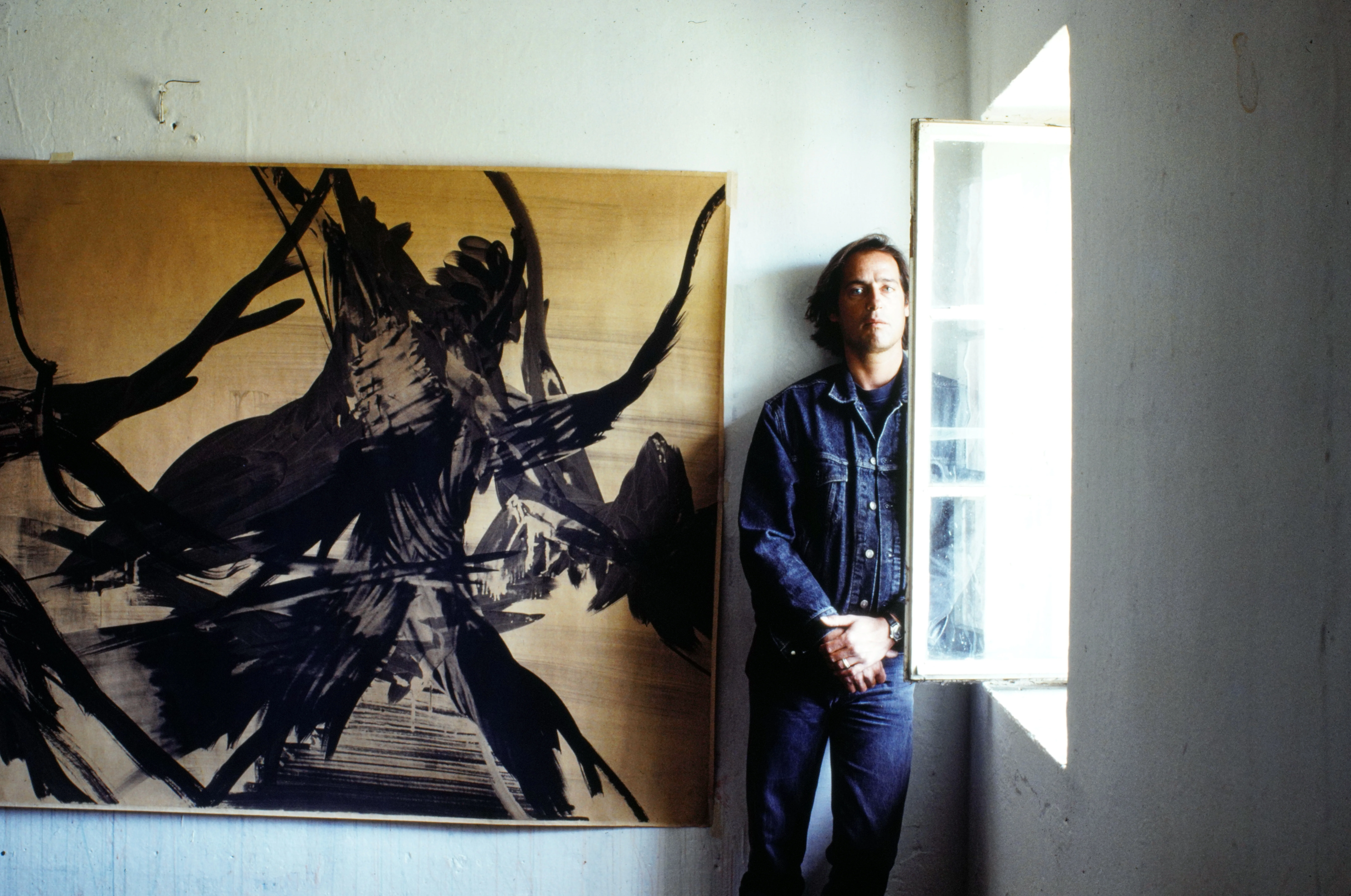
Image from Wikipedia
Image from Wikipedia
Daniel Nagel – Painter and Object Artist of the Vigorous Painting
A Great Gesturer Between Expressive Force and Silent Material Poetry
Daniel Nagel, born in 1951 in Heidelberg, is one of the prominent voices in the German art scene since the late 1970s. As a painter and object artist, he developed a distinct visual language that ranges from large-scale gestural painting to collages and reduced, material-conscious works on wood and stone. Over more than five decades, he has shaped a body of work that combines the energy of Vigorous Painting with intellectual precision, serial research, and a clear focus on form, space, and surface.
Biography and Artistic Development: From Heidelberg to Contemporary Studios
Growing up in the cultural environment of the Rhine-Neckar region, Nagel early on found drawing and painting as central forms of expression. His career is marked by consistent studio work, regular exhibitions, and the continuous development of his means. Since the mid-1970s, he has been presenting his works in prestigious galleries and art spaces. Characteristic of his visible music career – the artistic path as a continuous condensation of his own motifs – is the interplay between experimental openness and precise reduction: gestural paintings are flanked by collages, and later structure-focused, often monochrome surface images, wooden reliefs, and stone works emerge. Nagel's artistic development shows a clear dramaturgy: from the spontaneous stroke arises a reflected form of composition, in which physicality, materiality, and spatial construction play a significant role.
The 1980s: Vigorous Painting, Collage, and the Image as Stage
In the 1980s, Nagel is among the protagonists of Vigorous Painting, a neo-expressionist movement that makes the canvas a resonance space for emotion, critique, and a sense of time with vehement brush strokes, color-saturated fields, and calculated exaggeration. His paintings from this phase appear physical and impulsive, yet thoughtfully arranged in layers, grids, over-paintings, and washes. Collages expand the repertoire: found imagery, serially assembled, becomes a mirror of a visually overstimulated media culture. The stage of the image – large, direct, energetic – is both a laboratory and a loudspeaker for Nagel at this time: composition, color, gesture, and the conscious disruption of the reading flow interlock.
Drawing as a Space for Thought: Sword Carrier Drawings and the Topography of Brush Imprints
Since the 2010s, drawing has moved to the forefront as a precise space for thought. The so-called sword carrier drawings – ink paths on glossy Chromolux paper – explore the physical trace of the brush, the plasticity of the imprint, and the spatial connection of lines. What appears as a single, determined stroke is the result of controlled gesture, conscious weight shifting, and rhythmic placement. The brush imprint becomes a topography, and the sheet becomes the stage of hand movement. In these works, Nagel sharpens the connection between gesture and space: drawing is not a precursor to painting, but an independent composition in which material, gloss, contrast, and rhythm of the line unfold a visual dramaturgy.
Reduction, Material, Surface: Wood, Cardboard, Stone
Alongside gestural painting, a body of reduced works on wood and stone emerges. Grids, lattice, tensions of cardboard, canvas, and moldings create relief-like surfaces that turn the image carrier into a formative element. In the granite and stone works, Nagel's material thinking becomes more concentrated: the weight, porosity, the edge of processing, and the interaction of natural texture and artistic intervention result in a calm, concentrated presence. Color recedes, and space opens up through edges, shadows, and serial placements. Here, an artistic development is evident that leads from expressive abundance to economical precision – a composing with material, structure, and light.
Exhibitions and Milestones: Continuity Over Five Decades
Since 1976, solo exhibitions have been held in Munich, Vienna, Baden-Baden, Cologne, Freiburg, Landau, and internationally in Hong Kong – accompanied by significant group shows, such as in Hamburg, Frankfurt, Düsseldorf, Bremen, Chicago, and at institutions from the State Gallery of Modern Art (Munich) to the Museum Pfalzgalerie Kaiserslautern. These milestones attest to Nagel’s presence in the exhibition space: he showcases cycles, allows series and work groups to mature, and shifts weights between painting, drawing, collage, and object. The list of milestones not only documents visibility but also the thematic breadth of his oeuvre – from early, color-charged images to strictly rhythmically conscious constructions.
Retrospective 2026 at Kunstverein Fischerhude: Works from 50 Years
The large retrospective at Kunstverein Fischerhude (Buthmanns Hof) spans the arc from 1976 to 2026. This exhibition, designed as a concentrated insight into fifty years of creation, brings together central groups of works: gestural canvas works, serial head images, collages, drawings on Chromolux, grid images, and stone works. The retrospective access makes Nagel's artistic development comprehensible: from Vigorous Painting through conceptually sharpened series to reduction on carrier materials and volume. The show reaffirms his authority as an artist who continually balances form and expression between gesture, structure, and space.
Critical Reception: Gestural Authority and Calculated Distortion
The reception acknowledges Nagel's authority in the tension between expressiveness and control. Reviews since the 1970s and 1980s highlight his vehement brush control, rejection of mere rationalisms, and the sovereign use of serial techniques. From an art historical perspective, his work connects with discourses on the grotesque body image, media self-representations, and the deconstruction of idealized portraits. The "calculated distortion" becomes a stylistic device that charges physiognomies, reveals image constructions, and asserts the surface as an independent bearer of meaning. Nagel's works thus appear as X-rays of visual habits – precisely composed, artistically idiosyncratic, and intellectually grounded.
Positioning in Art History: Vigorous Painting, Neo-Expressionism, Media Critical Series
Historically, Nagel's oeuvre situates itself within the realm of Vigorous Painting and German Neo-Expressionism without being subsumed by it. His serial work, playing with overpainting, washing out, inscription, and erasure, connects with artistic strategies of the 20th century that operate with repetition, variation, and disturbance. References mentioned in the reception – from Cézanne and Matisse to the reduction of Minimal Art – do not mark dependencies but rather axes of reflection along which Nagel recalibrates material, gesture, and space. His compositions respond sensitively to the image culture of their time and oppose the rapid consumed image with a resistant, physically present painting.
Working on Form: Composition, Arrangement, Production
Whether on canvas, paper, wood, or stone – Nagel's works originate from the precise coordination of material, rhythm, and intervention. Composition here means not just the placement of forms but the arrangement of forces: pressure, pull, friction, absorbing and flowing behavior of color and ink. Production becomes a visible trace – the work reveals information about its creation process. This transparency enhances the credibility of the visual statement: it makes the artistic development readable and connects experience in handling tools and carriers with a reflected, often serially structured dramaturgy.
Work in Collections and Institutional Visibility
Nagel's presence in public collections underscores his position in the canon of contemporary art. Museum exhibitions and catalogues that illuminate drawing as a central genre of the 20th and 21st centuries locate his works within major currents. This makes his oeuvre long-term connective – for research, for curatorial narratives, and for an art-interested public that appreciates the connection between craftsmanship, material intelligence, and intellectual sharpness.
Cultural Influence: Image Critique, Body Discourse, and the Ethics of the Surface
Nagel’s works resonate beyond the art world because they question visual habits and probe the truth value of media images. The serial exploration of heads, the reduction to black and white, the preference for overpainting and washing out generate an ethics of the surface: What is visible was not always so – it has been shaped, corrected, left open. This attitude makes his art relevant to debates about identity, body politics, and the everyday practice of image editing. In this regard, his work unfolds cultural value: it strengthens the critical gaze on images in a present flooded with visuality.
Conclusion: Why Daniel Nagel is Relevant Today
Daniel Nagel combines gestural authority with conceptual precision. His images are energetic yet precisely composed spaces; his drawings chart movement and time; his material works condense calm and gravity. Anyone wishing to understand how painting navigates today between expressiveness, material awareness, and image critique will find in this work a reliable school of seeing. Recommendation: Experience the retrospective, study the surfaces up close, trace the dramaturgy of the series – and sharpen your own perception. In the exhibition space, these works unfold their full presence.
Official Channels of Daniel Nagel:
- Instagram: No official profile found
- Facebook: No official profile found
- YouTube: No official profile found
- Spotify: No official profile found
- TikTok: No official profile found
Sources:
- Daniel Nagel – Official Website: Exhibitions
- Wikipedia – Daniel Nagel (Status: November 25, 2025)
- Kunstverein Fischerhude in Buthmanns Hof e.V. – Exhibition Preview/Current (Retrospective 2026)
- Museum Pfalzgalerie Kaiserslautern – "The Magic of Hand Movement" (Special Exhibition/Catalog 2022)
- Weltkunst – Exhibition Calendar: The Magic of Hand Movement (2022)
- Bavarian State Painting Collections – Collection Entry Daniel Nagel
- Wikipedia: Image and text source