
Caspar David Friedrich
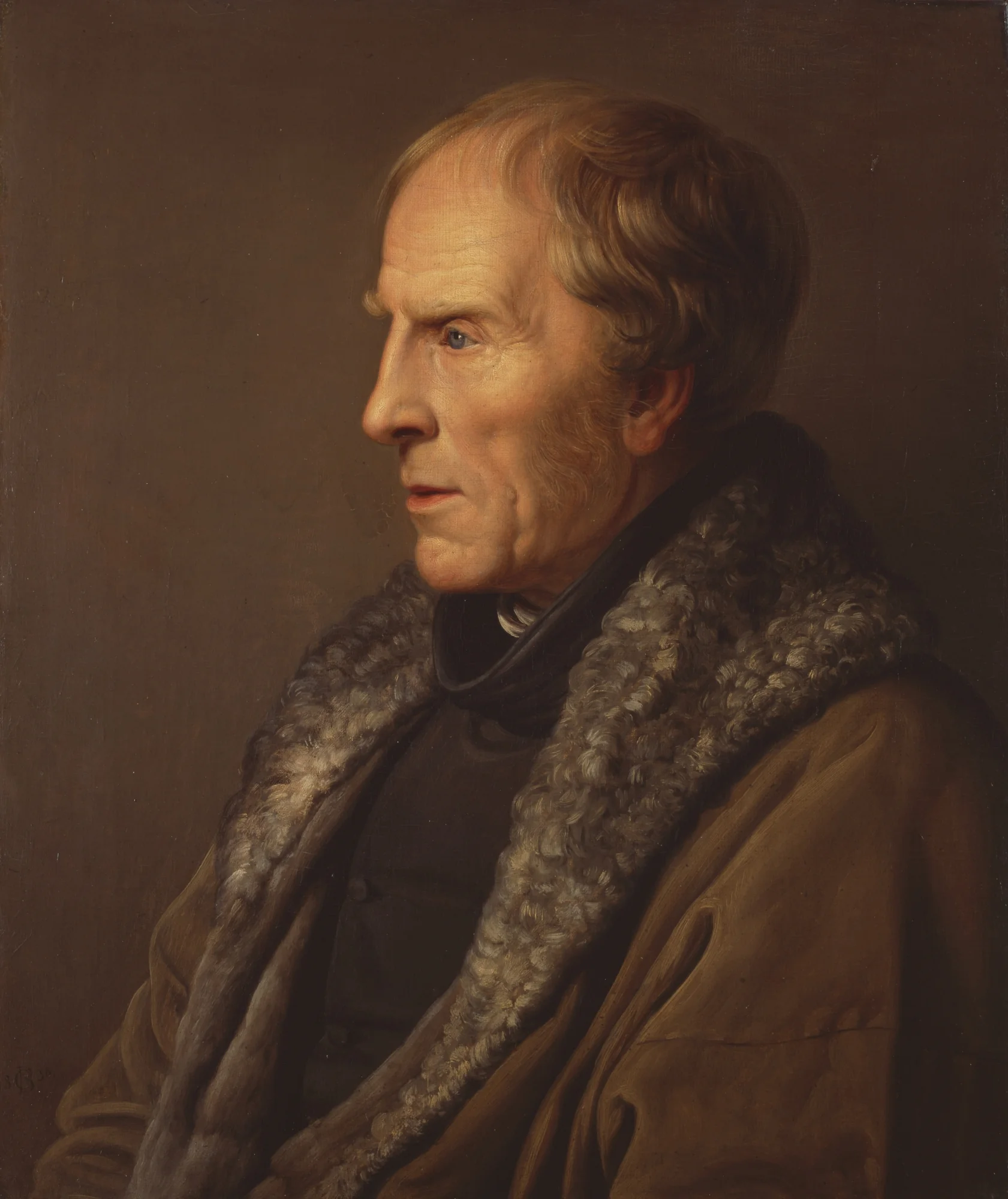
Image from Wikipedia
Image from Wikipedia
Caspar David Friedrich – The Visionary of Romanticism and Pioneer of Modern Landscape Painting
An artist who made nature the existential stage
Caspar David Friedrich shaped art history with a radically new perspective on landscapes: as a mirror of inner states, as a stage for metaphysical questions, as a space for silence, longing, and redemption. Born in 1774 in Greifswald and died in 1840 in Dresden, he is regarded today as a leading painter of Romanticism. His paintings, such as "The Wanderer above the Sea of Fog," "Monk by the Sea," or "Abbey in the Oakwood," are iconic for the fusion of nature, symbolism, and spirituality. In his musical career, there were no stations – yet his artistic development followed a stringent dramaturgical principle reminiscent of composition, arrangement, and production in music: counterpoints of light and dark, rhythmic lines in horizons and tree axes, carefully placed silences.
Friedrich's work transcends genre boundaries. He shifted the focus of European painting from heroic history to contemplative landscapes. This shift – aesthetically bold and compositionally thought-through – paved the way for modernity. The reception-aesthetic openness of his images invites viewers to this day to interpret meaning and locate emotions. This makes him an artist whose stage presence in the museum hall remains palpable even today.
Early years: Greifswald, studies, and the search for a unique voice
Raised along the windswept Baltic Sea, Friedrich absorbed coastlines, atmospheric layers, and the harsh light of Pomerania. These early natural impressions became the score of his later visual language. Studies in Copenhagen provided him with a solid drawing and compositional education; Danish drawing, the strictness of contours, and the restraint of color influenced his artistic development. Early on, his sensitivity to moods became apparent: Instead of narrative overload, he chose reduction, clearly structured rhythms, and symbolically charged spaces.
As he settled in Dresden, he shaped – much like a composer shaping his ideal sound – the gestural grammar of his landscapes: horizon lines as metronomes, staffage figures as resting voices, a controlled arrangement of emptiness and density. This language made him recognizable and unmistakable, while also provoking a new, serious way of seeing.
Breakthrough in Berlin: “Monk by the Sea” and “Abbey in the Oakwood”
His public breakthrough occurred in 1810 in Berlin: The large formats "Monk by the Sea" and "Abbey in the Oakwood" unfolded a previously unknown aesthetic effect – monumental expanses, ascetic image means, an almost musical silence. The procurement policy of the Prussian King Friedrich Wilhelm III elevated the painter and lent authority to his work. Instead of classical ideal landscapes, Friedrich presented reduced terrain, where the existential relationship between humanity, nature, and transcendence became the main subject.
The reception was mixed yet pioneering: some saw radical barrenness, while others perceived a new sublimity of nature. More decisive than agreement or rejection was the realization that landscapes could henceforth serve as carriers of metaphysical questions. This understanding reverberated through 19th-century art and continues to resonate today.
Composition, arrangement, production: How Friedrich “constructed” his images
Friedrich worked constructively, almost architecturally. He arranged forms as if they were motifs in a score: vertical tree trunks as supporting pillars, horizons as soundscapes, staffage figures as solo voices against the infinite expanse. His compositions follow clear axes, concealed diagonals, and precise lighting direction. The coloring remains controlled; colors are modulated like registers in an organ – muted, tense, with pointed highlights.
Technically, he sought balance between drawing precision and painterly atmosphere. The careful underpainting, the glazing color transitions, and the finely tuned tonal values generate depth without decorative excess. This creates that “sound of silence” that makes his images unmistakable and connects them to art history all the way to symbolism and modernity.
Masterworks and Canon of Motifs: Wanderer, Sea, Chalk Cliffs
His canon of motifs revolves around themes of solitude, transience, faith, and hope. “The Wanderer above the Sea of Fog” condenses the Romantic idea of the cognizant subject, who simultaneously experiences grandeur and limitation in confrontation with nature. “Chalk Cliffs on Rügen” combines topographical precision with allegorical readability: abysses and light, danger and insight. “The Sea of Ice” radicalizes this dramaturgy – a shattered, cold catastrophe in which human plans fail against the force of nature.
Even his religious images, from crosses in wintry landscapes to ruins, interpret transcendence not as glorious elevation but as a quiet possibility. In doing so, Friedrich shifted the religious iconography from pathos to introspection. His painterly “tone” – serious, concentrated, transparent – made him a master of the contemplative gaze.
Reception, critiques, and rediscovery
In the 19th century, Friedrich's art served as a counterpoint to historicist narrative exuberance. Nonetheless, after his death, it partially fell into obscurity until a Berlin exhibition in 1906 initiated its rediscovery. Art historians, writers, and philosophers saw in his “openness of meaning” the key to modernity: images that do not elucidate but open spaces of resonance. This interpretative breadth explains the range of later interpretations – from existential-philosophical readings to psychological and theological approaches.
In the 20th century, Friedrich became a benchmark for landscape as a space for thought. Artists and the international curator landscape alike engaged with his rigor, his light, and his “composed” empty spaces. His reputation grew, not least because of the inclusion of key works in major collections across Europe and beyond.
250 years of Caspar David Friedrich: Exhibition year 2024 and international resonance
The anniversary year 2024 has impressively confirmed Friedrich's relevance. In Hamburg, Berlin, and Dresden, leading museums dedicated major overview exhibitions to him with central loans. The Hamburg retrospective achieved historically high visitor numbers and became a public magnet. In Berlin, the key works “Monk by the Sea” and “Abbey in the Oakwood” came back into the spotlight for a broad public – a striking testament to the enduring impact of these visual creations.
The Dresden presentations highlighted work processes, drawings, and restoration research, creating a scientifically grounded yet audience-friendly narrative. The anniversary functioned not only as a memory space but also as a laboratory: new digital portals, provenance research, interdisciplinary mediation formats. Thus, Friedrich’s authority was reaffirmed in the interplay of depth of research and cultural significance in the present.
The leap to New York: Retrospective at the Metropolitan Museum of Art 2025
With the major retrospective “The Soul of Nature,” the Metropolitan Museum of Art will celebrate the first comprehensive overview of Friedrich in the USA in 2025. The exhibition, prepared in cooperation with leading German institutions, underscores his international significance. Key works such as “The Stages of Life” exemplify how Friedrich consolidates familial, existential, and nature-philosophical dimensions within a precise visual architecture.
This US exhibition serves as a transatlantic bridge: from the northern German coastal regions through the Dresden studios to the great museums of New York, the reception line of an artist who stages seeing as thinking unfolds. For the global art public, it becomes apparent how central Friedrich's visual solutions remain to modern landscape perception.
Style analysis: Genre, iconography, and cultural influence
Friedrich's “genre” is the psychologized landscape. Iconographically, he utilizes crosses, ruins, back figures, ships, banks of fog, and winter fields to shape inner states. His picture spaces work with clear depth zones and “silent cuts”: horizons as sharp pauses, groups of trees as scenic backdrops, staffage figures as offers for identification. These means combine to form a composition whose dynamics arise from reduction – a paradox that makes his images appear so modern.
His cultural influence extends beyond painting: literature, philosophy, photography, and film have adapted his visual grammar. Back figures as stand-ins for the public, “speaking” skies, symmetrically restrained infinity – all of this is found in visual media to this day. Friedrich's authority is nourished by this enduring adaptability, the verifiability of the factual basis in museums, and a long chain of well-founded art historical research.
Catalog of works, genres, and artistic development
Friedrich's discography in the artistic sense includes paintings, drawings, and prints. Over 60 paintings and around 100 drawings have recently been brought together in major overviews – a panorama that makes the diversity of his genres visible: seascapes, mountain panoramas, forest edges, winter landscapes, architectures within nature. The consistent avoidance of decorative excess sharpens the expressiveness of his visual language.
Chronologically, a densification of means can be observed: Early on, precise observation of nature dominates, later the more abstract, strictly constructed landscape. As his work matured, he increased semantic density while simultaneously reducing material – an artistic development that remains singular in the 19th century and can now be understood as a blueprint for conceptual landscapes.
Conclusion: Why Caspar David Friedrich is more relevant than ever today
Caspar David Friedrich turns nature into a resonance space for human questions. His images are not mere backdrops, but existential stages where light, emptiness, and line act like voices in a composition. This experiential quality – silence as intensity, reduction as fullness – explains the lasting fascination of his art. Between historical depth and contemporary readability, spaces emerge that teach us to see more precisely and to feel more consciously.
Those who experience Friedrich's work in the original feel this artistic development physically: the breath of the expanse, the weight of the sky, the tactile presence of the picture surface. Hence the clear appeal: Experience Caspar David Friedrich in the museum – there, where his compositions unfold their full sound and the stage of Romanticism extends into the present.
Official channels of Caspar David Friedrich:
- Instagram: No official profile found
- Facebook: No official profile found
- YouTube: No official profile found
- Spotify: No official profile found
- TikTok: No official profile found
Sources:
- Wikipedia - Caspar David Friedrich
- Hamburger Kunsthalle – Anniversary exhibition Caspar David Friedrich
- Hamburger Kunsthalle – Press release, April 2, 2024
- Deutsche Welle – 250 years of Caspar David Friedrich, April 18, 2024
- Associated Press – Major Berlin show marks 250th anniversary, April 17, 2024
- Official Anniversary Portal – Anniversary Exhibitions 2024/25
- The Metropolitan Museum of Art – Retrospective 2025 (Press)
- Caspar-David-Friedrich-Zentrum Greifswald – Exhibitions 2025
- Kirche-MV – Visitor record Greifswald, January 2025
Upcoming Events
Word and Music on Good Friday Evening: The Monk by the Sea – A Fast for the Eyes
The Visual Worlds of Caspar David Friedrich | Lecture
ASP Live in Kempten
ASP - More than ever! Tour 2026
ASP - More than ever! Tour 2026 in Kempten
ASP – More than ever! Tour 2026 | Support: Schöngeist