
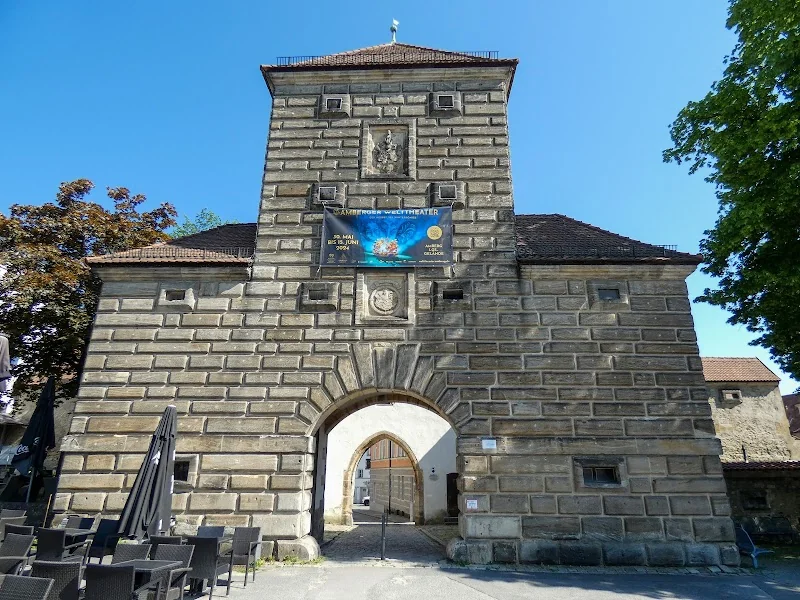
Wingershofer Tor, Amberg
Wingershofer Tor, 92224 Amberg, Germany
Wingershofer Gate | Events & Tickets
The Wingershofer Gate in Amberg is much more than an old city gate for visitors: it is a place where city history, lively guidance, and historical ambiance come together. Those looking for Wingershofer Gate events or Wingershofer Gate tickets will primarily find the experience of the Amberg City Guard, which leads through the gate and the armory located within it in historical costumes. The city of Amberg counts the Wingershofer Gate among the historical city gates of its old town, and the Tourist Information presents it as an impressive opportunity to immerse oneself in the era of the Thirty Years' War. This combination of monument, experience, and narrative makes the Wingershofer Gate a destination for guests who want to not only see a building but also feel the history of the city directly. ([tourismus.amberg.de](https://tourismus.amberg.de/besondere-erlebnisse/))
Tickets, Dates, and Guided Experience at Wingershofer Gate
The most important information for inquiries regarding Wingershofer Gate tickets and Wingershofer Gate events is quite simple: The public tour takes place as a guided city experience and can be booked online or at the Tourist Information Amberg. Registration is necessary, and the Tourist Information explicitly points out that purchased tickets are excluded from return. For 2026, several specific dates have been published on the official site, including April 11, May 30, June 13, July 11, August 29, and September 26, 2026, each at 3:00 PM. The tour lasts 45 to 60 minutes and is limited to a maximum of 25 people. These numbers are particularly important for planning, as they ensure that the offering remains intentionally personal and manageable. Those coming with family, friends, or as a small travel group can therefore plan the experience very specifically. The pricing structure for the tour is also clear: For children aged 7 to 12, it costs 2.50 euros, while adults pay 5.00 euros. This makes the offering one of the easily accessible cultural tours in Amberg and is also interesting for visitors who are looking for a short but content-rich city experience. ([tourismus.amberg.de](https://tourismus.amberg.de/besondere-erlebnisse/))
Especially for SEO and user intent, it is important that the tour should not only be understood as a visit to individual stones. It is staged as a presentation of historical city history, in which the gate itself, the armory inside, and the narrative about the city guard belong together. Those searching for tickets usually want not just an admission ticket but a reliable access to a clearly described experience. Exactly that is what the Wingershofer Gate provides: fixed dates, a limited group size, clear prices, and a connection to a historical theme that is strongly anchored in Amberg. Additionally, year-round bookings for groups are possible upon request, subject to availability. For groups, the Tourist Information mentions a size of 1 to a maximum of 25 people, with a group price of 60 euros; for school classes and kindergartens, up to 30 people including accompanying persons are possible, then for 45.00 euros. This makes the Wingershofer Gate attractive not only for individual guests but also for clubs, school groups, and culturally interested travel groups. So, for those looking for a compact, authentic, and well-organized city gate experience, there is a clear answer here. ([tourismus.amberg.de](https://tourismus.amberg.de/besondere-erlebnisse/))
History of the Wingershofer Gate in Amberg
The historical significance of the Wingershofer Gate begins with the larger city fortifications of Amberg. The city of Amberg explains that the oldest fortification on the left bank of the Vils likely dates back to the 12th century and that in 1326 the construction of the late medieval city fortifications began. This resulted in the well-known oval shape of the old town, which the people of Amberg affectionately refer to as an egg. The five gates Nabburger, Ziegel, Vils, Georgen, and Wingershofer Gate can already be traced back to the 14th century. It is also important for the Wingershofer Gate that it was relocated due to the castle-like expansion of the palace in the 15th century. This information is crucial as it shows that the gate is not simply a static monument but part of an urban development in which military technology, rule, and urban planning changes are closely intertwined. Thus, a single gate becomes a historical marker for upheavals in the city's history that goes far beyond mere architecture. ([amberg.de](https://amberg.de/kultourismus/heimat-tradition/bauten-denkmaeler/stadttore/stadtbefestigung))
The larger context is also important: In the 17th century, baroque fortifications were built in Amberg, while in the last third of the 16th century, the gates were primarily expanded in the style of the Renaissance. Despite the demilitarization of the city at the beginning of the 19th century, the city fortifications have largely been preserved. For the Wingershofer Gate, this means that it should not be viewed in isolation today, but as part of an astonishingly dense historical cityscape that overlaps many epochs. The historical sequence thus ranges from early fortification structures through late medieval city expansion to Renaissance, Baroque, and modern monument preservation. This is precisely where the fascination of the place lies: visitors see not just a gate but a structure that makes the layers of urban development visible. Those interested in history recognize here how closely the development of Amberg is connected with defense, trade routes, and urban identity. That the Wingershofer Gate is still a destination for tours today fits very well with its role as a historical memorial site. It tells not only of construction and relocation but also of how a city has preserved its image to this day. ([amberg.de](https://amberg.de/kultourismus/heimat-tradition/bauten-denkmaeler/stadttore/stadtbefestigung))
City Guard, Armory, and the Thirty Years' War
The special strength of the Wingershofer Gate lies in the connection between the structure and the experience. The Tourist Information Amberg describes that members of the Amberg City Guard lead through the Wingershofer Gate and the armory located within it in historical costumes. This staging makes the tour so attractive: visitors not only move in a historical place but experience it in a narrative that refers to the time of the Thirty Years' War. This is particularly relevant for keyword analysis, as search terms like Amberg City Guard, Armory Wingershofer Gate, or 30-year War Amberg hit exactly this experiential dimension. The tour is not a dry architectural walk but a lively conveyance of history. The goal is clear: the gate should not be experienced as a backdrop but as a stage for historical city history. The official description explicitly emphasizes that participants can take the opportunity to visit one of the four remaining city gates and immerse themselves in the era of the Thirty Years' War. Thus, the tour is a very good example of cultural-historical tourism with a local profile. ([tourismus.amberg.de](https://tourismus.amberg.de/besondere-erlebnisse/))
This format is also interesting for families, groups, and culturally interested guests because it combines a manageable time frame with a high experiential value. 45 to 60 minutes are sufficient to convey background knowledge without overwhelming the visit. The small group size of a maximum of 25 people ensures that the tour remains personal and that the historical impressions do not get lost in mass tourism. The character of the offering is further enhanced by the role of the city guard: historical costumes, the narrative from a bygone era, and the direct reference to the armory give the place a very concrete dramatic form. This is valuable for regional marketing as it sets the Wingershofer Gate apart from other attractions. While there are many historical buildings and city gates in Amberg, history is conveyed particularly vividly here. This makes the place equally interesting for guests looking for events and for those who prefer a cultural highlight with a real connection to the city's history. The tour combines information, atmosphere, and local color in a way that works for both first-time visitors and Amberg connoisseurs. ([tourismus.amberg.de](https://tourismus.amberg.de/besondere-erlebnisse/))
Directions, Parking, and Orientation in the Old Town
For visitors arriving by car, orientation in the Amberg Old Town is particularly important at the Wingershofer Gate. The city of Amberg provides various tips for parking in the city center and old town on its official parking page. Among other things, it points out mobile parking via app or SMS, as well as a map of parking zones, disabled parking spaces in the old town, and specifically designated motorcycle parking. A specific parking option mentioned is the parking garage at the Ziegeltor. For visiting the Wingershofer Gate, this means: those planning the tour should not only keep the address of the tour in mind but also utilize the regular city center parking options of the city of Amberg. Especially at a historical old town site, the parking situation is a practical topic that many users consider directly in search engines. Therefore, keywords like parking, directions, or tickets are contextually related. The official city page shows that Amberg offers various solutions to make parking in the old town as flexible as possible, including digital payment options and different parking zones. ([amberg.de](https://amberg.de/parken?utm_source=openai))
The location in the urban space is also significant for the visitor tour. The Tourist Information names the Wingershofer Gate itself as the meeting point for the tour. In the accompanying information of the city tour, the address Proviantamtsgäßchen 2 also appears, which makes it easier to locate in the old town area. For guests who move through Amberg on foot, this is an advantage: the gate is located in a historical environment where several attractions and city views can be connected. The city of Amberg also points out that there is a location in the municipal BayernWLAN at the Wingershofer Gate. This is useful for visitors who want to access maps, booking pages, or information while on the go. Therefore, those planning their arrival should view the tour as part of an old town visit and not as an isolated appointment. The Wingershofer Gate can be well combined with a walk through the historic city structure, and the official notes show that Amberg is well accessible for visitors both digitally and traditionally. It is particularly practical that the Tourist Information and the city administration do not require complicated special routes but rely on clearly marked city center solutions. ([tourismus.amberg.de](https://tourismus.amberg.de/besondere-erlebnisse/))
Wingershofer Gate as Part of the Amberg City Fortifications
To understand the Wingershofer Gate, it must be seen in the context of the entire Amberg city fortifications. The city of Amberg describes its fortifications as historically multifaceted and emphasizes that the five gates Nabburger, Ziegel, Vils, Georgen, and Wingershofer Gate can already be traced back to the 14th century. The Wingershofer Gate is therefore not a solitary structure but part of an urban system that has grown over centuries. The oval shape of the old town, affectionately called an egg by the people of Amberg, is closely linked to this fortification. For visitors, this is exciting because it brings the city map to life: those who visit the Wingershofer Gate automatically understand better how the old town came into being and why Amberg still appears so cohesive and historical today. This classification is central for search queries like Amberg city fortifications or Amberg city gate, as it embeds the gate in a larger ensemble of monuments. The audience thus receives not only a sight but also a piece of urban identity conveyed. ([amberg.de](https://amberg.de/kultourismus/heimat-tradition/bauten-denkmaeler/stadttore/stadtbefestigung))
The development of the fortifications also shows that the Wingershofer Gate has been repeatedly adapted to new urban and military conditions over the centuries. The city of Amberg explains that the gate was relocated in the 15th century due to the castle-like expansion of the palace. This fact makes it clear how closely the architecture of defense and rule were interconnected. Compared to later interventions, however, the city fortifications have largely been preserved, although the demilitarization at the beginning of the 19th century changed many cities. This good state of preservation is one reason why Amberg is perceived today as a historical city with a strong profile. The Wingershofer Gate contributes to this because it combines the function of a gate, the symbolism of a fortification, and the charm of an old town monument. Together with the other gates and the preserved wall sections, a coherent picture emerges. Therefore, those planning a city tour should not only see the Wingershofer Gate as a destination but as part of a historical route. The tour with the city guard is also ideal from an SEO perspective because it covers both the specific object and the larger theme of city fortifications, thus fulfilling several search intents simultaneously. ([amberg.de](https://amberg.de/kultourismus/heimat-tradition/bauten-denkmaeler/stadttore/stadtbefestigung))
Tips for Visiting and Suitable Combinations in Amberg
For a successful visit to the Wingershofer Gate, it is worth planning the date not as a standalone point but as part of a small old town program. The tour is short enough to be well combined with a walk through Amberg and dense enough in content to leave a lasting impression. Those booking tickets should check early which dates are offered on the official Tourist Info page, as the group size is intentionally limited. This ensures a calm atmosphere but also requires a bit of planning. It is also sensible to plan some buffer time during arrival to keep orientation in the old town relaxed. Since the city of Amberg offers several parking and payment options, the visit can be prepared flexibly. Particularly practical is that the tour starts directly at the gate, thus requiring no long transfer between the meeting point and the sight. For visitors interested in history, monument preservation, and urban development, the Wingershofer Gate is a good choice because it connects a historical site with a concrete experiential concept. ([tourismus.amberg.de](https://tourismus.amberg.de/besondere-erlebnisse/))
Those looking for a thematic connection to other Amberg topics can also link the visit with other historical points in the city. The city of Amberg refers to its city gates and city fortifications as part of the cultural heritage. This creates a small thematic route that is very suitable for guests experiencing Amberg for the first time. The character of the tour is intentionally low-threshold: adults and children pay moderate admission prices, group inquiries are possible, and the official description uses clear language and a tangible historical theme. For this reason, the Wingershofer Gate is interesting for various target groups, from families to school groups to cultural travelers. Therefore, those planning a visit should utilize the combination of history, guided tour, old town, and practical visitor information. The Wingershofer Gate impresses not through size but through density: a gate, an armory, a city guard, a historical context, and a city that has visibly preserved its fortifications. For seekers, this is a strong mix of information and experience, and for visitors, a short journey into the past of Amberg. ([tourismus.amberg.de](https://tourismus.amberg.de/besondere-erlebnisse/))
Sources:
- Tourist Information Amberg – Special Experiences ([tourismus.amberg.de](https://tourismus.amberg.de/besondere-erlebnisse/))
- City Amberg – City Gates ([amberg.de](https://amberg.de/kultourismus/heimat-geschichte/bauten-denkmaeler/stadttore))
- City Amberg – City Fortifications ([amberg.de](https://amberg.de/kultourismus/heimat-tradition/bauten-denkmaeler/stadttore/stadtbefestigung))
- City Amberg – Car Parking ([amberg.de](https://amberg.de/parken?utm_source=openai))
Mehr anzeigenWeniger anzeigen
Wingershofer Gate | Events & Tickets
The Wingershofer Gate in Amberg is much more than an old city gate for visitors: it is a place where city history, lively guidance, and historical ambiance come together. Those looking for Wingershofer Gate events or Wingershofer Gate tickets will primarily find the experience of the Amberg City Guard, which leads through the gate and the armory located within it in historical costumes. The city of Amberg counts the Wingershofer Gate among the historical city gates of its old town, and the Tourist Information presents it as an impressive opportunity to immerse oneself in the era of the Thirty Years' War. This combination of monument, experience, and narrative makes the Wingershofer Gate a destination for guests who want to not only see a building but also feel the history of the city directly. ([tourismus.amberg.de](https://tourismus.amberg.de/besondere-erlebnisse/))
Tickets, Dates, and Guided Experience at Wingershofer Gate
The most important information for inquiries regarding Wingershofer Gate tickets and Wingershofer Gate events is quite simple: The public tour takes place as a guided city experience and can be booked online or at the Tourist Information Amberg. Registration is necessary, and the Tourist Information explicitly points out that purchased tickets are excluded from return. For 2026, several specific dates have been published on the official site, including April 11, May 30, June 13, July 11, August 29, and September 26, 2026, each at 3:00 PM. The tour lasts 45 to 60 minutes and is limited to a maximum of 25 people. These numbers are particularly important for planning, as they ensure that the offering remains intentionally personal and manageable. Those coming with family, friends, or as a small travel group can therefore plan the experience very specifically. The pricing structure for the tour is also clear: For children aged 7 to 12, it costs 2.50 euros, while adults pay 5.00 euros. This makes the offering one of the easily accessible cultural tours in Amberg and is also interesting for visitors who are looking for a short but content-rich city experience. ([tourismus.amberg.de](https://tourismus.amberg.de/besondere-erlebnisse/))
Especially for SEO and user intent, it is important that the tour should not only be understood as a visit to individual stones. It is staged as a presentation of historical city history, in which the gate itself, the armory inside, and the narrative about the city guard belong together. Those searching for tickets usually want not just an admission ticket but a reliable access to a clearly described experience. Exactly that is what the Wingershofer Gate provides: fixed dates, a limited group size, clear prices, and a connection to a historical theme that is strongly anchored in Amberg. Additionally, year-round bookings for groups are possible upon request, subject to availability. For groups, the Tourist Information mentions a size of 1 to a maximum of 25 people, with a group price of 60 euros; for school classes and kindergartens, up to 30 people including accompanying persons are possible, then for 45.00 euros. This makes the Wingershofer Gate attractive not only for individual guests but also for clubs, school groups, and culturally interested travel groups. So, for those looking for a compact, authentic, and well-organized city gate experience, there is a clear answer here. ([tourismus.amberg.de](https://tourismus.amberg.de/besondere-erlebnisse/))
History of the Wingershofer Gate in Amberg
The historical significance of the Wingershofer Gate begins with the larger city fortifications of Amberg. The city of Amberg explains that the oldest fortification on the left bank of the Vils likely dates back to the 12th century and that in 1326 the construction of the late medieval city fortifications began. This resulted in the well-known oval shape of the old town, which the people of Amberg affectionately refer to as an egg. The five gates Nabburger, Ziegel, Vils, Georgen, and Wingershofer Gate can already be traced back to the 14th century. It is also important for the Wingershofer Gate that it was relocated due to the castle-like expansion of the palace in the 15th century. This information is crucial as it shows that the gate is not simply a static monument but part of an urban development in which military technology, rule, and urban planning changes are closely intertwined. Thus, a single gate becomes a historical marker for upheavals in the city's history that goes far beyond mere architecture. ([amberg.de](https://amberg.de/kultourismus/heimat-tradition/bauten-denkmaeler/stadttore/stadtbefestigung))
The larger context is also important: In the 17th century, baroque fortifications were built in Amberg, while in the last third of the 16th century, the gates were primarily expanded in the style of the Renaissance. Despite the demilitarization of the city at the beginning of the 19th century, the city fortifications have largely been preserved. For the Wingershofer Gate, this means that it should not be viewed in isolation today, but as part of an astonishingly dense historical cityscape that overlaps many epochs. The historical sequence thus ranges from early fortification structures through late medieval city expansion to Renaissance, Baroque, and modern monument preservation. This is precisely where the fascination of the place lies: visitors see not just a gate but a structure that makes the layers of urban development visible. Those interested in history recognize here how closely the development of Amberg is connected with defense, trade routes, and urban identity. That the Wingershofer Gate is still a destination for tours today fits very well with its role as a historical memorial site. It tells not only of construction and relocation but also of how a city has preserved its image to this day. ([amberg.de](https://amberg.de/kultourismus/heimat-tradition/bauten-denkmaeler/stadttore/stadtbefestigung))
City Guard, Armory, and the Thirty Years' War
The special strength of the Wingershofer Gate lies in the connection between the structure and the experience. The Tourist Information Amberg describes that members of the Amberg City Guard lead through the Wingershofer Gate and the armory located within it in historical costumes. This staging makes the tour so attractive: visitors not only move in a historical place but experience it in a narrative that refers to the time of the Thirty Years' War. This is particularly relevant for keyword analysis, as search terms like Amberg City Guard, Armory Wingershofer Gate, or 30-year War Amberg hit exactly this experiential dimension. The tour is not a dry architectural walk but a lively conveyance of history. The goal is clear: the gate should not be experienced as a backdrop but as a stage for historical city history. The official description explicitly emphasizes that participants can take the opportunity to visit one of the four remaining city gates and immerse themselves in the era of the Thirty Years' War. Thus, the tour is a very good example of cultural-historical tourism with a local profile. ([tourismus.amberg.de](https://tourismus.amberg.de/besondere-erlebnisse/))
This format is also interesting for families, groups, and culturally interested guests because it combines a manageable time frame with a high experiential value. 45 to 60 minutes are sufficient to convey background knowledge without overwhelming the visit. The small group size of a maximum of 25 people ensures that the tour remains personal and that the historical impressions do not get lost in mass tourism. The character of the offering is further enhanced by the role of the city guard: historical costumes, the narrative from a bygone era, and the direct reference to the armory give the place a very concrete dramatic form. This is valuable for regional marketing as it sets the Wingershofer Gate apart from other attractions. While there are many historical buildings and city gates in Amberg, history is conveyed particularly vividly here. This makes the place equally interesting for guests looking for events and for those who prefer a cultural highlight with a real connection to the city's history. The tour combines information, atmosphere, and local color in a way that works for both first-time visitors and Amberg connoisseurs. ([tourismus.amberg.de](https://tourismus.amberg.de/besondere-erlebnisse/))
Directions, Parking, and Orientation in the Old Town
For visitors arriving by car, orientation in the Amberg Old Town is particularly important at the Wingershofer Gate. The city of Amberg provides various tips for parking in the city center and old town on its official parking page. Among other things, it points out mobile parking via app or SMS, as well as a map of parking zones, disabled parking spaces in the old town, and specifically designated motorcycle parking. A specific parking option mentioned is the parking garage at the Ziegeltor. For visiting the Wingershofer Gate, this means: those planning the tour should not only keep the address of the tour in mind but also utilize the regular city center parking options of the city of Amberg. Especially at a historical old town site, the parking situation is a practical topic that many users consider directly in search engines. Therefore, keywords like parking, directions, or tickets are contextually related. The official city page shows that Amberg offers various solutions to make parking in the old town as flexible as possible, including digital payment options and different parking zones. ([amberg.de](https://amberg.de/parken?utm_source=openai))
The location in the urban space is also significant for the visitor tour. The Tourist Information names the Wingershofer Gate itself as the meeting point for the tour. In the accompanying information of the city tour, the address Proviantamtsgäßchen 2 also appears, which makes it easier to locate in the old town area. For guests who move through Amberg on foot, this is an advantage: the gate is located in a historical environment where several attractions and city views can be connected. The city of Amberg also points out that there is a location in the municipal BayernWLAN at the Wingershofer Gate. This is useful for visitors who want to access maps, booking pages, or information while on the go. Therefore, those planning their arrival should view the tour as part of an old town visit and not as an isolated appointment. The Wingershofer Gate can be well combined with a walk through the historic city structure, and the official notes show that Amberg is well accessible for visitors both digitally and traditionally. It is particularly practical that the Tourist Information and the city administration do not require complicated special routes but rely on clearly marked city center solutions. ([tourismus.amberg.de](https://tourismus.amberg.de/besondere-erlebnisse/))
Wingershofer Gate as Part of the Amberg City Fortifications
To understand the Wingershofer Gate, it must be seen in the context of the entire Amberg city fortifications. The city of Amberg describes its fortifications as historically multifaceted and emphasizes that the five gates Nabburger, Ziegel, Vils, Georgen, and Wingershofer Gate can already be traced back to the 14th century. The Wingershofer Gate is therefore not a solitary structure but part of an urban system that has grown over centuries. The oval shape of the old town, affectionately called an egg by the people of Amberg, is closely linked to this fortification. For visitors, this is exciting because it brings the city map to life: those who visit the Wingershofer Gate automatically understand better how the old town came into being and why Amberg still appears so cohesive and historical today. This classification is central for search queries like Amberg city fortifications or Amberg city gate, as it embeds the gate in a larger ensemble of monuments. The audience thus receives not only a sight but also a piece of urban identity conveyed. ([amberg.de](https://amberg.de/kultourismus/heimat-tradition/bauten-denkmaeler/stadttore/stadtbefestigung))
The development of the fortifications also shows that the Wingershofer Gate has been repeatedly adapted to new urban and military conditions over the centuries. The city of Amberg explains that the gate was relocated in the 15th century due to the castle-like expansion of the palace. This fact makes it clear how closely the architecture of defense and rule were interconnected. Compared to later interventions, however, the city fortifications have largely been preserved, although the demilitarization at the beginning of the 19th century changed many cities. This good state of preservation is one reason why Amberg is perceived today as a historical city with a strong profile. The Wingershofer Gate contributes to this because it combines the function of a gate, the symbolism of a fortification, and the charm of an old town monument. Together with the other gates and the preserved wall sections, a coherent picture emerges. Therefore, those planning a city tour should not only see the Wingershofer Gate as a destination but as part of a historical route. The tour with the city guard is also ideal from an SEO perspective because it covers both the specific object and the larger theme of city fortifications, thus fulfilling several search intents simultaneously. ([amberg.de](https://amberg.de/kultourismus/heimat-tradition/bauten-denkmaeler/stadttore/stadtbefestigung))
Tips for Visiting and Suitable Combinations in Amberg
For a successful visit to the Wingershofer Gate, it is worth planning the date not as a standalone point but as part of a small old town program. The tour is short enough to be well combined with a walk through Amberg and dense enough in content to leave a lasting impression. Those booking tickets should check early which dates are offered on the official Tourist Info page, as the group size is intentionally limited. This ensures a calm atmosphere but also requires a bit of planning. It is also sensible to plan some buffer time during arrival to keep orientation in the old town relaxed. Since the city of Amberg offers several parking and payment options, the visit can be prepared flexibly. Particularly practical is that the tour starts directly at the gate, thus requiring no long transfer between the meeting point and the sight. For visitors interested in history, monument preservation, and urban development, the Wingershofer Gate is a good choice because it connects a historical site with a concrete experiential concept. ([tourismus.amberg.de](https://tourismus.amberg.de/besondere-erlebnisse/))
Those looking for a thematic connection to other Amberg topics can also link the visit with other historical points in the city. The city of Amberg refers to its city gates and city fortifications as part of the cultural heritage. This creates a small thematic route that is very suitable for guests experiencing Amberg for the first time. The character of the tour is intentionally low-threshold: adults and children pay moderate admission prices, group inquiries are possible, and the official description uses clear language and a tangible historical theme. For this reason, the Wingershofer Gate is interesting for various target groups, from families to school groups to cultural travelers. Therefore, those planning a visit should utilize the combination of history, guided tour, old town, and practical visitor information. The Wingershofer Gate impresses not through size but through density: a gate, an armory, a city guard, a historical context, and a city that has visibly preserved its fortifications. For seekers, this is a strong mix of information and experience, and for visitors, a short journey into the past of Amberg. ([tourismus.amberg.de](https://tourismus.amberg.de/besondere-erlebnisse/))
Sources:
- Tourist Information Amberg – Special Experiences ([tourismus.amberg.de](https://tourismus.amberg.de/besondere-erlebnisse/))
- City Amberg – City Gates ([amberg.de](https://amberg.de/kultourismus/heimat-geschichte/bauten-denkmaeler/stadttore))
- City Amberg – City Fortifications ([amberg.de](https://amberg.de/kultourismus/heimat-tradition/bauten-denkmaeler/stadttore/stadtbefestigung))
- City Amberg – Car Parking ([amberg.de](https://amberg.de/parken?utm_source=openai))
Wingershofer Gate | Events & Tickets
The Wingershofer Gate in Amberg is much more than an old city gate for visitors: it is a place where city history, lively guidance, and historical ambiance come together. Those looking for Wingershofer Gate events or Wingershofer Gate tickets will primarily find the experience of the Amberg City Guard, which leads through the gate and the armory located within it in historical costumes. The city of Amberg counts the Wingershofer Gate among the historical city gates of its old town, and the Tourist Information presents it as an impressive opportunity to immerse oneself in the era of the Thirty Years' War. This combination of monument, experience, and narrative makes the Wingershofer Gate a destination for guests who want to not only see a building but also feel the history of the city directly. ([tourismus.amberg.de](https://tourismus.amberg.de/besondere-erlebnisse/))
Tickets, Dates, and Guided Experience at Wingershofer Gate
The most important information for inquiries regarding Wingershofer Gate tickets and Wingershofer Gate events is quite simple: The public tour takes place as a guided city experience and can be booked online or at the Tourist Information Amberg. Registration is necessary, and the Tourist Information explicitly points out that purchased tickets are excluded from return. For 2026, several specific dates have been published on the official site, including April 11, May 30, June 13, July 11, August 29, and September 26, 2026, each at 3:00 PM. The tour lasts 45 to 60 minutes and is limited to a maximum of 25 people. These numbers are particularly important for planning, as they ensure that the offering remains intentionally personal and manageable. Those coming with family, friends, or as a small travel group can therefore plan the experience very specifically. The pricing structure for the tour is also clear: For children aged 7 to 12, it costs 2.50 euros, while adults pay 5.00 euros. This makes the offering one of the easily accessible cultural tours in Amberg and is also interesting for visitors who are looking for a short but content-rich city experience. ([tourismus.amberg.de](https://tourismus.amberg.de/besondere-erlebnisse/))
Especially for SEO and user intent, it is important that the tour should not only be understood as a visit to individual stones. It is staged as a presentation of historical city history, in which the gate itself, the armory inside, and the narrative about the city guard belong together. Those searching for tickets usually want not just an admission ticket but a reliable access to a clearly described experience. Exactly that is what the Wingershofer Gate provides: fixed dates, a limited group size, clear prices, and a connection to a historical theme that is strongly anchored in Amberg. Additionally, year-round bookings for groups are possible upon request, subject to availability. For groups, the Tourist Information mentions a size of 1 to a maximum of 25 people, with a group price of 60 euros; for school classes and kindergartens, up to 30 people including accompanying persons are possible, then for 45.00 euros. This makes the Wingershofer Gate attractive not only for individual guests but also for clubs, school groups, and culturally interested travel groups. So, for those looking for a compact, authentic, and well-organized city gate experience, there is a clear answer here. ([tourismus.amberg.de](https://tourismus.amberg.de/besondere-erlebnisse/))
History of the Wingershofer Gate in Amberg
The historical significance of the Wingershofer Gate begins with the larger city fortifications of Amberg. The city of Amberg explains that the oldest fortification on the left bank of the Vils likely dates back to the 12th century and that in 1326 the construction of the late medieval city fortifications began. This resulted in the well-known oval shape of the old town, which the people of Amberg affectionately refer to as an egg. The five gates Nabburger, Ziegel, Vils, Georgen, and Wingershofer Gate can already be traced back to the 14th century. It is also important for the Wingershofer Gate that it was relocated due to the castle-like expansion of the palace in the 15th century. This information is crucial as it shows that the gate is not simply a static monument but part of an urban development in which military technology, rule, and urban planning changes are closely intertwined. Thus, a single gate becomes a historical marker for upheavals in the city's history that goes far beyond mere architecture. ([amberg.de](https://amberg.de/kultourismus/heimat-tradition/bauten-denkmaeler/stadttore/stadtbefestigung))
The larger context is also important: In the 17th century, baroque fortifications were built in Amberg, while in the last third of the 16th century, the gates were primarily expanded in the style of the Renaissance. Despite the demilitarization of the city at the beginning of the 19th century, the city fortifications have largely been preserved. For the Wingershofer Gate, this means that it should not be viewed in isolation today, but as part of an astonishingly dense historical cityscape that overlaps many epochs. The historical sequence thus ranges from early fortification structures through late medieval city expansion to Renaissance, Baroque, and modern monument preservation. This is precisely where the fascination of the place lies: visitors see not just a gate but a structure that makes the layers of urban development visible. Those interested in history recognize here how closely the development of Amberg is connected with defense, trade routes, and urban identity. That the Wingershofer Gate is still a destination for tours today fits very well with its role as a historical memorial site. It tells not only of construction and relocation but also of how a city has preserved its image to this day. ([amberg.de](https://amberg.de/kultourismus/heimat-tradition/bauten-denkmaeler/stadttore/stadtbefestigung))
City Guard, Armory, and the Thirty Years' War
The special strength of the Wingershofer Gate lies in the connection between the structure and the experience. The Tourist Information Amberg describes that members of the Amberg City Guard lead through the Wingershofer Gate and the armory located within it in historical costumes. This staging makes the tour so attractive: visitors not only move in a historical place but experience it in a narrative that refers to the time of the Thirty Years' War. This is particularly relevant for keyword analysis, as search terms like Amberg City Guard, Armory Wingershofer Gate, or 30-year War Amberg hit exactly this experiential dimension. The tour is not a dry architectural walk but a lively conveyance of history. The goal is clear: the gate should not be experienced as a backdrop but as a stage for historical city history. The official description explicitly emphasizes that participants can take the opportunity to visit one of the four remaining city gates and immerse themselves in the era of the Thirty Years' War. Thus, the tour is a very good example of cultural-historical tourism with a local profile. ([tourismus.amberg.de](https://tourismus.amberg.de/besondere-erlebnisse/))
This format is also interesting for families, groups, and culturally interested guests because it combines a manageable time frame with a high experiential value. 45 to 60 minutes are sufficient to convey background knowledge without overwhelming the visit. The small group size of a maximum of 25 people ensures that the tour remains personal and that the historical impressions do not get lost in mass tourism. The character of the offering is further enhanced by the role of the city guard: historical costumes, the narrative from a bygone era, and the direct reference to the armory give the place a very concrete dramatic form. This is valuable for regional marketing as it sets the Wingershofer Gate apart from other attractions. While there are many historical buildings and city gates in Amberg, history is conveyed particularly vividly here. This makes the place equally interesting for guests looking for events and for those who prefer a cultural highlight with a real connection to the city's history. The tour combines information, atmosphere, and local color in a way that works for both first-time visitors and Amberg connoisseurs. ([tourismus.amberg.de](https://tourismus.amberg.de/besondere-erlebnisse/))
Directions, Parking, and Orientation in the Old Town
For visitors arriving by car, orientation in the Amberg Old Town is particularly important at the Wingershofer Gate. The city of Amberg provides various tips for parking in the city center and old town on its official parking page. Among other things, it points out mobile parking via app or SMS, as well as a map of parking zones, disabled parking spaces in the old town, and specifically designated motorcycle parking. A specific parking option mentioned is the parking garage at the Ziegeltor. For visiting the Wingershofer Gate, this means: those planning the tour should not only keep the address of the tour in mind but also utilize the regular city center parking options of the city of Amberg. Especially at a historical old town site, the parking situation is a practical topic that many users consider directly in search engines. Therefore, keywords like parking, directions, or tickets are contextually related. The official city page shows that Amberg offers various solutions to make parking in the old town as flexible as possible, including digital payment options and different parking zones. ([amberg.de](https://amberg.de/parken?utm_source=openai))
The location in the urban space is also significant for the visitor tour. The Tourist Information names the Wingershofer Gate itself as the meeting point for the tour. In the accompanying information of the city tour, the address Proviantamtsgäßchen 2 also appears, which makes it easier to locate in the old town area. For guests who move through Amberg on foot, this is an advantage: the gate is located in a historical environment where several attractions and city views can be connected. The city of Amberg also points out that there is a location in the municipal BayernWLAN at the Wingershofer Gate. This is useful for visitors who want to access maps, booking pages, or information while on the go. Therefore, those planning their arrival should view the tour as part of an old town visit and not as an isolated appointment. The Wingershofer Gate can be well combined with a walk through the historic city structure, and the official notes show that Amberg is well accessible for visitors both digitally and traditionally. It is particularly practical that the Tourist Information and the city administration do not require complicated special routes but rely on clearly marked city center solutions. ([tourismus.amberg.de](https://tourismus.amberg.de/besondere-erlebnisse/))
Wingershofer Gate as Part of the Amberg City Fortifications
To understand the Wingershofer Gate, it must be seen in the context of the entire Amberg city fortifications. The city of Amberg describes its fortifications as historically multifaceted and emphasizes that the five gates Nabburger, Ziegel, Vils, Georgen, and Wingershofer Gate can already be traced back to the 14th century. The Wingershofer Gate is therefore not a solitary structure but part of an urban system that has grown over centuries. The oval shape of the old town, affectionately called an egg by the people of Amberg, is closely linked to this fortification. For visitors, this is exciting because it brings the city map to life: those who visit the Wingershofer Gate automatically understand better how the old town came into being and why Amberg still appears so cohesive and historical today. This classification is central for search queries like Amberg city fortifications or Amberg city gate, as it embeds the gate in a larger ensemble of monuments. The audience thus receives not only a sight but also a piece of urban identity conveyed. ([amberg.de](https://amberg.de/kultourismus/heimat-tradition/bauten-denkmaeler/stadttore/stadtbefestigung))
The development of the fortifications also shows that the Wingershofer Gate has been repeatedly adapted to new urban and military conditions over the centuries. The city of Amberg explains that the gate was relocated in the 15th century due to the castle-like expansion of the palace. This fact makes it clear how closely the architecture of defense and rule were interconnected. Compared to later interventions, however, the city fortifications have largely been preserved, although the demilitarization at the beginning of the 19th century changed many cities. This good state of preservation is one reason why Amberg is perceived today as a historical city with a strong profile. The Wingershofer Gate contributes to this because it combines the function of a gate, the symbolism of a fortification, and the charm of an old town monument. Together with the other gates and the preserved wall sections, a coherent picture emerges. Therefore, those planning a city tour should not only see the Wingershofer Gate as a destination but as part of a historical route. The tour with the city guard is also ideal from an SEO perspective because it covers both the specific object and the larger theme of city fortifications, thus fulfilling several search intents simultaneously. ([amberg.de](https://amberg.de/kultourismus/heimat-tradition/bauten-denkmaeler/stadttore/stadtbefestigung))
Tips for Visiting and Suitable Combinations in Amberg
For a successful visit to the Wingershofer Gate, it is worth planning the date not as a standalone point but as part of a small old town program. The tour is short enough to be well combined with a walk through Amberg and dense enough in content to leave a lasting impression. Those booking tickets should check early which dates are offered on the official Tourist Info page, as the group size is intentionally limited. This ensures a calm atmosphere but also requires a bit of planning. It is also sensible to plan some buffer time during arrival to keep orientation in the old town relaxed. Since the city of Amberg offers several parking and payment options, the visit can be prepared flexibly. Particularly practical is that the tour starts directly at the gate, thus requiring no long transfer between the meeting point and the sight. For visitors interested in history, monument preservation, and urban development, the Wingershofer Gate is a good choice because it connects a historical site with a concrete experiential concept. ([tourismus.amberg.de](https://tourismus.amberg.de/besondere-erlebnisse/))
Those looking for a thematic connection to other Amberg topics can also link the visit with other historical points in the city. The city of Amberg refers to its city gates and city fortifications as part of the cultural heritage. This creates a small thematic route that is very suitable for guests experiencing Amberg for the first time. The character of the tour is intentionally low-threshold: adults and children pay moderate admission prices, group inquiries are possible, and the official description uses clear language and a tangible historical theme. For this reason, the Wingershofer Gate is interesting for various target groups, from families to school groups to cultural travelers. Therefore, those planning a visit should utilize the combination of history, guided tour, old town, and practical visitor information. The Wingershofer Gate impresses not through size but through density: a gate, an armory, a city guard, a historical context, and a city that has visibly preserved its fortifications. For seekers, this is a strong mix of information and experience, and for visitors, a short journey into the past of Amberg. ([tourismus.amberg.de](https://tourismus.amberg.de/besondere-erlebnisse/))
Sources:
- Tourist Information Amberg – Special Experiences ([tourismus.amberg.de](https://tourismus.amberg.de/besondere-erlebnisse/))
- City Amberg – City Gates ([amberg.de](https://amberg.de/kultourismus/heimat-geschichte/bauten-denkmaeler/stadttore))
- City Amberg – City Fortifications ([amberg.de](https://amberg.de/kultourismus/heimat-tradition/bauten-denkmaeler/stadttore/stadtbefestigung))
- City Amberg – Car Parking ([amberg.de](https://amberg.de/parken?utm_source=openai))
Frequently Asked Questions
Reviews
david antoun
16. November 2025
16th century medieval gate.
Juergen Doerrich
28. December 2025
Birgit Hren
25. March 2026
The Wingershofertor with its museum in the tower takes visitors back to the time of the Thirty Years' War. Tickets for the tour are available at the tourist information.
Hans Siebenstich
16. October 2025
Jemi Rush
11. June 2024