
Amberg
Auf dem Mariahilfberg 3, 92224 Amberg, Deutschland
Pilgrimage Church of Maria Hilf | Amberg & History
The Pilgrimage Church of Maria Hilf on the Mariahilfberg is one of the most significant places in Amberg, as it brings together city history, baroque art, lived piety, and an impressive view in a compact space. Those who ascend the mountain experience not just a church, but a historically grown ensemble with a monastery, forecourt, open altar, staircase, and the wide panorama over the old town. The official website describes the place as an invitation to take a break from everyday life, to stroll around the church, and to enjoy the view of Amberg; at the same time, Maria Hilf remains an active pilgrimage site with fixed service times and a long Franciscan tradition. The city of Amberg also emphasizes the special significance of the church: The largest mountain pilgrimage in the Upper Palatinate originated during the plague in 1634, and the current church was rebuilt from 1697 after the fire disaster of the previous church. ([mariahilfberg-amberg.de](https://www.mariahilfberg-amberg.de/))
History of the Pilgrimage Church of Maria Hilf in Amberg
The history of the pilgrimage church is closely linked to an exceptional situation. In 1634, a severe plague epidemic struck the city of Amberg. In this situation, the citizens vowed, at the suggestion of the Jesuit rector P. Caspar Hell, to establish a Marian chapel. They chose the mountain above the city, where the tower of the former castle still stood. On September 3, 1634, a donated Marian image was transferred there. Just a few months later, the plague subsided, and the image quickly gained significance. The official church history thus describes not only an origin from need and hope but also the beginning of a pilgrimage that remained deeply rooted in the religious memory of Amberg. The city of Amberg adds to this development by noting that the mountain pilgrimage grew into the largest Marian pilgrimage in the Upper Palatinate. Today, a place is visible where collective crisis experience and long-term faith practice have been connected for centuries. ([mariahilfberg-amberg.de](https://www.mariahilfberg-amberg.de/geschichte-428638.html))
The current church is not the first architectural form of this pilgrimage site. The previous church burned down in 1646, and the reconstruction began in 1697 according to plans by Wolfgang Dientzenhofer. Due to the War of the Spanish Succession, completion was only achieved in 1711. This construction period explains why the church today conveys such a mature baroque impression: It is not only a relic from a single construction phase but the result of a longer development influenced by historical upheavals. The history also includes the Franciscans, who were entrusted with the pilgrimage in 1634 during the Counter-Reformation, were later expelled during secularization, and were able to establish a monastery on the mountain again in 1832. The existing Franciscan monastery dates back to the same founding year as the church and remains part of the ensemble to this day. This continuity explains why Maria Hilf does not appear as a museum-like monument but as a living, cared-for pilgrimage site. ([mariahilfberg-amberg.de](https://www.mariahilfberg-amberg.de/geschichte-428638.html))
A particularly important component of the history is the annual mountain festival. According to the official church history, the main festival of the Visitation of Mary is celebrated on July 2 as a whole festival week. Pilgrims walk from all over the Upper Palatinate and even from Upper Franconia. Thus, the mountain festival is not only a liturgical date but a regional event that continues to connect people to this day. For 2026, the church foundation's website names the period from June 27 to July 5. This makes it clear that the tradition does not end in retrospect but continues to be updated and shapes the annual rhythm of the Mariahilfberg. Therefore, anyone who wants to understand the pilgrimage church should not only look at the architecture but also at this living form of pilgrimage, celebration, and passing on from generation to generation. ([mariahilfberg-amberg.de](https://www.mariahilfberg-amberg.de/geschichte-428638.html))
Architecture, Frescoes, and the Gracious Image
The Pilgrimage Church of Maria Hilf is architecturally remarkable because it does not simply ignore the mountain and its topography but incorporates it into the design. The forecourt is monumental and leads up to the church via a staircase and an open altar. The facade, with its five axes and high base, is deliberately designed for distant visibility. According to the church's history page, the front is additionally divided by Ionic colossal pilasters; in the attic zone stand Maria Immaculata, Francis of Assisi, and Anthony of Padua. The city of Amberg also points out that the building on the Mariahilfberg was created according to plans by Wolfgang Dientzenhofer and completed in 1711. Thus, it is clear from the outside that there is a baroque total work of art here, which consists not only of the church space but of the interplay of ascent, space, facade, and sight axes. ([mariahilfberg-amberg.de](https://www.mariahilfberg-amberg.de/geschichte-428638.html))
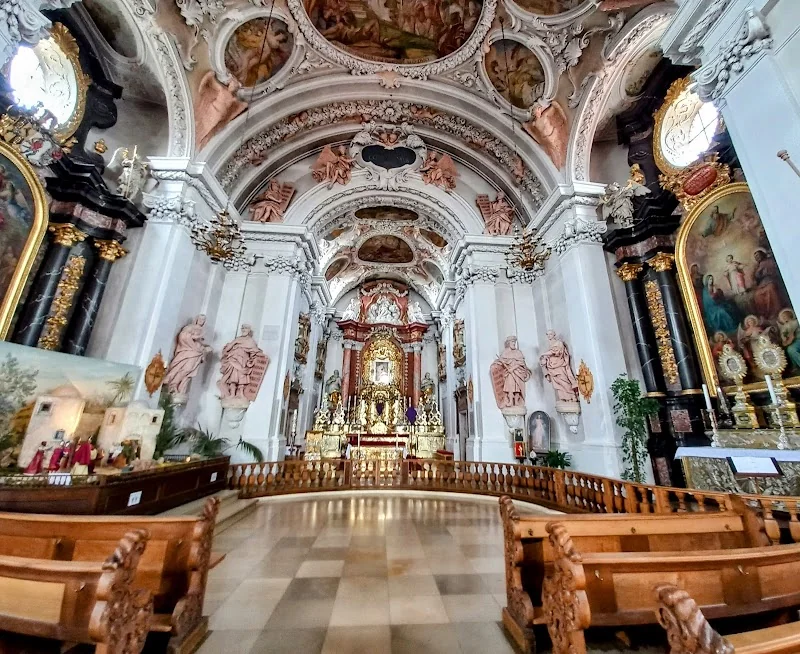
Inside, the church follows the baroque schema of the wall pillar church. Particularly impressive is the stucco decoration, which, according to church history, is attributed to the Carlone workshop. It frames the frescoes and emphasizes the spatial division. The ceiling program comes from Cosmas Damian Asam and depicts the history of the pilgrimage. The cycle begins with the plague year 1634 in the choir vault, followed by scenes of the transfer of the gracious image to the mountain keep and the rescue of the image from the flames in 1646. The city of Amberg additionally emphasizes that the focal point of the church is the gracious image, a copy of a depiction of the Madonna by Lucas Cranach. It is precisely this combination of artistic quality, narrative image sequence, and Marian piety that makes the space so impressive. Visitors do not experience a mere backdrop but a theologically and art-historically dense narrative. ([mariahilfberg-amberg.de](https://www.mariahilfberg-amberg.de/geschichte-428638.html))
Also noteworthy is the orientation of the church. Due to the geographical conditions of the mountain ridge, it is not oriented to the east, as is common with many sacred buildings, but to the northwest. This adaptation to the site shows how strongly architecture is connected to the landscape here. The baroque form thus serves not only for representation but also for integration into the mountain. Additionally, there is the long external effect: The monumental staircase already directs the gaze upwards, while the forecourt remains a transitional space between the city and the holy site. The church thus appears as a focal point that is visible from afar and rich in details up close. Therefore, those who observe the architecture see not only a building but a consciously composed experience of movement, perspective, and sacred sign. ([mariahilfberg-amberg.de](https://www.mariahilfberg-amberg.de/geschichte-428638.html))
Services, Confession, and Opening Hours
The Pilgrimage Church of Maria Hilf is an active liturgical place with clear and regular times. According to the official website, the church is open daily from 6:30 AM to 6:00 PM, Saturdays from 8:30 AM, and during the mountain festival week from 6:00 AM to 10:00 PM. This makes a spontaneous visit as possible as targeted participation in a service. For visitors, this reliability is important because the church functions not only as a sight but as a living space for devotion. The combination of an open church, a fixed prayer rhythm, and a strong pilgrimage tradition ensures that even day guests quickly feel that Maria Hilf is more than a viewpoint. The opening hours are also a practical hint for travelers who want to combine their visit with a city stroll or a hike. ([mariahilfberg-amberg.de](https://www.mariahilfberg-amberg.de/))
The service schedule is also clearly structured. On Sundays and holidays, masses are celebrated at 7:00 AM, 8:30 AM, and 10:00 AM, with an additional devotion at 3:00 PM. On Saturdays, the mass takes place at 9:00 AM, along with the evening mass at 4:00 PM. On weekdays, there are masses at 7:00 AM and 9:00 AM. For confession, the church names 15 minutes before each holy mass and Saturdays between 3:00 PM and 4:00 PM as regular times; additionally, an arrangement by phone is possible. These details show that the pilgrimage church lives not only during special festivals but is also shaped by daily prayer, sacraments, and personal reflection. This is particularly important for visitors seeking a quiet moment: The church offers clear structures without losing its openness. ([mariahilfberg-amberg.de](https://www.mariahilfberg-amberg.de/gottesdienstzeiten-428633.html))
It is also practical that the official site provides contact times for the monastery gate. On Mondays, the gate is closed all day, and from Tuesday to Thursday, it is open in the morning and afternoon, on Fridays in the morning, on Saturdays after the evening mass, and on Sundays after each service. Such information is helpful for pilgrims, groups, and organizers as it makes the visit well-planned. So, if someone is planning a pilgrimage, a family prayer, or a quiet walk, they can adjust their visit to the liturgical times. In the interplay of opening, service order, and accessibility, a place emerges that is strongly oriented towards practice and hospitality. For the search intentions around service times, opening hours, and contact, Maria Hilf is thus excellently documented and simultaneously usable in everyday life. ([mariahilfberg-amberg.de](https://www.mariahilfberg-amberg.de/))
Mountain Festival on the Mariahilfberg and Franciscan Tradition
The mountain festival is the highlight of the year on the Mariahilfberg and is closely linked to the identity of the pilgrimage church. The official history page describes it as the main festival of the Visitation of Mary on July 2, which is celebrated over a whole week. This form has developed into a firm tradition over decades and attracts foot pilgrims from all over the Upper Palatinate and beyond. For the city of Amberg, the Mariahilfberg is not only religiously significant but also a cultural reference point, as pilgrimage, local customs, and urban memory overlap here. Therefore, those who experience the mountain festival receive not only a church celebration but also a piece of regional identity. This also explains why the period is particularly noted each year and why the church offers longer opening hours during the mountain festival week. ([mariahilfberg-amberg.de](https://www.mariahilfberg-amberg.de/geschichte-428638.html))
The mountain festival is also closely associated with Franciscan care. The Franciscans took over the pilgrimage in 1634, were expelled again in 1804 during secularization, and returned to the mountain in 1832 when King Ludwig I approved the establishment of a Franciscan monastery. Since the expansion of 1861/62, they have been caring for the pilgrimage site to this day. This historical line is important because it explains why the place, despite its baroque monumentality, radiates a rather calm, spiritual atmosphere. Franciscan presence here means not only administration but a long tradition of pastoral care, confession offerings, prayer, and festival design. The church is thus not merely a monument of past piety but an actively guarded pilgrimage site with a vibrant spiritual profile. ([mariahilfberg-amberg.de](https://www.mariahilfberg-amberg.de/geschichte-428638.html))
This liveliness is particularly evident in the current notices on the website, such as the Hour of Mercy, the church bulletin, and the anniversary year of Saint Francis of Assisi from 1226 to 2026. Such entries make it clear that Maria Hilf is also embedded in a larger church calendar today. The place thrives on regular services as well as thematic devotions, pilgrimages, and festive times. For visitors seeking a place with religious depth, this is an important signal: Here, not only is the past referenced, but the present is shaped. The mountain festival remains the visible highlight, where the tradition is particularly condensed, and the pilgrimage church impressively shows its character as a regional focal point. ([mariahilfberg-amberg.de](https://www.mariahilfberg-amberg.de/die_stunde_der_barmherzigkeit-638740.html?utm_source=openai))
Access, Parking, and Walking Paths Around the Church
The Mariahilfberg is interesting not only as a pilgrimage destination but also as a starting point for walks and light hikes. The official homepage explicitly invites visitors to stroll around the pilgrimage church and enjoy the view of the old town of Amberg. The city's tourism brochure complements this perspective with the Erzweg: The circular hike is 2.9 kilometers long, classified as easy, and begins and ends at the parking lot by the Pilgrimage Church of Maria Hilf. Thus, the church is not only the destination of a pilgrimage but also a practical starting point for short nature experiences right on the edge of the city. For visitors who want to combine culture and movement, this is ideal. One can easily enter an environment where forest, views, and history lie closely together. ([mariahilfberg-amberg.de](https://www.mariahilfberg-amberg.de/))
The route is also content-wise appealing: According to the brochure, it leads through a generous forest area with mixed forest, partially follows the Water Hiking Trail and the Anniversary Hiking Trail, and offers beautiful views into the Amberg-Sulzbacher Land along the way. Particularly striking is the small detour around the church, where one can see the so-called Amberg Egg from above from the steps in front of the main portal. This is a very vivid example of how strongly the place is linked to the landscape and city view. Therefore, those who park here do not simply start a walk but experience a transition from the urban proximity of the old town into a quiet, green, and historical space. For travelers, families, and day guests, this is an important added value, as the visit can easily transform into a short excursion. ([tourismus.amberg.de](https://tourismus.amberg.de/wp-content/uploads/2022/08/Erzweg_Broschuere_web.pdf?utm_source=openai))
The location itself is also helpful for orientation. The church stands on the Mariahilfberg above the old town, and the official website emphasizes the beautiful view over Amberg. Together with the parking lot on the mountain, the regular service times, and the easily walkable paths, a well-accessible visit offer emerges. Those arriving by car benefit from the clear starting point logic of the Erzweg; those coming on foot connect the city with the mountain and the church. Since the historical information also highlights the forecourt, staircase, and open altar, the access to the site already becomes part of the experience. This is precisely why Maria Hilf is a worthwhile destination not only for pilgrims but also for day-trippers and cultural travelers. ([mariahilfberg-amberg.de](https://www.mariahilfberg-amberg.de/))
Photos, Views, and Tips for Your Visit
The Pilgrimage Church of Maria Hilf in Amberg is particularly grateful for photos, as it offers several strong motifs. The monumental staircase already provides an impressive perspective that automatically directs the gaze upwards. Additionally, there are the baroque facade, the forecourt with the open altar, and the effect of the building on the mountain ridge. Those who view the church from the city see a prominent landmark; those who approach it closer discover the details of pilasters, figures, and stucco. The location above the old town also ensures that exterior shots are not only architecturally convincing but also visually appealing. The place is thus ideal for visitors who want to document historical sacred architecture or simply take a picturesque image of the city. ([mariahilfberg-amberg.de](https://www.mariahilfberg-amberg.de/geschichte-428638.html))
The view from the steps is also a unique photo motif. The tourism brochure highlights that one can see the Amberg Egg from above from there. At the same time, the view of the old town is explicitly mentioned on the official website. This combination of city panorama and sacred space is one of the reasons why the Mariahilfberg is so popular. For visitors, it is advisable to plan enough time for the transition between the interior and exterior, as this change is precisely what makes the charm of the place. A brief visit while passing by is possible, but those who want to absorb the atmosphere should experience both the church space and the forecourt and the paths around it. The church lives not only from its art but from the way it is embedded in the landscape and sight axes. ([mariahilfberg-amberg.de](https://www.mariahilfberg-amberg.de/))
As a tip for visitors: It is best to combine the pilgrimage church with a walk on the Mariahilfberg or with a stay during the regular service times. This way, one experiences the church not only as a photo point but as a space with actual use and atmosphere. Those who visit the mountain festival experience the place at its greatest bustle and with particularly intense mood; those who come outside this time find more peace and expanse. Both have their value. For many visitors, it is precisely this change from quiet devotion, grand festival, and wide view that makes Maria Hilf special. The place is thus equally exciting for pilgrims, culture enthusiasts, photographers, and walkers while remaining clearly anchored in its religious function. ([mariahilfberg-amberg.de](https://www.mariahilfberg-amberg.de/geschichte-428638.html))
Sources:
- Pilgrimage Church of Maria Hilf Amberg - Official Website
- Pilgrimage Church of Maria Hilf Amberg - History
- Pilgrimage Church of Maria Hilf Amberg - Service Times
- Pilgrimage Church of Maria Hilf Amberg - Mountain Festival 2026
- City of Amberg - Mariahilfberg Church
- Tourism Amberg - Brochure 2025
- Tourism Amberg - Erzweg Brochure
Mehr anzeigenWeniger anzeigen
Pilgrimage Church of Maria Hilf | Amberg & History
The Pilgrimage Church of Maria Hilf on the Mariahilfberg is one of the most significant places in Amberg, as it brings together city history, baroque art, lived piety, and an impressive view in a compact space. Those who ascend the mountain experience not just a church, but a historically grown ensemble with a monastery, forecourt, open altar, staircase, and the wide panorama over the old town. The official website describes the place as an invitation to take a break from everyday life, to stroll around the church, and to enjoy the view of Amberg; at the same time, Maria Hilf remains an active pilgrimage site with fixed service times and a long Franciscan tradition. The city of Amberg also emphasizes the special significance of the church: The largest mountain pilgrimage in the Upper Palatinate originated during the plague in 1634, and the current church was rebuilt from 1697 after the fire disaster of the previous church. ([mariahilfberg-amberg.de](https://www.mariahilfberg-amberg.de/))
History of the Pilgrimage Church of Maria Hilf in Amberg
The history of the pilgrimage church is closely linked to an exceptional situation. In 1634, a severe plague epidemic struck the city of Amberg. In this situation, the citizens vowed, at the suggestion of the Jesuit rector P. Caspar Hell, to establish a Marian chapel. They chose the mountain above the city, where the tower of the former castle still stood. On September 3, 1634, a donated Marian image was transferred there. Just a few months later, the plague subsided, and the image quickly gained significance. The official church history thus describes not only an origin from need and hope but also the beginning of a pilgrimage that remained deeply rooted in the religious memory of Amberg. The city of Amberg adds to this development by noting that the mountain pilgrimage grew into the largest Marian pilgrimage in the Upper Palatinate. Today, a place is visible where collective crisis experience and long-term faith practice have been connected for centuries. ([mariahilfberg-amberg.de](https://www.mariahilfberg-amberg.de/geschichte-428638.html))
The current church is not the first architectural form of this pilgrimage site. The previous church burned down in 1646, and the reconstruction began in 1697 according to plans by Wolfgang Dientzenhofer. Due to the War of the Spanish Succession, completion was only achieved in 1711. This construction period explains why the church today conveys such a mature baroque impression: It is not only a relic from a single construction phase but the result of a longer development influenced by historical upheavals. The history also includes the Franciscans, who were entrusted with the pilgrimage in 1634 during the Counter-Reformation, were later expelled during secularization, and were able to establish a monastery on the mountain again in 1832. The existing Franciscan monastery dates back to the same founding year as the church and remains part of the ensemble to this day. This continuity explains why Maria Hilf does not appear as a museum-like monument but as a living, cared-for pilgrimage site. ([mariahilfberg-amberg.de](https://www.mariahilfberg-amberg.de/geschichte-428638.html))
A particularly important component of the history is the annual mountain festival. According to the official church history, the main festival of the Visitation of Mary is celebrated on July 2 as a whole festival week. Pilgrims walk from all over the Upper Palatinate and even from Upper Franconia. Thus, the mountain festival is not only a liturgical date but a regional event that continues to connect people to this day. For 2026, the church foundation's website names the period from June 27 to July 5. This makes it clear that the tradition does not end in retrospect but continues to be updated and shapes the annual rhythm of the Mariahilfberg. Therefore, anyone who wants to understand the pilgrimage church should not only look at the architecture but also at this living form of pilgrimage, celebration, and passing on from generation to generation. ([mariahilfberg-amberg.de](https://www.mariahilfberg-amberg.de/geschichte-428638.html))
Architecture, Frescoes, and the Gracious Image
The Pilgrimage Church of Maria Hilf is architecturally remarkable because it does not simply ignore the mountain and its topography but incorporates it into the design. The forecourt is monumental and leads up to the church via a staircase and an open altar. The facade, with its five axes and high base, is deliberately designed for distant visibility. According to the church's history page, the front is additionally divided by Ionic colossal pilasters; in the attic zone stand Maria Immaculata, Francis of Assisi, and Anthony of Padua. The city of Amberg also points out that the building on the Mariahilfberg was created according to plans by Wolfgang Dientzenhofer and completed in 1711. Thus, it is clear from the outside that there is a baroque total work of art here, which consists not only of the church space but of the interplay of ascent, space, facade, and sight axes. ([mariahilfberg-amberg.de](https://www.mariahilfberg-amberg.de/geschichte-428638.html))
Inside, the church follows the baroque schema of the wall pillar church. Particularly impressive is the stucco decoration, which, according to church history, is attributed to the Carlone workshop. It frames the frescoes and emphasizes the spatial division. The ceiling program comes from Cosmas Damian Asam and depicts the history of the pilgrimage. The cycle begins with the plague year 1634 in the choir vault, followed by scenes of the transfer of the gracious image to the mountain keep and the rescue of the image from the flames in 1646. The city of Amberg additionally emphasizes that the focal point of the church is the gracious image, a copy of a depiction of the Madonna by Lucas Cranach. It is precisely this combination of artistic quality, narrative image sequence, and Marian piety that makes the space so impressive. Visitors do not experience a mere backdrop but a theologically and art-historically dense narrative. ([mariahilfberg-amberg.de](https://www.mariahilfberg-amberg.de/geschichte-428638.html))
Also noteworthy is the orientation of the church. Due to the geographical conditions of the mountain ridge, it is not oriented to the east, as is common with many sacred buildings, but to the northwest. This adaptation to the site shows how strongly architecture is connected to the landscape here. The baroque form thus serves not only for representation but also for integration into the mountain. Additionally, there is the long external effect: The monumental staircase already directs the gaze upwards, while the forecourt remains a transitional space between the city and the holy site. The church thus appears as a focal point that is visible from afar and rich in details up close. Therefore, those who observe the architecture see not only a building but a consciously composed experience of movement, perspective, and sacred sign. ([mariahilfberg-amberg.de](https://www.mariahilfberg-amberg.de/geschichte-428638.html))
Services, Confession, and Opening Hours
The Pilgrimage Church of Maria Hilf is an active liturgical place with clear and regular times. According to the official website, the church is open daily from 6:30 AM to 6:00 PM, Saturdays from 8:30 AM, and during the mountain festival week from 6:00 AM to 10:00 PM. This makes a spontaneous visit as possible as targeted participation in a service. For visitors, this reliability is important because the church functions not only as a sight but as a living space for devotion. The combination of an open church, a fixed prayer rhythm, and a strong pilgrimage tradition ensures that even day guests quickly feel that Maria Hilf is more than a viewpoint. The opening hours are also a practical hint for travelers who want to combine their visit with a city stroll or a hike. ([mariahilfberg-amberg.de](https://www.mariahilfberg-amberg.de/))
The service schedule is also clearly structured. On Sundays and holidays, masses are celebrated at 7:00 AM, 8:30 AM, and 10:00 AM, with an additional devotion at 3:00 PM. On Saturdays, the mass takes place at 9:00 AM, along with the evening mass at 4:00 PM. On weekdays, there are masses at 7:00 AM and 9:00 AM. For confession, the church names 15 minutes before each holy mass and Saturdays between 3:00 PM and 4:00 PM as regular times; additionally, an arrangement by phone is possible. These details show that the pilgrimage church lives not only during special festivals but is also shaped by daily prayer, sacraments, and personal reflection. This is particularly important for visitors seeking a quiet moment: The church offers clear structures without losing its openness. ([mariahilfberg-amberg.de](https://www.mariahilfberg-amberg.de/gottesdienstzeiten-428633.html))
It is also practical that the official site provides contact times for the monastery gate. On Mondays, the gate is closed all day, and from Tuesday to Thursday, it is open in the morning and afternoon, on Fridays in the morning, on Saturdays after the evening mass, and on Sundays after each service. Such information is helpful for pilgrims, groups, and organizers as it makes the visit well-planned. So, if someone is planning a pilgrimage, a family prayer, or a quiet walk, they can adjust their visit to the liturgical times. In the interplay of opening, service order, and accessibility, a place emerges that is strongly oriented towards practice and hospitality. For the search intentions around service times, opening hours, and contact, Maria Hilf is thus excellently documented and simultaneously usable in everyday life. ([mariahilfberg-amberg.de](https://www.mariahilfberg-amberg.de/))
Mountain Festival on the Mariahilfberg and Franciscan Tradition
The mountain festival is the highlight of the year on the Mariahilfberg and is closely linked to the identity of the pilgrimage church. The official history page describes it as the main festival of the Visitation of Mary on July 2, which is celebrated over a whole week. This form has developed into a firm tradition over decades and attracts foot pilgrims from all over the Upper Palatinate and beyond. For the city of Amberg, the Mariahilfberg is not only religiously significant but also a cultural reference point, as pilgrimage, local customs, and urban memory overlap here. Therefore, those who experience the mountain festival receive not only a church celebration but also a piece of regional identity. This also explains why the period is particularly noted each year and why the church offers longer opening hours during the mountain festival week. ([mariahilfberg-amberg.de](https://www.mariahilfberg-amberg.de/geschichte-428638.html))
The mountain festival is also closely associated with Franciscan care. The Franciscans took over the pilgrimage in 1634, were expelled again in 1804 during secularization, and returned to the mountain in 1832 when King Ludwig I approved the establishment of a Franciscan monastery. Since the expansion of 1861/62, they have been caring for the pilgrimage site to this day. This historical line is important because it explains why the place, despite its baroque monumentality, radiates a rather calm, spiritual atmosphere. Franciscan presence here means not only administration but a long tradition of pastoral care, confession offerings, prayer, and festival design. The church is thus not merely a monument of past piety but an actively guarded pilgrimage site with a vibrant spiritual profile. ([mariahilfberg-amberg.de](https://www.mariahilfberg-amberg.de/geschichte-428638.html))
This liveliness is particularly evident in the current notices on the website, such as the Hour of Mercy, the church bulletin, and the anniversary year of Saint Francis of Assisi from 1226 to 2026. Such entries make it clear that Maria Hilf is also embedded in a larger church calendar today. The place thrives on regular services as well as thematic devotions, pilgrimages, and festive times. For visitors seeking a place with religious depth, this is an important signal: Here, not only is the past referenced, but the present is shaped. The mountain festival remains the visible highlight, where the tradition is particularly condensed, and the pilgrimage church impressively shows its character as a regional focal point. ([mariahilfberg-amberg.de](https://www.mariahilfberg-amberg.de/die_stunde_der_barmherzigkeit-638740.html?utm_source=openai))
Access, Parking, and Walking Paths Around the Church
The Mariahilfberg is interesting not only as a pilgrimage destination but also as a starting point for walks and light hikes. The official homepage explicitly invites visitors to stroll around the pilgrimage church and enjoy the view of the old town of Amberg. The city's tourism brochure complements this perspective with the Erzweg: The circular hike is 2.9 kilometers long, classified as easy, and begins and ends at the parking lot by the Pilgrimage Church of Maria Hilf. Thus, the church is not only the destination of a pilgrimage but also a practical starting point for short nature experiences right on the edge of the city. For visitors who want to combine culture and movement, this is ideal. One can easily enter an environment where forest, views, and history lie closely together. ([mariahilfberg-amberg.de](https://www.mariahilfberg-amberg.de/))
The route is also content-wise appealing: According to the brochure, it leads through a generous forest area with mixed forest, partially follows the Water Hiking Trail and the Anniversary Hiking Trail, and offers beautiful views into the Amberg-Sulzbacher Land along the way. Particularly striking is the small detour around the church, where one can see the so-called Amberg Egg from above from the steps in front of the main portal. This is a very vivid example of how strongly the place is linked to the landscape and city view. Therefore, those who park here do not simply start a walk but experience a transition from the urban proximity of the old town into a quiet, green, and historical space. For travelers, families, and day guests, this is an important added value, as the visit can easily transform into a short excursion. ([tourismus.amberg.de](https://tourismus.amberg.de/wp-content/uploads/2022/08/Erzweg_Broschuere_web.pdf?utm_source=openai))
The location itself is also helpful for orientation. The church stands on the Mariahilfberg above the old town, and the official website emphasizes the beautiful view over Amberg. Together with the parking lot on the mountain, the regular service times, and the easily walkable paths, a well-accessible visit offer emerges. Those arriving by car benefit from the clear starting point logic of the Erzweg; those coming on foot connect the city with the mountain and the church. Since the historical information also highlights the forecourt, staircase, and open altar, the access to the site already becomes part of the experience. This is precisely why Maria Hilf is a worthwhile destination not only for pilgrims but also for day-trippers and cultural travelers. ([mariahilfberg-amberg.de](https://www.mariahilfberg-amberg.de/))
Photos, Views, and Tips for Your Visit
The Pilgrimage Church of Maria Hilf in Amberg is particularly grateful for photos, as it offers several strong motifs. The monumental staircase already provides an impressive perspective that automatically directs the gaze upwards. Additionally, there are the baroque facade, the forecourt with the open altar, and the effect of the building on the mountain ridge. Those who view the church from the city see a prominent landmark; those who approach it closer discover the details of pilasters, figures, and stucco. The location above the old town also ensures that exterior shots are not only architecturally convincing but also visually appealing. The place is thus ideal for visitors who want to document historical sacred architecture or simply take a picturesque image of the city. ([mariahilfberg-amberg.de](https://www.mariahilfberg-amberg.de/geschichte-428638.html))
The view from the steps is also a unique photo motif. The tourism brochure highlights that one can see the Amberg Egg from above from there. At the same time, the view of the old town is explicitly mentioned on the official website. This combination of city panorama and sacred space is one of the reasons why the Mariahilfberg is so popular. For visitors, it is advisable to plan enough time for the transition between the interior and exterior, as this change is precisely what makes the charm of the place. A brief visit while passing by is possible, but those who want to absorb the atmosphere should experience both the church space and the forecourt and the paths around it. The church lives not only from its art but from the way it is embedded in the landscape and sight axes. ([mariahilfberg-amberg.de](https://www.mariahilfberg-amberg.de/))
As a tip for visitors: It is best to combine the pilgrimage church with a walk on the Mariahilfberg or with a stay during the regular service times. This way, one experiences the church not only as a photo point but as a space with actual use and atmosphere. Those who visit the mountain festival experience the place at its greatest bustle and with particularly intense mood; those who come outside this time find more peace and expanse. Both have their value. For many visitors, it is precisely this change from quiet devotion, grand festival, and wide view that makes Maria Hilf special. The place is thus equally exciting for pilgrims, culture enthusiasts, photographers, and walkers while remaining clearly anchored in its religious function. ([mariahilfberg-amberg.de](https://www.mariahilfberg-amberg.de/geschichte-428638.html))
Sources:
- Pilgrimage Church of Maria Hilf Amberg - Official Website
- Pilgrimage Church of Maria Hilf Amberg - History
- Pilgrimage Church of Maria Hilf Amberg - Service Times
- Pilgrimage Church of Maria Hilf Amberg - Mountain Festival 2026
- City of Amberg - Mariahilfberg Church
- Tourism Amberg - Brochure 2025
- Tourism Amberg - Erzweg Brochure
Pilgrimage Church of Maria Hilf | Amberg & History
The Pilgrimage Church of Maria Hilf on the Mariahilfberg is one of the most significant places in Amberg, as it brings together city history, baroque art, lived piety, and an impressive view in a compact space. Those who ascend the mountain experience not just a church, but a historically grown ensemble with a monastery, forecourt, open altar, staircase, and the wide panorama over the old town. The official website describes the place as an invitation to take a break from everyday life, to stroll around the church, and to enjoy the view of Amberg; at the same time, Maria Hilf remains an active pilgrimage site with fixed service times and a long Franciscan tradition. The city of Amberg also emphasizes the special significance of the church: The largest mountain pilgrimage in the Upper Palatinate originated during the plague in 1634, and the current church was rebuilt from 1697 after the fire disaster of the previous church. ([mariahilfberg-amberg.de](https://www.mariahilfberg-amberg.de/))
History of the Pilgrimage Church of Maria Hilf in Amberg
The history of the pilgrimage church is closely linked to an exceptional situation. In 1634, a severe plague epidemic struck the city of Amberg. In this situation, the citizens vowed, at the suggestion of the Jesuit rector P. Caspar Hell, to establish a Marian chapel. They chose the mountain above the city, where the tower of the former castle still stood. On September 3, 1634, a donated Marian image was transferred there. Just a few months later, the plague subsided, and the image quickly gained significance. The official church history thus describes not only an origin from need and hope but also the beginning of a pilgrimage that remained deeply rooted in the religious memory of Amberg. The city of Amberg adds to this development by noting that the mountain pilgrimage grew into the largest Marian pilgrimage in the Upper Palatinate. Today, a place is visible where collective crisis experience and long-term faith practice have been connected for centuries. ([mariahilfberg-amberg.de](https://www.mariahilfberg-amberg.de/geschichte-428638.html))
The current church is not the first architectural form of this pilgrimage site. The previous church burned down in 1646, and the reconstruction began in 1697 according to plans by Wolfgang Dientzenhofer. Due to the War of the Spanish Succession, completion was only achieved in 1711. This construction period explains why the church today conveys such a mature baroque impression: It is not only a relic from a single construction phase but the result of a longer development influenced by historical upheavals. The history also includes the Franciscans, who were entrusted with the pilgrimage in 1634 during the Counter-Reformation, were later expelled during secularization, and were able to establish a monastery on the mountain again in 1832. The existing Franciscan monastery dates back to the same founding year as the church and remains part of the ensemble to this day. This continuity explains why Maria Hilf does not appear as a museum-like monument but as a living, cared-for pilgrimage site. ([mariahilfberg-amberg.de](https://www.mariahilfberg-amberg.de/geschichte-428638.html))
A particularly important component of the history is the annual mountain festival. According to the official church history, the main festival of the Visitation of Mary is celebrated on July 2 as a whole festival week. Pilgrims walk from all over the Upper Palatinate and even from Upper Franconia. Thus, the mountain festival is not only a liturgical date but a regional event that continues to connect people to this day. For 2026, the church foundation's website names the period from June 27 to July 5. This makes it clear that the tradition does not end in retrospect but continues to be updated and shapes the annual rhythm of the Mariahilfberg. Therefore, anyone who wants to understand the pilgrimage church should not only look at the architecture but also at this living form of pilgrimage, celebration, and passing on from generation to generation. ([mariahilfberg-amberg.de](https://www.mariahilfberg-amberg.de/geschichte-428638.html))
Architecture, Frescoes, and the Gracious Image
The Pilgrimage Church of Maria Hilf is architecturally remarkable because it does not simply ignore the mountain and its topography but incorporates it into the design. The forecourt is monumental and leads up to the church via a staircase and an open altar. The facade, with its five axes and high base, is deliberately designed for distant visibility. According to the church's history page, the front is additionally divided by Ionic colossal pilasters; in the attic zone stand Maria Immaculata, Francis of Assisi, and Anthony of Padua. The city of Amberg also points out that the building on the Mariahilfberg was created according to plans by Wolfgang Dientzenhofer and completed in 1711. Thus, it is clear from the outside that there is a baroque total work of art here, which consists not only of the church space but of the interplay of ascent, space, facade, and sight axes. ([mariahilfberg-amberg.de](https://www.mariahilfberg-amberg.de/geschichte-428638.html))
Inside, the church follows the baroque schema of the wall pillar church. Particularly impressive is the stucco decoration, which, according to church history, is attributed to the Carlone workshop. It frames the frescoes and emphasizes the spatial division. The ceiling program comes from Cosmas Damian Asam and depicts the history of the pilgrimage. The cycle begins with the plague year 1634 in the choir vault, followed by scenes of the transfer of the gracious image to the mountain keep and the rescue of the image from the flames in 1646. The city of Amberg additionally emphasizes that the focal point of the church is the gracious image, a copy of a depiction of the Madonna by Lucas Cranach. It is precisely this combination of artistic quality, narrative image sequence, and Marian piety that makes the space so impressive. Visitors do not experience a mere backdrop but a theologically and art-historically dense narrative. ([mariahilfberg-amberg.de](https://www.mariahilfberg-amberg.de/geschichte-428638.html))
Also noteworthy is the orientation of the church. Due to the geographical conditions of the mountain ridge, it is not oriented to the east, as is common with many sacred buildings, but to the northwest. This adaptation to the site shows how strongly architecture is connected to the landscape here. The baroque form thus serves not only for representation but also for integration into the mountain. Additionally, there is the long external effect: The monumental staircase already directs the gaze upwards, while the forecourt remains a transitional space between the city and the holy site. The church thus appears as a focal point that is visible from afar and rich in details up close. Therefore, those who observe the architecture see not only a building but a consciously composed experience of movement, perspective, and sacred sign. ([mariahilfberg-amberg.de](https://www.mariahilfberg-amberg.de/geschichte-428638.html))
Services, Confession, and Opening Hours
The Pilgrimage Church of Maria Hilf is an active liturgical place with clear and regular times. According to the official website, the church is open daily from 6:30 AM to 6:00 PM, Saturdays from 8:30 AM, and during the mountain festival week from 6:00 AM to 10:00 PM. This makes a spontaneous visit as possible as targeted participation in a service. For visitors, this reliability is important because the church functions not only as a sight but as a living space for devotion. The combination of an open church, a fixed prayer rhythm, and a strong pilgrimage tradition ensures that even day guests quickly feel that Maria Hilf is more than a viewpoint. The opening hours are also a practical hint for travelers who want to combine their visit with a city stroll or a hike. ([mariahilfberg-amberg.de](https://www.mariahilfberg-amberg.de/))
The service schedule is also clearly structured. On Sundays and holidays, masses are celebrated at 7:00 AM, 8:30 AM, and 10:00 AM, with an additional devotion at 3:00 PM. On Saturdays, the mass takes place at 9:00 AM, along with the evening mass at 4:00 PM. On weekdays, there are masses at 7:00 AM and 9:00 AM. For confession, the church names 15 minutes before each holy mass and Saturdays between 3:00 PM and 4:00 PM as regular times; additionally, an arrangement by phone is possible. These details show that the pilgrimage church lives not only during special festivals but is also shaped by daily prayer, sacraments, and personal reflection. This is particularly important for visitors seeking a quiet moment: The church offers clear structures without losing its openness. ([mariahilfberg-amberg.de](https://www.mariahilfberg-amberg.de/gottesdienstzeiten-428633.html))
It is also practical that the official site provides contact times for the monastery gate. On Mondays, the gate is closed all day, and from Tuesday to Thursday, it is open in the morning and afternoon, on Fridays in the morning, on Saturdays after the evening mass, and on Sundays after each service. Such information is helpful for pilgrims, groups, and organizers as it makes the visit well-planned. So, if someone is planning a pilgrimage, a family prayer, or a quiet walk, they can adjust their visit to the liturgical times. In the interplay of opening, service order, and accessibility, a place emerges that is strongly oriented towards practice and hospitality. For the search intentions around service times, opening hours, and contact, Maria Hilf is thus excellently documented and simultaneously usable in everyday life. ([mariahilfberg-amberg.de](https://www.mariahilfberg-amberg.de/))
Mountain Festival on the Mariahilfberg and Franciscan Tradition
The mountain festival is the highlight of the year on the Mariahilfberg and is closely linked to the identity of the pilgrimage church. The official history page describes it as the main festival of the Visitation of Mary on July 2, which is celebrated over a whole week. This form has developed into a firm tradition over decades and attracts foot pilgrims from all over the Upper Palatinate and beyond. For the city of Amberg, the Mariahilfberg is not only religiously significant but also a cultural reference point, as pilgrimage, local customs, and urban memory overlap here. Therefore, those who experience the mountain festival receive not only a church celebration but also a piece of regional identity. This also explains why the period is particularly noted each year and why the church offers longer opening hours during the mountain festival week. ([mariahilfberg-amberg.de](https://www.mariahilfberg-amberg.de/geschichte-428638.html))
The mountain festival is also closely associated with Franciscan care. The Franciscans took over the pilgrimage in 1634, were expelled again in 1804 during secularization, and returned to the mountain in 1832 when King Ludwig I approved the establishment of a Franciscan monastery. Since the expansion of 1861/62, they have been caring for the pilgrimage site to this day. This historical line is important because it explains why the place, despite its baroque monumentality, radiates a rather calm, spiritual atmosphere. Franciscan presence here means not only administration but a long tradition of pastoral care, confession offerings, prayer, and festival design. The church is thus not merely a monument of past piety but an actively guarded pilgrimage site with a vibrant spiritual profile. ([mariahilfberg-amberg.de](https://www.mariahilfberg-amberg.de/geschichte-428638.html))
This liveliness is particularly evident in the current notices on the website, such as the Hour of Mercy, the church bulletin, and the anniversary year of Saint Francis of Assisi from 1226 to 2026. Such entries make it clear that Maria Hilf is also embedded in a larger church calendar today. The place thrives on regular services as well as thematic devotions, pilgrimages, and festive times. For visitors seeking a place with religious depth, this is an important signal: Here, not only is the past referenced, but the present is shaped. The mountain festival remains the visible highlight, where the tradition is particularly condensed, and the pilgrimage church impressively shows its character as a regional focal point. ([mariahilfberg-amberg.de](https://www.mariahilfberg-amberg.de/die_stunde_der_barmherzigkeit-638740.html?utm_source=openai))
Access, Parking, and Walking Paths Around the Church
The Mariahilfberg is interesting not only as a pilgrimage destination but also as a starting point for walks and light hikes. The official homepage explicitly invites visitors to stroll around the pilgrimage church and enjoy the view of the old town of Amberg. The city's tourism brochure complements this perspective with the Erzweg: The circular hike is 2.9 kilometers long, classified as easy, and begins and ends at the parking lot by the Pilgrimage Church of Maria Hilf. Thus, the church is not only the destination of a pilgrimage but also a practical starting point for short nature experiences right on the edge of the city. For visitors who want to combine culture and movement, this is ideal. One can easily enter an environment where forest, views, and history lie closely together. ([mariahilfberg-amberg.de](https://www.mariahilfberg-amberg.de/))
The route is also content-wise appealing: According to the brochure, it leads through a generous forest area with mixed forest, partially follows the Water Hiking Trail and the Anniversary Hiking Trail, and offers beautiful views into the Amberg-Sulzbacher Land along the way. Particularly striking is the small detour around the church, where one can see the so-called Amberg Egg from above from the steps in front of the main portal. This is a very vivid example of how strongly the place is linked to the landscape and city view. Therefore, those who park here do not simply start a walk but experience a transition from the urban proximity of the old town into a quiet, green, and historical space. For travelers, families, and day guests, this is an important added value, as the visit can easily transform into a short excursion. ([tourismus.amberg.de](https://tourismus.amberg.de/wp-content/uploads/2022/08/Erzweg_Broschuere_web.pdf?utm_source=openai))
The location itself is also helpful for orientation. The church stands on the Mariahilfberg above the old town, and the official website emphasizes the beautiful view over Amberg. Together with the parking lot on the mountain, the regular service times, and the easily walkable paths, a well-accessible visit offer emerges. Those arriving by car benefit from the clear starting point logic of the Erzweg; those coming on foot connect the city with the mountain and the church. Since the historical information also highlights the forecourt, staircase, and open altar, the access to the site already becomes part of the experience. This is precisely why Maria Hilf is a worthwhile destination not only for pilgrims but also for day-trippers and cultural travelers. ([mariahilfberg-amberg.de](https://www.mariahilfberg-amberg.de/))
Photos, Views, and Tips for Your Visit
The Pilgrimage Church of Maria Hilf in Amberg is particularly grateful for photos, as it offers several strong motifs. The monumental staircase already provides an impressive perspective that automatically directs the gaze upwards. Additionally, there are the baroque facade, the forecourt with the open altar, and the effect of the building on the mountain ridge. Those who view the church from the city see a prominent landmark; those who approach it closer discover the details of pilasters, figures, and stucco. The location above the old town also ensures that exterior shots are not only architecturally convincing but also visually appealing. The place is thus ideal for visitors who want to document historical sacred architecture or simply take a picturesque image of the city. ([mariahilfberg-amberg.de](https://www.mariahilfberg-amberg.de/geschichte-428638.html))
The view from the steps is also a unique photo motif. The tourism brochure highlights that one can see the Amberg Egg from above from there. At the same time, the view of the old town is explicitly mentioned on the official website. This combination of city panorama and sacred space is one of the reasons why the Mariahilfberg is so popular. For visitors, it is advisable to plan enough time for the transition between the interior and exterior, as this change is precisely what makes the charm of the place. A brief visit while passing by is possible, but those who want to absorb the atmosphere should experience both the church space and the forecourt and the paths around it. The church lives not only from its art but from the way it is embedded in the landscape and sight axes. ([mariahilfberg-amberg.de](https://www.mariahilfberg-amberg.de/))
As a tip for visitors: It is best to combine the pilgrimage church with a walk on the Mariahilfberg or with a stay during the regular service times. This way, one experiences the church not only as a photo point but as a space with actual use and atmosphere. Those who visit the mountain festival experience the place at its greatest bustle and with particularly intense mood; those who come outside this time find more peace and expanse. Both have their value. For many visitors, it is precisely this change from quiet devotion, grand festival, and wide view that makes Maria Hilf special. The place is thus equally exciting for pilgrims, culture enthusiasts, photographers, and walkers while remaining clearly anchored in its religious function. ([mariahilfberg-amberg.de](https://www.mariahilfberg-amberg.de/geschichte-428638.html))
Sources:
- Pilgrimage Church of Maria Hilf Amberg - Official Website
- Pilgrimage Church of Maria Hilf Amberg - History
- Pilgrimage Church of Maria Hilf Amberg - Service Times
- Pilgrimage Church of Maria Hilf Amberg - Mountain Festival 2026
- City of Amberg - Mariahilfberg Church
- Tourism Amberg - Brochure 2025
- Tourism Amberg - Erzweg Brochure
Upcoming Events
No events found
Frequently Asked Questions
Reviews
david antoun
16. November 2025
To save the people from the plague in the 17th century, the miraculous image was brought and the church was built to thank the holy Mary. A baroque pilgrimage church from the late 17th century. Located on top of the mountain instead of the old castle, overlooking Amberg. A must-see attraction in the area.
Anibal Pacheco
11. November 2024
I enjoyed hiking up to this peaceful place of worship above the city of Amberg. After going to the top via the side staircases, you can enjoy breathtaking views of the city. I went on a weekday and there was hardly anyone on site other than the groundskeepers and office personnel. However, you can feel God's presence throughout, and there is a strong sense of connection to our Virgin Mary, mother of Jesus.
John Sabala
14. July 2019
The restaurant is always a great place to go and have a meal or coffee with a dessert. On Sunday they serve an amazing duck entree. It's best to make reservations on the weekend. You should go soon as the place is going to close due to some contract issue with the church. A great place for a view and to visit the church and surrounding area. Highly recommended.
David Abrahams
27. May 2024
Nestled on a hilltop in a forest behind the old town of Amberg, this Maria Saviour church is remarkable for its detailed internal decorative work and craftsmanship. Make sure you go in through the big beautiful wooden door and be amazed by the pictorial beauty.
Mel Allred
2. October 2020
The Sanctuary is situated upon a hill providing not only a captivatingly elegant cathedral and grounds, but a beautiful elevated view of Amberg, and a very lovely old forest on the opposite side of the parking lot in which to walk and contemplate.