
Ursensollen
92289 Ursensollen-Hohenkemnath, Deutschland
St. Mary's Assumption | Hohenkemnath & Ursensollen
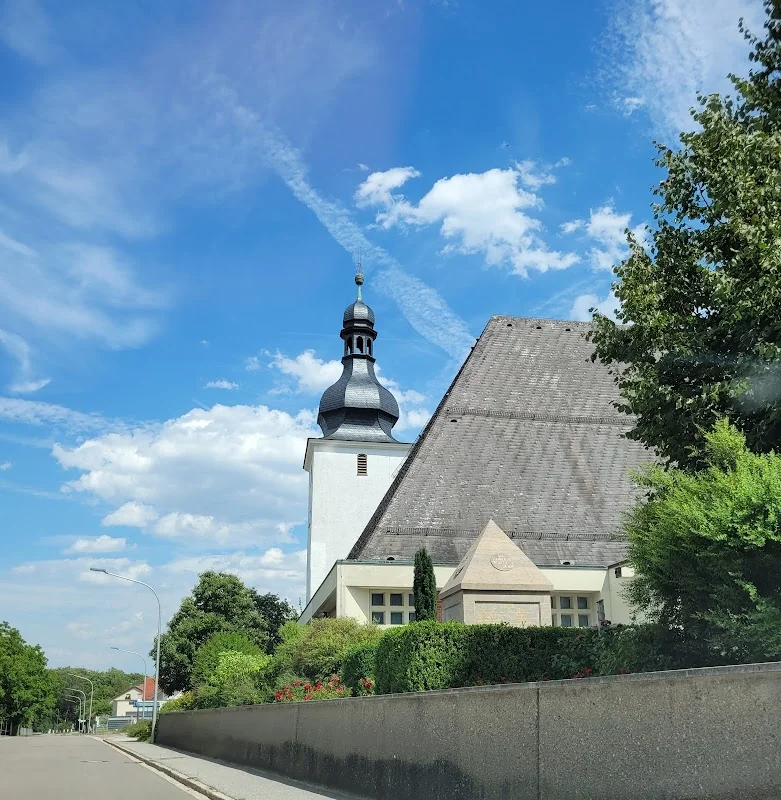
St. Mary's Assumption in Hohenkemnath is a church that one does not simply visit, but one that is first perceived from a distance. The distinctive building stands on a ridge of the Jura, politically belongs to the municipality of Ursensollen, and is located about nine kilometers southwest of Amberg. This very location creates the first impression: The church appears as a calm point of orientation above the village, clearly visible and closely connected to the landscape. Those interested in historical parish churches, Marian patronages, or church spaces that visibly merge the old and the new will find a very exciting place here. The preserved sources show a long development from the ecclesiastical origin in the castle environment to the present new building, which was consecrated in 1969. At the same time, the old tower has remained and preserves artistic treasures that are of interest far beyond the village. Thus, a picture emerges from history, architectural culture, and lived community that is typical for Hohenkemnath and makes the church much more than just a mere nameplate. ([br.de](https://www.br.de/radio/br-heimat/sendungen/zwoelfuhrlaeuten/oberpfalz/zwoelfuhrlaeuten-hohenkemnath-oberpfalz-102.html))
History of the Parish Church and Castle Chaplaincy
The ecclesiastical history of St. Mary's Assumption dates back to the 14th century according to researched information and is closely linked to the Kemnather family, who owned a castle here. In an older directory of the Diocese of Regensburg, Hohenkemnath is already mentioned as a parish in 1286; later, the village appears as an independent parish, and in 1412, a first pastor named Johannes, known as Amann, is documented. This early development is important because it shows that the village gained ecclesiastical significance not only in modern times but was already religiously shaped in the Middle Ages. Several sources suggest that the parish developed from a castle chaplaincy and thus remained directly tied to the lordly history of the place. The connection to the various castle-owning families is still perceptible in today's appearance, for example, through the grave tablets in the tower area. The history is therefore not an abstract collection of dates but directly explains why the church in Hohenkemnath is so closely intertwined with the village, the former castle, and the local culture of remembrance. ([br.de](https://www.br.de/radio/br-heimat/sendungen/zwoelfuhrlaeuten/oberpfalz/zwoelfuhrlaeuten-hohenkemnath-oberpfalz-102.html))
Especially interesting is that the church experienced several confessional changes during the Reformation period, thus also reflecting the religious tensions of the region. The sources indicate that the parish likely developed from a castle chaplaincy between 1350 and 1412 and that Hohenkemnath was listed as an independent parish in 1438 along with the current branch of Erlheim. This shows how early a stable ecclesiastical structure was formed here. Equally important is the finding that the Romanesque baptismal font from around 1200 is still in use today. Such a furnishing piece makes history tangible because it is not only preserved in a museum-like state but is still used liturgically. Visitors thus experience a place that has grown over many centuries, where medieval origins, baroque furnishings, and modern new construction do not displace each other but form an exciting whole. For inquiries about the history, origin, or age of the church, this connection is the central added value. ([onetz.de](https://www.onetz.de/oberpfalz/hohenkemnath-ursensollen/50-jahre-neue-pfarrkirche-mariae-himmelfahrt-hohenkemnath-%E2%80%93-k-grund-feiern-id2877183.html))
New Building of 1968/1969 and the Current Form
The current shape of St. Mary's Assumption cannot be understood without the new building of the late 1960s. According to sources, the old nave was demolished in 1968 and replaced by a new church space; in May 1969, Auxiliary Bishop Karl Flügel consecrated the newly built church. A BR article describes that the church nave was designed as a new construction in tent form and can thus be read in the sense of the liturgical reform as a sign of pilgrimage and openness to the world. This form may initially surprise visitors because one does not have a consistently baroque or medieval church in Hohenkemnath, but rather a consciously reduced, bright, and clear spatial idea. The impression inside is determined by conscious simplicity: altar, tabernacle, ambo, and Madonna are at the center, while overloaded decoration is avoided. This restraint directs attention to the essentials and allows the old tower with its artworks to stand out even more. The new building is thus not a break without reference to the past but a modern response to architectural and liturgical requirements that consciously integrates into the historical substance in Hohenkemnath. ([br.de](https://www.br.de/radio/br-heimat/sendungen/zwoelfuhrlaeuten/oberpfalz/zwoelfuhrlaeuten-hohenkemnath-oberpfalz-102.html))
The sources also indicate that the church was considered dilapidated and too small in the early 1960s. For this reason, the decision was made to replace the church nave. In public memory, this step was not without controversy, as a later Onetz article on the 50-year history makes clear. However, for today's perception, it is especially important that the old and new can be clearly distinguished in the ensemble: the old tower remains standing and carries the most artistically valuable elements, while the new building creates a functional, well-utilizable space for worship. This interplay also explains why the church is often described as a place of transition. It preserves the historical core and complements it with an architecture that continues to serve the community to this day. Therefore, anyone looking for a church that not only conserves history but translates it into a new form will find it in Hohenkemnath. This contrasting architecture provides a very strong thematic axis for SEO texts about churches, parish churches, new buildings, towers, and interiors. ([br.de](https://www.br.de/radio/br-heimat/sendungen/zwoelfuhrlaeuten/oberpfalz/zwoelfuhrlaeuten-hohenkemnath-oberpfalz-102.html))
Rococo Altar, Romanesque Baptismal Font, Stations of the Cross, and Organ
The old tower of St. Mary's Assumption is the place where the historical furnishings come together most densely. There stands the Rococo altar from around 1750, the grave tablets of the castle-owning families, and other art-historical details that make the space feel like a small memory archive. Particularly impressive is that the altar depicts the Assumption of Mary and thus directly refers to the patronage of the church. The researched descriptions also mention that the altar painting was repainted in 1864/65. This revision shows that the church has not only been preserved but has also been cared for and adapted over a long time. In the tower area, there are also coats of arms and historical references that point to the former castle affiliation. Therefore, visitors do not experience a standardized interior furnishing but a space with recognizable layers: medieval, baroque, historically renewed, and modernly utilized. For visitors searching for a Rococo altar or special artworks in Hohenkemnath, this is a central attraction. ([br.de](https://www.br.de/radio/br-heimat/sendungen/zwoelfuhrlaeuten/oberpfalz/zwoelfuhrlaeuten-hohenkemnath-oberpfalz-102.html))
Equally noteworthy is the Romanesque baptismal font from around 1200, which is still in use today. Such furnishings are particularly valuable in their continuity because they not only tell history but remain liturgically present. Additionally, there is the Stations of the Cross in Nazarene style, which was transferred from the old church or newly carved in 1865 and found its place on the side walls of the new building. This keeps the memory of the predecessor church visible in the new space. Another important detail is the organ, which was consecrated in 1990 and is adorned with the figures of Saints Cecilia and Joseph on the side. It represents the musical renewal of the place and shows that the community understands the church not as a museum but as a vibrant place of worship. This image is further complemented by the bells, which were replaced by four new specimens after the war in 1950 and, according to BR, possess a particularly harmonious sound. All these elements together make it clear: Hohenkemnath is not a place for superficial church visits but for people who want to experience historical substance, sacred art, and lived liturgy as a unity. ([br.de](https://www.br.de/radio/br-heimat/sendungen/zwoelfuhrlaeuten/oberpfalz/zwoelfuhrlaeuten-hohenkemnath-oberpfalz-102.html))
Address, Directions, and Orientation in Hohenkemnath
For practical orientation, it is especially important that the church in Hohenkemnath, municipality of Ursensollen, is connected with Schlossstraße 2. This very address appears in event announcements and the church guide and makes the journey in the village center easy to follow. Since the church is located on a ridge and is visible from afar, it also serves as a natural point of orientation in the village. Those coming from the direction of Amberg move into a rural environment with a clear historical structure, where the church, former castle, and village center are closely situated. The location is thus embedded not only geographically but also historically logical. For inquiries about address, directions, or location, this combination of postal orientation and visible landmark is particularly helpful. The church is not a remote sacred building without a reference point but a clearly identifiable place that can be easily integrated into a village walk or a cultural-historical tour. ([br.de](https://www.br.de/radio/br-heimat/sendungen/zwoelfuhrlaeuten/oberpfalz/zwoelfuhrlaeuten-hohenkemnath-oberpfalz-102.html))
However, care is important when it comes to parking. The sources found do not mention any officially designated visitor parking. For a church and tavern tour, the meeting point has been indicated directly in front of the church, which shows that the area around Schlossstraße 2 is used as a starting point. For visitors, this practically means: The journey should be oriented towards the village center of Hohenkemnath, not towards a large, specially marked parking facility. Those visiting the church should plan some time for the short walk in the village and orient themselves on-site at the historical church itself. This rather quiet, small-scale infrastructure fits the character of the place. It is not an event arena with large traffic flows but a grown parish church in the village center. For a page that should provide answers to the search terms directions and parking, this sober information is crucial: The best address is known, the meeting point is clear, but a separately documented parking concept is not specified in the researched sources. ([keb-amberg-sulzbach.de](https://www.keb-amberg-sulzbach.de/fileadmin/system/amberg-sulzbach/Dokumente/Kirche_und_Wirtshaus/KiWi_2019_Flyer.pdf))
Patronage, Services, and Lively Community Life
The name St. Mary's Assumption refers to the feast on August 15 and thus to a patronage that is widely spread in the Diocese of Regensburg. The ecclesiastical significance of this feast is described in the bishop's sources as a strong image of hope: Mary stands for trust, purposefulness, and a future beyond the earthly. This is precisely why the patronage fits very well with Hohenkemnath, where old castle history, village identity, and ecclesiastical life come together. The church is not only a listed building and artistically interesting but also liturgically anchored. This is evident from the continued use of the building, the consecration of the new church in 1969, and the regularly occurring community activities. Those looking for programs, festivals, or religious events will repeatedly find the church in regional event calendars and parish references as an active place. This indicates that St. Mary's Assumption does not exist merely as a memorial building but continues to be a center for worship and community life. ([bistum-regensburg.de](https://bistum-regensburg.de/news/mariae-himmelfahrt-wallfahrt-geschichte-und-brauchtum-im-bistum-regensburg?utm_source=openai))
Concrete references to parish festivals and Advent markets also show this liveliness. In the event entries, the church itself is mentioned as a venue for events, and further regional reports confirm that, for example, star singers are sent out or harvest thanksgiving is celebrated here. Such occasions are important because they integrate the church into the annual cycle of the community and give it a social function that goes far beyond the Sunday service. For visitors, this means: Hohenkemnath is not only exciting for architecture enthusiasts but also for people who want to experience the life of a small, active parish. Those searching for the keyword reviews will also notice that the strongest information in Hohenkemnath does not come from star ratings but from reports about specific events, liturgical celebrations, and historical features. This is precisely where the quality of this place lies. The church speaks through its history, its furnishings, and the fact that it continues to be regularly used. Those seeking such authentic places receive a very credible picture of ecclesiastical continuity in rural Bavaria. ([sitemaps.hey.bayern](https://www.sitemaps.hey.bayern/events/509079?utm_source=openai))
Hohenkemnath as a Destination in the Amberg-Sulzbacher Land
Hohenkemnath is interesting not only because of its church but also because of its location in the Amberg-Sulzbacher Land and in the surrounding natural area of the Upper Palatinate. The church guide points out that St. Mary's Assumption is part of the Simultankirchen cycling route, and this opens a second perspective on the place: The church can be experienced as a station in a cultural-historical route, not just as an isolated destination. Those traveling by bike or on foot can combine the visit with other church and village stations in the region. The church is thus excellently suited for people who prefer quiet, historically rich, and clearly scenic destinations. The distinctive tower, the preserved historical core, and the modern church space create an exciting destination for photography, architectural observation, and quiet contemplation. Hohenkemnath is therefore a place where religious significance, local identity, and gentle tourism complement each other well. ([keb-amberg-sulzbach.de](https://www.keb-amberg-sulzbach.de/fileadmin/system/amberg-sulzbach/Dokumente/Kirche_und_Wirtshaus/KiWi_2019_Flyer.pdf))
Anyone visiting the place should take their time consciously. The church is not a place that can be checked off in a few seconds. The external impression, the historical tower, the grave tablets, the Romanesque baptismal font, and the clear form of the new building only unfold their effect when viewed in sequence. The regional environment is also suitable for this, as it offers tranquility instead of sensory overload. Hohenkemnath is a parish village where history remains visible in the village image. For SEO purposes, this is precisely the right mix of informational value and search intent: People search for history, address, directions, parking, organ, altar, patronage, and events, and all these questions can be answered in a real, verifiable way at this place. Those interested in churches in the Amberg-Sulzbach district will find St. Mary's Assumption to be a very good example of a place where medieval roots, baroque art, and modern liturgy come together in a quiet but impressive form. ([br.de](https://www.br.de/radio/br-heimat/sendungen/zwoelfuhrlaeuten/oberpfalz/zwoelfuhrlaeuten-hohenkemnath-oberpfalz-102.html))
Sources:
Show moreShow less
St. Mary's Assumption | Hohenkemnath & Ursensollen
St. Mary's Assumption in Hohenkemnath is a church that one does not simply visit, but one that is first perceived from a distance. The distinctive building stands on a ridge of the Jura, politically belongs to the municipality of Ursensollen, and is located about nine kilometers southwest of Amberg. This very location creates the first impression: The church appears as a calm point of orientation above the village, clearly visible and closely connected to the landscape. Those interested in historical parish churches, Marian patronages, or church spaces that visibly merge the old and the new will find a very exciting place here. The preserved sources show a long development from the ecclesiastical origin in the castle environment to the present new building, which was consecrated in 1969. At the same time, the old tower has remained and preserves artistic treasures that are of interest far beyond the village. Thus, a picture emerges from history, architectural culture, and lived community that is typical for Hohenkemnath and makes the church much more than just a mere nameplate. ([br.de](https://www.br.de/radio/br-heimat/sendungen/zwoelfuhrlaeuten/oberpfalz/zwoelfuhrlaeuten-hohenkemnath-oberpfalz-102.html))
History of the Parish Church and Castle Chaplaincy
The ecclesiastical history of St. Mary's Assumption dates back to the 14th century according to researched information and is closely linked to the Kemnather family, who owned a castle here. In an older directory of the Diocese of Regensburg, Hohenkemnath is already mentioned as a parish in 1286; later, the village appears as an independent parish, and in 1412, a first pastor named Johannes, known as Amann, is documented. This early development is important because it shows that the village gained ecclesiastical significance not only in modern times but was already religiously shaped in the Middle Ages. Several sources suggest that the parish developed from a castle chaplaincy and thus remained directly tied to the lordly history of the place. The connection to the various castle-owning families is still perceptible in today's appearance, for example, through the grave tablets in the tower area. The history is therefore not an abstract collection of dates but directly explains why the church in Hohenkemnath is so closely intertwined with the village, the former castle, and the local culture of remembrance. ([br.de](https://www.br.de/radio/br-heimat/sendungen/zwoelfuhrlaeuten/oberpfalz/zwoelfuhrlaeuten-hohenkemnath-oberpfalz-102.html))
Especially interesting is that the church experienced several confessional changes during the Reformation period, thus also reflecting the religious tensions of the region. The sources indicate that the parish likely developed from a castle chaplaincy between 1350 and 1412 and that Hohenkemnath was listed as an independent parish in 1438 along with the current branch of Erlheim. This shows how early a stable ecclesiastical structure was formed here. Equally important is the finding that the Romanesque baptismal font from around 1200 is still in use today. Such a furnishing piece makes history tangible because it is not only preserved in a museum-like state but is still used liturgically. Visitors thus experience a place that has grown over many centuries, where medieval origins, baroque furnishings, and modern new construction do not displace each other but form an exciting whole. For inquiries about the history, origin, or age of the church, this connection is the central added value. ([onetz.de](https://www.onetz.de/oberpfalz/hohenkemnath-ursensollen/50-jahre-neue-pfarrkirche-mariae-himmelfahrt-hohenkemnath-%E2%80%93-k-grund-feiern-id2877183.html))
New Building of 1968/1969 and the Current Form
The current shape of St. Mary's Assumption cannot be understood without the new building of the late 1960s. According to sources, the old nave was demolished in 1968 and replaced by a new church space; in May 1969, Auxiliary Bishop Karl Flügel consecrated the newly built church. A BR article describes that the church nave was designed as a new construction in tent form and can thus be read in the sense of the liturgical reform as a sign of pilgrimage and openness to the world. This form may initially surprise visitors because one does not have a consistently baroque or medieval church in Hohenkemnath, but rather a consciously reduced, bright, and clear spatial idea. The impression inside is determined by conscious simplicity: altar, tabernacle, ambo, and Madonna are at the center, while overloaded decoration is avoided. This restraint directs attention to the essentials and allows the old tower with its artworks to stand out even more. The new building is thus not a break without reference to the past but a modern response to architectural and liturgical requirements that consciously integrates into the historical substance in Hohenkemnath. ([br.de](https://www.br.de/radio/br-heimat/sendungen/zwoelfuhrlaeuten/oberpfalz/zwoelfuhrlaeuten-hohenkemnath-oberpfalz-102.html))
The sources also indicate that the church was considered dilapidated and too small in the early 1960s. For this reason, the decision was made to replace the church nave. In public memory, this step was not without controversy, as a later Onetz article on the 50-year history makes clear. However, for today's perception, it is especially important that the old and new can be clearly distinguished in the ensemble: the old tower remains standing and carries the most artistically valuable elements, while the new building creates a functional, well-utilizable space for worship. This interplay also explains why the church is often described as a place of transition. It preserves the historical core and complements it with an architecture that continues to serve the community to this day. Therefore, anyone looking for a church that not only conserves history but translates it into a new form will find it in Hohenkemnath. This contrasting architecture provides a very strong thematic axis for SEO texts about churches, parish churches, new buildings, towers, and interiors. ([br.de](https://www.br.de/radio/br-heimat/sendungen/zwoelfuhrlaeuten/oberpfalz/zwoelfuhrlaeuten-hohenkemnath-oberpfalz-102.html))
Rococo Altar, Romanesque Baptismal Font, Stations of the Cross, and Organ
The old tower of St. Mary's Assumption is the place where the historical furnishings come together most densely. There stands the Rococo altar from around 1750, the grave tablets of the castle-owning families, and other art-historical details that make the space feel like a small memory archive. Particularly impressive is that the altar depicts the Assumption of Mary and thus directly refers to the patronage of the church. The researched descriptions also mention that the altar painting was repainted in 1864/65. This revision shows that the church has not only been preserved but has also been cared for and adapted over a long time. In the tower area, there are also coats of arms and historical references that point to the former castle affiliation. Therefore, visitors do not experience a standardized interior furnishing but a space with recognizable layers: medieval, baroque, historically renewed, and modernly utilized. For visitors searching for a Rococo altar or special artworks in Hohenkemnath, this is a central attraction. ([br.de](https://www.br.de/radio/br-heimat/sendungen/zwoelfuhrlaeuten/oberpfalz/zwoelfuhrlaeuten-hohenkemnath-oberpfalz-102.html))
Equally noteworthy is the Romanesque baptismal font from around 1200, which is still in use today. Such furnishings are particularly valuable in their continuity because they not only tell history but remain liturgically present. Additionally, there is the Stations of the Cross in Nazarene style, which was transferred from the old church or newly carved in 1865 and found its place on the side walls of the new building. This keeps the memory of the predecessor church visible in the new space. Another important detail is the organ, which was consecrated in 1990 and is adorned with the figures of Saints Cecilia and Joseph on the side. It represents the musical renewal of the place and shows that the community understands the church not as a museum but as a vibrant place of worship. This image is further complemented by the bells, which were replaced by four new specimens after the war in 1950 and, according to BR, possess a particularly harmonious sound. All these elements together make it clear: Hohenkemnath is not a place for superficial church visits but for people who want to experience historical substance, sacred art, and lived liturgy as a unity. ([br.de](https://www.br.de/radio/br-heimat/sendungen/zwoelfuhrlaeuten/oberpfalz/zwoelfuhrlaeuten-hohenkemnath-oberpfalz-102.html))
Address, Directions, and Orientation in Hohenkemnath
For practical orientation, it is especially important that the church in Hohenkemnath, municipality of Ursensollen, is connected with Schlossstraße 2. This very address appears in event announcements and the church guide and makes the journey in the village center easy to follow. Since the church is located on a ridge and is visible from afar, it also serves as a natural point of orientation in the village. Those coming from the direction of Amberg move into a rural environment with a clear historical structure, where the church, former castle, and village center are closely situated. The location is thus embedded not only geographically but also historically logical. For inquiries about address, directions, or location, this combination of postal orientation and visible landmark is particularly helpful. The church is not a remote sacred building without a reference point but a clearly identifiable place that can be easily integrated into a village walk or a cultural-historical tour. ([br.de](https://www.br.de/radio/br-heimat/sendungen/zwoelfuhrlaeuten/oberpfalz/zwoelfuhrlaeuten-hohenkemnath-oberpfalz-102.html))
However, care is important when it comes to parking. The sources found do not mention any officially designated visitor parking. For a church and tavern tour, the meeting point has been indicated directly in front of the church, which shows that the area around Schlossstraße 2 is used as a starting point. For visitors, this practically means: The journey should be oriented towards the village center of Hohenkemnath, not towards a large, specially marked parking facility. Those visiting the church should plan some time for the short walk in the village and orient themselves on-site at the historical church itself. This rather quiet, small-scale infrastructure fits the character of the place. It is not an event arena with large traffic flows but a grown parish church in the village center. For a page that should provide answers to the search terms directions and parking, this sober information is crucial: The best address is known, the meeting point is clear, but a separately documented parking concept is not specified in the researched sources. ([keb-amberg-sulzbach.de](https://www.keb-amberg-sulzbach.de/fileadmin/system/amberg-sulzbach/Dokumente/Kirche_und_Wirtshaus/KiWi_2019_Flyer.pdf))
Patronage, Services, and Lively Community Life
The name St. Mary's Assumption refers to the feast on August 15 and thus to a patronage that is widely spread in the Diocese of Regensburg. The ecclesiastical significance of this feast is described in the bishop's sources as a strong image of hope: Mary stands for trust, purposefulness, and a future beyond the earthly. This is precisely why the patronage fits very well with Hohenkemnath, where old castle history, village identity, and ecclesiastical life come together. The church is not only a listed building and artistically interesting but also liturgically anchored. This is evident from the continued use of the building, the consecration of the new church in 1969, and the regularly occurring community activities. Those looking for programs, festivals, or religious events will repeatedly find the church in regional event calendars and parish references as an active place. This indicates that St. Mary's Assumption does not exist merely as a memorial building but continues to be a center for worship and community life. ([bistum-regensburg.de](https://bistum-regensburg.de/news/mariae-himmelfahrt-wallfahrt-geschichte-und-brauchtum-im-bistum-regensburg?utm_source=openai))
Concrete references to parish festivals and Advent markets also show this liveliness. In the event entries, the church itself is mentioned as a venue for events, and further regional reports confirm that, for example, star singers are sent out or harvest thanksgiving is celebrated here. Such occasions are important because they integrate the church into the annual cycle of the community and give it a social function that goes far beyond the Sunday service. For visitors, this means: Hohenkemnath is not only exciting for architecture enthusiasts but also for people who want to experience the life of a small, active parish. Those searching for the keyword reviews will also notice that the strongest information in Hohenkemnath does not come from star ratings but from reports about specific events, liturgical celebrations, and historical features. This is precisely where the quality of this place lies. The church speaks through its history, its furnishings, and the fact that it continues to be regularly used. Those seeking such authentic places receive a very credible picture of ecclesiastical continuity in rural Bavaria. ([sitemaps.hey.bayern](https://www.sitemaps.hey.bayern/events/509079?utm_source=openai))
Hohenkemnath as a Destination in the Amberg-Sulzbacher Land
Hohenkemnath is interesting not only because of its church but also because of its location in the Amberg-Sulzbacher Land and in the surrounding natural area of the Upper Palatinate. The church guide points out that St. Mary's Assumption is part of the Simultankirchen cycling route, and this opens a second perspective on the place: The church can be experienced as a station in a cultural-historical route, not just as an isolated destination. Those traveling by bike or on foot can combine the visit with other church and village stations in the region. The church is thus excellently suited for people who prefer quiet, historically rich, and clearly scenic destinations. The distinctive tower, the preserved historical core, and the modern church space create an exciting destination for photography, architectural observation, and quiet contemplation. Hohenkemnath is therefore a place where religious significance, local identity, and gentle tourism complement each other well. ([keb-amberg-sulzbach.de](https://www.keb-amberg-sulzbach.de/fileadmin/system/amberg-sulzbach/Dokumente/Kirche_und_Wirtshaus/KiWi_2019_Flyer.pdf))
Anyone visiting the place should take their time consciously. The church is not a place that can be checked off in a few seconds. The external impression, the historical tower, the grave tablets, the Romanesque baptismal font, and the clear form of the new building only unfold their effect when viewed in sequence. The regional environment is also suitable for this, as it offers tranquility instead of sensory overload. Hohenkemnath is a parish village where history remains visible in the village image. For SEO purposes, this is precisely the right mix of informational value and search intent: People search for history, address, directions, parking, organ, altar, patronage, and events, and all these questions can be answered in a real, verifiable way at this place. Those interested in churches in the Amberg-Sulzbach district will find St. Mary's Assumption to be a very good example of a place where medieval roots, baroque art, and modern liturgy come together in a quiet but impressive form. ([br.de](https://www.br.de/radio/br-heimat/sendungen/zwoelfuhrlaeuten/oberpfalz/zwoelfuhrlaeuten-hohenkemnath-oberpfalz-102.html))
Sources:
St. Mary's Assumption | Hohenkemnath & Ursensollen
St. Mary's Assumption in Hohenkemnath is a church that one does not simply visit, but one that is first perceived from a distance. The distinctive building stands on a ridge of the Jura, politically belongs to the municipality of Ursensollen, and is located about nine kilometers southwest of Amberg. This very location creates the first impression: The church appears as a calm point of orientation above the village, clearly visible and closely connected to the landscape. Those interested in historical parish churches, Marian patronages, or church spaces that visibly merge the old and the new will find a very exciting place here. The preserved sources show a long development from the ecclesiastical origin in the castle environment to the present new building, which was consecrated in 1969. At the same time, the old tower has remained and preserves artistic treasures that are of interest far beyond the village. Thus, a picture emerges from history, architectural culture, and lived community that is typical for Hohenkemnath and makes the church much more than just a mere nameplate. ([br.de](https://www.br.de/radio/br-heimat/sendungen/zwoelfuhrlaeuten/oberpfalz/zwoelfuhrlaeuten-hohenkemnath-oberpfalz-102.html))
History of the Parish Church and Castle Chaplaincy
The ecclesiastical history of St. Mary's Assumption dates back to the 14th century according to researched information and is closely linked to the Kemnather family, who owned a castle here. In an older directory of the Diocese of Regensburg, Hohenkemnath is already mentioned as a parish in 1286; later, the village appears as an independent parish, and in 1412, a first pastor named Johannes, known as Amann, is documented. This early development is important because it shows that the village gained ecclesiastical significance not only in modern times but was already religiously shaped in the Middle Ages. Several sources suggest that the parish developed from a castle chaplaincy and thus remained directly tied to the lordly history of the place. The connection to the various castle-owning families is still perceptible in today's appearance, for example, through the grave tablets in the tower area. The history is therefore not an abstract collection of dates but directly explains why the church in Hohenkemnath is so closely intertwined with the village, the former castle, and the local culture of remembrance. ([br.de](https://www.br.de/radio/br-heimat/sendungen/zwoelfuhrlaeuten/oberpfalz/zwoelfuhrlaeuten-hohenkemnath-oberpfalz-102.html))
Especially interesting is that the church experienced several confessional changes during the Reformation period, thus also reflecting the religious tensions of the region. The sources indicate that the parish likely developed from a castle chaplaincy between 1350 and 1412 and that Hohenkemnath was listed as an independent parish in 1438 along with the current branch of Erlheim. This shows how early a stable ecclesiastical structure was formed here. Equally important is the finding that the Romanesque baptismal font from around 1200 is still in use today. Such a furnishing piece makes history tangible because it is not only preserved in a museum-like state but is still used liturgically. Visitors thus experience a place that has grown over many centuries, where medieval origins, baroque furnishings, and modern new construction do not displace each other but form an exciting whole. For inquiries about the history, origin, or age of the church, this connection is the central added value. ([onetz.de](https://www.onetz.de/oberpfalz/hohenkemnath-ursensollen/50-jahre-neue-pfarrkirche-mariae-himmelfahrt-hohenkemnath-%E2%80%93-k-grund-feiern-id2877183.html))
New Building of 1968/1969 and the Current Form
The current shape of St. Mary's Assumption cannot be understood without the new building of the late 1960s. According to sources, the old nave was demolished in 1968 and replaced by a new church space; in May 1969, Auxiliary Bishop Karl Flügel consecrated the newly built church. A BR article describes that the church nave was designed as a new construction in tent form and can thus be read in the sense of the liturgical reform as a sign of pilgrimage and openness to the world. This form may initially surprise visitors because one does not have a consistently baroque or medieval church in Hohenkemnath, but rather a consciously reduced, bright, and clear spatial idea. The impression inside is determined by conscious simplicity: altar, tabernacle, ambo, and Madonna are at the center, while overloaded decoration is avoided. This restraint directs attention to the essentials and allows the old tower with its artworks to stand out even more. The new building is thus not a break without reference to the past but a modern response to architectural and liturgical requirements that consciously integrates into the historical substance in Hohenkemnath. ([br.de](https://www.br.de/radio/br-heimat/sendungen/zwoelfuhrlaeuten/oberpfalz/zwoelfuhrlaeuten-hohenkemnath-oberpfalz-102.html))
The sources also indicate that the church was considered dilapidated and too small in the early 1960s. For this reason, the decision was made to replace the church nave. In public memory, this step was not without controversy, as a later Onetz article on the 50-year history makes clear. However, for today's perception, it is especially important that the old and new can be clearly distinguished in the ensemble: the old tower remains standing and carries the most artistically valuable elements, while the new building creates a functional, well-utilizable space for worship. This interplay also explains why the church is often described as a place of transition. It preserves the historical core and complements it with an architecture that continues to serve the community to this day. Therefore, anyone looking for a church that not only conserves history but translates it into a new form will find it in Hohenkemnath. This contrasting architecture provides a very strong thematic axis for SEO texts about churches, parish churches, new buildings, towers, and interiors. ([br.de](https://www.br.de/radio/br-heimat/sendungen/zwoelfuhrlaeuten/oberpfalz/zwoelfuhrlaeuten-hohenkemnath-oberpfalz-102.html))
Rococo Altar, Romanesque Baptismal Font, Stations of the Cross, and Organ
The old tower of St. Mary's Assumption is the place where the historical furnishings come together most densely. There stands the Rococo altar from around 1750, the grave tablets of the castle-owning families, and other art-historical details that make the space feel like a small memory archive. Particularly impressive is that the altar depicts the Assumption of Mary and thus directly refers to the patronage of the church. The researched descriptions also mention that the altar painting was repainted in 1864/65. This revision shows that the church has not only been preserved but has also been cared for and adapted over a long time. In the tower area, there are also coats of arms and historical references that point to the former castle affiliation. Therefore, visitors do not experience a standardized interior furnishing but a space with recognizable layers: medieval, baroque, historically renewed, and modernly utilized. For visitors searching for a Rococo altar or special artworks in Hohenkemnath, this is a central attraction. ([br.de](https://www.br.de/radio/br-heimat/sendungen/zwoelfuhrlaeuten/oberpfalz/zwoelfuhrlaeuten-hohenkemnath-oberpfalz-102.html))
Equally noteworthy is the Romanesque baptismal font from around 1200, which is still in use today. Such furnishings are particularly valuable in their continuity because they not only tell history but remain liturgically present. Additionally, there is the Stations of the Cross in Nazarene style, which was transferred from the old church or newly carved in 1865 and found its place on the side walls of the new building. This keeps the memory of the predecessor church visible in the new space. Another important detail is the organ, which was consecrated in 1990 and is adorned with the figures of Saints Cecilia and Joseph on the side. It represents the musical renewal of the place and shows that the community understands the church not as a museum but as a vibrant place of worship. This image is further complemented by the bells, which were replaced by four new specimens after the war in 1950 and, according to BR, possess a particularly harmonious sound. All these elements together make it clear: Hohenkemnath is not a place for superficial church visits but for people who want to experience historical substance, sacred art, and lived liturgy as a unity. ([br.de](https://www.br.de/radio/br-heimat/sendungen/zwoelfuhrlaeuten/oberpfalz/zwoelfuhrlaeuten-hohenkemnath-oberpfalz-102.html))
Address, Directions, and Orientation in Hohenkemnath
For practical orientation, it is especially important that the church in Hohenkemnath, municipality of Ursensollen, is connected with Schlossstraße 2. This very address appears in event announcements and the church guide and makes the journey in the village center easy to follow. Since the church is located on a ridge and is visible from afar, it also serves as a natural point of orientation in the village. Those coming from the direction of Amberg move into a rural environment with a clear historical structure, where the church, former castle, and village center are closely situated. The location is thus embedded not only geographically but also historically logical. For inquiries about address, directions, or location, this combination of postal orientation and visible landmark is particularly helpful. The church is not a remote sacred building without a reference point but a clearly identifiable place that can be easily integrated into a village walk or a cultural-historical tour. ([br.de](https://www.br.de/radio/br-heimat/sendungen/zwoelfuhrlaeuten/oberpfalz/zwoelfuhrlaeuten-hohenkemnath-oberpfalz-102.html))
However, care is important when it comes to parking. The sources found do not mention any officially designated visitor parking. For a church and tavern tour, the meeting point has been indicated directly in front of the church, which shows that the area around Schlossstraße 2 is used as a starting point. For visitors, this practically means: The journey should be oriented towards the village center of Hohenkemnath, not towards a large, specially marked parking facility. Those visiting the church should plan some time for the short walk in the village and orient themselves on-site at the historical church itself. This rather quiet, small-scale infrastructure fits the character of the place. It is not an event arena with large traffic flows but a grown parish church in the village center. For a page that should provide answers to the search terms directions and parking, this sober information is crucial: The best address is known, the meeting point is clear, but a separately documented parking concept is not specified in the researched sources. ([keb-amberg-sulzbach.de](https://www.keb-amberg-sulzbach.de/fileadmin/system/amberg-sulzbach/Dokumente/Kirche_und_Wirtshaus/KiWi_2019_Flyer.pdf))
Patronage, Services, and Lively Community Life
The name St. Mary's Assumption refers to the feast on August 15 and thus to a patronage that is widely spread in the Diocese of Regensburg. The ecclesiastical significance of this feast is described in the bishop's sources as a strong image of hope: Mary stands for trust, purposefulness, and a future beyond the earthly. This is precisely why the patronage fits very well with Hohenkemnath, where old castle history, village identity, and ecclesiastical life come together. The church is not only a listed building and artistically interesting but also liturgically anchored. This is evident from the continued use of the building, the consecration of the new church in 1969, and the regularly occurring community activities. Those looking for programs, festivals, or religious events will repeatedly find the church in regional event calendars and parish references as an active place. This indicates that St. Mary's Assumption does not exist merely as a memorial building but continues to be a center for worship and community life. ([bistum-regensburg.de](https://bistum-regensburg.de/news/mariae-himmelfahrt-wallfahrt-geschichte-und-brauchtum-im-bistum-regensburg?utm_source=openai))
Concrete references to parish festivals and Advent markets also show this liveliness. In the event entries, the church itself is mentioned as a venue for events, and further regional reports confirm that, for example, star singers are sent out or harvest thanksgiving is celebrated here. Such occasions are important because they integrate the church into the annual cycle of the community and give it a social function that goes far beyond the Sunday service. For visitors, this means: Hohenkemnath is not only exciting for architecture enthusiasts but also for people who want to experience the life of a small, active parish. Those searching for the keyword reviews will also notice that the strongest information in Hohenkemnath does not come from star ratings but from reports about specific events, liturgical celebrations, and historical features. This is precisely where the quality of this place lies. The church speaks through its history, its furnishings, and the fact that it continues to be regularly used. Those seeking such authentic places receive a very credible picture of ecclesiastical continuity in rural Bavaria. ([sitemaps.hey.bayern](https://www.sitemaps.hey.bayern/events/509079?utm_source=openai))
Hohenkemnath as a Destination in the Amberg-Sulzbacher Land
Hohenkemnath is interesting not only because of its church but also because of its location in the Amberg-Sulzbacher Land and in the surrounding natural area of the Upper Palatinate. The church guide points out that St. Mary's Assumption is part of the Simultankirchen cycling route, and this opens a second perspective on the place: The church can be experienced as a station in a cultural-historical route, not just as an isolated destination. Those traveling by bike or on foot can combine the visit with other church and village stations in the region. The church is thus excellently suited for people who prefer quiet, historically rich, and clearly scenic destinations. The distinctive tower, the preserved historical core, and the modern church space create an exciting destination for photography, architectural observation, and quiet contemplation. Hohenkemnath is therefore a place where religious significance, local identity, and gentle tourism complement each other well. ([keb-amberg-sulzbach.de](https://www.keb-amberg-sulzbach.de/fileadmin/system/amberg-sulzbach/Dokumente/Kirche_und_Wirtshaus/KiWi_2019_Flyer.pdf))
Anyone visiting the place should take their time consciously. The church is not a place that can be checked off in a few seconds. The external impression, the historical tower, the grave tablets, the Romanesque baptismal font, and the clear form of the new building only unfold their effect when viewed in sequence. The regional environment is also suitable for this, as it offers tranquility instead of sensory overload. Hohenkemnath is a parish village where history remains visible in the village image. For SEO purposes, this is precisely the right mix of informational value and search intent: People search for history, address, directions, parking, organ, altar, patronage, and events, and all these questions can be answered in a real, verifiable way at this place. Those interested in churches in the Amberg-Sulzbach district will find St. Mary's Assumption to be a very good example of a place where medieval roots, baroque art, and modern liturgy come together in a quiet but impressive form. ([br.de](https://www.br.de/radio/br-heimat/sendungen/zwoelfuhrlaeuten/oberpfalz/zwoelfuhrlaeuten-hohenkemnath-oberpfalz-102.html))
Sources:

Frequently Asked Questions
Reviews
No reviews found