
Hohenburg
Marktpl. 8, 92277 Hohenburg, Deutschland
St. James Hohenburg | Church & Camino de Santiago
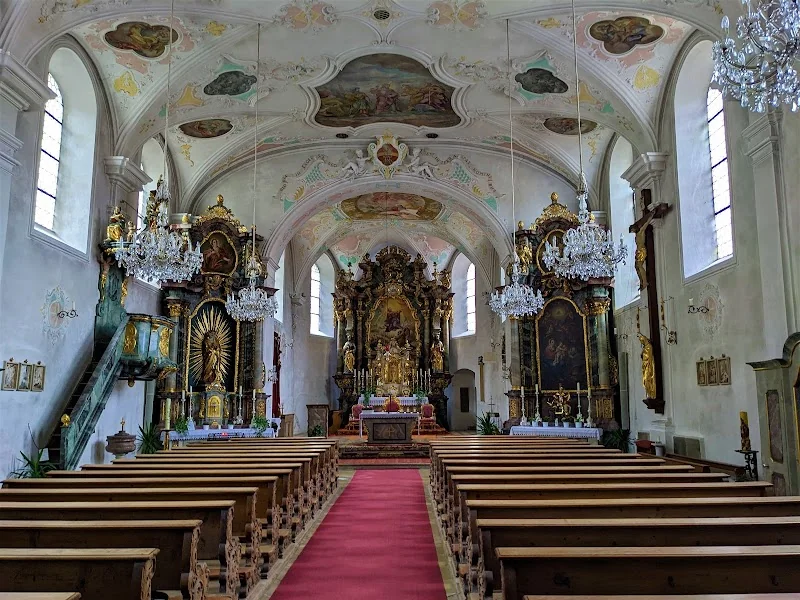
St. James in Hohenburg is much more than just a church at a good address in the town center. When you reach the marketplace, you encounter a place where religious tradition, regional history, and pilgrimage culture overlap directly. The parish church at Marktplatz 8 is one of the defining buildings of the market and is firmly anchored in the historical center as a Catholic parish church and a listed building. At the same time, Hohenburg is located on the Upper Palatinate Camino de Santiago, making the church an important stop not only for the local community but also for hikers and pilgrims. The view of the church tells of several construction phases, of medieval predecessors, of baroque redesign, and of a vibrant use that continues to this day. The community itself emphasizes the ecclesiastical significance of the site: Hohenburg only became its own parish in 1941, while the church and its surroundings had long before formed religious attractions. This creates an exciting contrast for visitors between historical heritage and modern local life. ([geodaten.bayern.de](https://www.geodaten.bayern.de/denkmal_static_data/externe_denkmalliste/pdf/denkmalliste_merge_371129.pdf))
History and Architecture of St. James Parish Church
The history of St. James goes back much further than the current building. The market community refers to the long ecclesiastical development of Hohenburg and mentions a historical market church that was rebuilt in 1663/64 using old building materials. The monument description from the Bavarian State Office for Monument Preservation complements this picture very precisely: It is a baroque hall building with a retracted, three-sided closed choir, which was built in 1663/64 using a late Gothic east tower with Romanesque wall remnants and was redesigned around 1725. This makes it clear that the church is not merely a new construction of the 17th century, but a building with several layers of time. Particularly interesting is the east tower with a spire, which, along with the older wall remnants, keeps the very early construction history visible. Additionally, there is the niche figure of Saint John of Nepomuk on the north facade, which adds another art-historical accent. The monument register also mentions archaeological findings from the medieval and early modern construction phases in the area of the church, i.e., traces of older predecessor buildings below the current level. This mixture of visible architecture and invisible prehistory makes St. James so attractive for culturally interested visitors. When observing the building, one sees not only baroque architecture but also the reuse of older materials, the memory of Romanesque beginnings, and the evolution of a church site that has adapted to the needs of its community over centuries. The current church is thus a typical yet very distinctive example of the layering of Bavarian sacral architecture in rural areas. ([geodaten.bayern.de](https://www.geodaten.bayern.de/denkmal_static_data/externe_denkmalliste/pdf/denkmalliste_merge_371129.pdf))
St. James on the Upper Palatinate Camino de Santiago
One of the strongest identities of the church lies in its location on the Upper Palatinate Camino de Santiago. The official pilgrimage flyer from the market of Hohenburg describes the stage from Ensdorf to Hohenburg very vividly: After the Ensdorf monastery, over the Stations of the Cross, through the Hirschwald forest, and past Stettkirchen, the path reaches Hohenburg, where the castle ruins are already visible from afar. On the Lauterach bridge, pilgrims encounter the Apostle James, who has been commemorated there with a monument, and directly at the marketplace stands the St. James Church. Particularly noteworthy is the flyer’s indication that the saint is depicted on the altar painting as an intercessor for the town of Hohenburg. This shows how closely the path, the place, and the church are interconnected. The Camino de Santiago here is not an abstract distant route, but a concrete cultural trace that connects Hohenburg with the European pilgrimage idea. The market of Hohenburg describes this section as a mix of natural experiences, historical art and buildings, and encounters with people. This connection is felt at St. James: The church is a destination, a stopover, and a place of identification at the same time. For hikers, it is a place of pause, for cultural travelers a visible anchor point in the Camino network, and for the community a symbol that radiates far beyond the town. Those who engage with the significance of St. James churches recognize here very well how strongly the name not only denotes a patronage but also a whole spiritual landscape of pilgrimage movement, local history, and sacred architecture. The fact that Hohenburg is mentioned in the flyer as a pilgrimage station with its own stamp underscores the role of the church as a genuine waypoint and not just as a decorative destination at the roadside. ([hohenburg.de](https://www.hohenburg.de/downloads/flyer-jakobsweg.pdf))
Directions to the Marketplace and Orientation in the Town Center
The location of St. James is very easy for visitors to understand, as it is situated right in the historical center. The official town map of the market Hohenburg refers to the address Marktplatz 19 for the town hall, and the church itself is only a few steps away at Marktplatz 8. This makes orientation in the town simple: Those heading to the marketplace will find the church at the core of the old market structure. This is particularly helpful for first-time visitors, as Hohenburg does not function as a large urban church location with a spacious forecourt, but as a closely intertwined market town with short distances. The monument description additionally mentions the direct location at the marketplace, thereby further emphasizing the central position of the building. For practical access, it is therefore advisable to use the community's town plan page, which facilitates entry into the local area. However, the sources we checked do not mention any explicitly designated parking spaces directly at the church. This is important because one should not derive parking guarantees from this. Instead, the realistic and clear conclusion is: One drives into the town center, orients oneself at the marketplace, and uses the community's guidance. For visitors arriving by bike or on foot, this is ideal anyway, as the town is compact and the church is located in an area that is very suitable as a starting point for a walk. The community facilities around the marketplace, including the town hall and kindergarten, also illustrate the dense, village- and market-centered structure of the town center. Therefore, those traveling to St. James should not think of the church as a standalone destination but as part of a historical market structure that is best explored directly in the town center. This is also where a great appeal of the visit lies: One experiences the church not in isolation but as an integral part of a vibrant marketplace. ([hohenburg.de](https://www.hohenburg.de/gemeinde-politik/anfahrt-ortsplan/?utm_source=openai))
Services, Pilgrim Stamps, and Church Life
St. James is not just a monument but remains a place of lived ecclesiastical practice. The official Hohenburg Camino de Santiago information explicitly mentions a pilgrim stamp in St. James Church at Nikolaus-Erb-Straße 1, which is a very practical note for hikers and also shows that the church site is still actively anchored in the pilgrimage network. At the same time, the market Hohenburg points out that church tours in Hohenburg are currently not possible because no local heritage custodian has been appointed. This information is important for visitors, as it prevents false expectations and directs attention to what is currently truly available: the free, independent visit of the site, the classification via the Camino de Santiago, and orientation based on the official community pages. Although we do not quote a current service schedule here, it is clear from the official sources that St. James plays a firm role in the ecclesiastical infrastructure of the market. The parish church is listed as part of the parish and pilgrimage landscape, and the pilgrimage sign at the church confirms its ongoing function. In practice, this means: Those visiting the church should not only pay attention to the architecture but also to its use as a contact point for people on the way. The stamp point is for many Camino de Santiago pilgrims more than just a formality; it marks a completed section, connects personal journey experience with a concrete station, and creates a small moment of affirmation. In an SEO context, terms like pilgrim stamp, Camino de Santiago, parish church, and church tour are particularly relevant because they very accurately meet the search intent of visitors. Hohenburg fulfills this intent through its official presence on the Camino de Santiago and its clearly defined contact points. ([hohenburg.de](https://www.hohenburg.de/downloads/flyer-jakobsweg.pdf))
Sights around the Marketplace, Castle Ruins, and Lauterachtal
Those visiting St. James should not only focus on the church itself but also on the entire environment of the market Hohenburg. The official tourism section mentions other churches and stations in the town and surrounding area, including the cemetery church of St. Salvator, the pilgrimage church of Stettkirchen, the church in Allersburg, and the destinations in Kastl. The Camino de Santiago flyer relates this landscape to the castle above the town, to the Lauterachtal valley, and to the juniper heaths that make the path particularly attractive. This makes Hohenburg a place where culture, nature, and spiritual paths converge. St. James Church is the central reference point in this ensemble at the market, but it does not stand alone: it belongs to an entire sacred and historical topography that extends from the pilgrimage church in Stettkirchen to the castle ruins above the market. This combination makes the visit worthwhile. While the church itself primarily tells the history of the place and the continuity of the patronage, the surroundings show how closely Hohenburg is intertwined with the pilgrimage route, regional memory, and the landscape situation. For travelers who consciously seek historical sites, this is an advantage: One can combine the church visit with a walk through the market, a glance at the castle, and a short distance along the Lauterach. The official description of the market also emphasizes the mix of natural experiences, historical art and buildings, and encounters with other pilgrims. This mix is not just a marketing phrase but a very fitting summary of what distinguishes Hohenburg in connection with St. James. Therefore, those searching for an authentic St. James church in the Upper Palatinate will find here a place where centuries-old sacred architecture, pilgrimage tradition, and a small-town shaped town center credibly complement each other. ([hohenburg.de](https://www.hohenburg.de/page_2_1.php?contrast=1&utm_source=openai))
Sources:
Show moreShow less
St. James Hohenburg | Church & Camino de Santiago
St. James in Hohenburg is much more than just a church at a good address in the town center. When you reach the marketplace, you encounter a place where religious tradition, regional history, and pilgrimage culture overlap directly. The parish church at Marktplatz 8 is one of the defining buildings of the market and is firmly anchored in the historical center as a Catholic parish church and a listed building. At the same time, Hohenburg is located on the Upper Palatinate Camino de Santiago, making the church an important stop not only for the local community but also for hikers and pilgrims. The view of the church tells of several construction phases, of medieval predecessors, of baroque redesign, and of a vibrant use that continues to this day. The community itself emphasizes the ecclesiastical significance of the site: Hohenburg only became its own parish in 1941, while the church and its surroundings had long before formed religious attractions. This creates an exciting contrast for visitors between historical heritage and modern local life. ([geodaten.bayern.de](https://www.geodaten.bayern.de/denkmal_static_data/externe_denkmalliste/pdf/denkmalliste_merge_371129.pdf))
History and Architecture of St. James Parish Church
The history of St. James goes back much further than the current building. The market community refers to the long ecclesiastical development of Hohenburg and mentions a historical market church that was rebuilt in 1663/64 using old building materials. The monument description from the Bavarian State Office for Monument Preservation complements this picture very precisely: It is a baroque hall building with a retracted, three-sided closed choir, which was built in 1663/64 using a late Gothic east tower with Romanesque wall remnants and was redesigned around 1725. This makes it clear that the church is not merely a new construction of the 17th century, but a building with several layers of time. Particularly interesting is the east tower with a spire, which, along with the older wall remnants, keeps the very early construction history visible. Additionally, there is the niche figure of Saint John of Nepomuk on the north facade, which adds another art-historical accent. The monument register also mentions archaeological findings from the medieval and early modern construction phases in the area of the church, i.e., traces of older predecessor buildings below the current level. This mixture of visible architecture and invisible prehistory makes St. James so attractive for culturally interested visitors. When observing the building, one sees not only baroque architecture but also the reuse of older materials, the memory of Romanesque beginnings, and the evolution of a church site that has adapted to the needs of its community over centuries. The current church is thus a typical yet very distinctive example of the layering of Bavarian sacral architecture in rural areas. ([geodaten.bayern.de](https://www.geodaten.bayern.de/denkmal_static_data/externe_denkmalliste/pdf/denkmalliste_merge_371129.pdf))
St. James on the Upper Palatinate Camino de Santiago
One of the strongest identities of the church lies in its location on the Upper Palatinate Camino de Santiago. The official pilgrimage flyer from the market of Hohenburg describes the stage from Ensdorf to Hohenburg very vividly: After the Ensdorf monastery, over the Stations of the Cross, through the Hirschwald forest, and past Stettkirchen, the path reaches Hohenburg, where the castle ruins are already visible from afar. On the Lauterach bridge, pilgrims encounter the Apostle James, who has been commemorated there with a monument, and directly at the marketplace stands the St. James Church. Particularly noteworthy is the flyer’s indication that the saint is depicted on the altar painting as an intercessor for the town of Hohenburg. This shows how closely the path, the place, and the church are interconnected. The Camino de Santiago here is not an abstract distant route, but a concrete cultural trace that connects Hohenburg with the European pilgrimage idea. The market of Hohenburg describes this section as a mix of natural experiences, historical art and buildings, and encounters with people. This connection is felt at St. James: The church is a destination, a stopover, and a place of identification at the same time. For hikers, it is a place of pause, for cultural travelers a visible anchor point in the Camino network, and for the community a symbol that radiates far beyond the town. Those who engage with the significance of St. James churches recognize here very well how strongly the name not only denotes a patronage but also a whole spiritual landscape of pilgrimage movement, local history, and sacred architecture. The fact that Hohenburg is mentioned in the flyer as a pilgrimage station with its own stamp underscores the role of the church as a genuine waypoint and not just as a decorative destination at the roadside. ([hohenburg.de](https://www.hohenburg.de/downloads/flyer-jakobsweg.pdf))
Directions to the Marketplace and Orientation in the Town Center
The location of St. James is very easy for visitors to understand, as it is situated right in the historical center. The official town map of the market Hohenburg refers to the address Marktplatz 19 for the town hall, and the church itself is only a few steps away at Marktplatz 8. This makes orientation in the town simple: Those heading to the marketplace will find the church at the core of the old market structure. This is particularly helpful for first-time visitors, as Hohenburg does not function as a large urban church location with a spacious forecourt, but as a closely intertwined market town with short distances. The monument description additionally mentions the direct location at the marketplace, thereby further emphasizing the central position of the building. For practical access, it is therefore advisable to use the community's town plan page, which facilitates entry into the local area. However, the sources we checked do not mention any explicitly designated parking spaces directly at the church. This is important because one should not derive parking guarantees from this. Instead, the realistic and clear conclusion is: One drives into the town center, orients oneself at the marketplace, and uses the community's guidance. For visitors arriving by bike or on foot, this is ideal anyway, as the town is compact and the church is located in an area that is very suitable as a starting point for a walk. The community facilities around the marketplace, including the town hall and kindergarten, also illustrate the dense, village- and market-centered structure of the town center. Therefore, those traveling to St. James should not think of the church as a standalone destination but as part of a historical market structure that is best explored directly in the town center. This is also where a great appeal of the visit lies: One experiences the church not in isolation but as an integral part of a vibrant marketplace. ([hohenburg.de](https://www.hohenburg.de/gemeinde-politik/anfahrt-ortsplan/?utm_source=openai))
Services, Pilgrim Stamps, and Church Life
St. James is not just a monument but remains a place of lived ecclesiastical practice. The official Hohenburg Camino de Santiago information explicitly mentions a pilgrim stamp in St. James Church at Nikolaus-Erb-Straße 1, which is a very practical note for hikers and also shows that the church site is still actively anchored in the pilgrimage network. At the same time, the market Hohenburg points out that church tours in Hohenburg are currently not possible because no local heritage custodian has been appointed. This information is important for visitors, as it prevents false expectations and directs attention to what is currently truly available: the free, independent visit of the site, the classification via the Camino de Santiago, and orientation based on the official community pages. Although we do not quote a current service schedule here, it is clear from the official sources that St. James plays a firm role in the ecclesiastical infrastructure of the market. The parish church is listed as part of the parish and pilgrimage landscape, and the pilgrimage sign at the church confirms its ongoing function. In practice, this means: Those visiting the church should not only pay attention to the architecture but also to its use as a contact point for people on the way. The stamp point is for many Camino de Santiago pilgrims more than just a formality; it marks a completed section, connects personal journey experience with a concrete station, and creates a small moment of affirmation. In an SEO context, terms like pilgrim stamp, Camino de Santiago, parish church, and church tour are particularly relevant because they very accurately meet the search intent of visitors. Hohenburg fulfills this intent through its official presence on the Camino de Santiago and its clearly defined contact points. ([hohenburg.de](https://www.hohenburg.de/downloads/flyer-jakobsweg.pdf))
Sights around the Marketplace, Castle Ruins, and Lauterachtal
Those visiting St. James should not only focus on the church itself but also on the entire environment of the market Hohenburg. The official tourism section mentions other churches and stations in the town and surrounding area, including the cemetery church of St. Salvator, the pilgrimage church of Stettkirchen, the church in Allersburg, and the destinations in Kastl. The Camino de Santiago flyer relates this landscape to the castle above the town, to the Lauterachtal valley, and to the juniper heaths that make the path particularly attractive. This makes Hohenburg a place where culture, nature, and spiritual paths converge. St. James Church is the central reference point in this ensemble at the market, but it does not stand alone: it belongs to an entire sacred and historical topography that extends from the pilgrimage church in Stettkirchen to the castle ruins above the market. This combination makes the visit worthwhile. While the church itself primarily tells the history of the place and the continuity of the patronage, the surroundings show how closely Hohenburg is intertwined with the pilgrimage route, regional memory, and the landscape situation. For travelers who consciously seek historical sites, this is an advantage: One can combine the church visit with a walk through the market, a glance at the castle, and a short distance along the Lauterach. The official description of the market also emphasizes the mix of natural experiences, historical art and buildings, and encounters with other pilgrims. This mix is not just a marketing phrase but a very fitting summary of what distinguishes Hohenburg in connection with St. James. Therefore, those searching for an authentic St. James church in the Upper Palatinate will find here a place where centuries-old sacred architecture, pilgrimage tradition, and a small-town shaped town center credibly complement each other. ([hohenburg.de](https://www.hohenburg.de/page_2_1.php?contrast=1&utm_source=openai))
Sources:
St. James Hohenburg | Church & Camino de Santiago
St. James in Hohenburg is much more than just a church at a good address in the town center. When you reach the marketplace, you encounter a place where religious tradition, regional history, and pilgrimage culture overlap directly. The parish church at Marktplatz 8 is one of the defining buildings of the market and is firmly anchored in the historical center as a Catholic parish church and a listed building. At the same time, Hohenburg is located on the Upper Palatinate Camino de Santiago, making the church an important stop not only for the local community but also for hikers and pilgrims. The view of the church tells of several construction phases, of medieval predecessors, of baroque redesign, and of a vibrant use that continues to this day. The community itself emphasizes the ecclesiastical significance of the site: Hohenburg only became its own parish in 1941, while the church and its surroundings had long before formed religious attractions. This creates an exciting contrast for visitors between historical heritage and modern local life. ([geodaten.bayern.de](https://www.geodaten.bayern.de/denkmal_static_data/externe_denkmalliste/pdf/denkmalliste_merge_371129.pdf))
History and Architecture of St. James Parish Church
The history of St. James goes back much further than the current building. The market community refers to the long ecclesiastical development of Hohenburg and mentions a historical market church that was rebuilt in 1663/64 using old building materials. The monument description from the Bavarian State Office for Monument Preservation complements this picture very precisely: It is a baroque hall building with a retracted, three-sided closed choir, which was built in 1663/64 using a late Gothic east tower with Romanesque wall remnants and was redesigned around 1725. This makes it clear that the church is not merely a new construction of the 17th century, but a building with several layers of time. Particularly interesting is the east tower with a spire, which, along with the older wall remnants, keeps the very early construction history visible. Additionally, there is the niche figure of Saint John of Nepomuk on the north facade, which adds another art-historical accent. The monument register also mentions archaeological findings from the medieval and early modern construction phases in the area of the church, i.e., traces of older predecessor buildings below the current level. This mixture of visible architecture and invisible prehistory makes St. James so attractive for culturally interested visitors. When observing the building, one sees not only baroque architecture but also the reuse of older materials, the memory of Romanesque beginnings, and the evolution of a church site that has adapted to the needs of its community over centuries. The current church is thus a typical yet very distinctive example of the layering of Bavarian sacral architecture in rural areas. ([geodaten.bayern.de](https://www.geodaten.bayern.de/denkmal_static_data/externe_denkmalliste/pdf/denkmalliste_merge_371129.pdf))
St. James on the Upper Palatinate Camino de Santiago
One of the strongest identities of the church lies in its location on the Upper Palatinate Camino de Santiago. The official pilgrimage flyer from the market of Hohenburg describes the stage from Ensdorf to Hohenburg very vividly: After the Ensdorf monastery, over the Stations of the Cross, through the Hirschwald forest, and past Stettkirchen, the path reaches Hohenburg, where the castle ruins are already visible from afar. On the Lauterach bridge, pilgrims encounter the Apostle James, who has been commemorated there with a monument, and directly at the marketplace stands the St. James Church. Particularly noteworthy is the flyer’s indication that the saint is depicted on the altar painting as an intercessor for the town of Hohenburg. This shows how closely the path, the place, and the church are interconnected. The Camino de Santiago here is not an abstract distant route, but a concrete cultural trace that connects Hohenburg with the European pilgrimage idea. The market of Hohenburg describes this section as a mix of natural experiences, historical art and buildings, and encounters with people. This connection is felt at St. James: The church is a destination, a stopover, and a place of identification at the same time. For hikers, it is a place of pause, for cultural travelers a visible anchor point in the Camino network, and for the community a symbol that radiates far beyond the town. Those who engage with the significance of St. James churches recognize here very well how strongly the name not only denotes a patronage but also a whole spiritual landscape of pilgrimage movement, local history, and sacred architecture. The fact that Hohenburg is mentioned in the flyer as a pilgrimage station with its own stamp underscores the role of the church as a genuine waypoint and not just as a decorative destination at the roadside. ([hohenburg.de](https://www.hohenburg.de/downloads/flyer-jakobsweg.pdf))
Directions to the Marketplace and Orientation in the Town Center
The location of St. James is very easy for visitors to understand, as it is situated right in the historical center. The official town map of the market Hohenburg refers to the address Marktplatz 19 for the town hall, and the church itself is only a few steps away at Marktplatz 8. This makes orientation in the town simple: Those heading to the marketplace will find the church at the core of the old market structure. This is particularly helpful for first-time visitors, as Hohenburg does not function as a large urban church location with a spacious forecourt, but as a closely intertwined market town with short distances. The monument description additionally mentions the direct location at the marketplace, thereby further emphasizing the central position of the building. For practical access, it is therefore advisable to use the community's town plan page, which facilitates entry into the local area. However, the sources we checked do not mention any explicitly designated parking spaces directly at the church. This is important because one should not derive parking guarantees from this. Instead, the realistic and clear conclusion is: One drives into the town center, orients oneself at the marketplace, and uses the community's guidance. For visitors arriving by bike or on foot, this is ideal anyway, as the town is compact and the church is located in an area that is very suitable as a starting point for a walk. The community facilities around the marketplace, including the town hall and kindergarten, also illustrate the dense, village- and market-centered structure of the town center. Therefore, those traveling to St. James should not think of the church as a standalone destination but as part of a historical market structure that is best explored directly in the town center. This is also where a great appeal of the visit lies: One experiences the church not in isolation but as an integral part of a vibrant marketplace. ([hohenburg.de](https://www.hohenburg.de/gemeinde-politik/anfahrt-ortsplan/?utm_source=openai))
Services, Pilgrim Stamps, and Church Life
St. James is not just a monument but remains a place of lived ecclesiastical practice. The official Hohenburg Camino de Santiago information explicitly mentions a pilgrim stamp in St. James Church at Nikolaus-Erb-Straße 1, which is a very practical note for hikers and also shows that the church site is still actively anchored in the pilgrimage network. At the same time, the market Hohenburg points out that church tours in Hohenburg are currently not possible because no local heritage custodian has been appointed. This information is important for visitors, as it prevents false expectations and directs attention to what is currently truly available: the free, independent visit of the site, the classification via the Camino de Santiago, and orientation based on the official community pages. Although we do not quote a current service schedule here, it is clear from the official sources that St. James plays a firm role in the ecclesiastical infrastructure of the market. The parish church is listed as part of the parish and pilgrimage landscape, and the pilgrimage sign at the church confirms its ongoing function. In practice, this means: Those visiting the church should not only pay attention to the architecture but also to its use as a contact point for people on the way. The stamp point is for many Camino de Santiago pilgrims more than just a formality; it marks a completed section, connects personal journey experience with a concrete station, and creates a small moment of affirmation. In an SEO context, terms like pilgrim stamp, Camino de Santiago, parish church, and church tour are particularly relevant because they very accurately meet the search intent of visitors. Hohenburg fulfills this intent through its official presence on the Camino de Santiago and its clearly defined contact points. ([hohenburg.de](https://www.hohenburg.de/downloads/flyer-jakobsweg.pdf))
Sights around the Marketplace, Castle Ruins, and Lauterachtal
Those visiting St. James should not only focus on the church itself but also on the entire environment of the market Hohenburg. The official tourism section mentions other churches and stations in the town and surrounding area, including the cemetery church of St. Salvator, the pilgrimage church of Stettkirchen, the church in Allersburg, and the destinations in Kastl. The Camino de Santiago flyer relates this landscape to the castle above the town, to the Lauterachtal valley, and to the juniper heaths that make the path particularly attractive. This makes Hohenburg a place where culture, nature, and spiritual paths converge. St. James Church is the central reference point in this ensemble at the market, but it does not stand alone: it belongs to an entire sacred and historical topography that extends from the pilgrimage church in Stettkirchen to the castle ruins above the market. This combination makes the visit worthwhile. While the church itself primarily tells the history of the place and the continuity of the patronage, the surroundings show how closely Hohenburg is intertwined with the pilgrimage route, regional memory, and the landscape situation. For travelers who consciously seek historical sites, this is an advantage: One can combine the church visit with a walk through the market, a glance at the castle, and a short distance along the Lauterach. The official description of the market also emphasizes the mix of natural experiences, historical art and buildings, and encounters with other pilgrims. This mix is not just a marketing phrase but a very fitting summary of what distinguishes Hohenburg in connection with St. James. Therefore, those searching for an authentic St. James church in the Upper Palatinate will find here a place where centuries-old sacred architecture, pilgrimage tradition, and a small-town shaped town center credibly complement each other. ([hohenburg.de](https://www.hohenburg.de/page_2_1.php?contrast=1&utm_source=openai))
Sources:
Frequently Asked Questions
Reviews
No reviews found