
Vilseck
Kirchgasse 9, 92249 Vilseck, Deutschland
St. Ägidius Vilseck | History & Tours
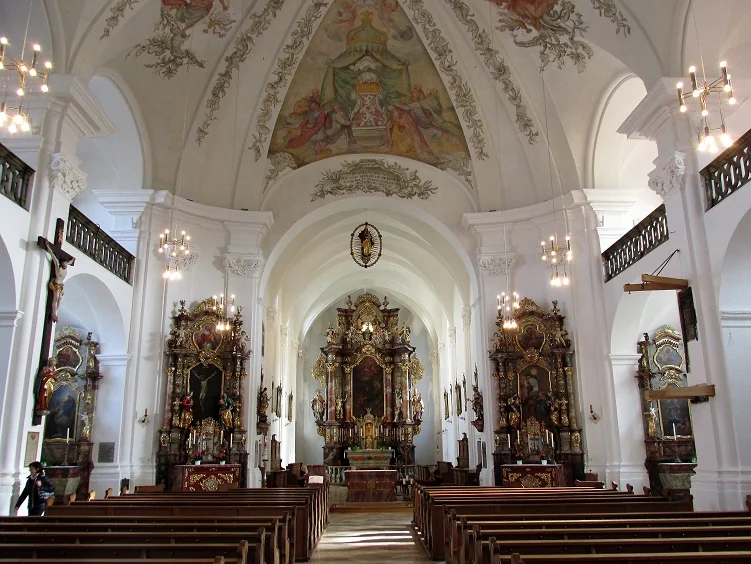
The parish church of St. Ägidius has shaped the historic old town of Vilseck for centuries, combining early church history, Gothic architecture, and Baroque furnishings into a place that goes far beyond an ordinary house of worship. Today, those who walk through the old town experience not only a distinctive church in the church square but a monument that visibly illustrates the development of the city: from the first Christian traces around the 8th century through Romanesque and Gothic construction phases to the Baroque redesign in the 18th century. The parish itself sees itself as a vibrant community with parish newsletters, groups, church music, and events, while the city of Vilseck highlights the church as an integral part of its historical tour and attractions. Particularly striking are the tall tower, the artistic treasures inside, and the close connection between the church, the old town, and community life. After the fire in 2013, the church was extensively restored, and in 2015 the community returned to the renewed interior. Thus, those who visit St. Ägidius find a place where history does not feel museum-like but continues to live in the everyday life of the community. ([pfarrei-vilseck.de](https://www.pfarrei-vilseck.de/pfarrkirche/))
History of the Parish Church of St. Ägidius in Vilseck
The history of St. Ägidius is closely linked to the beginnings of Christianity in the region. The parish refers to the life description of St. Wunibald, according to which preaching took place in the area around 770. In 777, Duke Tassilo gifted Wunibald a church at Nordvils, which was officially confirmed by Charlemagne in 791. Whether this church actually stood in Vilseck can no longer be definitively stated, but the tradition shows how early the place was shaped by the church. At the latest by 950, there was said to be a wooden church here according to the parish. During the reign of Bishop Otto I of Bamberg, a Romanesque church was built, of which the ashlar work, Romanesque slit windows, and the north wall of the tower still testify today. These early components are important because they show that St. Ägidius cannot be understood as a purely Baroque house of worship but as a multifaceted building that carries multiple epochs within it. The current structure began on September 1, 1407, the feast of St. Ägidius, in the Gothic style. Five years later, the construction was completed; primarily the choir remains from this Gothic church. The city of Vilseck identifies the same choir space as a construction phase from 1407 to 1412 and includes the church in its historical city tour. Thus, a clear picture emerges: St. Ägidius is a structure that has grown out of the earliest testimonies of the place and continues to make the historical continuity of Vilseck visible to this day. ([pfarrei-vilseck.de](https://www.pfarrei-vilseck.de/pfarrkirche/))
Over the centuries, the parish church has been rebuilt, supplemented, and restored multiple times. Particularly formative was the phase from 1751 to 1753 when, due to the danger of collapse of the western gable, the narrow Gothic nave was demolished and replaced by a significantly wider Baroque pillar hall. The church nave received a powerful vault that still gives the interior its generous effect today. The city of Vilseck summarizes this building form as a centralizing nave with wall pillars and galleries from 1752. The tower also received its present form during this time. With 27.5 meters of masonry and an additional 27-meter-high spire, it is visible from afar and is considered by the parish to be the tallest church tower in the area. Further interior renovations took place in 1938 and 1973, along with work on the facade, roof structure, and sandstone parts in the late 1990s. A significant event was the fire on January 9, 2013, which completely destroyed the Baroque pulpit and severely damaged the interior furnishings due to smoke, soot, and heat. The long restoration was a challenge for the community but also a sign of solidarity. In 2015, the parish community was able to return to the renewed church, further strengthening the emotional connection between the monument and community life. Thus, St. Ägidius is not only a historical building but a place of lived permanence. ([pfarrei-vilseck.de](https://www.pfarrei-vilseck.de/pfarrkirche/))
Organ, Tower, and Artistic Treasures in the City Parish Church
Those who enter St. Ägidius discover not only architecture but an astonishingly rich collection of art and furnishing elements. The parish reports that an organ was first mentioned in 1502, which stood on a lower gallery. Later, a larger Steinmeyer organ was built for 5,785 marks, whose casing was richly decorated with acanthus carvings. In 1979, this organ was replaced by a new instrument from the same company; the historical casing could be retained, and a major restoration was necessary in 2002. This shows how much the musical tradition in Vilseck has been cultivated and continues to be maintained. The organ is not only a liturgical instrument but also a cultural memory of the community. Additionally, there are the art-historically valuable relics of the older furnishings: In 1520, the church received a wing altar with scenes from the life of Mary from the Dürer school. The carved relief panels of this no longer existing altar are now mounted on the side walls of the choir. In 1714, a Baroque high altar was added to the church, into which the current altar painting depicting a scene from the life of St. Ägidius was inserted in 1766. Around the same time, the frescoes in the barrel vault of the church nave, as well as the altars of the Mother of God and the Cross, and the altars in honor of St. Lawrence and St. Joseph in Rococo style were created. These layers make the interior a textbook of art history. The city of Vilseck additionally highlights the 14 Holy Helpers from the 16th century and the relief panels of the former wing altar as special treasures. Together, they create the image of a church that is not only large and old but has achieved a remarkable cultural level in its furnishings. ([pfarrei-vilseck.de](https://www.pfarrei-vilseck.de/pfarrkirche/))
Another defining element is the church tower, which visibly shapes the silhouette of Vilseck. The parish states that the masonry reaches a height of 27.5 meters and the spire an additional 27 meters. This means that the tower is not only an architectural detail but a landmark that shapes the cityscape, perceivable from the old town and the surrounding area. The city of Vilseck describes the tower as resting on a Romanesque core and the church as a Gothic choir with a Baroque nave, allowing the various epochs to be read on the exterior and interior. In recent years, the parish has also drawn attention to unusual treasures, such as the large church tower bell named Peuglerin, which has its own story in the parish church. Additionally, there are the 20 processional poles, which the parish refers to as guild poles, of which a total of 20 pieces have been preserved in pairs. These poles are not mere decoration but an expression of a developed liturgical and local tradition that connects Corpus Christi, brotherhoods, veneration of saints, and local craft history. In connection with the tower levels, the organ, and the altars, a strong impression of continuity emerges: St. Ägidius is a church space where craftsmanship, piety, and regional identity have been inscribed over many generations. It is precisely this mixture of monumental presence and finely crafted details that makes the parish church so impressive for visitors. ([pfarrei-vilseck.de](https://www.pfarrei-vilseck.de/pfarrkirche/))
Corpus Christi, Mountain Festival, and Lively Services
St. Ägidius is not only a building to look at but the center of an active community life. A particularly illustrative example is the Corpus Christi festival in Vilseck: The parish reports that city pastor Hrudaya Madanu celebrated the holy Eucharist with the faithful in the city parish church and then joined the procession to the other altars in Breiten Gasse, in the suburbs, and on the marketplace, accompanied by the church choir and the youth wind orchestra. It is precisely here that it becomes clear how closely the church is connected to the urban space. The service does not end at the church door but continues as a visible and audible expression of faith in the streets. For visitors interested in local rituals, this is particularly valuable because they experience not only architecture in St. Ägidius but a living practice that fills the historical space with the present. Additionally, the parish regularly reports on further celebrations, patronages, and festivals, describing the church as a place of encounter. Benefit concerts are also part of this: The association Vilseck gives hope has been organizing concerts in the city parish church for many years, thereby complementing sacred space and musical culture. The church is thus not limited to Sunday services but is a multifunctional place where liturgy, music, customs, and community intertwine. For inquiries regarding services, programs, events, or Corpus Christi, St. Ägidius therefore provides genuine points of connection and not just a historical framework. ([pfarrei-vilseck.de](https://www.pfarrei-vilseck.de/fronleichnamsfest-in-vilseck/?utm_source=openai))
It is also particularly important for external perception that the parish makes its church digitally accessible. After the fire damage, a 3D tour was created by a regional specialist company, allowing visitors to explore the parish church online. This is especially helpful for people who want to gain a first impression before a visit or prepare for a church tour. The city of Vilseck complements this offer with historical tours that begin at the church square of St. Ägidius. In the descriptions of the tours, the church is explicitly mentioned as a place where true treasures can be discovered, such as the 14 Holy Helpers or the relief panels of the old wing altar. The tours also show that St. Ägidius should not be viewed in isolation but together with the historic city center, Dagestein Castle, and the old town. For SEO topics such as church tours, programs, tourism, and culture, this connection is crucial: the visitor can combine a tour of the city with a stop at the parish church, thus transforming history into an immediate experience. The parish itself also bridges the gap between tradition and everyday life with its current contributions and the parish newsletter. This creates a rare mix around St. Ägidius of monument, vibrant community, and digital accessibility, making the place attractive for both locals and guests. ([pfarrei-vilseck.de](https://www.pfarrei-vilseck.de/pfarrkirche/))
Access, Old Town, and Parking around St. Ägidius
The location of St. Ägidius is an essential part of its appeal. The church stands in the middle of the historic center of Vilseck, which the city describes as the old town with Dagestein Castle, the tower museum, and other attractions. Therefore, those visiting the church are not moving in a peripheral sacred landscape but in a developed urban structure where the marketplace, alleys, parish church, and castle belong together. Precisely for this reason, access is a practical topic for many visitors. The city of Vilseck explicitly names the Vilseck train station as a travel stop for its circular and hiking trails; this makes it clear that the train is also a sensible option if one wants to explore the old town without a car. For drivers, the city refers to the large parking lot at Ziegelanger, which lies directly on the Vils and serves as a starting point for a visit to the old town. There are also camper parking spaces available. This is particularly important for church and city tourism because visitors can conveniently reach the city center and then walk a few steps to the historical core with St. Ägidius. The parish and the city thus provide a visitor structure that focuses on short distances and good orientation. Therefore, anyone planning a tour should best view the church together with Dagestein Castle, the marketplace, and the other attractions. This makes the visit more efficient and impressive, as one experiences the church not in isolation but as the centerpiece of the old town image. ([vilseck.de](https://www.vilseck.de/wanderwege.php?utm_source=openai))
The urban surroundings also contribute to the presence of St. Ägidius. The city of Vilseck emphasizes in several texts that the preservation of the sightline to the parish church is positively evaluated and that the old town lives from a historical sequence of squares. This means for visitors: Even when walking through the old town, the church is a point of orientation, a visible target, and an identity-forming element. Those interested in photographic motifs will find strong perspectives between the tower, alleys, and historic masonry. Those arriving by car can combine their visit with a walk through the old town; those arriving by train reach Vilseck via the train station and walk into the center. City tours and the historical round tour are also designed to use the church square as a starting point. This combination of access, parking, and pedestrian exploration is particularly relevant for inquiries such as access, parking, or old town, as it allows for a genuine visit plan. St. Ägidius is not an isolated point on the map but part of a cultural ensemble that extends from the castle through the marketplace to the parish church. This is precisely what makes the place attractive for a day trip: one can visit the church, participate in a tour, stroll through the old town, and simultaneously experience the architectural and historical depth of the place. ([vilseck.de](https://www.vilseck.de/pdf/marktplatz/231208_Vilseck_Protokoll.pdf?utm_source=openai))
Parish Center, Library, and Community Life Onsite
Those who view St. Ägidius only as a church see only part of the reality. The parish describes a much broader community life that is also reflected in the adjacent facilities. Particularly important is the parish center of St. Ägidius, whose roots go back over 100 years. It all began with the convent of the Poor School Sisters. On November 13, 1886, they came to Vilseck and initially lived in the old school building. In 1893, Pastor Hierl advocated for a convent of their own and won the Meier and Trösch families in Munich for the Meier-Trösch Foundation, with whose help the convent could be built in 1894/95. In 1900, two adjacent plots were added, which were transformed into an orchard; in 1946/47, an extension was made on the garden side. After the dissolution of the convent community in 1990, altar servers, the church choir, Bible study group, and parish council moved into the premises. This transformed the former convent into the current parish center and a central place for community work. For visitors, this is interesting because it shows that St. Ägidius does not only refer to the large parish church but encompasses a whole living space of church groups, education, and encounters. The connection between liturgical space and parish center makes the parish visible in everyday life. ([pfarrei-vilseck.de](https://www.pfarrei-vilseck.de/pfarrheim-2/?utm_source=openai))
The church infrastructure also includes the city and parish library of Vilseck, which, according to the city, is under the sponsorship of the city of Vilseck and the Catholic parish of St. Ägidius. This is a nice example of how the church and municipality work together in Vilseck. Such joint facilities are important for families, children, senior circles, and volunteers because they create a low-threshold offer right in the city. The parish itself provides information on its website about current contributions, the parish newsletter, the parish calendar, altar servers, church music, the parish council, and other groups. This creates a broad network of spirituality, education, and social encounters. Events such as senior circle meetings, fundraising actions, or discussions about dialect and local culture are also made visible there. For a location page, this is a valuable aspect: St. Ägidius is not just a sight but the core of an active community where church, culture, and local engagement intertwine. Therefore, those searching for parish centers, libraries, community life, or events will find in Vilseck a surprisingly dense offer of church-shaped places that are interconnected. This explains why the parish and the city repeatedly appear together: both contribute to the experience of St. Ägidius as a place of identity, learning, and encounter. ([vilseck.de](https://www.vilseck.de/buecherei.php?utm_source=openai))
Saint Ägidius and the Special Aura of the Place
The patronage gives the church its name and spiritual center. St. Ägidius is dedicated to Saint Ägidius, a figure associated in Christian tradition with care, protection, and trust. The parish makes it clear that the patron saint is present in the inner and outer appearance of the church; the city and the parish also point out that his feast day and the church celebrations play a special role for the community. In the child-friendly church tours of the parish, the legend is taken up that Ägidius was nourished by a doe with milk. The diocesan website adds that the saint is also regarded as the patron of nursing mothers and was invoked together with the Mother of God and the legendary Three Bethen when it came to blessings for children. This connection of legend, protection, and hope fits well with a place like Vilseck, where the church is not only a monument but a lived space of faith. Precisely because St. Ägidius has been rebuilt, renovated, and restored after the fire of 2013 over the centuries, the place radiates something preserved and simultaneously renewed. Visitors feel not only the historical weight here but also the persistence of a community that has continually renewed its church. This is an important part of the aura: St. Ägidius connects memory and present, liturgical tradition and local everyday culture. In a city with a historic old town, castle, and community center, the church thus forms a calm yet highly present focal point. Therefore, those searching for history, photos, church architecture, tours, or spiritual atmosphere will find in St. Ägidius Vilseck exactly the interplay that makes good church places so special: a clearly recognizable place, a lively community, and a history that is not exhausted in dates but continues to be written to this day. ([pfarrei-vilseck.de](https://www.pfarrei-vilseck.de/wp-content/uploads/2019/09/Kirchenfuehrer-von-Kindern.pdf?utm_source=openai))
Sources:
- Homepage of the Catholic Parish Vilseck - Official Website ([pfarrei-vilseck.de](https://www.pfarrei-vilseck.de/))
- Parish Church St. Ägidius Vilseck - Parish Vilseck ([pfarrei-vilseck.de](https://www.pfarrei-vilseck.de/pfarrkirche/))
- Sights - City Vilseck ([vilseck.de](https://www.vilseck.de/sehenswuerdigkeiten.php))
- Tours - City Vilseck ([vilseck.de](https://www.vilseck.de/fuehrungen.php?utm_source=openai))
- Camper Parking - City Vilseck ([vilseck.de](https://www.vilseck.de/wohnmobilstellplatz.php?utm_source=openai))
- Jewels in the Diocese: The Processional Poles in Vilseck - Diocese of Regensburg ([bistum-regensburg.de](https://bistum-regensburg.de/news/schmuckstuecke-im-bistum-die-prozessionsstangen-in-vilseck?utm_source=openai))
Show moreShow less
St. Ägidius Vilseck | History & Tours
The parish church of St. Ägidius has shaped the historic old town of Vilseck for centuries, combining early church history, Gothic architecture, and Baroque furnishings into a place that goes far beyond an ordinary house of worship. Today, those who walk through the old town experience not only a distinctive church in the church square but a monument that visibly illustrates the development of the city: from the first Christian traces around the 8th century through Romanesque and Gothic construction phases to the Baroque redesign in the 18th century. The parish itself sees itself as a vibrant community with parish newsletters, groups, church music, and events, while the city of Vilseck highlights the church as an integral part of its historical tour and attractions. Particularly striking are the tall tower, the artistic treasures inside, and the close connection between the church, the old town, and community life. After the fire in 2013, the church was extensively restored, and in 2015 the community returned to the renewed interior. Thus, those who visit St. Ägidius find a place where history does not feel museum-like but continues to live in the everyday life of the community. ([pfarrei-vilseck.de](https://www.pfarrei-vilseck.de/pfarrkirche/))
History of the Parish Church of St. Ägidius in Vilseck
The history of St. Ägidius is closely linked to the beginnings of Christianity in the region. The parish refers to the life description of St. Wunibald, according to which preaching took place in the area around 770. In 777, Duke Tassilo gifted Wunibald a church at Nordvils, which was officially confirmed by Charlemagne in 791. Whether this church actually stood in Vilseck can no longer be definitively stated, but the tradition shows how early the place was shaped by the church. At the latest by 950, there was said to be a wooden church here according to the parish. During the reign of Bishop Otto I of Bamberg, a Romanesque church was built, of which the ashlar work, Romanesque slit windows, and the north wall of the tower still testify today. These early components are important because they show that St. Ägidius cannot be understood as a purely Baroque house of worship but as a multifaceted building that carries multiple epochs within it. The current structure began on September 1, 1407, the feast of St. Ägidius, in the Gothic style. Five years later, the construction was completed; primarily the choir remains from this Gothic church. The city of Vilseck identifies the same choir space as a construction phase from 1407 to 1412 and includes the church in its historical city tour. Thus, a clear picture emerges: St. Ägidius is a structure that has grown out of the earliest testimonies of the place and continues to make the historical continuity of Vilseck visible to this day. ([pfarrei-vilseck.de](https://www.pfarrei-vilseck.de/pfarrkirche/))
Over the centuries, the parish church has been rebuilt, supplemented, and restored multiple times. Particularly formative was the phase from 1751 to 1753 when, due to the danger of collapse of the western gable, the narrow Gothic nave was demolished and replaced by a significantly wider Baroque pillar hall. The church nave received a powerful vault that still gives the interior its generous effect today. The city of Vilseck summarizes this building form as a centralizing nave with wall pillars and galleries from 1752. The tower also received its present form during this time. With 27.5 meters of masonry and an additional 27-meter-high spire, it is visible from afar and is considered by the parish to be the tallest church tower in the area. Further interior renovations took place in 1938 and 1973, along with work on the facade, roof structure, and sandstone parts in the late 1990s. A significant event was the fire on January 9, 2013, which completely destroyed the Baroque pulpit and severely damaged the interior furnishings due to smoke, soot, and heat. The long restoration was a challenge for the community but also a sign of solidarity. In 2015, the parish community was able to return to the renewed church, further strengthening the emotional connection between the monument and community life. Thus, St. Ägidius is not only a historical building but a place of lived permanence. ([pfarrei-vilseck.de](https://www.pfarrei-vilseck.de/pfarrkirche/))
Organ, Tower, and Artistic Treasures in the City Parish Church
Those who enter St. Ägidius discover not only architecture but an astonishingly rich collection of art and furnishing elements. The parish reports that an organ was first mentioned in 1502, which stood on a lower gallery. Later, a larger Steinmeyer organ was built for 5,785 marks, whose casing was richly decorated with acanthus carvings. In 1979, this organ was replaced by a new instrument from the same company; the historical casing could be retained, and a major restoration was necessary in 2002. This shows how much the musical tradition in Vilseck has been cultivated and continues to be maintained. The organ is not only a liturgical instrument but also a cultural memory of the community. Additionally, there are the art-historically valuable relics of the older furnishings: In 1520, the church received a wing altar with scenes from the life of Mary from the Dürer school. The carved relief panels of this no longer existing altar are now mounted on the side walls of the choir. In 1714, a Baroque high altar was added to the church, into which the current altar painting depicting a scene from the life of St. Ägidius was inserted in 1766. Around the same time, the frescoes in the barrel vault of the church nave, as well as the altars of the Mother of God and the Cross, and the altars in honor of St. Lawrence and St. Joseph in Rococo style were created. These layers make the interior a textbook of art history. The city of Vilseck additionally highlights the 14 Holy Helpers from the 16th century and the relief panels of the former wing altar as special treasures. Together, they create the image of a church that is not only large and old but has achieved a remarkable cultural level in its furnishings. ([pfarrei-vilseck.de](https://www.pfarrei-vilseck.de/pfarrkirche/))
Another defining element is the church tower, which visibly shapes the silhouette of Vilseck. The parish states that the masonry reaches a height of 27.5 meters and the spire an additional 27 meters. This means that the tower is not only an architectural detail but a landmark that shapes the cityscape, perceivable from the old town and the surrounding area. The city of Vilseck describes the tower as resting on a Romanesque core and the church as a Gothic choir with a Baroque nave, allowing the various epochs to be read on the exterior and interior. In recent years, the parish has also drawn attention to unusual treasures, such as the large church tower bell named Peuglerin, which has its own story in the parish church. Additionally, there are the 20 processional poles, which the parish refers to as guild poles, of which a total of 20 pieces have been preserved in pairs. These poles are not mere decoration but an expression of a developed liturgical and local tradition that connects Corpus Christi, brotherhoods, veneration of saints, and local craft history. In connection with the tower levels, the organ, and the altars, a strong impression of continuity emerges: St. Ägidius is a church space where craftsmanship, piety, and regional identity have been inscribed over many generations. It is precisely this mixture of monumental presence and finely crafted details that makes the parish church so impressive for visitors. ([pfarrei-vilseck.de](https://www.pfarrei-vilseck.de/pfarrkirche/))
Corpus Christi, Mountain Festival, and Lively Services
St. Ägidius is not only a building to look at but the center of an active community life. A particularly illustrative example is the Corpus Christi festival in Vilseck: The parish reports that city pastor Hrudaya Madanu celebrated the holy Eucharist with the faithful in the city parish church and then joined the procession to the other altars in Breiten Gasse, in the suburbs, and on the marketplace, accompanied by the church choir and the youth wind orchestra. It is precisely here that it becomes clear how closely the church is connected to the urban space. The service does not end at the church door but continues as a visible and audible expression of faith in the streets. For visitors interested in local rituals, this is particularly valuable because they experience not only architecture in St. Ägidius but a living practice that fills the historical space with the present. Additionally, the parish regularly reports on further celebrations, patronages, and festivals, describing the church as a place of encounter. Benefit concerts are also part of this: The association Vilseck gives hope has been organizing concerts in the city parish church for many years, thereby complementing sacred space and musical culture. The church is thus not limited to Sunday services but is a multifunctional place where liturgy, music, customs, and community intertwine. For inquiries regarding services, programs, events, or Corpus Christi, St. Ägidius therefore provides genuine points of connection and not just a historical framework. ([pfarrei-vilseck.de](https://www.pfarrei-vilseck.de/fronleichnamsfest-in-vilseck/?utm_source=openai))
It is also particularly important for external perception that the parish makes its church digitally accessible. After the fire damage, a 3D tour was created by a regional specialist company, allowing visitors to explore the parish church online. This is especially helpful for people who want to gain a first impression before a visit or prepare for a church tour. The city of Vilseck complements this offer with historical tours that begin at the church square of St. Ägidius. In the descriptions of the tours, the church is explicitly mentioned as a place where true treasures can be discovered, such as the 14 Holy Helpers or the relief panels of the old wing altar. The tours also show that St. Ägidius should not be viewed in isolation but together with the historic city center, Dagestein Castle, and the old town. For SEO topics such as church tours, programs, tourism, and culture, this connection is crucial: the visitor can combine a tour of the city with a stop at the parish church, thus transforming history into an immediate experience. The parish itself also bridges the gap between tradition and everyday life with its current contributions and the parish newsletter. This creates a rare mix around St. Ägidius of monument, vibrant community, and digital accessibility, making the place attractive for both locals and guests. ([pfarrei-vilseck.de](https://www.pfarrei-vilseck.de/pfarrkirche/))
Access, Old Town, and Parking around St. Ägidius
The location of St. Ägidius is an essential part of its appeal. The church stands in the middle of the historic center of Vilseck, which the city describes as the old town with Dagestein Castle, the tower museum, and other attractions. Therefore, those visiting the church are not moving in a peripheral sacred landscape but in a developed urban structure where the marketplace, alleys, parish church, and castle belong together. Precisely for this reason, access is a practical topic for many visitors. The city of Vilseck explicitly names the Vilseck train station as a travel stop for its circular and hiking trails; this makes it clear that the train is also a sensible option if one wants to explore the old town without a car. For drivers, the city refers to the large parking lot at Ziegelanger, which lies directly on the Vils and serves as a starting point for a visit to the old town. There are also camper parking spaces available. This is particularly important for church and city tourism because visitors can conveniently reach the city center and then walk a few steps to the historical core with St. Ägidius. The parish and the city thus provide a visitor structure that focuses on short distances and good orientation. Therefore, anyone planning a tour should best view the church together with Dagestein Castle, the marketplace, and the other attractions. This makes the visit more efficient and impressive, as one experiences the church not in isolation but as the centerpiece of the old town image. ([vilseck.de](https://www.vilseck.de/wanderwege.php?utm_source=openai))
The urban surroundings also contribute to the presence of St. Ägidius. The city of Vilseck emphasizes in several texts that the preservation of the sightline to the parish church is positively evaluated and that the old town lives from a historical sequence of squares. This means for visitors: Even when walking through the old town, the church is a point of orientation, a visible target, and an identity-forming element. Those interested in photographic motifs will find strong perspectives between the tower, alleys, and historic masonry. Those arriving by car can combine their visit with a walk through the old town; those arriving by train reach Vilseck via the train station and walk into the center. City tours and the historical round tour are also designed to use the church square as a starting point. This combination of access, parking, and pedestrian exploration is particularly relevant for inquiries such as access, parking, or old town, as it allows for a genuine visit plan. St. Ägidius is not an isolated point on the map but part of a cultural ensemble that extends from the castle through the marketplace to the parish church. This is precisely what makes the place attractive for a day trip: one can visit the church, participate in a tour, stroll through the old town, and simultaneously experience the architectural and historical depth of the place. ([vilseck.de](https://www.vilseck.de/pdf/marktplatz/231208_Vilseck_Protokoll.pdf?utm_source=openai))
Parish Center, Library, and Community Life Onsite
Those who view St. Ägidius only as a church see only part of the reality. The parish describes a much broader community life that is also reflected in the adjacent facilities. Particularly important is the parish center of St. Ägidius, whose roots go back over 100 years. It all began with the convent of the Poor School Sisters. On November 13, 1886, they came to Vilseck and initially lived in the old school building. In 1893, Pastor Hierl advocated for a convent of their own and won the Meier and Trösch families in Munich for the Meier-Trösch Foundation, with whose help the convent could be built in 1894/95. In 1900, two adjacent plots were added, which were transformed into an orchard; in 1946/47, an extension was made on the garden side. After the dissolution of the convent community in 1990, altar servers, the church choir, Bible study group, and parish council moved into the premises. This transformed the former convent into the current parish center and a central place for community work. For visitors, this is interesting because it shows that St. Ägidius does not only refer to the large parish church but encompasses a whole living space of church groups, education, and encounters. The connection between liturgical space and parish center makes the parish visible in everyday life. ([pfarrei-vilseck.de](https://www.pfarrei-vilseck.de/pfarrheim-2/?utm_source=openai))
The church infrastructure also includes the city and parish library of Vilseck, which, according to the city, is under the sponsorship of the city of Vilseck and the Catholic parish of St. Ägidius. This is a nice example of how the church and municipality work together in Vilseck. Such joint facilities are important for families, children, senior circles, and volunteers because they create a low-threshold offer right in the city. The parish itself provides information on its website about current contributions, the parish newsletter, the parish calendar, altar servers, church music, the parish council, and other groups. This creates a broad network of spirituality, education, and social encounters. Events such as senior circle meetings, fundraising actions, or discussions about dialect and local culture are also made visible there. For a location page, this is a valuable aspect: St. Ägidius is not just a sight but the core of an active community where church, culture, and local engagement intertwine. Therefore, those searching for parish centers, libraries, community life, or events will find in Vilseck a surprisingly dense offer of church-shaped places that are interconnected. This explains why the parish and the city repeatedly appear together: both contribute to the experience of St. Ägidius as a place of identity, learning, and encounter. ([vilseck.de](https://www.vilseck.de/buecherei.php?utm_source=openai))
Saint Ägidius and the Special Aura of the Place
The patronage gives the church its name and spiritual center. St. Ägidius is dedicated to Saint Ägidius, a figure associated in Christian tradition with care, protection, and trust. The parish makes it clear that the patron saint is present in the inner and outer appearance of the church; the city and the parish also point out that his feast day and the church celebrations play a special role for the community. In the child-friendly church tours of the parish, the legend is taken up that Ägidius was nourished by a doe with milk. The diocesan website adds that the saint is also regarded as the patron of nursing mothers and was invoked together with the Mother of God and the legendary Three Bethen when it came to blessings for children. This connection of legend, protection, and hope fits well with a place like Vilseck, where the church is not only a monument but a lived space of faith. Precisely because St. Ägidius has been rebuilt, renovated, and restored after the fire of 2013 over the centuries, the place radiates something preserved and simultaneously renewed. Visitors feel not only the historical weight here but also the persistence of a community that has continually renewed its church. This is an important part of the aura: St. Ägidius connects memory and present, liturgical tradition and local everyday culture. In a city with a historic old town, castle, and community center, the church thus forms a calm yet highly present focal point. Therefore, those searching for history, photos, church architecture, tours, or spiritual atmosphere will find in St. Ägidius Vilseck exactly the interplay that makes good church places so special: a clearly recognizable place, a lively community, and a history that is not exhausted in dates but continues to be written to this day. ([pfarrei-vilseck.de](https://www.pfarrei-vilseck.de/wp-content/uploads/2019/09/Kirchenfuehrer-von-Kindern.pdf?utm_source=openai))
Sources:
- Homepage of the Catholic Parish Vilseck - Official Website ([pfarrei-vilseck.de](https://www.pfarrei-vilseck.de/))
- Parish Church St. Ägidius Vilseck - Parish Vilseck ([pfarrei-vilseck.de](https://www.pfarrei-vilseck.de/pfarrkirche/))
- Sights - City Vilseck ([vilseck.de](https://www.vilseck.de/sehenswuerdigkeiten.php))
- Tours - City Vilseck ([vilseck.de](https://www.vilseck.de/fuehrungen.php?utm_source=openai))
- Camper Parking - City Vilseck ([vilseck.de](https://www.vilseck.de/wohnmobilstellplatz.php?utm_source=openai))
- Jewels in the Diocese: The Processional Poles in Vilseck - Diocese of Regensburg ([bistum-regensburg.de](https://bistum-regensburg.de/news/schmuckstuecke-im-bistum-die-prozessionsstangen-in-vilseck?utm_source=openai))
St. Ägidius Vilseck | History & Tours
The parish church of St. Ägidius has shaped the historic old town of Vilseck for centuries, combining early church history, Gothic architecture, and Baroque furnishings into a place that goes far beyond an ordinary house of worship. Today, those who walk through the old town experience not only a distinctive church in the church square but a monument that visibly illustrates the development of the city: from the first Christian traces around the 8th century through Romanesque and Gothic construction phases to the Baroque redesign in the 18th century. The parish itself sees itself as a vibrant community with parish newsletters, groups, church music, and events, while the city of Vilseck highlights the church as an integral part of its historical tour and attractions. Particularly striking are the tall tower, the artistic treasures inside, and the close connection between the church, the old town, and community life. After the fire in 2013, the church was extensively restored, and in 2015 the community returned to the renewed interior. Thus, those who visit St. Ägidius find a place where history does not feel museum-like but continues to live in the everyday life of the community. ([pfarrei-vilseck.de](https://www.pfarrei-vilseck.de/pfarrkirche/))
History of the Parish Church of St. Ägidius in Vilseck
The history of St. Ägidius is closely linked to the beginnings of Christianity in the region. The parish refers to the life description of St. Wunibald, according to which preaching took place in the area around 770. In 777, Duke Tassilo gifted Wunibald a church at Nordvils, which was officially confirmed by Charlemagne in 791. Whether this church actually stood in Vilseck can no longer be definitively stated, but the tradition shows how early the place was shaped by the church. At the latest by 950, there was said to be a wooden church here according to the parish. During the reign of Bishop Otto I of Bamberg, a Romanesque church was built, of which the ashlar work, Romanesque slit windows, and the north wall of the tower still testify today. These early components are important because they show that St. Ägidius cannot be understood as a purely Baroque house of worship but as a multifaceted building that carries multiple epochs within it. The current structure began on September 1, 1407, the feast of St. Ägidius, in the Gothic style. Five years later, the construction was completed; primarily the choir remains from this Gothic church. The city of Vilseck identifies the same choir space as a construction phase from 1407 to 1412 and includes the church in its historical city tour. Thus, a clear picture emerges: St. Ägidius is a structure that has grown out of the earliest testimonies of the place and continues to make the historical continuity of Vilseck visible to this day. ([pfarrei-vilseck.de](https://www.pfarrei-vilseck.de/pfarrkirche/))
Over the centuries, the parish church has been rebuilt, supplemented, and restored multiple times. Particularly formative was the phase from 1751 to 1753 when, due to the danger of collapse of the western gable, the narrow Gothic nave was demolished and replaced by a significantly wider Baroque pillar hall. The church nave received a powerful vault that still gives the interior its generous effect today. The city of Vilseck summarizes this building form as a centralizing nave with wall pillars and galleries from 1752. The tower also received its present form during this time. With 27.5 meters of masonry and an additional 27-meter-high spire, it is visible from afar and is considered by the parish to be the tallest church tower in the area. Further interior renovations took place in 1938 and 1973, along with work on the facade, roof structure, and sandstone parts in the late 1990s. A significant event was the fire on January 9, 2013, which completely destroyed the Baroque pulpit and severely damaged the interior furnishings due to smoke, soot, and heat. The long restoration was a challenge for the community but also a sign of solidarity. In 2015, the parish community was able to return to the renewed church, further strengthening the emotional connection between the monument and community life. Thus, St. Ägidius is not only a historical building but a place of lived permanence. ([pfarrei-vilseck.de](https://www.pfarrei-vilseck.de/pfarrkirche/))
Organ, Tower, and Artistic Treasures in the City Parish Church
Those who enter St. Ägidius discover not only architecture but an astonishingly rich collection of art and furnishing elements. The parish reports that an organ was first mentioned in 1502, which stood on a lower gallery. Later, a larger Steinmeyer organ was built for 5,785 marks, whose casing was richly decorated with acanthus carvings. In 1979, this organ was replaced by a new instrument from the same company; the historical casing could be retained, and a major restoration was necessary in 2002. This shows how much the musical tradition in Vilseck has been cultivated and continues to be maintained. The organ is not only a liturgical instrument but also a cultural memory of the community. Additionally, there are the art-historically valuable relics of the older furnishings: In 1520, the church received a wing altar with scenes from the life of Mary from the Dürer school. The carved relief panels of this no longer existing altar are now mounted on the side walls of the choir. In 1714, a Baroque high altar was added to the church, into which the current altar painting depicting a scene from the life of St. Ägidius was inserted in 1766. Around the same time, the frescoes in the barrel vault of the church nave, as well as the altars of the Mother of God and the Cross, and the altars in honor of St. Lawrence and St. Joseph in Rococo style were created. These layers make the interior a textbook of art history. The city of Vilseck additionally highlights the 14 Holy Helpers from the 16th century and the relief panels of the former wing altar as special treasures. Together, they create the image of a church that is not only large and old but has achieved a remarkable cultural level in its furnishings. ([pfarrei-vilseck.de](https://www.pfarrei-vilseck.de/pfarrkirche/))
Another defining element is the church tower, which visibly shapes the silhouette of Vilseck. The parish states that the masonry reaches a height of 27.5 meters and the spire an additional 27 meters. This means that the tower is not only an architectural detail but a landmark that shapes the cityscape, perceivable from the old town and the surrounding area. The city of Vilseck describes the tower as resting on a Romanesque core and the church as a Gothic choir with a Baroque nave, allowing the various epochs to be read on the exterior and interior. In recent years, the parish has also drawn attention to unusual treasures, such as the large church tower bell named Peuglerin, which has its own story in the parish church. Additionally, there are the 20 processional poles, which the parish refers to as guild poles, of which a total of 20 pieces have been preserved in pairs. These poles are not mere decoration but an expression of a developed liturgical and local tradition that connects Corpus Christi, brotherhoods, veneration of saints, and local craft history. In connection with the tower levels, the organ, and the altars, a strong impression of continuity emerges: St. Ägidius is a church space where craftsmanship, piety, and regional identity have been inscribed over many generations. It is precisely this mixture of monumental presence and finely crafted details that makes the parish church so impressive for visitors. ([pfarrei-vilseck.de](https://www.pfarrei-vilseck.de/pfarrkirche/))
Corpus Christi, Mountain Festival, and Lively Services
St. Ägidius is not only a building to look at but the center of an active community life. A particularly illustrative example is the Corpus Christi festival in Vilseck: The parish reports that city pastor Hrudaya Madanu celebrated the holy Eucharist with the faithful in the city parish church and then joined the procession to the other altars in Breiten Gasse, in the suburbs, and on the marketplace, accompanied by the church choir and the youth wind orchestra. It is precisely here that it becomes clear how closely the church is connected to the urban space. The service does not end at the church door but continues as a visible and audible expression of faith in the streets. For visitors interested in local rituals, this is particularly valuable because they experience not only architecture in St. Ägidius but a living practice that fills the historical space with the present. Additionally, the parish regularly reports on further celebrations, patronages, and festivals, describing the church as a place of encounter. Benefit concerts are also part of this: The association Vilseck gives hope has been organizing concerts in the city parish church for many years, thereby complementing sacred space and musical culture. The church is thus not limited to Sunday services but is a multifunctional place where liturgy, music, customs, and community intertwine. For inquiries regarding services, programs, events, or Corpus Christi, St. Ägidius therefore provides genuine points of connection and not just a historical framework. ([pfarrei-vilseck.de](https://www.pfarrei-vilseck.de/fronleichnamsfest-in-vilseck/?utm_source=openai))
It is also particularly important for external perception that the parish makes its church digitally accessible. After the fire damage, a 3D tour was created by a regional specialist company, allowing visitors to explore the parish church online. This is especially helpful for people who want to gain a first impression before a visit or prepare for a church tour. The city of Vilseck complements this offer with historical tours that begin at the church square of St. Ägidius. In the descriptions of the tours, the church is explicitly mentioned as a place where true treasures can be discovered, such as the 14 Holy Helpers or the relief panels of the old wing altar. The tours also show that St. Ägidius should not be viewed in isolation but together with the historic city center, Dagestein Castle, and the old town. For SEO topics such as church tours, programs, tourism, and culture, this connection is crucial: the visitor can combine a tour of the city with a stop at the parish church, thus transforming history into an immediate experience. The parish itself also bridges the gap between tradition and everyday life with its current contributions and the parish newsletter. This creates a rare mix around St. Ägidius of monument, vibrant community, and digital accessibility, making the place attractive for both locals and guests. ([pfarrei-vilseck.de](https://www.pfarrei-vilseck.de/pfarrkirche/))
Access, Old Town, and Parking around St. Ägidius
The location of St. Ägidius is an essential part of its appeal. The church stands in the middle of the historic center of Vilseck, which the city describes as the old town with Dagestein Castle, the tower museum, and other attractions. Therefore, those visiting the church are not moving in a peripheral sacred landscape but in a developed urban structure where the marketplace, alleys, parish church, and castle belong together. Precisely for this reason, access is a practical topic for many visitors. The city of Vilseck explicitly names the Vilseck train station as a travel stop for its circular and hiking trails; this makes it clear that the train is also a sensible option if one wants to explore the old town without a car. For drivers, the city refers to the large parking lot at Ziegelanger, which lies directly on the Vils and serves as a starting point for a visit to the old town. There are also camper parking spaces available. This is particularly important for church and city tourism because visitors can conveniently reach the city center and then walk a few steps to the historical core with St. Ägidius. The parish and the city thus provide a visitor structure that focuses on short distances and good orientation. Therefore, anyone planning a tour should best view the church together with Dagestein Castle, the marketplace, and the other attractions. This makes the visit more efficient and impressive, as one experiences the church not in isolation but as the centerpiece of the old town image. ([vilseck.de](https://www.vilseck.de/wanderwege.php?utm_source=openai))
The urban surroundings also contribute to the presence of St. Ägidius. The city of Vilseck emphasizes in several texts that the preservation of the sightline to the parish church is positively evaluated and that the old town lives from a historical sequence of squares. This means for visitors: Even when walking through the old town, the church is a point of orientation, a visible target, and an identity-forming element. Those interested in photographic motifs will find strong perspectives between the tower, alleys, and historic masonry. Those arriving by car can combine their visit with a walk through the old town; those arriving by train reach Vilseck via the train station and walk into the center. City tours and the historical round tour are also designed to use the church square as a starting point. This combination of access, parking, and pedestrian exploration is particularly relevant for inquiries such as access, parking, or old town, as it allows for a genuine visit plan. St. Ägidius is not an isolated point on the map but part of a cultural ensemble that extends from the castle through the marketplace to the parish church. This is precisely what makes the place attractive for a day trip: one can visit the church, participate in a tour, stroll through the old town, and simultaneously experience the architectural and historical depth of the place. ([vilseck.de](https://www.vilseck.de/pdf/marktplatz/231208_Vilseck_Protokoll.pdf?utm_source=openai))
Parish Center, Library, and Community Life Onsite
Those who view St. Ägidius only as a church see only part of the reality. The parish describes a much broader community life that is also reflected in the adjacent facilities. Particularly important is the parish center of St. Ägidius, whose roots go back over 100 years. It all began with the convent of the Poor School Sisters. On November 13, 1886, they came to Vilseck and initially lived in the old school building. In 1893, Pastor Hierl advocated for a convent of their own and won the Meier and Trösch families in Munich for the Meier-Trösch Foundation, with whose help the convent could be built in 1894/95. In 1900, two adjacent plots were added, which were transformed into an orchard; in 1946/47, an extension was made on the garden side. After the dissolution of the convent community in 1990, altar servers, the church choir, Bible study group, and parish council moved into the premises. This transformed the former convent into the current parish center and a central place for community work. For visitors, this is interesting because it shows that St. Ägidius does not only refer to the large parish church but encompasses a whole living space of church groups, education, and encounters. The connection between liturgical space and parish center makes the parish visible in everyday life. ([pfarrei-vilseck.de](https://www.pfarrei-vilseck.de/pfarrheim-2/?utm_source=openai))
The church infrastructure also includes the city and parish library of Vilseck, which, according to the city, is under the sponsorship of the city of Vilseck and the Catholic parish of St. Ägidius. This is a nice example of how the church and municipality work together in Vilseck. Such joint facilities are important for families, children, senior circles, and volunteers because they create a low-threshold offer right in the city. The parish itself provides information on its website about current contributions, the parish newsletter, the parish calendar, altar servers, church music, the parish council, and other groups. This creates a broad network of spirituality, education, and social encounters. Events such as senior circle meetings, fundraising actions, or discussions about dialect and local culture are also made visible there. For a location page, this is a valuable aspect: St. Ägidius is not just a sight but the core of an active community where church, culture, and local engagement intertwine. Therefore, those searching for parish centers, libraries, community life, or events will find in Vilseck a surprisingly dense offer of church-shaped places that are interconnected. This explains why the parish and the city repeatedly appear together: both contribute to the experience of St. Ägidius as a place of identity, learning, and encounter. ([vilseck.de](https://www.vilseck.de/buecherei.php?utm_source=openai))
Saint Ägidius and the Special Aura of the Place
The patronage gives the church its name and spiritual center. St. Ägidius is dedicated to Saint Ägidius, a figure associated in Christian tradition with care, protection, and trust. The parish makes it clear that the patron saint is present in the inner and outer appearance of the church; the city and the parish also point out that his feast day and the church celebrations play a special role for the community. In the child-friendly church tours of the parish, the legend is taken up that Ägidius was nourished by a doe with milk. The diocesan website adds that the saint is also regarded as the patron of nursing mothers and was invoked together with the Mother of God and the legendary Three Bethen when it came to blessings for children. This connection of legend, protection, and hope fits well with a place like Vilseck, where the church is not only a monument but a lived space of faith. Precisely because St. Ägidius has been rebuilt, renovated, and restored after the fire of 2013 over the centuries, the place radiates something preserved and simultaneously renewed. Visitors feel not only the historical weight here but also the persistence of a community that has continually renewed its church. This is an important part of the aura: St. Ägidius connects memory and present, liturgical tradition and local everyday culture. In a city with a historic old town, castle, and community center, the church thus forms a calm yet highly present focal point. Therefore, those searching for history, photos, church architecture, tours, or spiritual atmosphere will find in St. Ägidius Vilseck exactly the interplay that makes good church places so special: a clearly recognizable place, a lively community, and a history that is not exhausted in dates but continues to be written to this day. ([pfarrei-vilseck.de](https://www.pfarrei-vilseck.de/wp-content/uploads/2019/09/Kirchenfuehrer-von-Kindern.pdf?utm_source=openai))
Sources:
- Homepage of the Catholic Parish Vilseck - Official Website ([pfarrei-vilseck.de](https://www.pfarrei-vilseck.de/))
- Parish Church St. Ägidius Vilseck - Parish Vilseck ([pfarrei-vilseck.de](https://www.pfarrei-vilseck.de/pfarrkirche/))
- Sights - City Vilseck ([vilseck.de](https://www.vilseck.de/sehenswuerdigkeiten.php))
- Tours - City Vilseck ([vilseck.de](https://www.vilseck.de/fuehrungen.php?utm_source=openai))
- Camper Parking - City Vilseck ([vilseck.de](https://www.vilseck.de/wohnmobilstellplatz.php?utm_source=openai))
- Jewels in the Diocese: The Processional Poles in Vilseck - Diocese of Regensburg ([bistum-regensburg.de](https://bistum-regensburg.de/news/schmuckstuecke-im-bistum-die-prozessionsstangen-in-vilseck?utm_source=openai))
Frequently Asked Questions
Reviews
No reviews found