

Vilseck
Dr.-Fitzthum-Straße 18, 92249 Vilseck-Sorghof, Deutschland
Sorghof | Kirwa & Sports Field
Sorghof is a district of the town of Vilseck, which, despite its manageable size, has an astonishingly dense everyday and community structure. Those who look at the place today encounter a mix of residential area, church, kindergarten, fire department, sports grounds, and customs, which together create a clear picture of Upper Palatinate village culture. The official documents of the town locate Sorghof at the western edge of Vilseck, about four kilometers from the town center, and also show that the place is well connected in terms of traffic. The municipal directories list, among other things, kindergarten, cemetery, fire department, parish library, and several clubs in Sorghof, which describes the place as a functioning and very community-oriented part of Vilseck. For visitors and newcomers, Sorghof is therefore not just a point on the map, but a place where family life, leisure, tradition, and local infrastructure come together directly. This very mix makes Sorghof relevant for search queries related to map, Kirwa, sports field, football, and current information. At the same time, the history of the district shows that not only has construction taken place here over decades, but also community has been formed. School, church, water connection, and kindergarten symbolically represent a development that has turned a growing village into an independent, vibrant district. ([vilseck.de](https://www.vilseck.de/publikationen/brunnleite/Stadt_Vilseck_Bebauungsplan_Brunnleite_Sorghof_21Mrz2022.pdf))
Sorghof on the map: Location, access, and orientation
Those looking for Sorghof on the map should first keep the reference to the core town of Vilseck in mind. The district is located at the western edge of the urban area, north of the district road AS 16; the town also describes for the planning area of Brunnleite that there is a connection to the B 85 towards Auerbach and Amberg as well as to the B 299 towards Grafenwöhr and Amberg via the state road St 2166 running south of Sorghof. At the same time, according to city documents, the center of Sorghof is only about 750 meters away from the Herz Jesu church and the daycare center, making many routes in everyday life possible on foot. For overregional orientation, it is also interesting that the Vilseck train station is about three kilometers away from Sorghof. This makes the place easily accessible for both commuters and visitors arriving by train. The roads around Vilseck also pass by the outskirts of Sorghof: On Hammergutweg, it is explicitly mentioned that three former Stations of the Cross from Langenbruck stand there, making the place visible for hikers and local history enthusiasts. Those who want to understand the place not just on a digital map but on site quickly recognize the typical Upper Palatinate structure: village center, residential areas, club areas, church facilities, and fields interconnect. Sorghof thus appears calm and rural on one hand, yet surprisingly close to the city, train station, and important traffic routes on the other. For search queries like Sorghof maps, Sorghof Vilseck, or Sorghof near Vilseck house rental, this combination of clear location description, proximity to the city, and village independence is crucial. The municipal planning documents also confirm that Sorghof is not on the edge of perception but a well-defined part of the urban development of Vilseck. ([vilseck.de](https://www.vilseck.de/publikationen/brunnleite/Stadt_Vilseck_Bebauungsplan_Brunnleite_Sorghof_21Mrz2022.pdf))
Kirwa in Sorghof: Customs, village square, and KKWU
Sorghof is closely connected with Kirwa and customs. A city council protocol from 2014 describes that a Kirwa community was founded in Sorghof in February of the same year, aiming to preserve, maintain, and promote the cultural values of Upper Palatinate customs and to pass on the inherited traditions and customs. That this impulse was not merely symbolic is shown by looking at the city's event calendar: The Sorghof Kirwa appears as a cultural event in the area. The regional significance of Sorghof becomes particularly visible through the Kreis-Kirwa-Warm-Up of the SV Sorghof. The club reports that around 3,000 young guests attended a new edition, about 70 Kirwa societies reserved their tables, six shuttle bus lines were in operation, and well over 100 helpers took care of serving, bar, grilling, and admission. The KKWU is thus much more than a club evening; it is a supra-regional meeting for an entire Kirwa scene from the district, Upper Palatinate, and Franconia. It is precisely this mix of local roots and regional impact that makes Sorghof interesting for anyone searching for Sorghof Kirwa or Sorghof KKWU. Here, customs are not treated as an old ritual but as an open, modern festive life that brings people from different places together. For village identity, this is important because events of this kind create a sense of cohesion that extends beyond the actual festival day. Sorghof thus clearly shows that Kirwa here is not just a term from the past but a vibrant part of the annual calendar that connects generations and keeps the place visible in regional memory. Those who want to understand the local culture cannot overlook this festive character. ([vilseck.de](https://www.vilseck.de/pdf/protokolle/stadtrat/2014/oe20140623.pdf?utm_source=openai))
Sports Field SV Sorghof: Football, club life, and match days
The sports area is a defining theme for Sorghof. SV Sorghof was founded on October 17, 1969, and developed according to the club's history from the C-Class through the B- and A-Class to promotion to the state league, which is described as the greatest success in the club's history. The structural development of the sports grounds shows how consistently the club has created infrastructure over decades: The A-field was inaugurated in June 1977, the sports home was handed over in 1979, the B-field was opened in 1985, the training and kickabout field with floodlights was put into operation in 1991, and the sports restaurant with 84 seats was added in 1998. The club history also notes that the club had 318 members in 2020. Currently, SV Sorghof lists the playing community SG SV Sorghof / FV Vilseck on its website as well as the match operations in the A-Class North 25/26; the BFV and FuPa materials name the sports grounds Sorghof or the A/B field at Heringnohe 17 as the venue. For families and football fans, this is important because Sorghof thus not only has a place to kick but also an organized club center with men's team, old boys, women's gymnastics, and youth connection through the JFG Obere Vils 08. The club pages also show that sports are not thought of in isolation: youth, match schedule, statistics, board, and sports grounds belong together at SV Sorghof. For this reason, the place repeatedly appears in search queries like Sorghof sports field, Sorghof football, or also Sorghof facebook in connection with club life. Even if the place seems small, it has a clear structure in football that operates beyond local neighborhoods. The sports grounds are not just an area but a meeting point for training, home games, club evenings, and the emotional bond of many residents to their place. Therefore, to understand Sorghof, one must also understand the place through its sports club. ([sv-sorghof.de](https://sv-sorghof.de/ueber-uns/vereinsgeschichte.html))
Kindergarten, church, and supply in the district
The functional infrastructure for everyday life is also part of Sorghof's identity. The city's historical representation mentions the construction of the school from 1949 to 1951, the construction of the church from 1950/51, and the connection to the water supply network in 1953 for Sorghof. Later, in 1997, the St. Barbara kindergarten was completed. This development shows that Sorghof historically did not just emerge as a settlement area but was gradually supplemented by central facilities. Today, the city of Vilseck lists the St. Barbara kindergarten at Dr.-Fitzthum-Str. 3, the Sorghof parish library at Kürmreuther Str. 22, and the Sorghof fire department at Auerbacher Str. 16 or the club address at Dr.-Fitzthum-Str. 28 in its directories. The Brunnleite development plan complements the picture: It describes the center of Sorghof with the Herz Jesu church and the daycare center and places the new residential area within walking distance of these facilities. In addition, the city maintains its own cemetery and mortuaries in the statute for Sorghof, which underscores the independence of the district within the municipal structure. For residents, it is important that Sorghof is more than just a residential area on the outskirts: the place has church, social, and administrative structures that concretely ease everyday life and make the place an independent community. Therefore, those who live here or are looking for Sorghof kindergarten find not just a single service but an interconnected network of care, faith life, neighborhood, and municipal supply. This reliability is often the reason why places like Sorghof count more in everyday life than their size might suggest. ([vilseck.de](https://www.vilseck.de/geschichtliches.php))
Clubs, neighborhood, and current information from Sorghof
The club and community structure in Sorghof is particularly dense. The club directory of the city of Vilseck lists, among others, the FFW Sorghof, the settlers' community Sorghof, the KAB Sorghof, the kindergarten support group Sorghof e.V., the SV Sorghof 1969 e.V., the shooting club Eichenlaub Sorghof, and the water rescue Vilseck-Sorghof. Together, these entries show how many areas of local life are supported by volunteers: safety, family life, housing, customs, sports, and assistance. It is particularly interesting that SV Sorghof not only maintains match reports and the first team on its website but also provides a youth department, a club history, a board, and the KKWU page. The KKWU text also makes it clear that the club organizes the event with high organizational density and many helpers; references to social networks and external partners also appear in the contributions. For keyword searches around Sorghof Facebook or current info, this is exactly relevant: Those who want to learn about Sorghof will regularly find updated content on the official club and city pages, ranging from sports to festivals to municipal facilities. The city of Vilseck additionally bundles such information in its directories for facilities, clubs, and administration, making Sorghof very present online despite its manageable size. This makes the place attractive for people who are looking for not just a residential address but a functioning social environment. Sorghof thus appears as a place where neighborhood is not just claimed but truly organized. This is felt in the numerous clubs, the fixed addresses in the village image, and the way sports, customs, and everyday life interweave. ([vilseck.de](https://www.vilseck.de/vereine.php/index.php))
History of Sorghof: From a district with its own identity
The historical references of the city of Vilseck reveal that Sorghof did not acquire its current character overnight. The school construction from 1949 to 1951, the church construction from 1950/51, the water connection in 1953, and the kindergarten from 1997 mark stages of a development that has turned the place from a growing settlement into a permanently equipped district. Additionally, the culture of remembrance surrounding the old village of Langenbruck continues to live on in the region: A city council protocol describes that a club flag of the boys' club Langenbruck was located in Sorghof after the military training area was expanded in 1938. This history also remains visible on the hiking trails around Vilseck, as three former Stations of the Cross from Langenbruck stand at the end of Sorghof. Thus, Sorghof is not only present but also a bearer of memory, tradition, and regional continuity. Those who visit the place quickly recognize that modern village infrastructure, church life, sports, customs, and historical references complement each other here. This connection of everyday life and history also explains why Sorghof has its own contour in local perception and does not merely appear as an appendage of Vilseck. For search queries like Sorghof Vilseck, Sorghof maps, or Sorghof near Vilseck house rental, this independence is important because it shows that this is a place with a developed identity. Sorghof combines quality of life, reliability, and community with a historical depth that remains visible in the village image and in municipal documents. ([vilseck.de](https://www.vilseck.de/geschichtliches.php))
Sources:
Show moreShow less
Sorghof | Kirwa & Sports Field
Sorghof is a district of the town of Vilseck, which, despite its manageable size, has an astonishingly dense everyday and community structure. Those who look at the place today encounter a mix of residential area, church, kindergarten, fire department, sports grounds, and customs, which together create a clear picture of Upper Palatinate village culture. The official documents of the town locate Sorghof at the western edge of Vilseck, about four kilometers from the town center, and also show that the place is well connected in terms of traffic. The municipal directories list, among other things, kindergarten, cemetery, fire department, parish library, and several clubs in Sorghof, which describes the place as a functioning and very community-oriented part of Vilseck. For visitors and newcomers, Sorghof is therefore not just a point on the map, but a place where family life, leisure, tradition, and local infrastructure come together directly. This very mix makes Sorghof relevant for search queries related to map, Kirwa, sports field, football, and current information. At the same time, the history of the district shows that not only has construction taken place here over decades, but also community has been formed. School, church, water connection, and kindergarten symbolically represent a development that has turned a growing village into an independent, vibrant district. ([vilseck.de](https://www.vilseck.de/publikationen/brunnleite/Stadt_Vilseck_Bebauungsplan_Brunnleite_Sorghof_21Mrz2022.pdf))
Sorghof on the map: Location, access, and orientation
Those looking for Sorghof on the map should first keep the reference to the core town of Vilseck in mind. The district is located at the western edge of the urban area, north of the district road AS 16; the town also describes for the planning area of Brunnleite that there is a connection to the B 85 towards Auerbach and Amberg as well as to the B 299 towards Grafenwöhr and Amberg via the state road St 2166 running south of Sorghof. At the same time, according to city documents, the center of Sorghof is only about 750 meters away from the Herz Jesu church and the daycare center, making many routes in everyday life possible on foot. For overregional orientation, it is also interesting that the Vilseck train station is about three kilometers away from Sorghof. This makes the place easily accessible for both commuters and visitors arriving by train. The roads around Vilseck also pass by the outskirts of Sorghof: On Hammergutweg, it is explicitly mentioned that three former Stations of the Cross from Langenbruck stand there, making the place visible for hikers and local history enthusiasts. Those who want to understand the place not just on a digital map but on site quickly recognize the typical Upper Palatinate structure: village center, residential areas, club areas, church facilities, and fields interconnect. Sorghof thus appears calm and rural on one hand, yet surprisingly close to the city, train station, and important traffic routes on the other. For search queries like Sorghof maps, Sorghof Vilseck, or Sorghof near Vilseck house rental, this combination of clear location description, proximity to the city, and village independence is crucial. The municipal planning documents also confirm that Sorghof is not on the edge of perception but a well-defined part of the urban development of Vilseck. ([vilseck.de](https://www.vilseck.de/publikationen/brunnleite/Stadt_Vilseck_Bebauungsplan_Brunnleite_Sorghof_21Mrz2022.pdf))
Kirwa in Sorghof: Customs, village square, and KKWU
Sorghof is closely connected with Kirwa and customs. A city council protocol from 2014 describes that a Kirwa community was founded in Sorghof in February of the same year, aiming to preserve, maintain, and promote the cultural values of Upper Palatinate customs and to pass on the inherited traditions and customs. That this impulse was not merely symbolic is shown by looking at the city's event calendar: The Sorghof Kirwa appears as a cultural event in the area. The regional significance of Sorghof becomes particularly visible through the Kreis-Kirwa-Warm-Up of the SV Sorghof. The club reports that around 3,000 young guests attended a new edition, about 70 Kirwa societies reserved their tables, six shuttle bus lines were in operation, and well over 100 helpers took care of serving, bar, grilling, and admission. The KKWU is thus much more than a club evening; it is a supra-regional meeting for an entire Kirwa scene from the district, Upper Palatinate, and Franconia. It is precisely this mix of local roots and regional impact that makes Sorghof interesting for anyone searching for Sorghof Kirwa or Sorghof KKWU. Here, customs are not treated as an old ritual but as an open, modern festive life that brings people from different places together. For village identity, this is important because events of this kind create a sense of cohesion that extends beyond the actual festival day. Sorghof thus clearly shows that Kirwa here is not just a term from the past but a vibrant part of the annual calendar that connects generations and keeps the place visible in regional memory. Those who want to understand the local culture cannot overlook this festive character. ([vilseck.de](https://www.vilseck.de/pdf/protokolle/stadtrat/2014/oe20140623.pdf?utm_source=openai))
Sports Field SV Sorghof: Football, club life, and match days
The sports area is a defining theme for Sorghof. SV Sorghof was founded on October 17, 1969, and developed according to the club's history from the C-Class through the B- and A-Class to promotion to the state league, which is described as the greatest success in the club's history. The structural development of the sports grounds shows how consistently the club has created infrastructure over decades: The A-field was inaugurated in June 1977, the sports home was handed over in 1979, the B-field was opened in 1985, the training and kickabout field with floodlights was put into operation in 1991, and the sports restaurant with 84 seats was added in 1998. The club history also notes that the club had 318 members in 2020. Currently, SV Sorghof lists the playing community SG SV Sorghof / FV Vilseck on its website as well as the match operations in the A-Class North 25/26; the BFV and FuPa materials name the sports grounds Sorghof or the A/B field at Heringnohe 17 as the venue. For families and football fans, this is important because Sorghof thus not only has a place to kick but also an organized club center with men's team, old boys, women's gymnastics, and youth connection through the JFG Obere Vils 08. The club pages also show that sports are not thought of in isolation: youth, match schedule, statistics, board, and sports grounds belong together at SV Sorghof. For this reason, the place repeatedly appears in search queries like Sorghof sports field, Sorghof football, or also Sorghof facebook in connection with club life. Even if the place seems small, it has a clear structure in football that operates beyond local neighborhoods. The sports grounds are not just an area but a meeting point for training, home games, club evenings, and the emotional bond of many residents to their place. Therefore, to understand Sorghof, one must also understand the place through its sports club. ([sv-sorghof.de](https://sv-sorghof.de/ueber-uns/vereinsgeschichte.html))
Kindergarten, church, and supply in the district
The functional infrastructure for everyday life is also part of Sorghof's identity. The city's historical representation mentions the construction of the school from 1949 to 1951, the construction of the church from 1950/51, and the connection to the water supply network in 1953 for Sorghof. Later, in 1997, the St. Barbara kindergarten was completed. This development shows that Sorghof historically did not just emerge as a settlement area but was gradually supplemented by central facilities. Today, the city of Vilseck lists the St. Barbara kindergarten at Dr.-Fitzthum-Str. 3, the Sorghof parish library at Kürmreuther Str. 22, and the Sorghof fire department at Auerbacher Str. 16 or the club address at Dr.-Fitzthum-Str. 28 in its directories. The Brunnleite development plan complements the picture: It describes the center of Sorghof with the Herz Jesu church and the daycare center and places the new residential area within walking distance of these facilities. In addition, the city maintains its own cemetery and mortuaries in the statute for Sorghof, which underscores the independence of the district within the municipal structure. For residents, it is important that Sorghof is more than just a residential area on the outskirts: the place has church, social, and administrative structures that concretely ease everyday life and make the place an independent community. Therefore, those who live here or are looking for Sorghof kindergarten find not just a single service but an interconnected network of care, faith life, neighborhood, and municipal supply. This reliability is often the reason why places like Sorghof count more in everyday life than their size might suggest. ([vilseck.de](https://www.vilseck.de/geschichtliches.php))
Clubs, neighborhood, and current information from Sorghof
The club and community structure in Sorghof is particularly dense. The club directory of the city of Vilseck lists, among others, the FFW Sorghof, the settlers' community Sorghof, the KAB Sorghof, the kindergarten support group Sorghof e.V., the SV Sorghof 1969 e.V., the shooting club Eichenlaub Sorghof, and the water rescue Vilseck-Sorghof. Together, these entries show how many areas of local life are supported by volunteers: safety, family life, housing, customs, sports, and assistance. It is particularly interesting that SV Sorghof not only maintains match reports and the first team on its website but also provides a youth department, a club history, a board, and the KKWU page. The KKWU text also makes it clear that the club organizes the event with high organizational density and many helpers; references to social networks and external partners also appear in the contributions. For keyword searches around Sorghof Facebook or current info, this is exactly relevant: Those who want to learn about Sorghof will regularly find updated content on the official club and city pages, ranging from sports to festivals to municipal facilities. The city of Vilseck additionally bundles such information in its directories for facilities, clubs, and administration, making Sorghof very present online despite its manageable size. This makes the place attractive for people who are looking for not just a residential address but a functioning social environment. Sorghof thus appears as a place where neighborhood is not just claimed but truly organized. This is felt in the numerous clubs, the fixed addresses in the village image, and the way sports, customs, and everyday life interweave. ([vilseck.de](https://www.vilseck.de/vereine.php/index.php))
History of Sorghof: From a district with its own identity
The historical references of the city of Vilseck reveal that Sorghof did not acquire its current character overnight. The school construction from 1949 to 1951, the church construction from 1950/51, the water connection in 1953, and the kindergarten from 1997 mark stages of a development that has turned the place from a growing settlement into a permanently equipped district. Additionally, the culture of remembrance surrounding the old village of Langenbruck continues to live on in the region: A city council protocol describes that a club flag of the boys' club Langenbruck was located in Sorghof after the military training area was expanded in 1938. This history also remains visible on the hiking trails around Vilseck, as three former Stations of the Cross from Langenbruck stand at the end of Sorghof. Thus, Sorghof is not only present but also a bearer of memory, tradition, and regional continuity. Those who visit the place quickly recognize that modern village infrastructure, church life, sports, customs, and historical references complement each other here. This connection of everyday life and history also explains why Sorghof has its own contour in local perception and does not merely appear as an appendage of Vilseck. For search queries like Sorghof Vilseck, Sorghof maps, or Sorghof near Vilseck house rental, this independence is important because it shows that this is a place with a developed identity. Sorghof combines quality of life, reliability, and community with a historical depth that remains visible in the village image and in municipal documents. ([vilseck.de](https://www.vilseck.de/geschichtliches.php))
Sources:
Sorghof | Kirwa & Sports Field
Sorghof is a district of the town of Vilseck, which, despite its manageable size, has an astonishingly dense everyday and community structure. Those who look at the place today encounter a mix of residential area, church, kindergarten, fire department, sports grounds, and customs, which together create a clear picture of Upper Palatinate village culture. The official documents of the town locate Sorghof at the western edge of Vilseck, about four kilometers from the town center, and also show that the place is well connected in terms of traffic. The municipal directories list, among other things, kindergarten, cemetery, fire department, parish library, and several clubs in Sorghof, which describes the place as a functioning and very community-oriented part of Vilseck. For visitors and newcomers, Sorghof is therefore not just a point on the map, but a place where family life, leisure, tradition, and local infrastructure come together directly. This very mix makes Sorghof relevant for search queries related to map, Kirwa, sports field, football, and current information. At the same time, the history of the district shows that not only has construction taken place here over decades, but also community has been formed. School, church, water connection, and kindergarten symbolically represent a development that has turned a growing village into an independent, vibrant district. ([vilseck.de](https://www.vilseck.de/publikationen/brunnleite/Stadt_Vilseck_Bebauungsplan_Brunnleite_Sorghof_21Mrz2022.pdf))
Sorghof on the map: Location, access, and orientation
Those looking for Sorghof on the map should first keep the reference to the core town of Vilseck in mind. The district is located at the western edge of the urban area, north of the district road AS 16; the town also describes for the planning area of Brunnleite that there is a connection to the B 85 towards Auerbach and Amberg as well as to the B 299 towards Grafenwöhr and Amberg via the state road St 2166 running south of Sorghof. At the same time, according to city documents, the center of Sorghof is only about 750 meters away from the Herz Jesu church and the daycare center, making many routes in everyday life possible on foot. For overregional orientation, it is also interesting that the Vilseck train station is about three kilometers away from Sorghof. This makes the place easily accessible for both commuters and visitors arriving by train. The roads around Vilseck also pass by the outskirts of Sorghof: On Hammergutweg, it is explicitly mentioned that three former Stations of the Cross from Langenbruck stand there, making the place visible for hikers and local history enthusiasts. Those who want to understand the place not just on a digital map but on site quickly recognize the typical Upper Palatinate structure: village center, residential areas, club areas, church facilities, and fields interconnect. Sorghof thus appears calm and rural on one hand, yet surprisingly close to the city, train station, and important traffic routes on the other. For search queries like Sorghof maps, Sorghof Vilseck, or Sorghof near Vilseck house rental, this combination of clear location description, proximity to the city, and village independence is crucial. The municipal planning documents also confirm that Sorghof is not on the edge of perception but a well-defined part of the urban development of Vilseck. ([vilseck.de](https://www.vilseck.de/publikationen/brunnleite/Stadt_Vilseck_Bebauungsplan_Brunnleite_Sorghof_21Mrz2022.pdf))
Kirwa in Sorghof: Customs, village square, and KKWU
Sorghof is closely connected with Kirwa and customs. A city council protocol from 2014 describes that a Kirwa community was founded in Sorghof in February of the same year, aiming to preserve, maintain, and promote the cultural values of Upper Palatinate customs and to pass on the inherited traditions and customs. That this impulse was not merely symbolic is shown by looking at the city's event calendar: The Sorghof Kirwa appears as a cultural event in the area. The regional significance of Sorghof becomes particularly visible through the Kreis-Kirwa-Warm-Up of the SV Sorghof. The club reports that around 3,000 young guests attended a new edition, about 70 Kirwa societies reserved their tables, six shuttle bus lines were in operation, and well over 100 helpers took care of serving, bar, grilling, and admission. The KKWU is thus much more than a club evening; it is a supra-regional meeting for an entire Kirwa scene from the district, Upper Palatinate, and Franconia. It is precisely this mix of local roots and regional impact that makes Sorghof interesting for anyone searching for Sorghof Kirwa or Sorghof KKWU. Here, customs are not treated as an old ritual but as an open, modern festive life that brings people from different places together. For village identity, this is important because events of this kind create a sense of cohesion that extends beyond the actual festival day. Sorghof thus clearly shows that Kirwa here is not just a term from the past but a vibrant part of the annual calendar that connects generations and keeps the place visible in regional memory. Those who want to understand the local culture cannot overlook this festive character. ([vilseck.de](https://www.vilseck.de/pdf/protokolle/stadtrat/2014/oe20140623.pdf?utm_source=openai))
Sports Field SV Sorghof: Football, club life, and match days
The sports area is a defining theme for Sorghof. SV Sorghof was founded on October 17, 1969, and developed according to the club's history from the C-Class through the B- and A-Class to promotion to the state league, which is described as the greatest success in the club's history. The structural development of the sports grounds shows how consistently the club has created infrastructure over decades: The A-field was inaugurated in June 1977, the sports home was handed over in 1979, the B-field was opened in 1985, the training and kickabout field with floodlights was put into operation in 1991, and the sports restaurant with 84 seats was added in 1998. The club history also notes that the club had 318 members in 2020. Currently, SV Sorghof lists the playing community SG SV Sorghof / FV Vilseck on its website as well as the match operations in the A-Class North 25/26; the BFV and FuPa materials name the sports grounds Sorghof or the A/B field at Heringnohe 17 as the venue. For families and football fans, this is important because Sorghof thus not only has a place to kick but also an organized club center with men's team, old boys, women's gymnastics, and youth connection through the JFG Obere Vils 08. The club pages also show that sports are not thought of in isolation: youth, match schedule, statistics, board, and sports grounds belong together at SV Sorghof. For this reason, the place repeatedly appears in search queries like Sorghof sports field, Sorghof football, or also Sorghof facebook in connection with club life. Even if the place seems small, it has a clear structure in football that operates beyond local neighborhoods. The sports grounds are not just an area but a meeting point for training, home games, club evenings, and the emotional bond of many residents to their place. Therefore, to understand Sorghof, one must also understand the place through its sports club. ([sv-sorghof.de](https://sv-sorghof.de/ueber-uns/vereinsgeschichte.html))
Kindergarten, church, and supply in the district
The functional infrastructure for everyday life is also part of Sorghof's identity. The city's historical representation mentions the construction of the school from 1949 to 1951, the construction of the church from 1950/51, and the connection to the water supply network in 1953 for Sorghof. Later, in 1997, the St. Barbara kindergarten was completed. This development shows that Sorghof historically did not just emerge as a settlement area but was gradually supplemented by central facilities. Today, the city of Vilseck lists the St. Barbara kindergarten at Dr.-Fitzthum-Str. 3, the Sorghof parish library at Kürmreuther Str. 22, and the Sorghof fire department at Auerbacher Str. 16 or the club address at Dr.-Fitzthum-Str. 28 in its directories. The Brunnleite development plan complements the picture: It describes the center of Sorghof with the Herz Jesu church and the daycare center and places the new residential area within walking distance of these facilities. In addition, the city maintains its own cemetery and mortuaries in the statute for Sorghof, which underscores the independence of the district within the municipal structure. For residents, it is important that Sorghof is more than just a residential area on the outskirts: the place has church, social, and administrative structures that concretely ease everyday life and make the place an independent community. Therefore, those who live here or are looking for Sorghof kindergarten find not just a single service but an interconnected network of care, faith life, neighborhood, and municipal supply. This reliability is often the reason why places like Sorghof count more in everyday life than their size might suggest. ([vilseck.de](https://www.vilseck.de/geschichtliches.php))
Clubs, neighborhood, and current information from Sorghof
The club and community structure in Sorghof is particularly dense. The club directory of the city of Vilseck lists, among others, the FFW Sorghof, the settlers' community Sorghof, the KAB Sorghof, the kindergarten support group Sorghof e.V., the SV Sorghof 1969 e.V., the shooting club Eichenlaub Sorghof, and the water rescue Vilseck-Sorghof. Together, these entries show how many areas of local life are supported by volunteers: safety, family life, housing, customs, sports, and assistance. It is particularly interesting that SV Sorghof not only maintains match reports and the first team on its website but also provides a youth department, a club history, a board, and the KKWU page. The KKWU text also makes it clear that the club organizes the event with high organizational density and many helpers; references to social networks and external partners also appear in the contributions. For keyword searches around Sorghof Facebook or current info, this is exactly relevant: Those who want to learn about Sorghof will regularly find updated content on the official club and city pages, ranging from sports to festivals to municipal facilities. The city of Vilseck additionally bundles such information in its directories for facilities, clubs, and administration, making Sorghof very present online despite its manageable size. This makes the place attractive for people who are looking for not just a residential address but a functioning social environment. Sorghof thus appears as a place where neighborhood is not just claimed but truly organized. This is felt in the numerous clubs, the fixed addresses in the village image, and the way sports, customs, and everyday life interweave. ([vilseck.de](https://www.vilseck.de/vereine.php/index.php))
History of Sorghof: From a district with its own identity
The historical references of the city of Vilseck reveal that Sorghof did not acquire its current character overnight. The school construction from 1949 to 1951, the church construction from 1950/51, the water connection in 1953, and the kindergarten from 1997 mark stages of a development that has turned the place from a growing settlement into a permanently equipped district. Additionally, the culture of remembrance surrounding the old village of Langenbruck continues to live on in the region: A city council protocol describes that a club flag of the boys' club Langenbruck was located in Sorghof after the military training area was expanded in 1938. This history also remains visible on the hiking trails around Vilseck, as three former Stations of the Cross from Langenbruck stand at the end of Sorghof. Thus, Sorghof is not only present but also a bearer of memory, tradition, and regional continuity. Those who visit the place quickly recognize that modern village infrastructure, church life, sports, customs, and historical references complement each other here. This connection of everyday life and history also explains why Sorghof has its own contour in local perception and does not merely appear as an appendage of Vilseck. For search queries like Sorghof Vilseck, Sorghof maps, or Sorghof near Vilseck house rental, this independence is important because it shows that this is a place with a developed identity. Sorghof combines quality of life, reliability, and community with a historical depth that remains visible in the village image and in municipal documents. ([vilseck.de](https://www.vilseck.de/geschichtliches.php))
Sources:
Upcoming Events

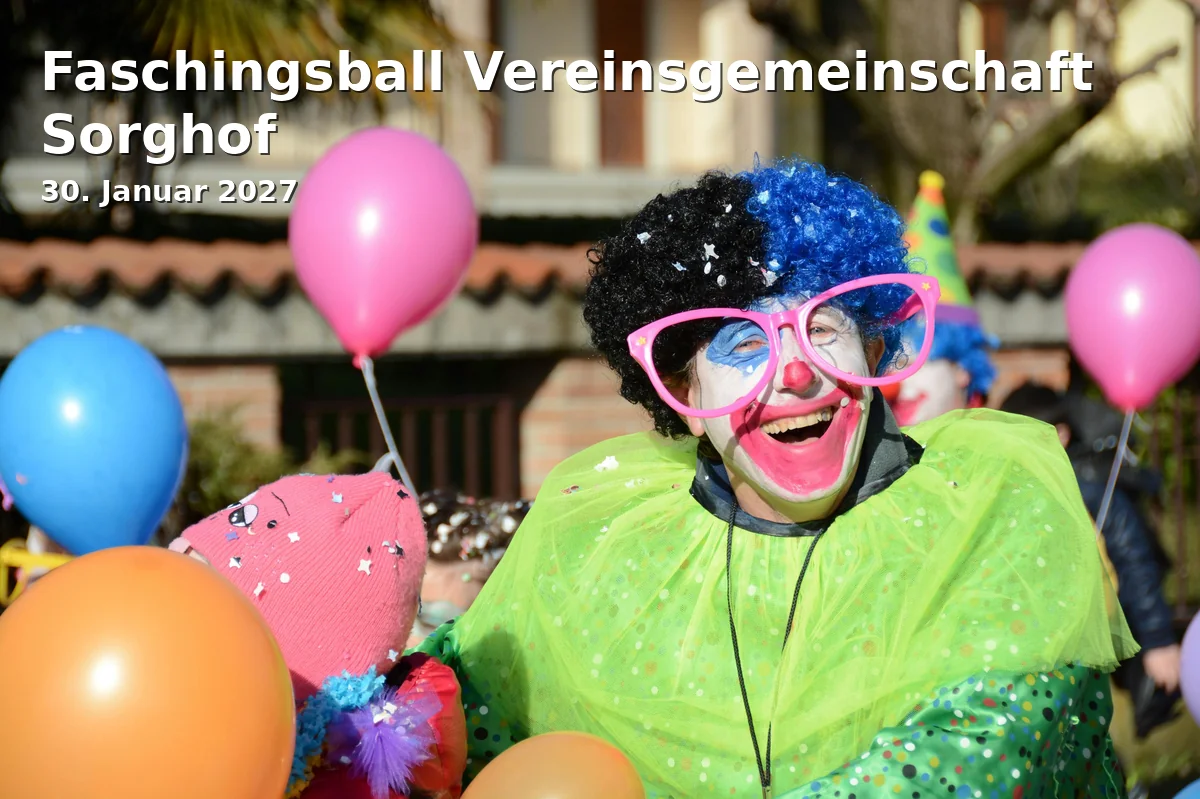
Carnival Ball Sorghof 2027
Sorghof becomes a carnival stronghold: A festive night with costumes, dance, and village party awaits in Wolfgangsheim. 30.01.2027, admission 7 euros. #Carnival
Carnival Ball Association Sorghof
Sorghof celebrates Carnival at Wolfgangsheim: local community, dance, and festive mood on 30.01.2027. An evening full of energy and party vibe. #Carnival
Frequently Asked Questions
Reviews
No reviews found