
Auf dem Mariahilfberg 3, Amberg
Auf dem Mariahilfberg 3, 92224 Amberg, Germany
Sanctuary of Maria Hilf | Pilgrimage Church & Mountain Festival
The pilgrimage church Maria Hilf on the Mariahilfberg is one of those destinations that fulfill several longings at once in Amberg: a place of silence, a piece of lived faith history, a baroque cultural monument, and a viewpoint with a wide view over the old town. The official website explicitly invites you to take a break from everyday life, discover the special architecture, stroll around the church, and enjoy the view over Amberg. The city and the tourist information also highlight the location above the old town as well as the strong panoramic view. This very mix makes the place so special: Maria Hilf is not only a religious center but also a destination for walkers, history enthusiasts, and visitors who want to experience Amberg from its most beautiful side. ([mariahilfberg-amberg.de](https://www.mariahilfberg-amberg.de/?utm_source=openai))
History of the Pilgrimage at Mariahilfberg
The history of Mariahilfberg is closely linked to the plague period of the 17th century. The plague raged particularly severely in Amberg in the years 1633 and 1634; on September 3, 1634, a statue of Mary was carried up the mountain in a solemn procession, after which the plague subsided. This tradition forms the origin of the pilgrimage and explains why Mariahilfberg is still considered an important Marian pilgrimage site today. Previously, the hill had a church function: the tower of the former castle was converted into a chapel, and shortly thereafter a round chapel was built after the model of the Lechfeld chapel. Later, the predecessor church burned down in 1646. The current church was then newly constructed starting in 1697 and completed in 1711. The subsequent Franciscan monastery is closely related to its founding history and is still part of the ensemble today. ([mariahilfberg-amberg.de](https://www.mariahilfberg-amberg.de/geschichte-428638.html))
This long development is the reason why the Maria Hilf Church is perceived not only as a local attraction but also as a spiritual center of the region. The official church description emphasizes that Mariahilfberg is still the largest Marian pilgrimage site in the Upper Palatinate today and that the main festival of the Visitation of Mary on July 2 is celebrated as a mountain festival for an entire week. Foot pilgrims come from the Upper Palatinate and even from Upper Franconia. The connection of crisis, gratitude, pilgrimage, and a fixed annual rhythm has shaped the place over centuries. Therefore, anyone visiting the mountain today experiences not only a beautiful church but also a place where city history, piety, and regional identity have condensed over several centuries. ([mariahilfberg-amberg.de](https://www.mariahilfberg-amberg.de/geschichte-428638.html))
Architecture, Frescoes, and Furnishings
Architecturally, Maria Hilf is an exceptionally characteristic baroque ensemble. The current pilgrimage church was begun according to plans by Wolfgang Dientzenhofer; due to the War of the Spanish Succession, the construction could only be completed in 1711. The church is not oriented in the usual east-west direction but is aligned to the northwest. The building description of the church foundation highlights the monumental staircase with a free altar that leads to the forecourt and further to the five-axial façade. The high base and the Ionic colossal pilasters give the front a distant effect, so that the church is perceived as a deliberately staged structure even from the ascent. This suits its function as a pilgrimage church: the way up is part of the experience, and the architecture enhances the impression of arrival and transition into a special space. ([mariahilfberg-amberg.de](https://www.mariahilfberg-amberg.de/geschichte-428638.html))
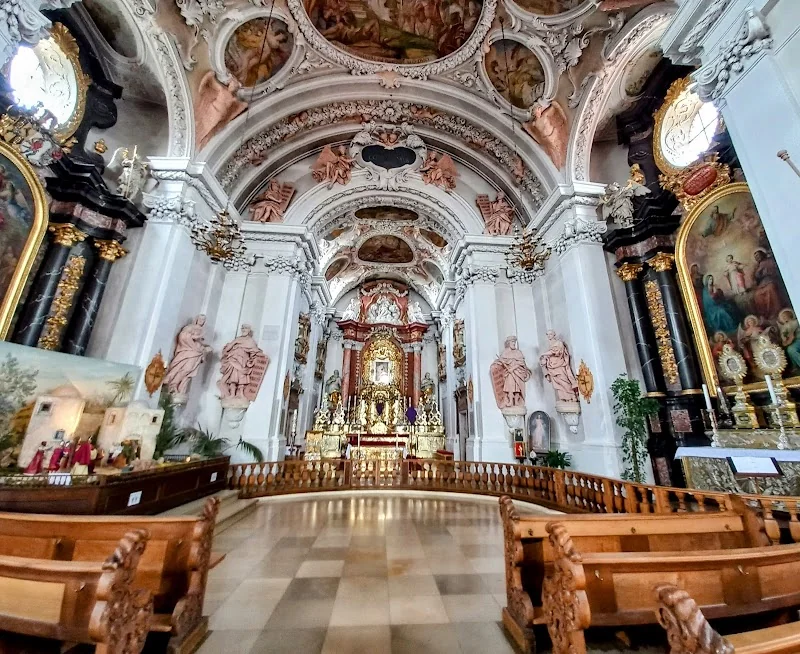
Inside, the full quality of the baroque furnishings is revealed. The church follows the popular baroque scheme of the wall pillar church. The heavy plastic stucco decoration is attributed to the Carlone workshop and frames the frescoes created by Cosmas Damian Asam. These ceiling paintings tell the story of the pilgrimage and set a continuous image cycle from the plague year 1634 through the transfer of the miraculous image to further scenes of Mary's life and the consecration of the church. In addition, there is the high altar from 1703 made of marble, stucco marble, and stucco, the precious framing of the miraculous image, the side altars, the pulpit from 1713, and the curved organ prospect from 1733. The miraculous image itself is described as a copy of a Marian depiction by Lucas Cranach. Together, this results in a furnishing that is not merely decorative but tells the story of the pilgrimage as a visual program. The city of Amberg explicitly honors the church as a stone monument of the Counter-Reformation. ([mariahilfberg-amberg.de](https://www.mariahilfberg-amberg.de/geschichte-428638.html))
Opening Hours, Services, and Visits
Maria Hilf is pleasantly uncomplicated to access for visitors. The official website of the pilgrimage church provides clear opening hours: daily from 6:30 AM to 6:00 PM, Saturdays from 8:30 AM, and during the mountain festival week from 6:00 AM to 10:00 PM. This makes the place suitable for both an early quiet visit in the morning and a detour in the afternoon or evening when the old town is already bathed in soft light. Those planning their visit should note that the times around holidays and special liturgical occasions may be extended. This makes the church a good destination for people looking for reliable visiting windows without losing the quiet character of the place. The official site conveys exactly this impression: open, welcoming, and explicitly intended as a place for a break. ([mariahilfberg-amberg.de](https://www.mariahilfberg-amberg.de/?utm_source=openai))
In addition to the church opening, there are indications on the contact page of the foundation regarding the monastery gate. There, the accessibility and the times of the monastery gate are listed: closed on Monday, Tuesday to Thursday at fixed afternoon and morning times, Friday mornings, and Saturday after the evening mass and Sunday after each service. Therefore, anyone with organizational questions or looking for the sacristan will find a clear framework for that. This is helpful for the visit itself, as spiritual peace and practical orientation can be well combined. Especially for travelers who want to explore Amberg in one day, it makes sense to plan the pilgrimage church not as an isolated point but as part of a larger round trip. The official site recommends walks around the church; this makes it clear that the visit is not only aimed at the interior but at the overall experience of path, expanse, silence, and view. ([mariahilfberg-amberg.de](https://www.mariahilfberg-amberg.de/kontakt-428765.html))
Access, Parking, and Ascent to Mariahilfberg
The location of the church is above the old town but is still easily accessible. A development plan of the city describes the access via the publicly dedicated mountain ascent, as well as via the extended Lindenallee, the Philosopher's Path, and the so-called steps path. From the west, the area is connected via the Schwammerl. The plan also mentions that the vehicle parking space is located in the adjacent church parking lot. For everyday life, this means: those arriving by car will find a structured access and parking space in the immediate vicinity, even if the hilly location naturally requires a bit more planning than a visit in the city center. At the same time, the plan shows that the area is not directly connected to public transport outside the mountain festival, and the nearest bus stops are several hundred meters away. ([amberg.de](https://amberg.de/fileadmin/Beteiligung/AM_153_Gaststaette_Mariahilfberg/Begruendung_zum_Bebauungsplanentwurf_Amberg_153_Sanierung_und_Erweiterung.pdf))
For pedestrians and cyclists, Mariahilfberg is particularly attractive because the path becomes part of the experience. The tourist information describes the ascent to the church as an approximately 150-meter-long climb, rewarded with a particularly beautiful view over Amberg. The same panoramic view is also highlighted in the photo spot section of the city: directly in front of the church, one has the most beautiful panoramic view over Amberg, especially at sunset. The place is therefore not only a destination but also a stage. Those coming up from the old town experience the transition from urban space to a quiet, green, and elevated perspective. This is precisely what makes the path so appealing for many visitors: the church is not a transit point but a deliberately reached viewpoint with a spiritual dimension. ([bavaria.travel](https://bavaria.travel/stories/amberg-sights-highlights/))
Mountain Festival, Pilgrimage, and Special Dates in the Annual Cycle
The mountain festival is one of the most important dates at Mariahilfberg. For 2026, the official website states the period from June 27 to July 5, 2026. The festival is thematically linked to the main festival of the Visitation of Mary on July 2, which is traditionally celebrated with pilgrimage, preaching, and food and drink. The tourist information describes the festival as an event that attracts many visitors every year and where the pilgrimage is combined with regional festival culture. This very mix is typical for Amberg: religious tradition, communal experience, and a strong sense of place and season. Those looking for a date in the summer should definitely keep an eye on the mountain festival period, as the visitor experience then differs significantly from a normal weekday. ([mariahilfberg-amberg.de](https://www.mariahilfberg-amberg.de/bergfest-743485.html))
Even outside the mountain festival, Mariahilfberg remains a place with a lively calendar. The foundation publishes current dates and special spiritual offers on its website, including a jubilee year of Saint Francis of Assisi for 2026 to 2027, as well as prayer and devotion formats. The city of Amberg also reports on the Forest Christmas Market around the pilgrimage church, where the place transforms into a particularly atmospheric backdrop in winter. It features hunting horn sounds, traditional offerings from the local forests, and a winter experience for families. Thus, Mariahilfberg presents itself differently in various seasons: in summer as a pilgrimage and festival site, in winter as an atmospheric venue for a special market. This versatility makes the location so interesting for visitors. ([mariahilfberg-amberg.de](https://www.mariahilfberg-amberg.de/das_jubilaeumsjahr_des_heiligen_franziskus_von_assisi-1280218.html?utm_source=openai))
View, Walks, and Photo Spots
Maria Hilf thrives not only on history and liturgy but also on its location. The official website invites you to take time for walks around the pilgrimage church and enjoy the view over the old town. The tourist information adds to this impression with a very concrete recommendation: directly in front of the church at Mariahilfberg, one has the most beautiful panoramic view over Amberg, especially at sunset. This makes the place interesting not only for those coming for the religious significance but also for those seeking a quiet moment with a view, photo, and cityscape. Particularly during the fringe hours of the day, the location unfolds a special atmosphere as light, expanse, and historical silhouette connect. ([mariahilfberg-amberg.de](https://www.mariahilfberg-amberg.de/?utm_source=openai))
The tourist perspective on Amberg also confirms the uniqueness of the hill. The Bavarian tourism site describes the Maria Hilf pilgrimage church as a baroque masterpiece high above the city and emphasizes that the approximately 150-meter-long ascent through autumn-colored forests is rewarded with a strong view. Thus, Mariahilfberg is not only a destination for pilgrims and art lovers but also a coherent starting or ending point for a city tour. Those who want to experience Amberg as a historical overall city ideally combine the visit with the old town, with walks, and perhaps with a second look in the evening when the roofs and towers are bathed in warm light. The combination of nature, city panorama, and baroque architecture is rarely experienced so compactly as here. ([bavaria.travel](https://bavaria.travel/stories/amberg-sights-highlights/))
Sources:
Show moreShow less
Sanctuary of Maria Hilf | Pilgrimage Church & Mountain Festival
The pilgrimage church Maria Hilf on the Mariahilfberg is one of those destinations that fulfill several longings at once in Amberg: a place of silence, a piece of lived faith history, a baroque cultural monument, and a viewpoint with a wide view over the old town. The official website explicitly invites you to take a break from everyday life, discover the special architecture, stroll around the church, and enjoy the view over Amberg. The city and the tourist information also highlight the location above the old town as well as the strong panoramic view. This very mix makes the place so special: Maria Hilf is not only a religious center but also a destination for walkers, history enthusiasts, and visitors who want to experience Amberg from its most beautiful side. ([mariahilfberg-amberg.de](https://www.mariahilfberg-amberg.de/?utm_source=openai))
History of the Pilgrimage at Mariahilfberg
The history of Mariahilfberg is closely linked to the plague period of the 17th century. The plague raged particularly severely in Amberg in the years 1633 and 1634; on September 3, 1634, a statue of Mary was carried up the mountain in a solemn procession, after which the plague subsided. This tradition forms the origin of the pilgrimage and explains why Mariahilfberg is still considered an important Marian pilgrimage site today. Previously, the hill had a church function: the tower of the former castle was converted into a chapel, and shortly thereafter a round chapel was built after the model of the Lechfeld chapel. Later, the predecessor church burned down in 1646. The current church was then newly constructed starting in 1697 and completed in 1711. The subsequent Franciscan monastery is closely related to its founding history and is still part of the ensemble today. ([mariahilfberg-amberg.de](https://www.mariahilfberg-amberg.de/geschichte-428638.html))
This long development is the reason why the Maria Hilf Church is perceived not only as a local attraction but also as a spiritual center of the region. The official church description emphasizes that Mariahilfberg is still the largest Marian pilgrimage site in the Upper Palatinate today and that the main festival of the Visitation of Mary on July 2 is celebrated as a mountain festival for an entire week. Foot pilgrims come from the Upper Palatinate and even from Upper Franconia. The connection of crisis, gratitude, pilgrimage, and a fixed annual rhythm has shaped the place over centuries. Therefore, anyone visiting the mountain today experiences not only a beautiful church but also a place where city history, piety, and regional identity have condensed over several centuries. ([mariahilfberg-amberg.de](https://www.mariahilfberg-amberg.de/geschichte-428638.html))
Architecture, Frescoes, and Furnishings
Architecturally, Maria Hilf is an exceptionally characteristic baroque ensemble. The current pilgrimage church was begun according to plans by Wolfgang Dientzenhofer; due to the War of the Spanish Succession, the construction could only be completed in 1711. The church is not oriented in the usual east-west direction but is aligned to the northwest. The building description of the church foundation highlights the monumental staircase with a free altar that leads to the forecourt and further to the five-axial façade. The high base and the Ionic colossal pilasters give the front a distant effect, so that the church is perceived as a deliberately staged structure even from the ascent. This suits its function as a pilgrimage church: the way up is part of the experience, and the architecture enhances the impression of arrival and transition into a special space. ([mariahilfberg-amberg.de](https://www.mariahilfberg-amberg.de/geschichte-428638.html))
Inside, the full quality of the baroque furnishings is revealed. The church follows the popular baroque scheme of the wall pillar church. The heavy plastic stucco decoration is attributed to the Carlone workshop and frames the frescoes created by Cosmas Damian Asam. These ceiling paintings tell the story of the pilgrimage and set a continuous image cycle from the plague year 1634 through the transfer of the miraculous image to further scenes of Mary's life and the consecration of the church. In addition, there is the high altar from 1703 made of marble, stucco marble, and stucco, the precious framing of the miraculous image, the side altars, the pulpit from 1713, and the curved organ prospect from 1733. The miraculous image itself is described as a copy of a Marian depiction by Lucas Cranach. Together, this results in a furnishing that is not merely decorative but tells the story of the pilgrimage as a visual program. The city of Amberg explicitly honors the church as a stone monument of the Counter-Reformation. ([mariahilfberg-amberg.de](https://www.mariahilfberg-amberg.de/geschichte-428638.html))
Opening Hours, Services, and Visits
Maria Hilf is pleasantly uncomplicated to access for visitors. The official website of the pilgrimage church provides clear opening hours: daily from 6:30 AM to 6:00 PM, Saturdays from 8:30 AM, and during the mountain festival week from 6:00 AM to 10:00 PM. This makes the place suitable for both an early quiet visit in the morning and a detour in the afternoon or evening when the old town is already bathed in soft light. Those planning their visit should note that the times around holidays and special liturgical occasions may be extended. This makes the church a good destination for people looking for reliable visiting windows without losing the quiet character of the place. The official site conveys exactly this impression: open, welcoming, and explicitly intended as a place for a break. ([mariahilfberg-amberg.de](https://www.mariahilfberg-amberg.de/?utm_source=openai))
In addition to the church opening, there are indications on the contact page of the foundation regarding the monastery gate. There, the accessibility and the times of the monastery gate are listed: closed on Monday, Tuesday to Thursday at fixed afternoon and morning times, Friday mornings, and Saturday after the evening mass and Sunday after each service. Therefore, anyone with organizational questions or looking for the sacristan will find a clear framework for that. This is helpful for the visit itself, as spiritual peace and practical orientation can be well combined. Especially for travelers who want to explore Amberg in one day, it makes sense to plan the pilgrimage church not as an isolated point but as part of a larger round trip. The official site recommends walks around the church; this makes it clear that the visit is not only aimed at the interior but at the overall experience of path, expanse, silence, and view. ([mariahilfberg-amberg.de](https://www.mariahilfberg-amberg.de/kontakt-428765.html))
Access, Parking, and Ascent to Mariahilfberg
The location of the church is above the old town but is still easily accessible. A development plan of the city describes the access via the publicly dedicated mountain ascent, as well as via the extended Lindenallee, the Philosopher's Path, and the so-called steps path. From the west, the area is connected via the Schwammerl. The plan also mentions that the vehicle parking space is located in the adjacent church parking lot. For everyday life, this means: those arriving by car will find a structured access and parking space in the immediate vicinity, even if the hilly location naturally requires a bit more planning than a visit in the city center. At the same time, the plan shows that the area is not directly connected to public transport outside the mountain festival, and the nearest bus stops are several hundred meters away. ([amberg.de](https://amberg.de/fileadmin/Beteiligung/AM_153_Gaststaette_Mariahilfberg/Begruendung_zum_Bebauungsplanentwurf_Amberg_153_Sanierung_und_Erweiterung.pdf))
For pedestrians and cyclists, Mariahilfberg is particularly attractive because the path becomes part of the experience. The tourist information describes the ascent to the church as an approximately 150-meter-long climb, rewarded with a particularly beautiful view over Amberg. The same panoramic view is also highlighted in the photo spot section of the city: directly in front of the church, one has the most beautiful panoramic view over Amberg, especially at sunset. The place is therefore not only a destination but also a stage. Those coming up from the old town experience the transition from urban space to a quiet, green, and elevated perspective. This is precisely what makes the path so appealing for many visitors: the church is not a transit point but a deliberately reached viewpoint with a spiritual dimension. ([bavaria.travel](https://bavaria.travel/stories/amberg-sights-highlights/))
Mountain Festival, Pilgrimage, and Special Dates in the Annual Cycle
The mountain festival is one of the most important dates at Mariahilfberg. For 2026, the official website states the period from June 27 to July 5, 2026. The festival is thematically linked to the main festival of the Visitation of Mary on July 2, which is traditionally celebrated with pilgrimage, preaching, and food and drink. The tourist information describes the festival as an event that attracts many visitors every year and where the pilgrimage is combined with regional festival culture. This very mix is typical for Amberg: religious tradition, communal experience, and a strong sense of place and season. Those looking for a date in the summer should definitely keep an eye on the mountain festival period, as the visitor experience then differs significantly from a normal weekday. ([mariahilfberg-amberg.de](https://www.mariahilfberg-amberg.de/bergfest-743485.html))
Even outside the mountain festival, Mariahilfberg remains a place with a lively calendar. The foundation publishes current dates and special spiritual offers on its website, including a jubilee year of Saint Francis of Assisi for 2026 to 2027, as well as prayer and devotion formats. The city of Amberg also reports on the Forest Christmas Market around the pilgrimage church, where the place transforms into a particularly atmospheric backdrop in winter. It features hunting horn sounds, traditional offerings from the local forests, and a winter experience for families. Thus, Mariahilfberg presents itself differently in various seasons: in summer as a pilgrimage and festival site, in winter as an atmospheric venue for a special market. This versatility makes the location so interesting for visitors. ([mariahilfberg-amberg.de](https://www.mariahilfberg-amberg.de/das_jubilaeumsjahr_des_heiligen_franziskus_von_assisi-1280218.html?utm_source=openai))
View, Walks, and Photo Spots
Maria Hilf thrives not only on history and liturgy but also on its location. The official website invites you to take time for walks around the pilgrimage church and enjoy the view over the old town. The tourist information adds to this impression with a very concrete recommendation: directly in front of the church at Mariahilfberg, one has the most beautiful panoramic view over Amberg, especially at sunset. This makes the place interesting not only for those coming for the religious significance but also for those seeking a quiet moment with a view, photo, and cityscape. Particularly during the fringe hours of the day, the location unfolds a special atmosphere as light, expanse, and historical silhouette connect. ([mariahilfberg-amberg.de](https://www.mariahilfberg-amberg.de/?utm_source=openai))
The tourist perspective on Amberg also confirms the uniqueness of the hill. The Bavarian tourism site describes the Maria Hilf pilgrimage church as a baroque masterpiece high above the city and emphasizes that the approximately 150-meter-long ascent through autumn-colored forests is rewarded with a strong view. Thus, Mariahilfberg is not only a destination for pilgrims and art lovers but also a coherent starting or ending point for a city tour. Those who want to experience Amberg as a historical overall city ideally combine the visit with the old town, with walks, and perhaps with a second look in the evening when the roofs and towers are bathed in warm light. The combination of nature, city panorama, and baroque architecture is rarely experienced so compactly as here. ([bavaria.travel](https://bavaria.travel/stories/amberg-sights-highlights/))
Sources:
Sanctuary of Maria Hilf | Pilgrimage Church & Mountain Festival
The pilgrimage church Maria Hilf on the Mariahilfberg is one of those destinations that fulfill several longings at once in Amberg: a place of silence, a piece of lived faith history, a baroque cultural monument, and a viewpoint with a wide view over the old town. The official website explicitly invites you to take a break from everyday life, discover the special architecture, stroll around the church, and enjoy the view over Amberg. The city and the tourist information also highlight the location above the old town as well as the strong panoramic view. This very mix makes the place so special: Maria Hilf is not only a religious center but also a destination for walkers, history enthusiasts, and visitors who want to experience Amberg from its most beautiful side. ([mariahilfberg-amberg.de](https://www.mariahilfberg-amberg.de/?utm_source=openai))
History of the Pilgrimage at Mariahilfberg
The history of Mariahilfberg is closely linked to the plague period of the 17th century. The plague raged particularly severely in Amberg in the years 1633 and 1634; on September 3, 1634, a statue of Mary was carried up the mountain in a solemn procession, after which the plague subsided. This tradition forms the origin of the pilgrimage and explains why Mariahilfberg is still considered an important Marian pilgrimage site today. Previously, the hill had a church function: the tower of the former castle was converted into a chapel, and shortly thereafter a round chapel was built after the model of the Lechfeld chapel. Later, the predecessor church burned down in 1646. The current church was then newly constructed starting in 1697 and completed in 1711. The subsequent Franciscan monastery is closely related to its founding history and is still part of the ensemble today. ([mariahilfberg-amberg.de](https://www.mariahilfberg-amberg.de/geschichte-428638.html))
This long development is the reason why the Maria Hilf Church is perceived not only as a local attraction but also as a spiritual center of the region. The official church description emphasizes that Mariahilfberg is still the largest Marian pilgrimage site in the Upper Palatinate today and that the main festival of the Visitation of Mary on July 2 is celebrated as a mountain festival for an entire week. Foot pilgrims come from the Upper Palatinate and even from Upper Franconia. The connection of crisis, gratitude, pilgrimage, and a fixed annual rhythm has shaped the place over centuries. Therefore, anyone visiting the mountain today experiences not only a beautiful church but also a place where city history, piety, and regional identity have condensed over several centuries. ([mariahilfberg-amberg.de](https://www.mariahilfberg-amberg.de/geschichte-428638.html))
Architecture, Frescoes, and Furnishings
Architecturally, Maria Hilf is an exceptionally characteristic baroque ensemble. The current pilgrimage church was begun according to plans by Wolfgang Dientzenhofer; due to the War of the Spanish Succession, the construction could only be completed in 1711. The church is not oriented in the usual east-west direction but is aligned to the northwest. The building description of the church foundation highlights the monumental staircase with a free altar that leads to the forecourt and further to the five-axial façade. The high base and the Ionic colossal pilasters give the front a distant effect, so that the church is perceived as a deliberately staged structure even from the ascent. This suits its function as a pilgrimage church: the way up is part of the experience, and the architecture enhances the impression of arrival and transition into a special space. ([mariahilfberg-amberg.de](https://www.mariahilfberg-amberg.de/geschichte-428638.html))
Inside, the full quality of the baroque furnishings is revealed. The church follows the popular baroque scheme of the wall pillar church. The heavy plastic stucco decoration is attributed to the Carlone workshop and frames the frescoes created by Cosmas Damian Asam. These ceiling paintings tell the story of the pilgrimage and set a continuous image cycle from the plague year 1634 through the transfer of the miraculous image to further scenes of Mary's life and the consecration of the church. In addition, there is the high altar from 1703 made of marble, stucco marble, and stucco, the precious framing of the miraculous image, the side altars, the pulpit from 1713, and the curved organ prospect from 1733. The miraculous image itself is described as a copy of a Marian depiction by Lucas Cranach. Together, this results in a furnishing that is not merely decorative but tells the story of the pilgrimage as a visual program. The city of Amberg explicitly honors the church as a stone monument of the Counter-Reformation. ([mariahilfberg-amberg.de](https://www.mariahilfberg-amberg.de/geschichte-428638.html))
Opening Hours, Services, and Visits
Maria Hilf is pleasantly uncomplicated to access for visitors. The official website of the pilgrimage church provides clear opening hours: daily from 6:30 AM to 6:00 PM, Saturdays from 8:30 AM, and during the mountain festival week from 6:00 AM to 10:00 PM. This makes the place suitable for both an early quiet visit in the morning and a detour in the afternoon or evening when the old town is already bathed in soft light. Those planning their visit should note that the times around holidays and special liturgical occasions may be extended. This makes the church a good destination for people looking for reliable visiting windows without losing the quiet character of the place. The official site conveys exactly this impression: open, welcoming, and explicitly intended as a place for a break. ([mariahilfberg-amberg.de](https://www.mariahilfberg-amberg.de/?utm_source=openai))
In addition to the church opening, there are indications on the contact page of the foundation regarding the monastery gate. There, the accessibility and the times of the monastery gate are listed: closed on Monday, Tuesday to Thursday at fixed afternoon and morning times, Friday mornings, and Saturday after the evening mass and Sunday after each service. Therefore, anyone with organizational questions or looking for the sacristan will find a clear framework for that. This is helpful for the visit itself, as spiritual peace and practical orientation can be well combined. Especially for travelers who want to explore Amberg in one day, it makes sense to plan the pilgrimage church not as an isolated point but as part of a larger round trip. The official site recommends walks around the church; this makes it clear that the visit is not only aimed at the interior but at the overall experience of path, expanse, silence, and view. ([mariahilfberg-amberg.de](https://www.mariahilfberg-amberg.de/kontakt-428765.html))
Access, Parking, and Ascent to Mariahilfberg
The location of the church is above the old town but is still easily accessible. A development plan of the city describes the access via the publicly dedicated mountain ascent, as well as via the extended Lindenallee, the Philosopher's Path, and the so-called steps path. From the west, the area is connected via the Schwammerl. The plan also mentions that the vehicle parking space is located in the adjacent church parking lot. For everyday life, this means: those arriving by car will find a structured access and parking space in the immediate vicinity, even if the hilly location naturally requires a bit more planning than a visit in the city center. At the same time, the plan shows that the area is not directly connected to public transport outside the mountain festival, and the nearest bus stops are several hundred meters away. ([amberg.de](https://amberg.de/fileadmin/Beteiligung/AM_153_Gaststaette_Mariahilfberg/Begruendung_zum_Bebauungsplanentwurf_Amberg_153_Sanierung_und_Erweiterung.pdf))
For pedestrians and cyclists, Mariahilfberg is particularly attractive because the path becomes part of the experience. The tourist information describes the ascent to the church as an approximately 150-meter-long climb, rewarded with a particularly beautiful view over Amberg. The same panoramic view is also highlighted in the photo spot section of the city: directly in front of the church, one has the most beautiful panoramic view over Amberg, especially at sunset. The place is therefore not only a destination but also a stage. Those coming up from the old town experience the transition from urban space to a quiet, green, and elevated perspective. This is precisely what makes the path so appealing for many visitors: the church is not a transit point but a deliberately reached viewpoint with a spiritual dimension. ([bavaria.travel](https://bavaria.travel/stories/amberg-sights-highlights/))
Mountain Festival, Pilgrimage, and Special Dates in the Annual Cycle
The mountain festival is one of the most important dates at Mariahilfberg. For 2026, the official website states the period from June 27 to July 5, 2026. The festival is thematically linked to the main festival of the Visitation of Mary on July 2, which is traditionally celebrated with pilgrimage, preaching, and food and drink. The tourist information describes the festival as an event that attracts many visitors every year and where the pilgrimage is combined with regional festival culture. This very mix is typical for Amberg: religious tradition, communal experience, and a strong sense of place and season. Those looking for a date in the summer should definitely keep an eye on the mountain festival period, as the visitor experience then differs significantly from a normal weekday. ([mariahilfberg-amberg.de](https://www.mariahilfberg-amberg.de/bergfest-743485.html))
Even outside the mountain festival, Mariahilfberg remains a place with a lively calendar. The foundation publishes current dates and special spiritual offers on its website, including a jubilee year of Saint Francis of Assisi for 2026 to 2027, as well as prayer and devotion formats. The city of Amberg also reports on the Forest Christmas Market around the pilgrimage church, where the place transforms into a particularly atmospheric backdrop in winter. It features hunting horn sounds, traditional offerings from the local forests, and a winter experience for families. Thus, Mariahilfberg presents itself differently in various seasons: in summer as a pilgrimage and festival site, in winter as an atmospheric venue for a special market. This versatility makes the location so interesting for visitors. ([mariahilfberg-amberg.de](https://www.mariahilfberg-amberg.de/das_jubilaeumsjahr_des_heiligen_franziskus_von_assisi-1280218.html?utm_source=openai))
View, Walks, and Photo Spots
Maria Hilf thrives not only on history and liturgy but also on its location. The official website invites you to take time for walks around the pilgrimage church and enjoy the view over the old town. The tourist information adds to this impression with a very concrete recommendation: directly in front of the church at Mariahilfberg, one has the most beautiful panoramic view over Amberg, especially at sunset. This makes the place interesting not only for those coming for the religious significance but also for those seeking a quiet moment with a view, photo, and cityscape. Particularly during the fringe hours of the day, the location unfolds a special atmosphere as light, expanse, and historical silhouette connect. ([mariahilfberg-amberg.de](https://www.mariahilfberg-amberg.de/?utm_source=openai))
The tourist perspective on Amberg also confirms the uniqueness of the hill. The Bavarian tourism site describes the Maria Hilf pilgrimage church as a baroque masterpiece high above the city and emphasizes that the approximately 150-meter-long ascent through autumn-colored forests is rewarded with a strong view. Thus, Mariahilfberg is not only a destination for pilgrims and art lovers but also a coherent starting or ending point for a city tour. Those who want to experience Amberg as a historical overall city ideally combine the visit with the old town, with walks, and perhaps with a second look in the evening when the roofs and towers are bathed in warm light. The combination of nature, city panorama, and baroque architecture is rarely experienced so compactly as here. ([bavaria.travel](https://bavaria.travel/stories/amberg-sights-highlights/))
Sources:
Frequently Asked Questions
Reviews
david antoun
16. November 2025
To save the people from the plague in the 17th century, the miraculous image was brought, and the church was built to thank the holy Mary. A baroque pilgrimage church from the end of the 17th century. It’s located on top of the mountain instead of the old castle and overlooks Amberg. A must-see attraction in the area.
Anibal Pacheco
11. November 2024
I enjoyed hiking up to this peaceful place of worship above the city of Amberg. After going to the top via the side staircases, you can enjoy breathtaking views of the city. I went on a weekday, and there was hardly anyone on site other than the groundskeepers and office personnel. However, you can feel God's presence throughout, and there is a strong sense of connection to our Virgin Mary, mother of Jesus.
John Sabala
14. July 2019
The restaurant is always a great place to go and have a meal or coffee with dessert. On Sunday, they serve an amazing duck entree. It’s best to make reservations on the weekend. You’ll need to go soon as the place is going to close due to some contract issue with the church. A great place for a view and to visit the church and surrounding area. Highly recommended.
David Abrahams
27. May 2024
Nestled on a hilltop in a forest behind the old town of Amberg, this Maria Saviour church is remarkable for its detailed internal decorative work and craftsmanship. Make sure you go in through the big beautiful wooden door and be amazed by the pictorial beauty.
Mel Allred
2. October 2020
The Sanctuary is situated upon a hill providing not only a captivatingly elegant cathedral and grounds but a beautiful elevated view of Amberg, and a very lovely old forest on the opposite side of the parking lot in which to walk and contemplate.