
Paulanerpl. 2, Amberg
Paulanerpl. 2, 92224 Amberg, Germany
Paulanerkirche Amberg | Services & Events
The Paulanerkirche Amberg is much more than a historic place of worship in the old town: it is the main Protestant church of a community that fills its place with life, music, prayer, and encounters. Those looking for the church will find it in a densely built urban environment shaped by the history of Amberg, which is still characterized by short distances, old squares, and a vibrant community life. The official community describes the Paulanerkirche as a central place for services, events, groups, and church support in everyday life. The city of Amberg, in turn, emphasizes the long, eventful history of the building, which has undergone many transformations from the Paulaner order through secularization and profanation to Protestant use. It is precisely this connection of historical depth and lived present that makes the Paulanerkirche so interesting for visitors: it is a monument, a community church, an event venue, and an identity-forming center all at once. Those interested in Baroque architecture, Protestant church spaces, organ music, or the history of the Amberg old town will find a place here where all of this comes together. ([amberg.de](https://amberg.de/kultourismus/heimat-tradition/bauten-denkmaeler/kirchen/paulanerkirche))
Services, Holidays, and Community Life
At the center of the Paulanerkirche is still the service. The community itself emphasizes that services are a central part of community life and that special forms of celebration are explicitly included. The church's website lists the regular services on Sundays and holidays at 9:30 AM; additionally, there are fixed liturgical forms such as Holy Communion on the first Sunday of the month and church coffee on the fourth Sunday of the month. Thus, the Paulanerkirche is not only a place for Sunday visits but also a reliable meeting point throughout the entire church year. Additionally, there are baptism services by arrangement, confirmation services, family offerings, and thematic formats aimed at different generations. Particularly important is the mix of classical liturgy and open community culture: those seeking peace, familiarity, and a clear spiritual framework will find a place here, just as those who seek access to the church through music, family formats, or special services. The community utilizes various spaces and connects the Paulanerkirche with other service locations and community houses in the city area. ([paulanerkirche-amberg.de](https://www.paulanerkirche-amberg.de/ihr-weg-zu-uns/paulanerkirche/))
The variety of offerings also shows that church does not only take place on Sundays. The Paulanerkirche's website refers to events, concerts, lectures, and groups for children, teenagers, families, adults, and seniors. This makes the church a place where faith is not understood as an isolated event but as a social and cultural process. Those searching for terms like Paulanerkirche services, Paulanerkirche Amberg services, or family service Amberg are often looking for a place where church is reliably, accessibly, and diversely experienced. Exactly this is what the community in Amberg offers: a clearly recognizable liturgical home with an open program for different needs. The community describes itself as a fellowship where people meet each other, see each other in services, become active in groups and circles, and find support in all areas of life. This mix of tradition and present is one of the main reasons why the Paulanerkirche in Amberg functions as a lively meeting point and is not only perceived as a historic building. ([paulanerkirche-amberg.de](https://www.paulanerkirche-amberg.de/))
History of the Paulanerkirche in Amberg
The history of the Paulanerkirche begins with the Paulaner order, which came to Amberg in 1652. The city of Amberg describes the long period between the arrival of the fathers and the later construction of the monastery and names Wolfgang Dientzenhofer as the planner of the complex. For the church itself, the city refers to the construction period from 1717 to 1719; the community describes it as a monastery church that was planned at the end of the 17th century and later completed. Both representations share the fact that the church emerged from the environment of a Paulaner monastery and was dedicated to Saint Joseph. It exemplifies those Baroque church buildings in Bavaria that arose from monastic functions and later lost their original purpose due to the political and ecclesiastical upheaval of secularization. The city and the community together depict a building that must not be understood as a static monument but as a structure with breaks, repurposings, and reappropriations. This history explains why the Paulanerkirche today is both a historical memory and an active community church. ([amberg.de](https://amberg.de/kultourismus/heimat-tradition/bauten-denkmaeler/kirchen/paulanerkirche))
After the secularization of 1802, the use changed radically. The building was profaned, the furnishings sold, and the sacred space initially received entirely secular functions. The city of Amberg mentions a use as a salt store; the community describes that the entire interior was removed, a false ceiling was installed, and the towers were demolished, turning the church into a warehouse. It was not until 1851 that the upper floor of the newly founded Protestant community was allowed to be used for services. In 1862, the community purchased the entire church, and shortly thereafter it was elevated to a parish. A comprehensive renovation in 1888 brought the space back to life as a Protestant city parish church. In the 20th century, further changes followed, including redesigns of the post-war period and later reflections on a simpler spatial effect. Today, according to the community, the Paulanerkirche presents itself as a bright, deliberately simply designed space, where the past is not erased but preserved in traces. Therefore, those searching for the history of the Paulanerkirche will not discover a linear success story but the exciting development of a building that has been reinvented multiple times and precisely because of this tells so much. ([amberg.de](https://amberg.de/kultourismus/heimat-tradition/bauten-denkmaeler/kirchen/paulanerkirche))
Architecture, Interior, and Baroque Traces
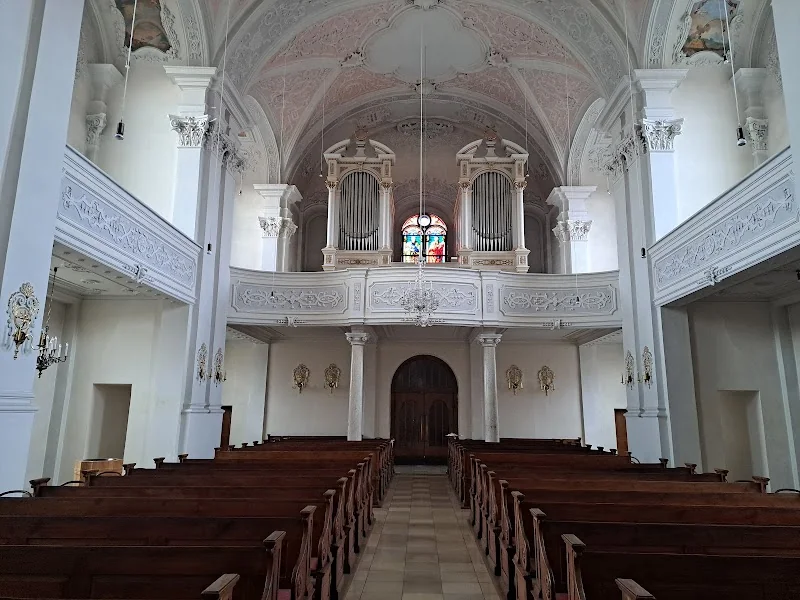
Architecturally, the Paulanerkirche is a structure with clear Baroque references and a remarkable layering of epochs. The community describes the original monastery church with two facade towers, a small organ loft, the so-called swallow's nest, and ceiling paintings depicting the life of Saint Joseph. Here lies a significant appeal of the building: it was not only designed once but has been changed, reduced, and re-staged multiple times over the centuries. The current tower dates from the second half of the 19th century, after the Protestant community acquired the building. The city of Amberg and the community also emphasize that after the renovation of 1888, part of the former spatial impression was restored in a neo-Baroque style. At the same time, larger windows and a surrounding gallery made the space more functional and brighter for the new Protestant use. This connects the church's Baroque origins with Protestant spatial concepts: less abundance, more clarity, but still a historically grown aura. For visitors, this tension is both visible and palpable. ([paulanerkirche-amberg.de](https://www.paulanerkirche-amberg.de/ihr-weg-zu-uns/paulanerkirche/))
The current interior appears, according to the community, light and simple, yet the past is not gone. The community has consciously preserved existing remnants of older designs, including earlier altar paintings, retables, and other elements that can today be found in the parish office, community house, or other church spaces of the community. The ceiling paintings from the early 20th century also play a role in the memory of the space, as do the alterations of the 1950s and the later distancing from these decisions. For SEO-relevant search queries like Baroque church Amberg or Paulanerkirche photos, it is particularly important to know: the church is not a museum-frozen Baroque space, but a historically grown place with traces of various epochs. This makes the Paulanerkirche interesting for architecture enthusiasts because one can read the consequences of monastic time, secularization, Protestant repurposing, and modern community practice from a single building. Upon entering the church, one sees not just a space but a piece of religious and urban history of Amberg translated into built form. ([paulanerkirche-amberg.de](https://www.paulanerkirche-amberg.de/ihr-weg-zu-uns/paulanerkirche/))
Organ, Music, and Events in the Paulanerkirche
A central profile feature of the Paulanerkirche is its church music. On the website, the community dedicates a separate page to the organ and describes the development of the instrument very precisely. The current Hey organ was commissioned in 1985, has three manuals and 39 speaking stops, and continues to use the historical case as well as a large part of the old pipe stock. This stands for a conscious handling of tradition: the historically grown was not simply replaced but elevated to a new level sonically and technically. In 2010, there was another renovation of the register structure, supplemented by additional timbres such as a trumpet 8 feet in the pedal and a zimbelstern. For smaller services and concerts, there is also a portable chest organ from the year 2000 that can be used flexibly. For search queries like Paulanerkirche organ or music in the church, this is particularly relevant because the church is much more than a pure sacred space: it is a place for sonic diversity, liturgical accompaniment, and demanding church music. ([paulanerkirche-amberg.de](https://www.paulanerkirche-amberg.de/musik-in-der-kirche/orgel/))
The musical work does not stop at the organ. The community points to a wide range of offerings with a choir, brass choir, gospel choir, children's choir, sparrow choir, motet choir, flute circle, and other formats. The homepage explicitly mentions that the community organizes different events throughout the year, from concerts to lectures. The events page also shows that the Paulaner community uses its church and the associated spaces for a versatile program that includes services, musical offerings, exhibitions, spiritual formats, and educational offerings. Therefore, those searching for Paulanerkirche events will find not only liturgical dates but also an active community culture with cultural breadth. This is important for the external perception of the location: the Paulanerkirche is not just a historical point on the city map but a place where singing, making music, discussing, and celebrating regularly takes place. It is precisely the combination of sacred acoustics, historical backdrop, and vibrant musical work that makes the Paulanerkirche a special event venue in the Protestant context of the Upper Palatinate. ([paulanerkirche-amberg.de](https://www.paulanerkirche-amberg.de/musik-in-der-kirche/))
Directions, Parking, and Practical Information
For visitors, the location of the Paulanerkirche is a real advantage: it is located in the Amberg old town and is thus well integrated into the historic city center. The official address of the church is Paulanergasse 12 in 92224 Amberg; the community's pages also describe the surroundings around Paulanerplatz and other church buildings. Those arriving by car will find various parking options in the city center. The city of Amberg indicates 636 parking spaces in the old town. Particularly important for orientation are the old town-adjacent parking garages and parking lots: the parking garage at Ziegeltor with 257 parking spaces, the parking garage at Kurfürstenbad with 242 parking spaces, the old town garage with 191 parking spaces, the theater garage with 112 parking spaces, and the parking garage Marienstraße with 860 parking spaces. Thus, the Paulanerkirche is very well integrated into the city's parking infrastructure, although one should naturally plan the visit to the old town with some time for the walk. ([paulanerkirche-amberg.de](https://www.paulanerkirche-amberg.de/ihr-weg-zu-uns/paulanerkirche/))
The city of Amberg also offers mobile parking via app or SMS throughout the old town area. This is convenient for anyone who is just stopping by the church, a concert, or a conversation in the parish office. Additionally, the city indicates 13 disabled parking spaces in the old town and designates motorcycle parking areas, among others, at Hallplatz, Roßmarkt, and Malteserplatz. For visitors with limited mobility, not only the church itself but also the surrounding area is generally well accessible. Because the Paulanerkirche is located in the midst of the grown urban fabric, a combined visit is also worthwhile: first church and service or concert, then a walk through the historic old town. Those searching for directions to Paulanerkirche Amberg or parking at Paulanerplatz are primarily looking for a convenient mix of centrality and good accessibility. Exactly that is what the location offers. The city of Amberg makes it clear that parking in the old town is regulated but clearly organized; this significantly eases the planning for a relaxed visit to the church. ([amberg.de](https://amberg.de/parken))
Parish Office, Contact, and Visiting Tips
Those who want to not only look at the Paulanerkirche but also use it practically will find reliable contact information on the official website. The parish office is located at Paulanergasse 12, 92224 Amberg; the community provides the phone number 09621-48590, the email address paulanerkirche.amberg@elkb.de, and the current office hours. This is helpful for planning and scheduling appointments, such as for baptism services, confirmation questions, weddings, counseling, or other personal concerns. The community emphasizes that support throughout life is a firm part of its self-understanding. This makes the church a credible place: it is not only there for Sundays but also for life transitions and conversations. Those wishing to contact the community will also find further areas on the website, such as groups, children's and youth work, senior offerings, and church music information. Thus, the Paulanerkirche is interesting not only for tourists but also for people looking for a reliable church contact point in Amberg. ([paulanerkirche-amberg.de](https://www.paulanerkirche-amberg.de/ihr-weg-zu-uns/paulanerkirche/))
For the visit itself, a quick look at the current service and event calendar is worthwhile, as the community publishes not only the regular Sunday services but also special formats, music projects, and seasonal offerings. The events page makes it clear that dates can be filtered by target groups, categories, and dates, making planning easy. Therefore, those visiting the Paulanerkirche for a special celebration, concert, family service, or spiritual offering should check the current overview. Particularly for search queries like Paulanerkirche Christmas Eve, Paulanerkirche Holy Mass, or Paulanerkirche Vienna services, it is important to know that this is the main Protestant church in Amberg and that the current plan of the community is decisive. The church thus combines reliable liturgy, historical ambiance, and an active community life. For visitors, this means: one does not come to a silent monument but to a lively place where one can experience history, music, and the present in close proximity. This mix makes the Paulanerkirche Amberg a worthwhile destination for urban explorers, community members, and culture enthusiasts alike. ([paulanerkirche-amberg.de](https://www.paulanerkirche-amberg.de/veranstaltungen/))
Sources:
Show moreShow less
Paulanerkirche Amberg | Services & Events
The Paulanerkirche Amberg is much more than a historic place of worship in the old town: it is the main Protestant church of a community that fills its place with life, music, prayer, and encounters. Those looking for the church will find it in a densely built urban environment shaped by the history of Amberg, which is still characterized by short distances, old squares, and a vibrant community life. The official community describes the Paulanerkirche as a central place for services, events, groups, and church support in everyday life. The city of Amberg, in turn, emphasizes the long, eventful history of the building, which has undergone many transformations from the Paulaner order through secularization and profanation to Protestant use. It is precisely this connection of historical depth and lived present that makes the Paulanerkirche so interesting for visitors: it is a monument, a community church, an event venue, and an identity-forming center all at once. Those interested in Baroque architecture, Protestant church spaces, organ music, or the history of the Amberg old town will find a place here where all of this comes together. ([amberg.de](https://amberg.de/kultourismus/heimat-tradition/bauten-denkmaeler/kirchen/paulanerkirche))
Services, Holidays, and Community Life
At the center of the Paulanerkirche is still the service. The community itself emphasizes that services are a central part of community life and that special forms of celebration are explicitly included. The church's website lists the regular services on Sundays and holidays at 9:30 AM; additionally, there are fixed liturgical forms such as Holy Communion on the first Sunday of the month and church coffee on the fourth Sunday of the month. Thus, the Paulanerkirche is not only a place for Sunday visits but also a reliable meeting point throughout the entire church year. Additionally, there are baptism services by arrangement, confirmation services, family offerings, and thematic formats aimed at different generations. Particularly important is the mix of classical liturgy and open community culture: those seeking peace, familiarity, and a clear spiritual framework will find a place here, just as those who seek access to the church through music, family formats, or special services. The community utilizes various spaces and connects the Paulanerkirche with other service locations and community houses in the city area. ([paulanerkirche-amberg.de](https://www.paulanerkirche-amberg.de/ihr-weg-zu-uns/paulanerkirche/))
The variety of offerings also shows that church does not only take place on Sundays. The Paulanerkirche's website refers to events, concerts, lectures, and groups for children, teenagers, families, adults, and seniors. This makes the church a place where faith is not understood as an isolated event but as a social and cultural process. Those searching for terms like Paulanerkirche services, Paulanerkirche Amberg services, or family service Amberg are often looking for a place where church is reliably, accessibly, and diversely experienced. Exactly this is what the community in Amberg offers: a clearly recognizable liturgical home with an open program for different needs. The community describes itself as a fellowship where people meet each other, see each other in services, become active in groups and circles, and find support in all areas of life. This mix of tradition and present is one of the main reasons why the Paulanerkirche in Amberg functions as a lively meeting point and is not only perceived as a historic building. ([paulanerkirche-amberg.de](https://www.paulanerkirche-amberg.de/))
History of the Paulanerkirche in Amberg
The history of the Paulanerkirche begins with the Paulaner order, which came to Amberg in 1652. The city of Amberg describes the long period between the arrival of the fathers and the later construction of the monastery and names Wolfgang Dientzenhofer as the planner of the complex. For the church itself, the city refers to the construction period from 1717 to 1719; the community describes it as a monastery church that was planned at the end of the 17th century and later completed. Both representations share the fact that the church emerged from the environment of a Paulaner monastery and was dedicated to Saint Joseph. It exemplifies those Baroque church buildings in Bavaria that arose from monastic functions and later lost their original purpose due to the political and ecclesiastical upheaval of secularization. The city and the community together depict a building that must not be understood as a static monument but as a structure with breaks, repurposings, and reappropriations. This history explains why the Paulanerkirche today is both a historical memory and an active community church. ([amberg.de](https://amberg.de/kultourismus/heimat-tradition/bauten-denkmaeler/kirchen/paulanerkirche))
After the secularization of 1802, the use changed radically. The building was profaned, the furnishings sold, and the sacred space initially received entirely secular functions. The city of Amberg mentions a use as a salt store; the community describes that the entire interior was removed, a false ceiling was installed, and the towers were demolished, turning the church into a warehouse. It was not until 1851 that the upper floor of the newly founded Protestant community was allowed to be used for services. In 1862, the community purchased the entire church, and shortly thereafter it was elevated to a parish. A comprehensive renovation in 1888 brought the space back to life as a Protestant city parish church. In the 20th century, further changes followed, including redesigns of the post-war period and later reflections on a simpler spatial effect. Today, according to the community, the Paulanerkirche presents itself as a bright, deliberately simply designed space, where the past is not erased but preserved in traces. Therefore, those searching for the history of the Paulanerkirche will not discover a linear success story but the exciting development of a building that has been reinvented multiple times and precisely because of this tells so much. ([amberg.de](https://amberg.de/kultourismus/heimat-tradition/bauten-denkmaeler/kirchen/paulanerkirche))
Architecture, Interior, and Baroque Traces
Architecturally, the Paulanerkirche is a structure with clear Baroque references and a remarkable layering of epochs. The community describes the original monastery church with two facade towers, a small organ loft, the so-called swallow's nest, and ceiling paintings depicting the life of Saint Joseph. Here lies a significant appeal of the building: it was not only designed once but has been changed, reduced, and re-staged multiple times over the centuries. The current tower dates from the second half of the 19th century, after the Protestant community acquired the building. The city of Amberg and the community also emphasize that after the renovation of 1888, part of the former spatial impression was restored in a neo-Baroque style. At the same time, larger windows and a surrounding gallery made the space more functional and brighter for the new Protestant use. This connects the church's Baroque origins with Protestant spatial concepts: less abundance, more clarity, but still a historically grown aura. For visitors, this tension is both visible and palpable. ([paulanerkirche-amberg.de](https://www.paulanerkirche-amberg.de/ihr-weg-zu-uns/paulanerkirche/))
The current interior appears, according to the community, light and simple, yet the past is not gone. The community has consciously preserved existing remnants of older designs, including earlier altar paintings, retables, and other elements that can today be found in the parish office, community house, or other church spaces of the community. The ceiling paintings from the early 20th century also play a role in the memory of the space, as do the alterations of the 1950s and the later distancing from these decisions. For SEO-relevant search queries like Baroque church Amberg or Paulanerkirche photos, it is particularly important to know: the church is not a museum-frozen Baroque space, but a historically grown place with traces of various epochs. This makes the Paulanerkirche interesting for architecture enthusiasts because one can read the consequences of monastic time, secularization, Protestant repurposing, and modern community practice from a single building. Upon entering the church, one sees not just a space but a piece of religious and urban history of Amberg translated into built form. ([paulanerkirche-amberg.de](https://www.paulanerkirche-amberg.de/ihr-weg-zu-uns/paulanerkirche/))
Organ, Music, and Events in the Paulanerkirche
A central profile feature of the Paulanerkirche is its church music. On the website, the community dedicates a separate page to the organ and describes the development of the instrument very precisely. The current Hey organ was commissioned in 1985, has three manuals and 39 speaking stops, and continues to use the historical case as well as a large part of the old pipe stock. This stands for a conscious handling of tradition: the historically grown was not simply replaced but elevated to a new level sonically and technically. In 2010, there was another renovation of the register structure, supplemented by additional timbres such as a trumpet 8 feet in the pedal and a zimbelstern. For smaller services and concerts, there is also a portable chest organ from the year 2000 that can be used flexibly. For search queries like Paulanerkirche organ or music in the church, this is particularly relevant because the church is much more than a pure sacred space: it is a place for sonic diversity, liturgical accompaniment, and demanding church music. ([paulanerkirche-amberg.de](https://www.paulanerkirche-amberg.de/musik-in-der-kirche/orgel/))
The musical work does not stop at the organ. The community points to a wide range of offerings with a choir, brass choir, gospel choir, children's choir, sparrow choir, motet choir, flute circle, and other formats. The homepage explicitly mentions that the community organizes different events throughout the year, from concerts to lectures. The events page also shows that the Paulaner community uses its church and the associated spaces for a versatile program that includes services, musical offerings, exhibitions, spiritual formats, and educational offerings. Therefore, those searching for Paulanerkirche events will find not only liturgical dates but also an active community culture with cultural breadth. This is important for the external perception of the location: the Paulanerkirche is not just a historical point on the city map but a place where singing, making music, discussing, and celebrating regularly takes place. It is precisely the combination of sacred acoustics, historical backdrop, and vibrant musical work that makes the Paulanerkirche a special event venue in the Protestant context of the Upper Palatinate. ([paulanerkirche-amberg.de](https://www.paulanerkirche-amberg.de/musik-in-der-kirche/))
Directions, Parking, and Practical Information
For visitors, the location of the Paulanerkirche is a real advantage: it is located in the Amberg old town and is thus well integrated into the historic city center. The official address of the church is Paulanergasse 12 in 92224 Amberg; the community's pages also describe the surroundings around Paulanerplatz and other church buildings. Those arriving by car will find various parking options in the city center. The city of Amberg indicates 636 parking spaces in the old town. Particularly important for orientation are the old town-adjacent parking garages and parking lots: the parking garage at Ziegeltor with 257 parking spaces, the parking garage at Kurfürstenbad with 242 parking spaces, the old town garage with 191 parking spaces, the theater garage with 112 parking spaces, and the parking garage Marienstraße with 860 parking spaces. Thus, the Paulanerkirche is very well integrated into the city's parking infrastructure, although one should naturally plan the visit to the old town with some time for the walk. ([paulanerkirche-amberg.de](https://www.paulanerkirche-amberg.de/ihr-weg-zu-uns/paulanerkirche/))
The city of Amberg also offers mobile parking via app or SMS throughout the old town area. This is convenient for anyone who is just stopping by the church, a concert, or a conversation in the parish office. Additionally, the city indicates 13 disabled parking spaces in the old town and designates motorcycle parking areas, among others, at Hallplatz, Roßmarkt, and Malteserplatz. For visitors with limited mobility, not only the church itself but also the surrounding area is generally well accessible. Because the Paulanerkirche is located in the midst of the grown urban fabric, a combined visit is also worthwhile: first church and service or concert, then a walk through the historic old town. Those searching for directions to Paulanerkirche Amberg or parking at Paulanerplatz are primarily looking for a convenient mix of centrality and good accessibility. Exactly that is what the location offers. The city of Amberg makes it clear that parking in the old town is regulated but clearly organized; this significantly eases the planning for a relaxed visit to the church. ([amberg.de](https://amberg.de/parken))
Parish Office, Contact, and Visiting Tips
Those who want to not only look at the Paulanerkirche but also use it practically will find reliable contact information on the official website. The parish office is located at Paulanergasse 12, 92224 Amberg; the community provides the phone number 09621-48590, the email address paulanerkirche.amberg@elkb.de, and the current office hours. This is helpful for planning and scheduling appointments, such as for baptism services, confirmation questions, weddings, counseling, or other personal concerns. The community emphasizes that support throughout life is a firm part of its self-understanding. This makes the church a credible place: it is not only there for Sundays but also for life transitions and conversations. Those wishing to contact the community will also find further areas on the website, such as groups, children's and youth work, senior offerings, and church music information. Thus, the Paulanerkirche is interesting not only for tourists but also for people looking for a reliable church contact point in Amberg. ([paulanerkirche-amberg.de](https://www.paulanerkirche-amberg.de/ihr-weg-zu-uns/paulanerkirche/))
For the visit itself, a quick look at the current service and event calendar is worthwhile, as the community publishes not only the regular Sunday services but also special formats, music projects, and seasonal offerings. The events page makes it clear that dates can be filtered by target groups, categories, and dates, making planning easy. Therefore, those visiting the Paulanerkirche for a special celebration, concert, family service, or spiritual offering should check the current overview. Particularly for search queries like Paulanerkirche Christmas Eve, Paulanerkirche Holy Mass, or Paulanerkirche Vienna services, it is important to know that this is the main Protestant church in Amberg and that the current plan of the community is decisive. The church thus combines reliable liturgy, historical ambiance, and an active community life. For visitors, this means: one does not come to a silent monument but to a lively place where one can experience history, music, and the present in close proximity. This mix makes the Paulanerkirche Amberg a worthwhile destination for urban explorers, community members, and culture enthusiasts alike. ([paulanerkirche-amberg.de](https://www.paulanerkirche-amberg.de/veranstaltungen/))
Sources:
Paulanerkirche Amberg | Services & Events
The Paulanerkirche Amberg is much more than a historic place of worship in the old town: it is the main Protestant church of a community that fills its place with life, music, prayer, and encounters. Those looking for the church will find it in a densely built urban environment shaped by the history of Amberg, which is still characterized by short distances, old squares, and a vibrant community life. The official community describes the Paulanerkirche as a central place for services, events, groups, and church support in everyday life. The city of Amberg, in turn, emphasizes the long, eventful history of the building, which has undergone many transformations from the Paulaner order through secularization and profanation to Protestant use. It is precisely this connection of historical depth and lived present that makes the Paulanerkirche so interesting for visitors: it is a monument, a community church, an event venue, and an identity-forming center all at once. Those interested in Baroque architecture, Protestant church spaces, organ music, or the history of the Amberg old town will find a place here where all of this comes together. ([amberg.de](https://amberg.de/kultourismus/heimat-tradition/bauten-denkmaeler/kirchen/paulanerkirche))
Services, Holidays, and Community Life
At the center of the Paulanerkirche is still the service. The community itself emphasizes that services are a central part of community life and that special forms of celebration are explicitly included. The church's website lists the regular services on Sundays and holidays at 9:30 AM; additionally, there are fixed liturgical forms such as Holy Communion on the first Sunday of the month and church coffee on the fourth Sunday of the month. Thus, the Paulanerkirche is not only a place for Sunday visits but also a reliable meeting point throughout the entire church year. Additionally, there are baptism services by arrangement, confirmation services, family offerings, and thematic formats aimed at different generations. Particularly important is the mix of classical liturgy and open community culture: those seeking peace, familiarity, and a clear spiritual framework will find a place here, just as those who seek access to the church through music, family formats, or special services. The community utilizes various spaces and connects the Paulanerkirche with other service locations and community houses in the city area. ([paulanerkirche-amberg.de](https://www.paulanerkirche-amberg.de/ihr-weg-zu-uns/paulanerkirche/))
The variety of offerings also shows that church does not only take place on Sundays. The Paulanerkirche's website refers to events, concerts, lectures, and groups for children, teenagers, families, adults, and seniors. This makes the church a place where faith is not understood as an isolated event but as a social and cultural process. Those searching for terms like Paulanerkirche services, Paulanerkirche Amberg services, or family service Amberg are often looking for a place where church is reliably, accessibly, and diversely experienced. Exactly this is what the community in Amberg offers: a clearly recognizable liturgical home with an open program for different needs. The community describes itself as a fellowship where people meet each other, see each other in services, become active in groups and circles, and find support in all areas of life. This mix of tradition and present is one of the main reasons why the Paulanerkirche in Amberg functions as a lively meeting point and is not only perceived as a historic building. ([paulanerkirche-amberg.de](https://www.paulanerkirche-amberg.de/))
History of the Paulanerkirche in Amberg
The history of the Paulanerkirche begins with the Paulaner order, which came to Amberg in 1652. The city of Amberg describes the long period between the arrival of the fathers and the later construction of the monastery and names Wolfgang Dientzenhofer as the planner of the complex. For the church itself, the city refers to the construction period from 1717 to 1719; the community describes it as a monastery church that was planned at the end of the 17th century and later completed. Both representations share the fact that the church emerged from the environment of a Paulaner monastery and was dedicated to Saint Joseph. It exemplifies those Baroque church buildings in Bavaria that arose from monastic functions and later lost their original purpose due to the political and ecclesiastical upheaval of secularization. The city and the community together depict a building that must not be understood as a static monument but as a structure with breaks, repurposings, and reappropriations. This history explains why the Paulanerkirche today is both a historical memory and an active community church. ([amberg.de](https://amberg.de/kultourismus/heimat-tradition/bauten-denkmaeler/kirchen/paulanerkirche))
After the secularization of 1802, the use changed radically. The building was profaned, the furnishings sold, and the sacred space initially received entirely secular functions. The city of Amberg mentions a use as a salt store; the community describes that the entire interior was removed, a false ceiling was installed, and the towers were demolished, turning the church into a warehouse. It was not until 1851 that the upper floor of the newly founded Protestant community was allowed to be used for services. In 1862, the community purchased the entire church, and shortly thereafter it was elevated to a parish. A comprehensive renovation in 1888 brought the space back to life as a Protestant city parish church. In the 20th century, further changes followed, including redesigns of the post-war period and later reflections on a simpler spatial effect. Today, according to the community, the Paulanerkirche presents itself as a bright, deliberately simply designed space, where the past is not erased but preserved in traces. Therefore, those searching for the history of the Paulanerkirche will not discover a linear success story but the exciting development of a building that has been reinvented multiple times and precisely because of this tells so much. ([amberg.de](https://amberg.de/kultourismus/heimat-tradition/bauten-denkmaeler/kirchen/paulanerkirche))
Architecture, Interior, and Baroque Traces
Architecturally, the Paulanerkirche is a structure with clear Baroque references and a remarkable layering of epochs. The community describes the original monastery church with two facade towers, a small organ loft, the so-called swallow's nest, and ceiling paintings depicting the life of Saint Joseph. Here lies a significant appeal of the building: it was not only designed once but has been changed, reduced, and re-staged multiple times over the centuries. The current tower dates from the second half of the 19th century, after the Protestant community acquired the building. The city of Amberg and the community also emphasize that after the renovation of 1888, part of the former spatial impression was restored in a neo-Baroque style. At the same time, larger windows and a surrounding gallery made the space more functional and brighter for the new Protestant use. This connects the church's Baroque origins with Protestant spatial concepts: less abundance, more clarity, but still a historically grown aura. For visitors, this tension is both visible and palpable. ([paulanerkirche-amberg.de](https://www.paulanerkirche-amberg.de/ihr-weg-zu-uns/paulanerkirche/))
The current interior appears, according to the community, light and simple, yet the past is not gone. The community has consciously preserved existing remnants of older designs, including earlier altar paintings, retables, and other elements that can today be found in the parish office, community house, or other church spaces of the community. The ceiling paintings from the early 20th century also play a role in the memory of the space, as do the alterations of the 1950s and the later distancing from these decisions. For SEO-relevant search queries like Baroque church Amberg or Paulanerkirche photos, it is particularly important to know: the church is not a museum-frozen Baroque space, but a historically grown place with traces of various epochs. This makes the Paulanerkirche interesting for architecture enthusiasts because one can read the consequences of monastic time, secularization, Protestant repurposing, and modern community practice from a single building. Upon entering the church, one sees not just a space but a piece of religious and urban history of Amberg translated into built form. ([paulanerkirche-amberg.de](https://www.paulanerkirche-amberg.de/ihr-weg-zu-uns/paulanerkirche/))
Organ, Music, and Events in the Paulanerkirche
A central profile feature of the Paulanerkirche is its church music. On the website, the community dedicates a separate page to the organ and describes the development of the instrument very precisely. The current Hey organ was commissioned in 1985, has three manuals and 39 speaking stops, and continues to use the historical case as well as a large part of the old pipe stock. This stands for a conscious handling of tradition: the historically grown was not simply replaced but elevated to a new level sonically and technically. In 2010, there was another renovation of the register structure, supplemented by additional timbres such as a trumpet 8 feet in the pedal and a zimbelstern. For smaller services and concerts, there is also a portable chest organ from the year 2000 that can be used flexibly. For search queries like Paulanerkirche organ or music in the church, this is particularly relevant because the church is much more than a pure sacred space: it is a place for sonic diversity, liturgical accompaniment, and demanding church music. ([paulanerkirche-amberg.de](https://www.paulanerkirche-amberg.de/musik-in-der-kirche/orgel/))
The musical work does not stop at the organ. The community points to a wide range of offerings with a choir, brass choir, gospel choir, children's choir, sparrow choir, motet choir, flute circle, and other formats. The homepage explicitly mentions that the community organizes different events throughout the year, from concerts to lectures. The events page also shows that the Paulaner community uses its church and the associated spaces for a versatile program that includes services, musical offerings, exhibitions, spiritual formats, and educational offerings. Therefore, those searching for Paulanerkirche events will find not only liturgical dates but also an active community culture with cultural breadth. This is important for the external perception of the location: the Paulanerkirche is not just a historical point on the city map but a place where singing, making music, discussing, and celebrating regularly takes place. It is precisely the combination of sacred acoustics, historical backdrop, and vibrant musical work that makes the Paulanerkirche a special event venue in the Protestant context of the Upper Palatinate. ([paulanerkirche-amberg.de](https://www.paulanerkirche-amberg.de/musik-in-der-kirche/))
Directions, Parking, and Practical Information
For visitors, the location of the Paulanerkirche is a real advantage: it is located in the Amberg old town and is thus well integrated into the historic city center. The official address of the church is Paulanergasse 12 in 92224 Amberg; the community's pages also describe the surroundings around Paulanerplatz and other church buildings. Those arriving by car will find various parking options in the city center. The city of Amberg indicates 636 parking spaces in the old town. Particularly important for orientation are the old town-adjacent parking garages and parking lots: the parking garage at Ziegeltor with 257 parking spaces, the parking garage at Kurfürstenbad with 242 parking spaces, the old town garage with 191 parking spaces, the theater garage with 112 parking spaces, and the parking garage Marienstraße with 860 parking spaces. Thus, the Paulanerkirche is very well integrated into the city's parking infrastructure, although one should naturally plan the visit to the old town with some time for the walk. ([paulanerkirche-amberg.de](https://www.paulanerkirche-amberg.de/ihr-weg-zu-uns/paulanerkirche/))
The city of Amberg also offers mobile parking via app or SMS throughout the old town area. This is convenient for anyone who is just stopping by the church, a concert, or a conversation in the parish office. Additionally, the city indicates 13 disabled parking spaces in the old town and designates motorcycle parking areas, among others, at Hallplatz, Roßmarkt, and Malteserplatz. For visitors with limited mobility, not only the church itself but also the surrounding area is generally well accessible. Because the Paulanerkirche is located in the midst of the grown urban fabric, a combined visit is also worthwhile: first church and service or concert, then a walk through the historic old town. Those searching for directions to Paulanerkirche Amberg or parking at Paulanerplatz are primarily looking for a convenient mix of centrality and good accessibility. Exactly that is what the location offers. The city of Amberg makes it clear that parking in the old town is regulated but clearly organized; this significantly eases the planning for a relaxed visit to the church. ([amberg.de](https://amberg.de/parken))
Parish Office, Contact, and Visiting Tips
Those who want to not only look at the Paulanerkirche but also use it practically will find reliable contact information on the official website. The parish office is located at Paulanergasse 12, 92224 Amberg; the community provides the phone number 09621-48590, the email address paulanerkirche.amberg@elkb.de, and the current office hours. This is helpful for planning and scheduling appointments, such as for baptism services, confirmation questions, weddings, counseling, or other personal concerns. The community emphasizes that support throughout life is a firm part of its self-understanding. This makes the church a credible place: it is not only there for Sundays but also for life transitions and conversations. Those wishing to contact the community will also find further areas on the website, such as groups, children's and youth work, senior offerings, and church music information. Thus, the Paulanerkirche is interesting not only for tourists but also for people looking for a reliable church contact point in Amberg. ([paulanerkirche-amberg.de](https://www.paulanerkirche-amberg.de/ihr-weg-zu-uns/paulanerkirche/))
For the visit itself, a quick look at the current service and event calendar is worthwhile, as the community publishes not only the regular Sunday services but also special formats, music projects, and seasonal offerings. The events page makes it clear that dates can be filtered by target groups, categories, and dates, making planning easy. Therefore, those visiting the Paulanerkirche for a special celebration, concert, family service, or spiritual offering should check the current overview. Particularly for search queries like Paulanerkirche Christmas Eve, Paulanerkirche Holy Mass, or Paulanerkirche Vienna services, it is important to know that this is the main Protestant church in Amberg and that the current plan of the community is decisive. The church thus combines reliable liturgy, historical ambiance, and an active community life. For visitors, this means: one does not come to a silent monument but to a lively place where one can experience history, music, and the present in close proximity. This mix makes the Paulanerkirche Amberg a worthwhile destination for urban explorers, community members, and culture enthusiasts alike. ([paulanerkirche-amberg.de](https://www.paulanerkirche-amberg.de/veranstaltungen/))
Sources:
Upcoming Events
No events found
Frequently Asked Questions
Reviews
david antoun
16. November 2025
evangelical church from 18th century. red and yellow exterior and very simple white interior.
Peter Rudl
4. September 2024
The Paulaner Church is an architectural gem 🤩. Even from the outside, the Baroque building impresses with its elegant facade and artistic decorations. The architecture is a wonderful example of 17th-century Baroque building. Upon entering the church, you are greeted by a magnificent interior. The high ceilings and richly decorated altars create a very inviting atmosphere. The beautiful frescoes and intricate stucco work adorning the walls and ceilings are particularly noteworthy. The atmosphere inside is calm and peaceful, perfect for a moment of reflection. The Paulaner Church is not only a place of worship but also a cultural highlight in Amberg. A visit is definitely worthwhile, whether you are interested in architecture, history, or simply a quiet moment. 🙏🏻🍀💫🕊️
Sven Kado
17. October 2025
Very well restored
Sabine
4. August 2021
A relatively inconspicuous church with a beautiful organ, somewhat hidden away.
Hans Eisenrieder
24. January 2026
Wonderful stucco work