
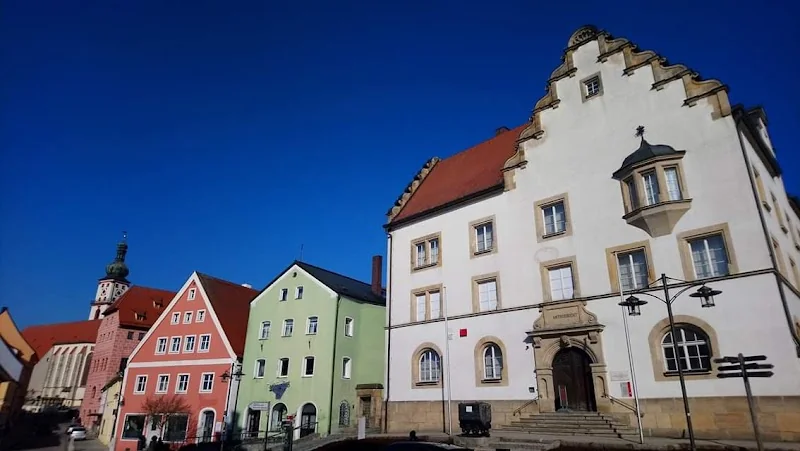
Rosenberger Str. 9, Sulzbach-Rosenberg
Rosenberger Str. 9, 92237 Sulzbach-Rosenberg, Germany
Literary Archive Sulzbach-Rosenberg | Program & Events
The Literary Archive Sulzbach-Rosenberg | Literary House Upper Palatinate is much more than a classic archive. In the old town of Sulzbach-Rosenberg, the house connects literary history, current debates, exhibitions, readings, and research in a place that is both a public cultural center and a scientific address. Those looking for a house that does not separate literary memory and present but brings them together will find one of the most distinctive institutions in the Upper Palatinate here. The institution has been working for decades at the intersection of archive, museum, and literary house, opening collections for researchers and simultaneously its spaces for visitors who are eager for books, conversations, and new perspectives. This mixture is precisely what makes it appealing: The house not only preserves materials but also tells stories with them that deal with the literary scene since 1945, networks, author biographies, and cultural mediation.
Events and Program at the Literary House Upper Palatinate
The heart of the house beats in the event program. The Literary House Upper Palatinate invites authors, publishers, editors, and translators and focuses on new releases, literary workshops, discussion formats, and topics that go beyond a single book. This is precisely where one of the most important reasons for searching and visiting the Literary Archive Sulzbach-Rosenberg lies: Those looking for programs, dates, events, or readings do not end up at an interchangeable event location but at a place with its own literary stance. The program is geared towards current books, literary topics, and the exchange between the audience and the stage. It is not only about classic readings but also about discussions, conferences, and formats that make literature visible in a social context. The current program is provided on the website and as a PDF, allowing interested parties to plan their visits well.
Particularly characteristic is that the house brings together literary practice and literary scientific reflection. This is evident in readings with discussions, collaborations with translators, and evenings that trace the path of a text from the idea to publication. The annual Literary Summer Festival also belongs to this tradition: It combines encounters, readings, exhibition tours, and often music into a culturally rich summer event. In this context, new special exhibitions are opened, there are insights into archival finds, and space for conversations over food and drink. This makes the event not only attractive for regular guests but also for people discovering the house for the first time. The Literary House Upper Palatinate thus understands literature as a living process, not as a finished archival object. This openness shapes the perception of the place and explains why search terms like program, events, readings, or summer festival are so closely associated with the house.
Directions, Opening Hours, and Parking in the Old Town
The Literary Archive is located at Rosenberger Straße 9 in the middle of the old town of Sulzbach-Rosenberg. The location is practical for access and typical for a historic city center: By car, the house can be reached via the Sulzbach-Rosenberg exit on the A6 or, coming from Schwandorf, via the B85. Those arriving by train can reach Sulzbach-Rosenberg hourly from Nuremberg or Regensburg. From the train station, the Literary House is about a 10-minute walk; the path initially leads through the city park and then up into the old town. This combination of train, short walking distance, and central location makes the house equally usable for day visits, research stays, and event evenings.
The opening hours are clearly regulated: Tuesday to Friday from 9 am to 5 pm and Sundays from 2 pm to 5 pm, the latter only during ongoing special exhibitions. This is important for practical planning because not every visit has to coincide with an event. Those specifically wanting to visit the archive, library, or exhibition should orient themselves in advance and check the current notices on the website for special dates. Regarding parking, the location in the old town is also helpful, as there are public parking options in the old town area and at the large parking lot on Bayreuther Straße. According to the city, there is a limited parking duration in the old town, while the large parking lot is a nearby alternative for longer stays. For visitors, this means: The house is easily accessible, but as in any historic city center, it is worth keeping an eye on parking discs, signage, and time limits. Those arriving by public transport have the most convenient access and can experience the walk through the city park as a small introduction to their visit.
Special Exhibitions and Literary Museum
A second major attraction is the Literary Museum with its special exhibitions. The house regularly shows exhibitions on literature and art, usually with references to its own collections and themes of the permanent exhibition. This creates not an isolated exhibition operation but a contentually closely intertwined museum concept. The permanent exhibition offers a glimpse into German-language post-war and contemporary literature and presents authors and their books, magazines, author discussions, and literary debates that have sustainably shaped the development of literature through letters, photos, and first editions. In the state museum description, the exhibition is located in eight rooms in the former district court, which underscores the special historical atmosphere of the place. The house is thus not only a place of storage but also a narrative space where literary history becomes visually and documentarily tangible.
Particularly current is the special exhibition World of Languages. Translating Literature. It places literary translation at the center and shows how important translators are for the exchange across language and cultural boundaries. The exhibition questions the creation process of a new text, the decisions made between the original and target language, and the role of publishers, editorial offices, and market mechanisms. This perspective is particularly fitting for the Literary Archive Sulzbach-Rosenberg, as the house itself preserves several important estates and drafts from translators. For visitors, this creates a content-rich offering: historical documents, aesthetic mediation, and current debates about language and cultural translation intertwine. Those looking for special exhibitions, the literary museum, or a lively combination of knowledge and insight will find a place here that does not understand exhibition as a static space but as a dialogue between collection, research, and audience.
Archive, Library, and Collections since 1945
The core of the house lies in the archive. The Literary Archive Sulzbach-Rosenberg was founded in 1977 by Walter Höllerer after he donated a large part of his archive to the Free State of Bavaria. Initially, it found its place in the former district court building, later becoming an institution that connects archive, literary house, and museum. The collections document German-language literature since 1945 and provide insight into the history of the literary scene, especially during the time of Group 47 and the networks of post-war literature. Outstanding collections include the editorial correspondence of the literary magazine Akzente from 1954 to 1970, the estate of Walter Höllerer, and the only surviving original manuscript of the first version of The Tin Drum by Günter Grass. Additional collections include material from authors from the region, the estate of Eugen Oker, a draft from Bernhard Setzwein, and the publishing archive of lichtung verlag. The archive of the Literary Colloquium Berlin is also scientifically explored in Sulzbach-Rosenberg.
This profile is complemented by the library. It comprises around 8,000 titles and specializes in literature of the 20th and 21st centuries. Important areas include the collection on contemporary literature since 1945, Walter Höllerer's working library with many first editions and dedication copies, as well as a collection on regional northeastern Bavarian literature. This makes the house suitable not only for classic archival research but also for literary historical orientation, scientific deepening, and thematic preparations. The library is accessible during opening hours, making it available to researchers, students, journalists, as well as teachers and interested readers. This openness makes the place particularly special: The Literary Archive Sulzbach-Rosenberg not only collects but also mediates. It invites people to learn about literature not abstractly but through concrete letters, manuscripts, photos, and books. Thus, the house becomes an address for all who think of literary archive, library, or collections not only in terms of storage but as vibrant research.
Regional Book Fair Upper Palatinate and Literary Networks
Another important topic is the Regional Book Fair Upper Palatinate. Since 2013, the Literary House Upper Palatinate has organized it together with the Historical Printing House J. E. von Seidel – Forum for Art and Culture e.V. every two years. The fair is firmly anchored in regional book culture and is also interesting far beyond the Upper Palatinate because it offers independent publishers a stage. The Literary House understands the fair as a meeting point for publishers and a discovery place for the audience. Visitors can get to know new releases, engage in conversations with the book makers, and get an impression of the diversity of the independent publishing landscape. With the historical reference to Sulzbach-Rosenberg as the city of books, the format gains additional depth: Here, not only a market is shown but a cultivated literary culture that dates back to the early history of book printing in the city.
The fair also reflects the role of the house as a network node. It brings together publishers from East Bavaria, the Nuremberg metropolitan region, and now from all over Bavaria. Since 2020, independent publishers have been made more visible through the publishing awards of the Free State of Bavaria, and awarded houses are regularly invited to participate. The fair is thus not only an event for readers but also an instrument of cultural promotion. In connection with reading stages, discussions, and booths, a format emerges that fits very well with the search terms regional book fair Upper Palatinate, literary house Upper Palatinate, and events. Those who visit the fair experience literature as industry practice, as social exchange, and as regional self-presentation. This is typical for the entire house: It does not think culture narrowly but networks and connects local history with current publishing work and literary present.
Walter Höllerer and the History of the House
Without Walter Höllerer, the Literary Archive Sulzbach-Rosenberg would be unthinkable. The literary scholar, author, and co-creator of the post-war literary scene from Sulzbach-Rosenberg was a member of Group 47 and pursued throughout his life the idea of understanding literature not as a marginal topic but as a socially effective practice. His open view on authors, media, and discourses also shaped the character of the archive. In 1977, he donated a large part of his collection, thereby enabling the founding of the Literary Archive in his hometown. The well-known thought Province is what you make of it summarizes this attitude very well to this day. The house took its place in the former district court and developed from a pure archive into a versatile literary house. Since 2010, it has officially borne the name Literary House Upper Palatinate, which underscores its regional significance and makes the literary mission even clearer.
Today, the house continues this history into the present. It cooperates closely with the University of Regensburg and the Literary Colloquium Berlin, whose establishment is also connected to Höllerer. This institutional networking shows that Sulzbach-Rosenberg is not a remote outpost but a place where research, publication practice, and the literary scene converge. For visitors, this is visible in every area: in the archive with its correspondences and manuscripts, in the museum with its literary narrative spaces, in the event program with readings and discussions, and in the Regional Book Fair with the independent publishing world. The history of the house is therefore not only a chapter of regional cultural history but a model of how literature can remain present in a city. Precisely because scientific collection and public mediation play so closely together here, the Literary Archive Sulzbach-Rosenberg has a special radiance far beyond the Upper Palatinate.
Those who visit the Literary Archive Sulzbach-Rosenberg experience a place where archive, exhibition, encounter, and research mutually reinforce each other. The location in the old town, the good access by train and car, the regular readings, the special exhibitions, and the strong historical basis make the house an address for literature lovers, researchers, and curious visitors alike. This connection of tradition and present, of collection and program, of regional place and supra-regional significance continues to shape the character of the Literary House Upper Palatinate to this day.
Sources:
- Literary Archive SuRo – Home
- Literary Archive SuRo – About Us
- Literary Archive SuRo – Directions
- Literary Archive SuRo – Opening Hours
- Literary Archive SuRo – Library
- Literary Archive SuRo – Special Exhibitions
- Literary Archive SuRo – Events
- Literary Archive SuRo – Regional Book Fair Upper Palatinate
- Museums in Bavaria – Literary Archive Sulzbach-Rosenberg
- Amberg24 – Parking in Sulzbach-Rosenberg
Show moreShow less
Literary Archive Sulzbach-Rosenberg | Program & Events
The Literary Archive Sulzbach-Rosenberg | Literary House Upper Palatinate is much more than a classic archive. In the old town of Sulzbach-Rosenberg, the house connects literary history, current debates, exhibitions, readings, and research in a place that is both a public cultural center and a scientific address. Those looking for a house that does not separate literary memory and present but brings them together will find one of the most distinctive institutions in the Upper Palatinate here. The institution has been working for decades at the intersection of archive, museum, and literary house, opening collections for researchers and simultaneously its spaces for visitors who are eager for books, conversations, and new perspectives. This mixture is precisely what makes it appealing: The house not only preserves materials but also tells stories with them that deal with the literary scene since 1945, networks, author biographies, and cultural mediation.
Events and Program at the Literary House Upper Palatinate
The heart of the house beats in the event program. The Literary House Upper Palatinate invites authors, publishers, editors, and translators and focuses on new releases, literary workshops, discussion formats, and topics that go beyond a single book. This is precisely where one of the most important reasons for searching and visiting the Literary Archive Sulzbach-Rosenberg lies: Those looking for programs, dates, events, or readings do not end up at an interchangeable event location but at a place with its own literary stance. The program is geared towards current books, literary topics, and the exchange between the audience and the stage. It is not only about classic readings but also about discussions, conferences, and formats that make literature visible in a social context. The current program is provided on the website and as a PDF, allowing interested parties to plan their visits well.
Particularly characteristic is that the house brings together literary practice and literary scientific reflection. This is evident in readings with discussions, collaborations with translators, and evenings that trace the path of a text from the idea to publication. The annual Literary Summer Festival also belongs to this tradition: It combines encounters, readings, exhibition tours, and often music into a culturally rich summer event. In this context, new special exhibitions are opened, there are insights into archival finds, and space for conversations over food and drink. This makes the event not only attractive for regular guests but also for people discovering the house for the first time. The Literary House Upper Palatinate thus understands literature as a living process, not as a finished archival object. This openness shapes the perception of the place and explains why search terms like program, events, readings, or summer festival are so closely associated with the house.
Directions, Opening Hours, and Parking in the Old Town
The Literary Archive is located at Rosenberger Straße 9 in the middle of the old town of Sulzbach-Rosenberg. The location is practical for access and typical for a historic city center: By car, the house can be reached via the Sulzbach-Rosenberg exit on the A6 or, coming from Schwandorf, via the B85. Those arriving by train can reach Sulzbach-Rosenberg hourly from Nuremberg or Regensburg. From the train station, the Literary House is about a 10-minute walk; the path initially leads through the city park and then up into the old town. This combination of train, short walking distance, and central location makes the house equally usable for day visits, research stays, and event evenings.
The opening hours are clearly regulated: Tuesday to Friday from 9 am to 5 pm and Sundays from 2 pm to 5 pm, the latter only during ongoing special exhibitions. This is important for practical planning because not every visit has to coincide with an event. Those specifically wanting to visit the archive, library, or exhibition should orient themselves in advance and check the current notices on the website for special dates. Regarding parking, the location in the old town is also helpful, as there are public parking options in the old town area and at the large parking lot on Bayreuther Straße. According to the city, there is a limited parking duration in the old town, while the large parking lot is a nearby alternative for longer stays. For visitors, this means: The house is easily accessible, but as in any historic city center, it is worth keeping an eye on parking discs, signage, and time limits. Those arriving by public transport have the most convenient access and can experience the walk through the city park as a small introduction to their visit.
Special Exhibitions and Literary Museum
A second major attraction is the Literary Museum with its special exhibitions. The house regularly shows exhibitions on literature and art, usually with references to its own collections and themes of the permanent exhibition. This creates not an isolated exhibition operation but a contentually closely intertwined museum concept. The permanent exhibition offers a glimpse into German-language post-war and contemporary literature and presents authors and their books, magazines, author discussions, and literary debates that have sustainably shaped the development of literature through letters, photos, and first editions. In the state museum description, the exhibition is located in eight rooms in the former district court, which underscores the special historical atmosphere of the place. The house is thus not only a place of storage but also a narrative space where literary history becomes visually and documentarily tangible.
Particularly current is the special exhibition World of Languages. Translating Literature. It places literary translation at the center and shows how important translators are for the exchange across language and cultural boundaries. The exhibition questions the creation process of a new text, the decisions made between the original and target language, and the role of publishers, editorial offices, and market mechanisms. This perspective is particularly fitting for the Literary Archive Sulzbach-Rosenberg, as the house itself preserves several important estates and drafts from translators. For visitors, this creates a content-rich offering: historical documents, aesthetic mediation, and current debates about language and cultural translation intertwine. Those looking for special exhibitions, the literary museum, or a lively combination of knowledge and insight will find a place here that does not understand exhibition as a static space but as a dialogue between collection, research, and audience.
Archive, Library, and Collections since 1945
The core of the house lies in the archive. The Literary Archive Sulzbach-Rosenberg was founded in 1977 by Walter Höllerer after he donated a large part of his archive to the Free State of Bavaria. Initially, it found its place in the former district court building, later becoming an institution that connects archive, literary house, and museum. The collections document German-language literature since 1945 and provide insight into the history of the literary scene, especially during the time of Group 47 and the networks of post-war literature. Outstanding collections include the editorial correspondence of the literary magazine Akzente from 1954 to 1970, the estate of Walter Höllerer, and the only surviving original manuscript of the first version of The Tin Drum by Günter Grass. Additional collections include material from authors from the region, the estate of Eugen Oker, a draft from Bernhard Setzwein, and the publishing archive of lichtung verlag. The archive of the Literary Colloquium Berlin is also scientifically explored in Sulzbach-Rosenberg.
This profile is complemented by the library. It comprises around 8,000 titles and specializes in literature of the 20th and 21st centuries. Important areas include the collection on contemporary literature since 1945, Walter Höllerer's working library with many first editions and dedication copies, as well as a collection on regional northeastern Bavarian literature. This makes the house suitable not only for classic archival research but also for literary historical orientation, scientific deepening, and thematic preparations. The library is accessible during opening hours, making it available to researchers, students, journalists, as well as teachers and interested readers. This openness makes the place particularly special: The Literary Archive Sulzbach-Rosenberg not only collects but also mediates. It invites people to learn about literature not abstractly but through concrete letters, manuscripts, photos, and books. Thus, the house becomes an address for all who think of literary archive, library, or collections not only in terms of storage but as vibrant research.
Regional Book Fair Upper Palatinate and Literary Networks
Another important topic is the Regional Book Fair Upper Palatinate. Since 2013, the Literary House Upper Palatinate has organized it together with the Historical Printing House J. E. von Seidel – Forum for Art and Culture e.V. every two years. The fair is firmly anchored in regional book culture and is also interesting far beyond the Upper Palatinate because it offers independent publishers a stage. The Literary House understands the fair as a meeting point for publishers and a discovery place for the audience. Visitors can get to know new releases, engage in conversations with the book makers, and get an impression of the diversity of the independent publishing landscape. With the historical reference to Sulzbach-Rosenberg as the city of books, the format gains additional depth: Here, not only a market is shown but a cultivated literary culture that dates back to the early history of book printing in the city.
The fair also reflects the role of the house as a network node. It brings together publishers from East Bavaria, the Nuremberg metropolitan region, and now from all over Bavaria. Since 2020, independent publishers have been made more visible through the publishing awards of the Free State of Bavaria, and awarded houses are regularly invited to participate. The fair is thus not only an event for readers but also an instrument of cultural promotion. In connection with reading stages, discussions, and booths, a format emerges that fits very well with the search terms regional book fair Upper Palatinate, literary house Upper Palatinate, and events. Those who visit the fair experience literature as industry practice, as social exchange, and as regional self-presentation. This is typical for the entire house: It does not think culture narrowly but networks and connects local history with current publishing work and literary present.
Walter Höllerer and the History of the House
Without Walter Höllerer, the Literary Archive Sulzbach-Rosenberg would be unthinkable. The literary scholar, author, and co-creator of the post-war literary scene from Sulzbach-Rosenberg was a member of Group 47 and pursued throughout his life the idea of understanding literature not as a marginal topic but as a socially effective practice. His open view on authors, media, and discourses also shaped the character of the archive. In 1977, he donated a large part of his collection, thereby enabling the founding of the Literary Archive in his hometown. The well-known thought Province is what you make of it summarizes this attitude very well to this day. The house took its place in the former district court and developed from a pure archive into a versatile literary house. Since 2010, it has officially borne the name Literary House Upper Palatinate, which underscores its regional significance and makes the literary mission even clearer.
Today, the house continues this history into the present. It cooperates closely with the University of Regensburg and the Literary Colloquium Berlin, whose establishment is also connected to Höllerer. This institutional networking shows that Sulzbach-Rosenberg is not a remote outpost but a place where research, publication practice, and the literary scene converge. For visitors, this is visible in every area: in the archive with its correspondences and manuscripts, in the museum with its literary narrative spaces, in the event program with readings and discussions, and in the Regional Book Fair with the independent publishing world. The history of the house is therefore not only a chapter of regional cultural history but a model of how literature can remain present in a city. Precisely because scientific collection and public mediation play so closely together here, the Literary Archive Sulzbach-Rosenberg has a special radiance far beyond the Upper Palatinate.
Those who visit the Literary Archive Sulzbach-Rosenberg experience a place where archive, exhibition, encounter, and research mutually reinforce each other. The location in the old town, the good access by train and car, the regular readings, the special exhibitions, and the strong historical basis make the house an address for literature lovers, researchers, and curious visitors alike. This connection of tradition and present, of collection and program, of regional place and supra-regional significance continues to shape the character of the Literary House Upper Palatinate to this day.
Sources:
- Literary Archive SuRo – Home
- Literary Archive SuRo – About Us
- Literary Archive SuRo – Directions
- Literary Archive SuRo – Opening Hours
- Literary Archive SuRo – Library
- Literary Archive SuRo – Special Exhibitions
- Literary Archive SuRo – Events
- Literary Archive SuRo – Regional Book Fair Upper Palatinate
- Museums in Bavaria – Literary Archive Sulzbach-Rosenberg
- Amberg24 – Parking in Sulzbach-Rosenberg
Literary Archive Sulzbach-Rosenberg | Program & Events
The Literary Archive Sulzbach-Rosenberg | Literary House Upper Palatinate is much more than a classic archive. In the old town of Sulzbach-Rosenberg, the house connects literary history, current debates, exhibitions, readings, and research in a place that is both a public cultural center and a scientific address. Those looking for a house that does not separate literary memory and present but brings them together will find one of the most distinctive institutions in the Upper Palatinate here. The institution has been working for decades at the intersection of archive, museum, and literary house, opening collections for researchers and simultaneously its spaces for visitors who are eager for books, conversations, and new perspectives. This mixture is precisely what makes it appealing: The house not only preserves materials but also tells stories with them that deal with the literary scene since 1945, networks, author biographies, and cultural mediation.
Events and Program at the Literary House Upper Palatinate
The heart of the house beats in the event program. The Literary House Upper Palatinate invites authors, publishers, editors, and translators and focuses on new releases, literary workshops, discussion formats, and topics that go beyond a single book. This is precisely where one of the most important reasons for searching and visiting the Literary Archive Sulzbach-Rosenberg lies: Those looking for programs, dates, events, or readings do not end up at an interchangeable event location but at a place with its own literary stance. The program is geared towards current books, literary topics, and the exchange between the audience and the stage. It is not only about classic readings but also about discussions, conferences, and formats that make literature visible in a social context. The current program is provided on the website and as a PDF, allowing interested parties to plan their visits well.
Particularly characteristic is that the house brings together literary practice and literary scientific reflection. This is evident in readings with discussions, collaborations with translators, and evenings that trace the path of a text from the idea to publication. The annual Literary Summer Festival also belongs to this tradition: It combines encounters, readings, exhibition tours, and often music into a culturally rich summer event. In this context, new special exhibitions are opened, there are insights into archival finds, and space for conversations over food and drink. This makes the event not only attractive for regular guests but also for people discovering the house for the first time. The Literary House Upper Palatinate thus understands literature as a living process, not as a finished archival object. This openness shapes the perception of the place and explains why search terms like program, events, readings, or summer festival are so closely associated with the house.
Directions, Opening Hours, and Parking in the Old Town
The Literary Archive is located at Rosenberger Straße 9 in the middle of the old town of Sulzbach-Rosenberg. The location is practical for access and typical for a historic city center: By car, the house can be reached via the Sulzbach-Rosenberg exit on the A6 or, coming from Schwandorf, via the B85. Those arriving by train can reach Sulzbach-Rosenberg hourly from Nuremberg or Regensburg. From the train station, the Literary House is about a 10-minute walk; the path initially leads through the city park and then up into the old town. This combination of train, short walking distance, and central location makes the house equally usable for day visits, research stays, and event evenings.
The opening hours are clearly regulated: Tuesday to Friday from 9 am to 5 pm and Sundays from 2 pm to 5 pm, the latter only during ongoing special exhibitions. This is important for practical planning because not every visit has to coincide with an event. Those specifically wanting to visit the archive, library, or exhibition should orient themselves in advance and check the current notices on the website for special dates. Regarding parking, the location in the old town is also helpful, as there are public parking options in the old town area and at the large parking lot on Bayreuther Straße. According to the city, there is a limited parking duration in the old town, while the large parking lot is a nearby alternative for longer stays. For visitors, this means: The house is easily accessible, but as in any historic city center, it is worth keeping an eye on parking discs, signage, and time limits. Those arriving by public transport have the most convenient access and can experience the walk through the city park as a small introduction to their visit.
Special Exhibitions and Literary Museum
A second major attraction is the Literary Museum with its special exhibitions. The house regularly shows exhibitions on literature and art, usually with references to its own collections and themes of the permanent exhibition. This creates not an isolated exhibition operation but a contentually closely intertwined museum concept. The permanent exhibition offers a glimpse into German-language post-war and contemporary literature and presents authors and their books, magazines, author discussions, and literary debates that have sustainably shaped the development of literature through letters, photos, and first editions. In the state museum description, the exhibition is located in eight rooms in the former district court, which underscores the special historical atmosphere of the place. The house is thus not only a place of storage but also a narrative space where literary history becomes visually and documentarily tangible.
Particularly current is the special exhibition World of Languages. Translating Literature. It places literary translation at the center and shows how important translators are for the exchange across language and cultural boundaries. The exhibition questions the creation process of a new text, the decisions made between the original and target language, and the role of publishers, editorial offices, and market mechanisms. This perspective is particularly fitting for the Literary Archive Sulzbach-Rosenberg, as the house itself preserves several important estates and drafts from translators. For visitors, this creates a content-rich offering: historical documents, aesthetic mediation, and current debates about language and cultural translation intertwine. Those looking for special exhibitions, the literary museum, or a lively combination of knowledge and insight will find a place here that does not understand exhibition as a static space but as a dialogue between collection, research, and audience.
Archive, Library, and Collections since 1945
The core of the house lies in the archive. The Literary Archive Sulzbach-Rosenberg was founded in 1977 by Walter Höllerer after he donated a large part of his archive to the Free State of Bavaria. Initially, it found its place in the former district court building, later becoming an institution that connects archive, literary house, and museum. The collections document German-language literature since 1945 and provide insight into the history of the literary scene, especially during the time of Group 47 and the networks of post-war literature. Outstanding collections include the editorial correspondence of the literary magazine Akzente from 1954 to 1970, the estate of Walter Höllerer, and the only surviving original manuscript of the first version of The Tin Drum by Günter Grass. Additional collections include material from authors from the region, the estate of Eugen Oker, a draft from Bernhard Setzwein, and the publishing archive of lichtung verlag. The archive of the Literary Colloquium Berlin is also scientifically explored in Sulzbach-Rosenberg.
This profile is complemented by the library. It comprises around 8,000 titles and specializes in literature of the 20th and 21st centuries. Important areas include the collection on contemporary literature since 1945, Walter Höllerer's working library with many first editions and dedication copies, as well as a collection on regional northeastern Bavarian literature. This makes the house suitable not only for classic archival research but also for literary historical orientation, scientific deepening, and thematic preparations. The library is accessible during opening hours, making it available to researchers, students, journalists, as well as teachers and interested readers. This openness makes the place particularly special: The Literary Archive Sulzbach-Rosenberg not only collects but also mediates. It invites people to learn about literature not abstractly but through concrete letters, manuscripts, photos, and books. Thus, the house becomes an address for all who think of literary archive, library, or collections not only in terms of storage but as vibrant research.
Regional Book Fair Upper Palatinate and Literary Networks
Another important topic is the Regional Book Fair Upper Palatinate. Since 2013, the Literary House Upper Palatinate has organized it together with the Historical Printing House J. E. von Seidel – Forum for Art and Culture e.V. every two years. The fair is firmly anchored in regional book culture and is also interesting far beyond the Upper Palatinate because it offers independent publishers a stage. The Literary House understands the fair as a meeting point for publishers and a discovery place for the audience. Visitors can get to know new releases, engage in conversations with the book makers, and get an impression of the diversity of the independent publishing landscape. With the historical reference to Sulzbach-Rosenberg as the city of books, the format gains additional depth: Here, not only a market is shown but a cultivated literary culture that dates back to the early history of book printing in the city.
The fair also reflects the role of the house as a network node. It brings together publishers from East Bavaria, the Nuremberg metropolitan region, and now from all over Bavaria. Since 2020, independent publishers have been made more visible through the publishing awards of the Free State of Bavaria, and awarded houses are regularly invited to participate. The fair is thus not only an event for readers but also an instrument of cultural promotion. In connection with reading stages, discussions, and booths, a format emerges that fits very well with the search terms regional book fair Upper Palatinate, literary house Upper Palatinate, and events. Those who visit the fair experience literature as industry practice, as social exchange, and as regional self-presentation. This is typical for the entire house: It does not think culture narrowly but networks and connects local history with current publishing work and literary present.
Walter Höllerer and the History of the House
Without Walter Höllerer, the Literary Archive Sulzbach-Rosenberg would be unthinkable. The literary scholar, author, and co-creator of the post-war literary scene from Sulzbach-Rosenberg was a member of Group 47 and pursued throughout his life the idea of understanding literature not as a marginal topic but as a socially effective practice. His open view on authors, media, and discourses also shaped the character of the archive. In 1977, he donated a large part of his collection, thereby enabling the founding of the Literary Archive in his hometown. The well-known thought Province is what you make of it summarizes this attitude very well to this day. The house took its place in the former district court and developed from a pure archive into a versatile literary house. Since 2010, it has officially borne the name Literary House Upper Palatinate, which underscores its regional significance and makes the literary mission even clearer.
Today, the house continues this history into the present. It cooperates closely with the University of Regensburg and the Literary Colloquium Berlin, whose establishment is also connected to Höllerer. This institutional networking shows that Sulzbach-Rosenberg is not a remote outpost but a place where research, publication practice, and the literary scene converge. For visitors, this is visible in every area: in the archive with its correspondences and manuscripts, in the museum with its literary narrative spaces, in the event program with readings and discussions, and in the Regional Book Fair with the independent publishing world. The history of the house is therefore not only a chapter of regional cultural history but a model of how literature can remain present in a city. Precisely because scientific collection and public mediation play so closely together here, the Literary Archive Sulzbach-Rosenberg has a special radiance far beyond the Upper Palatinate.
Those who visit the Literary Archive Sulzbach-Rosenberg experience a place where archive, exhibition, encounter, and research mutually reinforce each other. The location in the old town, the good access by train and car, the regular readings, the special exhibitions, and the strong historical basis make the house an address for literature lovers, researchers, and curious visitors alike. This connection of tradition and present, of collection and program, of regional place and supra-regional significance continues to shape the character of the Literary House Upper Palatinate to this day.
Sources:
- Literary Archive SuRo – Home
- Literary Archive SuRo – About Us
- Literary Archive SuRo – Directions
- Literary Archive SuRo – Opening Hours
- Literary Archive SuRo – Library
- Literary Archive SuRo – Special Exhibitions
- Literary Archive SuRo – Events
- Literary Archive SuRo – Regional Book Fair Upper Palatinate
- Museums in Bavaria – Literary Archive Sulzbach-Rosenberg
- Amberg24 – Parking in Sulzbach-Rosenberg
Upcoming Events
World of Languages: Translating Literature in Sulzbach-Rosenberg
A quiet, insightful look at the art of translation in Sulzbach-Rosenberg. World of Languages connects archives, literature, and linguistic art. #Literature
Special Exhibition 'Views' by Günther Bayerl
Poetry in perspective: Günther Bayerl's Views at the Literary House Oberpfalz. From 03.06.2026, free admission. Intense visual experience, new view of architecture. Experience it now! #Views
Frequently Asked Questions
Reviews
No reviews found