
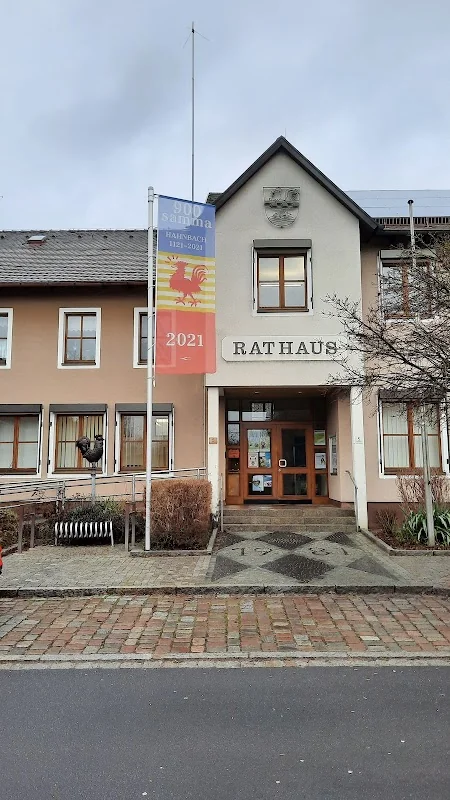
Hahnbach
Herbert-Falk-Straße 5, 92256 Hahnbach, Deutschland
Municipal Administration Market Hahnbach | Opening Hours & Phone
The Municipal Administration Market Hahnbach at Herbert-Falk-Straße 5 is the central point of contact for citizens who have questions regarding registration matters, civil registry, forms, or general administrative concerns. The Market Hahnbach is located in the upper Vilstal, covers 67.41 km², includes 27 municipal parts, and has around 5,028 inhabitants. For this reason, many people specifically search for opening hours, phone numbers, addresses, photos, and reviews before visiting in person. For this information search, the town hall is not just an office, but a practical service point with clear responsibilities and a well-structured website. ([hahnbach.de](https://www.hahnbach.de/rathaus/kontakt/oeffnungszeiten?utm_source=openai))
Opening Hours of the Municipal Administration Market Hahnbach
Those who wish to visit the town hall in Hahnbach in person will find clear and reliable opening hours on the official contact page. The municipal administration is open on Mondays from 08:00 to 12:00 and from 13:30 to 16:00, Tuesdays from 08:00 to 12:00, Wednesdays from 08:00 to 12:00, Thursdays from 08:00 to 12:00 and from 13:30 to 17:00, and Fridays from 08:00 to 12:00. This covers both the classic morning consultation hours and two longer afternoon windows. This is particularly convenient for visitors, as private errands and official visits can be better planned. Those with a quick question can utilize the earlier morning hours; those who are more professionally engaged will find longer opening blocks on Monday and Thursday. The opening hours are clearly stated on the website and are therefore excellent as easily findable information for search queries such as Market Hahnbach opening hours or Town Hall Hahnbach opening hours. ([hahnbach.de](https://www.hahnbach.de/rathaus/kontakt/oeffnungszeiten?utm_source=openai))
The opening hours also show that the Market Hahnbach consciously organizes the classic administrative service in a citizen-friendly manner. The times are not only available on a few days, but are spread throughout the entire work week. This is important for many concerns, as municipal processes often need to be prepared, for example at the registration office, for certificates, or for inquiries about forms. Anyone planning an appointment or a personal visit should not only look at the time but also consider the specific concern. Questions regarding registration, inquiries about the civil registry, or general administrative questions are well taken care of at the town hall, while other municipal tasks such as water, public works, or sewage treatment plant have their own contact paths. This clear structure facilitates the visit on-site. From an SEO perspective, the opening hours are one of the strongest search drivers, as users generally do not want to search for long but want to know immediately when the town hall is reachable. The fact that Hahnbach prominently publishes this information is therefore a clear advantage for user-friendliness. ([hahnbach.de](https://www.hahnbach.de/rathaus/kontakt/oeffnungszeiten?utm_source=openai))
Phone Number, Email, and Direct Contacts at the Town Hall
The central phone number of the Municipal Administration Market Hahnbach is 09664/9134-0, supplemented by the email address markt@hahnbach.de. The official contact page also lists fax numbers and other emergency contacts for municipal areas, showing that the Market Hahnbach organizes its administration broadly and service-oriented. For many visitors, the phone number is the first point of contact, as it clarifies which documents need to be brought, whether an appointment is advisable, or which office is responsible. Especially for search queries like Market Hahnbach phone number or Town Hall Hahnbach phone, this direct line is particularly valuable. Those who do not wish to appear in person can still quickly gain orientation. This is especially important when it comes to time-critical issues or when a concern needs to be clarified in advance. The municipality relies on a clear, easily findable communication structure that is helpful for citizens as well as for new residents. ([hahnbach.de](https://www.hahnbach.de/rathaus/kontakt/oeffnungszeiten?utm_source=openai))
Particularly interesting are the specifically named contacts in the registration office. The website lists several contact persons with direct lines and email addresses, including for Hahnbach and Hahnbach/Gebenbach. This is a real added value for visitors, as many administrative questions are of a personal nature and cannot always be resolved through a general central office. Additionally, the website also makes other municipal contacts visible, such as for public works, water management, and sewage treatment plant. This creates the impression of an administration that does not operate behind an anonymous facade but with clearly defined responsibilities. For SEO and user guidance, this is ideal, as those searching for Hahnbach contact, Hahnbach citizen office, or Hahnbach registration office find not only a main number but also concrete paths to resolve their concerns. Those who prepare well can save time and avoid waiting times with this information. For this reason, phone numbers and direct contacts are among the most important contents for the municipal administration's website. ([hahnbach.de](https://www.hahnbach.de/buergerservice/online-formulare/einwohnermeldeamt?utm_source=openai))
Directions, Location, and Orientation at the Town Hall
The Municipal Administration is located at Herbert-Falk-Straße 5 in 92256 Hahnbach. This address is not only the formal address but also the central point of orientation for all who wish to visit the town hall in person. The Market Hahnbach itself is located in the district of Amberg-Sulzbach in the Upper Palatinate, about 12 kilometers northwest of Amberg, with an area of 67.41 km² and 27 municipal parts. Particularly helpful for directions is that the official website offers a dedicated page for location and directions as well as a local map. This allows visitors to check their route in advance instead of just working with the pure postal address. Additionally, the municipality points out that Hahnbach is located on the Golden Road or B14. This is a useful geographical anchor, as it makes it easier to place the town. Therefore, those searching for the municipal administration benefit from a good combination of clear address, map page, and regional location description. ([hahnbach.de](https://www.hahnbach.de/rathaus/kontakt/oeffnungszeiten?utm_source=openai))
For the question of parking, it is important to clearly distinguish between secured information and plausible assumptions. The official contact page lists opening hours, address, phone, and email, but does not describe any separate designated parking spaces for the town hall. Instead, the website refers to the local map and the location and directions page, which is the right way for concrete orientation. Therefore, anyone planning a trip to the municipal administration should prepare their journey not only via GPS but also through the official local information. This is especially useful when multiple errands are pending or when one wants to visit additional municipal stations such as the citizen service, the registration office, or other municipal facilities. The location in the town center or in the administrative environment makes the municipality easily findable, but the safest information base remains the official website with its map and contact offerings. For search terms like Hahnbach directions, Hahnbach address, or Town Hall Hahnbach parking, this connection between map and address is ideal. ([hahnbach.de](https://www.hahnbach.de/rathaus/kontakt/oeffnungszeiten?utm_source=openai))
Photos and Reviews of the Municipal Administration Hahnbach
The profile of the Municipal Administration Market Hahnbach conveys a very positive impression online: With 4.9 stars from 17 reviews, the perception is strikingly strong. Especially for an authority, this is remarkable, as visitors to municipal institutions often primarily expect reliability, friendliness, and clear processes. Good reviews indicate that the processes on-site are experienced as pleasant and helpful by many people. Those searching for reviews of the Municipal Administration Market Hahnbach usually want to confirm this feeling: Is the town hall easily accessible? Are questions answered understandably? Is the contact uncomplicated? The existing rating suggests that Hahnbach leaves a good impression in these respects. For potential visitors, this is a reassuring signal, especially when the visit to the authority is not a common occurrence. Reviews therefore help not only in selecting restaurants or hotels but also in municipal contact points, as they create certainty of expectation. ([hahnbach.de](https://www.hahnbach.de/markt-hahnbach/hahnbach-in-zahlen/?utm_source=openai))
The topic of photos also plays a larger role than it may seem at first glance. The official website uses images and structured page areas in several places, such as in Historical, Hahnbach in Numbers, Swimming Pool, or the Leisure and Tourism pages. This does not mean that every single image directly shows the town hall, but it conveys an overall lively picture of the market community. For users searching for photos of the Municipal Administration Market Hahnbach, this is helpful, as they not only receive an address but also a visual impression of the place and its surroundings. Especially for a town hall, photos are practical to categorize the location, the character of the town, and the environment in advance. In combination with the very good reviews, this creates a coherent digital overall picture: The administration appears accessible, the place looks well-kept, and the online presence seems structured. Those who want to get to know the municipal administration not only factually but also with an initial visual impression receive convincing orientation through the website and the review profile. ([hahnbach.de](https://www.hahnbach.de/markt-hahnbach/historisches?utm_source=openai))
Citizen Service, Registration Office, and Online Forms
The municipality of Hahnbach sees itself not only as a classic town hall but as a service point organized both digitally and analogously. The website features numerous topics in the citizen service area, including registration and passport office, lost property, fees and charges, property tax reform, elections, water meter readings, statutes and regulations, as well as various online forms. Especially the online forms are a strong argument for many visitors, as they can partially prepare or even replace the trip to the town hall. The registration office is particularly important for everyday administrative steps, such as registering, changing, or deregistering a residence. Additionally, other forms such as power of attorney or confirmation from the landlord are also offered there. Those searching for Hahnbach registration office, Hahnbach citizen office, or Municipality Hahnbach forms will find a very useful digital infrastructure here. This reduces barriers and makes the administration more modern and user-friendly. ([hahnbach.de](https://www.hahnbach.de/buergerservice/?utm_source=openai))
For practical processes, this means: Many typical concerns can already be structured before the visit. Those who prepare their documents can ask more targeted questions at the town hall and often save time. This aligns with the fact that the Market Hahnbach transparently lists its employees and contacts, thereby facilitating access to specialist departments. The inclusion of further municipal topics on the website is also useful, such as in waste management, broadband expansion, kindergartens, flood protection, or municipal heat planning. This makes the municipal administration visible as a central hub of local everyday life. This is an important SEO aspect, as users not only search for opening hours but also for specific administrative services. Therefore, those expecting an answer to Hahnbach civil registry, Hahnbach phone, or Hahnbach administration benefit from the clear information architecture. The market thus shows that modern administration today consists of personal contact, clear responsibilities, and digital templates. This blend makes the municipal administration particularly accessible for citizens. ([hahnbach.de](https://www.hahnbach.de/buergerservice/?utm_source=openai))
Hahnbach as a Market Community: History, Size, and Special Features
The Municipal Administration Hahnbach is not isolated but closely connected to the history and profile of the market community. Hahnbach has been mentioned in history since 1121; the name suggests a settlement at the brook of a Han(-n)o. The coat of arms of the market has been documented since 1447 and shows a red rooster over a blue wavy bar, thus a speaking coat of arms with direct local reference. The market community today has 27 municipal parts and was shaped into its current form by the territorial reform of 1972. With an area of 67.41 km², around 5,028 inhabitants, and a location in the upper Vilstal, Hahnbach is a place that connects administration, living, landscape, and regional identity. For visitors, this means: Those who visit the town hall do not just enter an administrative building but a community with a long history and strong local awareness. This makes the location particularly interesting for search queries related to photos, reviews, and background information. ([hahnbach.de](https://www.hahnbach.de/markt-hahnbach/historisches?utm_source=openai))
The current development of the market community is also important for the classification of the administration. The First Mayor describes Hahnbach as a place that has developed from an agriculturally shaped community to a sought-after residential area where history, tradition, and progress come together. This blend is indirectly reflected in the town hall: On one hand, there is the classic personal accessibility with fixed opening hours and specific contacts, while on the other hand, there is a modern website with citizen service, online forms, and clear information pathways. For the search for Municipal Administration Market Hahnbach photos, Municipal Administration Market Hahnbach reviews, or Municipality Hahnbach opening hours, this combination of tradition and service is crucial. Those wanting to get to know Hahnbach better will also find historical pages, local map, location and directions, as well as tourist information about Vils, Frohnberg, and the leisure routes around the town. This makes the municipal administration the starting point for a community that is much more than just an administrative location. ([hahnbach.de](https://www.hahnbach.de/rathaus/buergermeister/?utm_source=openai))
Sources:
Show moreShow less
Municipal Administration Market Hahnbach | Opening Hours & Phone
The Municipal Administration Market Hahnbach at Herbert-Falk-Straße 5 is the central point of contact for citizens who have questions regarding registration matters, civil registry, forms, or general administrative concerns. The Market Hahnbach is located in the upper Vilstal, covers 67.41 km², includes 27 municipal parts, and has around 5,028 inhabitants. For this reason, many people specifically search for opening hours, phone numbers, addresses, photos, and reviews before visiting in person. For this information search, the town hall is not just an office, but a practical service point with clear responsibilities and a well-structured website. ([hahnbach.de](https://www.hahnbach.de/rathaus/kontakt/oeffnungszeiten?utm_source=openai))
Opening Hours of the Municipal Administration Market Hahnbach
Those who wish to visit the town hall in Hahnbach in person will find clear and reliable opening hours on the official contact page. The municipal administration is open on Mondays from 08:00 to 12:00 and from 13:30 to 16:00, Tuesdays from 08:00 to 12:00, Wednesdays from 08:00 to 12:00, Thursdays from 08:00 to 12:00 and from 13:30 to 17:00, and Fridays from 08:00 to 12:00. This covers both the classic morning consultation hours and two longer afternoon windows. This is particularly convenient for visitors, as private errands and official visits can be better planned. Those with a quick question can utilize the earlier morning hours; those who are more professionally engaged will find longer opening blocks on Monday and Thursday. The opening hours are clearly stated on the website and are therefore excellent as easily findable information for search queries such as Market Hahnbach opening hours or Town Hall Hahnbach opening hours. ([hahnbach.de](https://www.hahnbach.de/rathaus/kontakt/oeffnungszeiten?utm_source=openai))
The opening hours also show that the Market Hahnbach consciously organizes the classic administrative service in a citizen-friendly manner. The times are not only available on a few days, but are spread throughout the entire work week. This is important for many concerns, as municipal processes often need to be prepared, for example at the registration office, for certificates, or for inquiries about forms. Anyone planning an appointment or a personal visit should not only look at the time but also consider the specific concern. Questions regarding registration, inquiries about the civil registry, or general administrative questions are well taken care of at the town hall, while other municipal tasks such as water, public works, or sewage treatment plant have their own contact paths. This clear structure facilitates the visit on-site. From an SEO perspective, the opening hours are one of the strongest search drivers, as users generally do not want to search for long but want to know immediately when the town hall is reachable. The fact that Hahnbach prominently publishes this information is therefore a clear advantage for user-friendliness. ([hahnbach.de](https://www.hahnbach.de/rathaus/kontakt/oeffnungszeiten?utm_source=openai))
Phone Number, Email, and Direct Contacts at the Town Hall
The central phone number of the Municipal Administration Market Hahnbach is 09664/9134-0, supplemented by the email address markt@hahnbach.de. The official contact page also lists fax numbers and other emergency contacts for municipal areas, showing that the Market Hahnbach organizes its administration broadly and service-oriented. For many visitors, the phone number is the first point of contact, as it clarifies which documents need to be brought, whether an appointment is advisable, or which office is responsible. Especially for search queries like Market Hahnbach phone number or Town Hall Hahnbach phone, this direct line is particularly valuable. Those who do not wish to appear in person can still quickly gain orientation. This is especially important when it comes to time-critical issues or when a concern needs to be clarified in advance. The municipality relies on a clear, easily findable communication structure that is helpful for citizens as well as for new residents. ([hahnbach.de](https://www.hahnbach.de/rathaus/kontakt/oeffnungszeiten?utm_source=openai))
Particularly interesting are the specifically named contacts in the registration office. The website lists several contact persons with direct lines and email addresses, including for Hahnbach and Hahnbach/Gebenbach. This is a real added value for visitors, as many administrative questions are of a personal nature and cannot always be resolved through a general central office. Additionally, the website also makes other municipal contacts visible, such as for public works, water management, and sewage treatment plant. This creates the impression of an administration that does not operate behind an anonymous facade but with clearly defined responsibilities. For SEO and user guidance, this is ideal, as those searching for Hahnbach contact, Hahnbach citizen office, or Hahnbach registration office find not only a main number but also concrete paths to resolve their concerns. Those who prepare well can save time and avoid waiting times with this information. For this reason, phone numbers and direct contacts are among the most important contents for the municipal administration's website. ([hahnbach.de](https://www.hahnbach.de/buergerservice/online-formulare/einwohnermeldeamt?utm_source=openai))
Directions, Location, and Orientation at the Town Hall
The Municipal Administration is located at Herbert-Falk-Straße 5 in 92256 Hahnbach. This address is not only the formal address but also the central point of orientation for all who wish to visit the town hall in person. The Market Hahnbach itself is located in the district of Amberg-Sulzbach in the Upper Palatinate, about 12 kilometers northwest of Amberg, with an area of 67.41 km² and 27 municipal parts. Particularly helpful for directions is that the official website offers a dedicated page for location and directions as well as a local map. This allows visitors to check their route in advance instead of just working with the pure postal address. Additionally, the municipality points out that Hahnbach is located on the Golden Road or B14. This is a useful geographical anchor, as it makes it easier to place the town. Therefore, those searching for the municipal administration benefit from a good combination of clear address, map page, and regional location description. ([hahnbach.de](https://www.hahnbach.de/rathaus/kontakt/oeffnungszeiten?utm_source=openai))
For the question of parking, it is important to clearly distinguish between secured information and plausible assumptions. The official contact page lists opening hours, address, phone, and email, but does not describe any separate designated parking spaces for the town hall. Instead, the website refers to the local map and the location and directions page, which is the right way for concrete orientation. Therefore, anyone planning a trip to the municipal administration should prepare their journey not only via GPS but also through the official local information. This is especially useful when multiple errands are pending or when one wants to visit additional municipal stations such as the citizen service, the registration office, or other municipal facilities. The location in the town center or in the administrative environment makes the municipality easily findable, but the safest information base remains the official website with its map and contact offerings. For search terms like Hahnbach directions, Hahnbach address, or Town Hall Hahnbach parking, this connection between map and address is ideal. ([hahnbach.de](https://www.hahnbach.de/rathaus/kontakt/oeffnungszeiten?utm_source=openai))
Photos and Reviews of the Municipal Administration Hahnbach
The profile of the Municipal Administration Market Hahnbach conveys a very positive impression online: With 4.9 stars from 17 reviews, the perception is strikingly strong. Especially for an authority, this is remarkable, as visitors to municipal institutions often primarily expect reliability, friendliness, and clear processes. Good reviews indicate that the processes on-site are experienced as pleasant and helpful by many people. Those searching for reviews of the Municipal Administration Market Hahnbach usually want to confirm this feeling: Is the town hall easily accessible? Are questions answered understandably? Is the contact uncomplicated? The existing rating suggests that Hahnbach leaves a good impression in these respects. For potential visitors, this is a reassuring signal, especially when the visit to the authority is not a common occurrence. Reviews therefore help not only in selecting restaurants or hotels but also in municipal contact points, as they create certainty of expectation. ([hahnbach.de](https://www.hahnbach.de/markt-hahnbach/hahnbach-in-zahlen/?utm_source=openai))
The topic of photos also plays a larger role than it may seem at first glance. The official website uses images and structured page areas in several places, such as in Historical, Hahnbach in Numbers, Swimming Pool, or the Leisure and Tourism pages. This does not mean that every single image directly shows the town hall, but it conveys an overall lively picture of the market community. For users searching for photos of the Municipal Administration Market Hahnbach, this is helpful, as they not only receive an address but also a visual impression of the place and its surroundings. Especially for a town hall, photos are practical to categorize the location, the character of the town, and the environment in advance. In combination with the very good reviews, this creates a coherent digital overall picture: The administration appears accessible, the place looks well-kept, and the online presence seems structured. Those who want to get to know the municipal administration not only factually but also with an initial visual impression receive convincing orientation through the website and the review profile. ([hahnbach.de](https://www.hahnbach.de/markt-hahnbach/historisches?utm_source=openai))
Citizen Service, Registration Office, and Online Forms
The municipality of Hahnbach sees itself not only as a classic town hall but as a service point organized both digitally and analogously. The website features numerous topics in the citizen service area, including registration and passport office, lost property, fees and charges, property tax reform, elections, water meter readings, statutes and regulations, as well as various online forms. Especially the online forms are a strong argument for many visitors, as they can partially prepare or even replace the trip to the town hall. The registration office is particularly important for everyday administrative steps, such as registering, changing, or deregistering a residence. Additionally, other forms such as power of attorney or confirmation from the landlord are also offered there. Those searching for Hahnbach registration office, Hahnbach citizen office, or Municipality Hahnbach forms will find a very useful digital infrastructure here. This reduces barriers and makes the administration more modern and user-friendly. ([hahnbach.de](https://www.hahnbach.de/buergerservice/?utm_source=openai))
For practical processes, this means: Many typical concerns can already be structured before the visit. Those who prepare their documents can ask more targeted questions at the town hall and often save time. This aligns with the fact that the Market Hahnbach transparently lists its employees and contacts, thereby facilitating access to specialist departments. The inclusion of further municipal topics on the website is also useful, such as in waste management, broadband expansion, kindergartens, flood protection, or municipal heat planning. This makes the municipal administration visible as a central hub of local everyday life. This is an important SEO aspect, as users not only search for opening hours but also for specific administrative services. Therefore, those expecting an answer to Hahnbach civil registry, Hahnbach phone, or Hahnbach administration benefit from the clear information architecture. The market thus shows that modern administration today consists of personal contact, clear responsibilities, and digital templates. This blend makes the municipal administration particularly accessible for citizens. ([hahnbach.de](https://www.hahnbach.de/buergerservice/?utm_source=openai))
Hahnbach as a Market Community: History, Size, and Special Features
The Municipal Administration Hahnbach is not isolated but closely connected to the history and profile of the market community. Hahnbach has been mentioned in history since 1121; the name suggests a settlement at the brook of a Han(-n)o. The coat of arms of the market has been documented since 1447 and shows a red rooster over a blue wavy bar, thus a speaking coat of arms with direct local reference. The market community today has 27 municipal parts and was shaped into its current form by the territorial reform of 1972. With an area of 67.41 km², around 5,028 inhabitants, and a location in the upper Vilstal, Hahnbach is a place that connects administration, living, landscape, and regional identity. For visitors, this means: Those who visit the town hall do not just enter an administrative building but a community with a long history and strong local awareness. This makes the location particularly interesting for search queries related to photos, reviews, and background information. ([hahnbach.de](https://www.hahnbach.de/markt-hahnbach/historisches?utm_source=openai))
The current development of the market community is also important for the classification of the administration. The First Mayor describes Hahnbach as a place that has developed from an agriculturally shaped community to a sought-after residential area where history, tradition, and progress come together. This blend is indirectly reflected in the town hall: On one hand, there is the classic personal accessibility with fixed opening hours and specific contacts, while on the other hand, there is a modern website with citizen service, online forms, and clear information pathways. For the search for Municipal Administration Market Hahnbach photos, Municipal Administration Market Hahnbach reviews, or Municipality Hahnbach opening hours, this combination of tradition and service is crucial. Those wanting to get to know Hahnbach better will also find historical pages, local map, location and directions, as well as tourist information about Vils, Frohnberg, and the leisure routes around the town. This makes the municipal administration the starting point for a community that is much more than just an administrative location. ([hahnbach.de](https://www.hahnbach.de/rathaus/buergermeister/?utm_source=openai))
Sources:
Municipal Administration Market Hahnbach | Opening Hours & Phone
The Municipal Administration Market Hahnbach at Herbert-Falk-Straße 5 is the central point of contact for citizens who have questions regarding registration matters, civil registry, forms, or general administrative concerns. The Market Hahnbach is located in the upper Vilstal, covers 67.41 km², includes 27 municipal parts, and has around 5,028 inhabitants. For this reason, many people specifically search for opening hours, phone numbers, addresses, photos, and reviews before visiting in person. For this information search, the town hall is not just an office, but a practical service point with clear responsibilities and a well-structured website. ([hahnbach.de](https://www.hahnbach.de/rathaus/kontakt/oeffnungszeiten?utm_source=openai))
Opening Hours of the Municipal Administration Market Hahnbach
Those who wish to visit the town hall in Hahnbach in person will find clear and reliable opening hours on the official contact page. The municipal administration is open on Mondays from 08:00 to 12:00 and from 13:30 to 16:00, Tuesdays from 08:00 to 12:00, Wednesdays from 08:00 to 12:00, Thursdays from 08:00 to 12:00 and from 13:30 to 17:00, and Fridays from 08:00 to 12:00. This covers both the classic morning consultation hours and two longer afternoon windows. This is particularly convenient for visitors, as private errands and official visits can be better planned. Those with a quick question can utilize the earlier morning hours; those who are more professionally engaged will find longer opening blocks on Monday and Thursday. The opening hours are clearly stated on the website and are therefore excellent as easily findable information for search queries such as Market Hahnbach opening hours or Town Hall Hahnbach opening hours. ([hahnbach.de](https://www.hahnbach.de/rathaus/kontakt/oeffnungszeiten?utm_source=openai))
The opening hours also show that the Market Hahnbach consciously organizes the classic administrative service in a citizen-friendly manner. The times are not only available on a few days, but are spread throughout the entire work week. This is important for many concerns, as municipal processes often need to be prepared, for example at the registration office, for certificates, or for inquiries about forms. Anyone planning an appointment or a personal visit should not only look at the time but also consider the specific concern. Questions regarding registration, inquiries about the civil registry, or general administrative questions are well taken care of at the town hall, while other municipal tasks such as water, public works, or sewage treatment plant have their own contact paths. This clear structure facilitates the visit on-site. From an SEO perspective, the opening hours are one of the strongest search drivers, as users generally do not want to search for long but want to know immediately when the town hall is reachable. The fact that Hahnbach prominently publishes this information is therefore a clear advantage for user-friendliness. ([hahnbach.de](https://www.hahnbach.de/rathaus/kontakt/oeffnungszeiten?utm_source=openai))
Phone Number, Email, and Direct Contacts at the Town Hall
The central phone number of the Municipal Administration Market Hahnbach is 09664/9134-0, supplemented by the email address markt@hahnbach.de. The official contact page also lists fax numbers and other emergency contacts for municipal areas, showing that the Market Hahnbach organizes its administration broadly and service-oriented. For many visitors, the phone number is the first point of contact, as it clarifies which documents need to be brought, whether an appointment is advisable, or which office is responsible. Especially for search queries like Market Hahnbach phone number or Town Hall Hahnbach phone, this direct line is particularly valuable. Those who do not wish to appear in person can still quickly gain orientation. This is especially important when it comes to time-critical issues or when a concern needs to be clarified in advance. The municipality relies on a clear, easily findable communication structure that is helpful for citizens as well as for new residents. ([hahnbach.de](https://www.hahnbach.de/rathaus/kontakt/oeffnungszeiten?utm_source=openai))
Particularly interesting are the specifically named contacts in the registration office. The website lists several contact persons with direct lines and email addresses, including for Hahnbach and Hahnbach/Gebenbach. This is a real added value for visitors, as many administrative questions are of a personal nature and cannot always be resolved through a general central office. Additionally, the website also makes other municipal contacts visible, such as for public works, water management, and sewage treatment plant. This creates the impression of an administration that does not operate behind an anonymous facade but with clearly defined responsibilities. For SEO and user guidance, this is ideal, as those searching for Hahnbach contact, Hahnbach citizen office, or Hahnbach registration office find not only a main number but also concrete paths to resolve their concerns. Those who prepare well can save time and avoid waiting times with this information. For this reason, phone numbers and direct contacts are among the most important contents for the municipal administration's website. ([hahnbach.de](https://www.hahnbach.de/buergerservice/online-formulare/einwohnermeldeamt?utm_source=openai))
Directions, Location, and Orientation at the Town Hall
The Municipal Administration is located at Herbert-Falk-Straße 5 in 92256 Hahnbach. This address is not only the formal address but also the central point of orientation for all who wish to visit the town hall in person. The Market Hahnbach itself is located in the district of Amberg-Sulzbach in the Upper Palatinate, about 12 kilometers northwest of Amberg, with an area of 67.41 km² and 27 municipal parts. Particularly helpful for directions is that the official website offers a dedicated page for location and directions as well as a local map. This allows visitors to check their route in advance instead of just working with the pure postal address. Additionally, the municipality points out that Hahnbach is located on the Golden Road or B14. This is a useful geographical anchor, as it makes it easier to place the town. Therefore, those searching for the municipal administration benefit from a good combination of clear address, map page, and regional location description. ([hahnbach.de](https://www.hahnbach.de/rathaus/kontakt/oeffnungszeiten?utm_source=openai))
For the question of parking, it is important to clearly distinguish between secured information and plausible assumptions. The official contact page lists opening hours, address, phone, and email, but does not describe any separate designated parking spaces for the town hall. Instead, the website refers to the local map and the location and directions page, which is the right way for concrete orientation. Therefore, anyone planning a trip to the municipal administration should prepare their journey not only via GPS but also through the official local information. This is especially useful when multiple errands are pending or when one wants to visit additional municipal stations such as the citizen service, the registration office, or other municipal facilities. The location in the town center or in the administrative environment makes the municipality easily findable, but the safest information base remains the official website with its map and contact offerings. For search terms like Hahnbach directions, Hahnbach address, or Town Hall Hahnbach parking, this connection between map and address is ideal. ([hahnbach.de](https://www.hahnbach.de/rathaus/kontakt/oeffnungszeiten?utm_source=openai))
Photos and Reviews of the Municipal Administration Hahnbach
The profile of the Municipal Administration Market Hahnbach conveys a very positive impression online: With 4.9 stars from 17 reviews, the perception is strikingly strong. Especially for an authority, this is remarkable, as visitors to municipal institutions often primarily expect reliability, friendliness, and clear processes. Good reviews indicate that the processes on-site are experienced as pleasant and helpful by many people. Those searching for reviews of the Municipal Administration Market Hahnbach usually want to confirm this feeling: Is the town hall easily accessible? Are questions answered understandably? Is the contact uncomplicated? The existing rating suggests that Hahnbach leaves a good impression in these respects. For potential visitors, this is a reassuring signal, especially when the visit to the authority is not a common occurrence. Reviews therefore help not only in selecting restaurants or hotels but also in municipal contact points, as they create certainty of expectation. ([hahnbach.de](https://www.hahnbach.de/markt-hahnbach/hahnbach-in-zahlen/?utm_source=openai))
The topic of photos also plays a larger role than it may seem at first glance. The official website uses images and structured page areas in several places, such as in Historical, Hahnbach in Numbers, Swimming Pool, or the Leisure and Tourism pages. This does not mean that every single image directly shows the town hall, but it conveys an overall lively picture of the market community. For users searching for photos of the Municipal Administration Market Hahnbach, this is helpful, as they not only receive an address but also a visual impression of the place and its surroundings. Especially for a town hall, photos are practical to categorize the location, the character of the town, and the environment in advance. In combination with the very good reviews, this creates a coherent digital overall picture: The administration appears accessible, the place looks well-kept, and the online presence seems structured. Those who want to get to know the municipal administration not only factually but also with an initial visual impression receive convincing orientation through the website and the review profile. ([hahnbach.de](https://www.hahnbach.de/markt-hahnbach/historisches?utm_source=openai))
Citizen Service, Registration Office, and Online Forms
The municipality of Hahnbach sees itself not only as a classic town hall but as a service point organized both digitally and analogously. The website features numerous topics in the citizen service area, including registration and passport office, lost property, fees and charges, property tax reform, elections, water meter readings, statutes and regulations, as well as various online forms. Especially the online forms are a strong argument for many visitors, as they can partially prepare or even replace the trip to the town hall. The registration office is particularly important for everyday administrative steps, such as registering, changing, or deregistering a residence. Additionally, other forms such as power of attorney or confirmation from the landlord are also offered there. Those searching for Hahnbach registration office, Hahnbach citizen office, or Municipality Hahnbach forms will find a very useful digital infrastructure here. This reduces barriers and makes the administration more modern and user-friendly. ([hahnbach.de](https://www.hahnbach.de/buergerservice/?utm_source=openai))
For practical processes, this means: Many typical concerns can already be structured before the visit. Those who prepare their documents can ask more targeted questions at the town hall and often save time. This aligns with the fact that the Market Hahnbach transparently lists its employees and contacts, thereby facilitating access to specialist departments. The inclusion of further municipal topics on the website is also useful, such as in waste management, broadband expansion, kindergartens, flood protection, or municipal heat planning. This makes the municipal administration visible as a central hub of local everyday life. This is an important SEO aspect, as users not only search for opening hours but also for specific administrative services. Therefore, those expecting an answer to Hahnbach civil registry, Hahnbach phone, or Hahnbach administration benefit from the clear information architecture. The market thus shows that modern administration today consists of personal contact, clear responsibilities, and digital templates. This blend makes the municipal administration particularly accessible for citizens. ([hahnbach.de](https://www.hahnbach.de/buergerservice/?utm_source=openai))
Hahnbach as a Market Community: History, Size, and Special Features
The Municipal Administration Hahnbach is not isolated but closely connected to the history and profile of the market community. Hahnbach has been mentioned in history since 1121; the name suggests a settlement at the brook of a Han(-n)o. The coat of arms of the market has been documented since 1447 and shows a red rooster over a blue wavy bar, thus a speaking coat of arms with direct local reference. The market community today has 27 municipal parts and was shaped into its current form by the territorial reform of 1972. With an area of 67.41 km², around 5,028 inhabitants, and a location in the upper Vilstal, Hahnbach is a place that connects administration, living, landscape, and regional identity. For visitors, this means: Those who visit the town hall do not just enter an administrative building but a community with a long history and strong local awareness. This makes the location particularly interesting for search queries related to photos, reviews, and background information. ([hahnbach.de](https://www.hahnbach.de/markt-hahnbach/historisches?utm_source=openai))
The current development of the market community is also important for the classification of the administration. The First Mayor describes Hahnbach as a place that has developed from an agriculturally shaped community to a sought-after residential area where history, tradition, and progress come together. This blend is indirectly reflected in the town hall: On one hand, there is the classic personal accessibility with fixed opening hours and specific contacts, while on the other hand, there is a modern website with citizen service, online forms, and clear information pathways. For the search for Municipal Administration Market Hahnbach photos, Municipal Administration Market Hahnbach reviews, or Municipality Hahnbach opening hours, this combination of tradition and service is crucial. Those wanting to get to know Hahnbach better will also find historical pages, local map, location and directions, as well as tourist information about Vils, Frohnberg, and the leisure routes around the town. This makes the municipal administration the starting point for a community that is much more than just an administrative location. ([hahnbach.de](https://www.hahnbach.de/rathaus/buergermeister/?utm_source=openai))
Sources:
Frequently Asked Questions
Reviews
No reviews found