
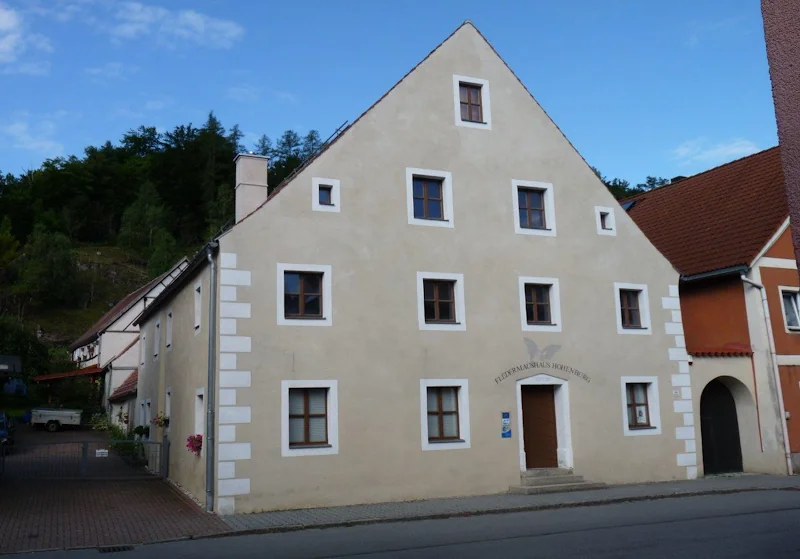
Hohenburg
Marktpl. 32, 92277 Hohenburg, Deutschland
Bat House Hohenburg | Opening Hours & Tours
The Bat House Hohenburg is much more than an unusual attraction in the marketplace. It is a place where species conservation becomes visible, an information center with real significance for a highly endangered species, and a destination that attracts attention far beyond the region due to its special history. Those looking for photos, images, or opening hours quickly encounter the essential point: In Hohenburg, it is not about a classic museum operation with daily standard hours, but about guided evening appointments where visitors can experience the rare animals in their natural behavior. This is exactly what makes the charm of this place. The Bat House is home to the last nursery of the Greater Horseshoe Bat in Germany, and this fact gives the house a special responsibility and a unique status in nature conservation. The location in the Lauterachtal, the proximity to Marktplatz 32, and the close connection between the building, landscape, and project work make the place an example of how environmental education, regional identity, and practical protection can come together. Therefore, those planning a visit will find here not just any excursion destination, but a rare nature experience with clear guided times, exciting history, and a true unique selling point. ([ostbayern-tourismus.de](https://www.ostbayern-tourismus.de/attraktionen/fledermaushaus-hohenburg-d13639b0cc))
Opening Hours and Tours at the Bat House Hohenburg
When searching for the opening hours, it becomes clear that the Bat House Hohenburg operates differently than many classic visitor attractions. The nature park website explicitly describes guided tours taking place on Fridays in the courtyard of the Bat House, seasonally at fixed evening times: in May and August at 7:00 PM and in June and July at 8:00 PM. The LBV adds that the regular tour season ends with the Bavarian summer holidays and that group tours are available upon request. It quickly becomes clear that a visit here should be planned and not just spontaneously like in a daily open exhibition operation. However, this structure fits excellently with the content of the house, as the animals are nocturnal, and observation in the evening is part of the experience. Therefore, those looking for opening hours should rather inquire about tour times: The visit focuses on the moment when the bats fly out and their activity begins before the eyes of the guests. This makes scheduling particularly important, as the coveted spots are tied to fixed processes. Those wishing to register an individual or larger group can contact the LBV directly; Ostbayern Tourism also points out that tours only take place upon request. This creates an offer that is less focused on passing trade and more on conscious nature experiences. ([naturparkhirschwald.de](https://www.naturparkhirschwald.de/de/naturerlebnisse/fledermaushaus-hohenburg.html))
For visitors, this form of opening has a significant advantage: The tour is not just a brief look at a building, but an observation situation with real added value. The focus is on the animals flying out, on understandable communication, and on the direct connection to local species conservation work. Those who take the time to come on the right evening experience the place precisely at the moment when its significance becomes visible. This is also the reason why many people search for terms like tour, opening hours, or excursion observation: The Bat House does not offer a usual program, but a clearly scheduled, nature-related encounter. The official location at Marktplatz 32 in Hohenburg is easy to identify, and the contacts on the project pages ensure that groups or interested individual visitors can clarify their questions directly. The atmosphere is consciously calm and factual, as the focus is on the animals and their way of life. This is precisely what makes the tour so impressive: It is focused on observation, knowledge, and respect for the sensitive colony. For SEO and for real visitors, this thought is particularly important: Opening hours here are identical to the experience window in which nature is not only explained but becomes immediately visible. ([lbv.de](https://www.lbv.de/naturschutz/life-natur-projekte/life-projekt-grosse-hufeisennase/fledermaushaus-hohenburg/))
Greater Horseshoe Bat: Germany's Last Nursery
The animal living in Hohenburg is at the center of the entire project: the Greater Horseshoe Bat. The official description makes it clear that the Bat House is the last nursery of this species in Germany. This means that Hohenburg is not only a place with a special animal population but the crucial German location for the reproduction of this bat species. Since its discovery in 1992, the population has been strictly protected to ensure the survival of these highly endangered animals. The nature park website and the LBV consistently emphasize that this colony is unique nationwide. This fact alone explains why the tours are organized with such attention and sensitivity: It is about a rare species whose habitat must not be disturbed. The term nursery refers to the place where females give birth to and raise their young. This function is precisely what the Bat House in Hohenburg fulfills, which is why the location plays a special role in the professional world and in public relations. For visitors, this is more than a biological footnote. It means that the place is relevant not because of spectacular architecture but because of its living conservation value. Therefore, those visiting the Bat House do not simply see a pretty building but the core of a successful yet still sensitive species conservation project. ([ostbayern-tourismus.de](https://www.ostbayern-tourismus.de/attraktionen/fledermaushaus-hohenburg-d13639b0cc))
The Horseshoe Bat itself is closely linked to the conditions in the vicinity of Hohenburg. The regional project descriptions explain that the animals need large, undisturbed caves for their hibernation and summer landscapes rich in structure with sufficient insects. Such conditions can be found in the area of Hohenburg and in the Lauterachtal. The market Hohenburg and its partners emphasize that the area bears a special responsibility for this species because here lies its last breeding occurrence in all of Germany. The development of the population is also described as a success story: Despite all protective measures, the species remains sensitive, but regular observation shows that the population has stabilized and developed over the years. The Bat House is therefore not only an information center but also a symbol of continuous nature conservation, regional cooperation, and long-term care. Those searching for Greater Horseshoe Bats, Hufis, or the special occurrence in Hohenburg will find not only tourist information but also the story of a rare species that would hardly have a future without targeted protection. This is precisely what makes the content strength of this location: It connects scientifically important species conservation with an experience that is understandable and well communicable for visitors. ([lbv.de](https://www.lbv.de/naturschutz/life-natur-projekte/life-projekt-grosse-hufeisennase/fledermaushaus-hohenburg/))
History, Renovation, and Information Center at the Marketplace
The history of the Bat House is closely linked to the history of the rediscovery and securing of the colony. The municipality of Hohenburg describes a chronology in which the first Greater Horseshoe Bats were documented in the Berghausen Cave as early as 1961, before further animals were noticed in buildings of the market in 1990, and finally, in 1992, the nursery quarter in the barn of the property at Marktplatz 32 was discovered with the help of telemetry. After that, the property was initially leased by the Higher Nature Conservation Authority of the Government of Upper Palatinate and later, after long purchase negotiations, acquired in 2008 with the support of the Bavarian Nature Conservation Fund, the district of Amberg-Sulzbach, and several nature conservation associations. In 2009, funds for renovation were approved, and in 2011, the restoration was successfully completed. This sequence shows that the current Bat House did not come into being by chance but is the result of years of cooperation, planning, and persistent work. The building itself was transformed from an acutely endangered structure into a place that is now publicly accessible and simultaneously fulfills species conservation functions. For visitors, this backstory is important because it explains why the place appears so inconspicuous at first glance while being so significant. ([hohenburg.de](https://www.hohenburg.de/tourismus-freizeit/sehenswuerdigkeiten/?utm_source=openai))
Particularly noteworthy is also the architectural and historical dimension of the house. The municipality describes the renovated property as a gem in the marketplace, where the oldest found facade from the 16th century has been preserved. This historical layer makes the place interesting not only from a natural history perspective but also from a local historical perspective. From a once structurally endangered building, an information center has emerged that imparts knowledge about bats and habitats while simultaneously raising awareness for a highly endangered species. The LBV clearly articulates this claim: The information center aims to deepen public awareness of the Greater Horseshoe Bat. In this way, the house fulfills two tasks simultaneously. It protects a habitat and explains it. This is precisely what makes the significance at the marketplace so great, as the building is not isolated but situated in the middle of the town and thus in the midst of everyday life in Hohenburg. Visitors experience an example of how a small house can have a great impact. The renovation, public accessibility, and the connection of monument value and nature conservation make the Bat House a unique destination in the Upper Palatinate and a place where history, research, and environmental education converge. ([hohenburg.de](https://www.hohenburg.de/tourismus-freizeit/sehenswuerdigkeiten/?utm_source=openai))
Photos, Images, and the Hufi-Cam Before the Visit
Those looking for photos or images of the Bat House Hohenburg generally want to know what the place looks like, how the animals can be observed, and whether a visit is worthwhile. Official pages offer helpful impressions right here. On the tourism sites and at the LBV, images of the Bat House are embedded, showing the character of the building and the exterior view. Even more exciting is the LBV's Hufi-Cam, which provides a live insight into the Bat House and thus allows a glimpse into the world of the animals without disturbing them. This is particularly valuable for those interested, as the actual experience takes place in the cover of night. The webcam makes the secretive lifestyle of the Horseshoe Bats visible and complements the on-site tours with a digital observation opportunity. Therefore, those seeking information about photos, impressions, or images before the visit will find not only static images but also a dynamic view into the colony. This is helpful for planning, as one gets a feel for the place in advance and understands that it is not about a big show but about quiet nature observation. Especially for families, nature lovers, and people who connect the visit with an interest in biodiversity, this visual preparation is a real added value. ([ostbayern-tourismus.de](https://www.ostbayern-tourismus.de/attraktionen/fledermaushaus-hohenburg-d13639b0cc))
The Hufi-Cam also fits thematically very well with the special season of the visit. The Ostbayern page mentions that in June there are good chances of observing a birth live, and LBV materials regularly point out that raising young and flying out are central experiences in the annual cycle. Thus, images, live observation, and tours combine into a single visit concept. Particularly interesting is that the visual experience is not only pretty but also educationally valuable. The camera and the insights offered on-site help to better understand the animals and make their needs comprehensible. Therefore, anyone wondering whether it is worth looking at pictures or photos in advance can clearly answer with yes: They help to grasp the uniqueness of the place and increase the anticipation for the actual appointment. At the same time, the core of the experience on-site remains unchanged: only the guided observation of the exit shows how lively and significant this place really is. Therefore, photos and webcam are not just marketing but meaningful additions to a sensitive nature offering. The Bat House Hohenburg thus also becomes accessible online without losing its actual strength: the immediate encounter with a unique, protected habitat. ([ostbayern-tourismus.de](https://www.ostbayern-tourismus.de/veranstaltungen/fledermaushaus-hohenburg-21b45ac3f0?utm_source=openai))
Location, Directions, and Practical Tips for Hohenburg
The Bat House Hohenburg is located at Marktplatz 32 in 92277 Hohenburg, thus in a central location in the town. This address is consistently provided on several official pages and makes it easy to find the destination on maps or navigation systems. Those planning their visit should align the date not only by distance but especially by the appropriate tour time. This is particularly important because the observation takes place in the evening, and thus a certain lead time for arrival is sensible. Hohenburg itself is described by local and regional tourism sites as an attractive place in the Lauterachtal and in the Hirschwald Nature Park. This location is part of the visit experience, as the surroundings are content-wise part of the conservation project. This means: The journey is not just a way to a building but into a landscape that is crucial for the Greater Horseshoe Bat. For visitors who are heading to the Bat House for the first time, a brief look at the local situation and the evening appointment is therefore particularly helpful. Those who arrive early can take in the marketplace, the surroundings, and the atmosphere in peace before the tour begins. The public description of the address, the information on group registration, and the reference to the project partner Market Hohenburg make it clear that the place relies on orderly, well-prepared visits. ([ostbayern-tourismus.de](https://www.ostbayern-tourismus.de/attraktionen/fledermaushaus-hohenburg-d13639b0cc))
It is also practically important that the Bat House is not a place for hectic transit tourism. The regular tours are tied to fixed months and times, groups should register in advance, and the visitor situation is consciously oriented towards consideration and observation. This is precisely why it is worthwhile to check the contacts in advance and plan the visit like a small nature excursion. The LBV names Alexander Gnatz for this purpose, and the contact details are provided on its project page, while Ostbayern Tourism and the Hirschwald Nature Park provide additional orientation. SEO-relevant search queries such as directions, parking, opening hours, or tours thus reflect genuine visitor questions. Even if the available official information does not list classic daily opening hours, the location at the marketplace is a clear advantage as it facilitates access in the town center. Those looking for additional impressions of Hohenburg alongside the Bat House will find hints on the tourism sites about the attractive landscape and the Lauterachtal. This makes the visit even more coherent: One does not come only for a single house but for a special nature and cultural space. This combination should be kept in mind when planning. The Bat House Hohenburg is thus a destination for people who want to observe, understand, and experience consciously. ([lbv.de](https://www.lbv.de/naturschutz/life-natur-projekte/life-projekt-grosse-hufeisennase/fledermaushaus-hohenburg/))
Sources:
Mehr anzeigenWeniger anzeigen
Bat House Hohenburg | Opening Hours & Tours
The Bat House Hohenburg is much more than an unusual attraction in the marketplace. It is a place where species conservation becomes visible, an information center with real significance for a highly endangered species, and a destination that attracts attention far beyond the region due to its special history. Those looking for photos, images, or opening hours quickly encounter the essential point: In Hohenburg, it is not about a classic museum operation with daily standard hours, but about guided evening appointments where visitors can experience the rare animals in their natural behavior. This is exactly what makes the charm of this place. The Bat House is home to the last nursery of the Greater Horseshoe Bat in Germany, and this fact gives the house a special responsibility and a unique status in nature conservation. The location in the Lauterachtal, the proximity to Marktplatz 32, and the close connection between the building, landscape, and project work make the place an example of how environmental education, regional identity, and practical protection can come together. Therefore, those planning a visit will find here not just any excursion destination, but a rare nature experience with clear guided times, exciting history, and a true unique selling point. ([ostbayern-tourismus.de](https://www.ostbayern-tourismus.de/attraktionen/fledermaushaus-hohenburg-d13639b0cc))
Opening Hours and Tours at the Bat House Hohenburg
When searching for the opening hours, it becomes clear that the Bat House Hohenburg operates differently than many classic visitor attractions. The nature park website explicitly describes guided tours taking place on Fridays in the courtyard of the Bat House, seasonally at fixed evening times: in May and August at 7:00 PM and in June and July at 8:00 PM. The LBV adds that the regular tour season ends with the Bavarian summer holidays and that group tours are available upon request. It quickly becomes clear that a visit here should be planned and not just spontaneously like in a daily open exhibition operation. However, this structure fits excellently with the content of the house, as the animals are nocturnal, and observation in the evening is part of the experience. Therefore, those looking for opening hours should rather inquire about tour times: The visit focuses on the moment when the bats fly out and their activity begins before the eyes of the guests. This makes scheduling particularly important, as the coveted spots are tied to fixed processes. Those wishing to register an individual or larger group can contact the LBV directly; Ostbayern Tourism also points out that tours only take place upon request. This creates an offer that is less focused on passing trade and more on conscious nature experiences. ([naturparkhirschwald.de](https://www.naturparkhirschwald.de/de/naturerlebnisse/fledermaushaus-hohenburg.html))
For visitors, this form of opening has a significant advantage: The tour is not just a brief look at a building, but an observation situation with real added value. The focus is on the animals flying out, on understandable communication, and on the direct connection to local species conservation work. Those who take the time to come on the right evening experience the place precisely at the moment when its significance becomes visible. This is also the reason why many people search for terms like tour, opening hours, or excursion observation: The Bat House does not offer a usual program, but a clearly scheduled, nature-related encounter. The official location at Marktplatz 32 in Hohenburg is easy to identify, and the contacts on the project pages ensure that groups or interested individual visitors can clarify their questions directly. The atmosphere is consciously calm and factual, as the focus is on the animals and their way of life. This is precisely what makes the tour so impressive: It is focused on observation, knowledge, and respect for the sensitive colony. For SEO and for real visitors, this thought is particularly important: Opening hours here are identical to the experience window in which nature is not only explained but becomes immediately visible. ([lbv.de](https://www.lbv.de/naturschutz/life-natur-projekte/life-projekt-grosse-hufeisennase/fledermaushaus-hohenburg/))
Greater Horseshoe Bat: Germany's Last Nursery
The animal living in Hohenburg is at the center of the entire project: the Greater Horseshoe Bat. The official description makes it clear that the Bat House is the last nursery of this species in Germany. This means that Hohenburg is not only a place with a special animal population but the crucial German location for the reproduction of this bat species. Since its discovery in 1992, the population has been strictly protected to ensure the survival of these highly endangered animals. The nature park website and the LBV consistently emphasize that this colony is unique nationwide. This fact alone explains why the tours are organized with such attention and sensitivity: It is about a rare species whose habitat must not be disturbed. The term nursery refers to the place where females give birth to and raise their young. This function is precisely what the Bat House in Hohenburg fulfills, which is why the location plays a special role in the professional world and in public relations. For visitors, this is more than a biological footnote. It means that the place is relevant not because of spectacular architecture but because of its living conservation value. Therefore, those visiting the Bat House do not simply see a pretty building but the core of a successful yet still sensitive species conservation project. ([ostbayern-tourismus.de](https://www.ostbayern-tourismus.de/attraktionen/fledermaushaus-hohenburg-d13639b0cc))
The Horseshoe Bat itself is closely linked to the conditions in the vicinity of Hohenburg. The regional project descriptions explain that the animals need large, undisturbed caves for their hibernation and summer landscapes rich in structure with sufficient insects. Such conditions can be found in the area of Hohenburg and in the Lauterachtal. The market Hohenburg and its partners emphasize that the area bears a special responsibility for this species because here lies its last breeding occurrence in all of Germany. The development of the population is also described as a success story: Despite all protective measures, the species remains sensitive, but regular observation shows that the population has stabilized and developed over the years. The Bat House is therefore not only an information center but also a symbol of continuous nature conservation, regional cooperation, and long-term care. Those searching for Greater Horseshoe Bats, Hufis, or the special occurrence in Hohenburg will find not only tourist information but also the story of a rare species that would hardly have a future without targeted protection. This is precisely what makes the content strength of this location: It connects scientifically important species conservation with an experience that is understandable and well communicable for visitors. ([lbv.de](https://www.lbv.de/naturschutz/life-natur-projekte/life-projekt-grosse-hufeisennase/fledermaushaus-hohenburg/))
History, Renovation, and Information Center at the Marketplace
The history of the Bat House is closely linked to the history of the rediscovery and securing of the colony. The municipality of Hohenburg describes a chronology in which the first Greater Horseshoe Bats were documented in the Berghausen Cave as early as 1961, before further animals were noticed in buildings of the market in 1990, and finally, in 1992, the nursery quarter in the barn of the property at Marktplatz 32 was discovered with the help of telemetry. After that, the property was initially leased by the Higher Nature Conservation Authority of the Government of Upper Palatinate and later, after long purchase negotiations, acquired in 2008 with the support of the Bavarian Nature Conservation Fund, the district of Amberg-Sulzbach, and several nature conservation associations. In 2009, funds for renovation were approved, and in 2011, the restoration was successfully completed. This sequence shows that the current Bat House did not come into being by chance but is the result of years of cooperation, planning, and persistent work. The building itself was transformed from an acutely endangered structure into a place that is now publicly accessible and simultaneously fulfills species conservation functions. For visitors, this backstory is important because it explains why the place appears so inconspicuous at first glance while being so significant. ([hohenburg.de](https://www.hohenburg.de/tourismus-freizeit/sehenswuerdigkeiten/?utm_source=openai))
Particularly noteworthy is also the architectural and historical dimension of the house. The municipality describes the renovated property as a gem in the marketplace, where the oldest found facade from the 16th century has been preserved. This historical layer makes the place interesting not only from a natural history perspective but also from a local historical perspective. From a once structurally endangered building, an information center has emerged that imparts knowledge about bats and habitats while simultaneously raising awareness for a highly endangered species. The LBV clearly articulates this claim: The information center aims to deepen public awareness of the Greater Horseshoe Bat. In this way, the house fulfills two tasks simultaneously. It protects a habitat and explains it. This is precisely what makes the significance at the marketplace so great, as the building is not isolated but situated in the middle of the town and thus in the midst of everyday life in Hohenburg. Visitors experience an example of how a small house can have a great impact. The renovation, public accessibility, and the connection of monument value and nature conservation make the Bat House a unique destination in the Upper Palatinate and a place where history, research, and environmental education converge. ([hohenburg.de](https://www.hohenburg.de/tourismus-freizeit/sehenswuerdigkeiten/?utm_source=openai))
Photos, Images, and the Hufi-Cam Before the Visit
Those looking for photos or images of the Bat House Hohenburg generally want to know what the place looks like, how the animals can be observed, and whether a visit is worthwhile. Official pages offer helpful impressions right here. On the tourism sites and at the LBV, images of the Bat House are embedded, showing the character of the building and the exterior view. Even more exciting is the LBV's Hufi-Cam, which provides a live insight into the Bat House and thus allows a glimpse into the world of the animals without disturbing them. This is particularly valuable for those interested, as the actual experience takes place in the cover of night. The webcam makes the secretive lifestyle of the Horseshoe Bats visible and complements the on-site tours with a digital observation opportunity. Therefore, those seeking information about photos, impressions, or images before the visit will find not only static images but also a dynamic view into the colony. This is helpful for planning, as one gets a feel for the place in advance and understands that it is not about a big show but about quiet nature observation. Especially for families, nature lovers, and people who connect the visit with an interest in biodiversity, this visual preparation is a real added value. ([ostbayern-tourismus.de](https://www.ostbayern-tourismus.de/attraktionen/fledermaushaus-hohenburg-d13639b0cc))
The Hufi-Cam also fits thematically very well with the special season of the visit. The Ostbayern page mentions that in June there are good chances of observing a birth live, and LBV materials regularly point out that raising young and flying out are central experiences in the annual cycle. Thus, images, live observation, and tours combine into a single visit concept. Particularly interesting is that the visual experience is not only pretty but also educationally valuable. The camera and the insights offered on-site help to better understand the animals and make their needs comprehensible. Therefore, anyone wondering whether it is worth looking at pictures or photos in advance can clearly answer with yes: They help to grasp the uniqueness of the place and increase the anticipation for the actual appointment. At the same time, the core of the experience on-site remains unchanged: only the guided observation of the exit shows how lively and significant this place really is. Therefore, photos and webcam are not just marketing but meaningful additions to a sensitive nature offering. The Bat House Hohenburg thus also becomes accessible online without losing its actual strength: the immediate encounter with a unique, protected habitat. ([ostbayern-tourismus.de](https://www.ostbayern-tourismus.de/veranstaltungen/fledermaushaus-hohenburg-21b45ac3f0?utm_source=openai))
Location, Directions, and Practical Tips for Hohenburg
The Bat House Hohenburg is located at Marktplatz 32 in 92277 Hohenburg, thus in a central location in the town. This address is consistently provided on several official pages and makes it easy to find the destination on maps or navigation systems. Those planning their visit should align the date not only by distance but especially by the appropriate tour time. This is particularly important because the observation takes place in the evening, and thus a certain lead time for arrival is sensible. Hohenburg itself is described by local and regional tourism sites as an attractive place in the Lauterachtal and in the Hirschwald Nature Park. This location is part of the visit experience, as the surroundings are content-wise part of the conservation project. This means: The journey is not just a way to a building but into a landscape that is crucial for the Greater Horseshoe Bat. For visitors who are heading to the Bat House for the first time, a brief look at the local situation and the evening appointment is therefore particularly helpful. Those who arrive early can take in the marketplace, the surroundings, and the atmosphere in peace before the tour begins. The public description of the address, the information on group registration, and the reference to the project partner Market Hohenburg make it clear that the place relies on orderly, well-prepared visits. ([ostbayern-tourismus.de](https://www.ostbayern-tourismus.de/attraktionen/fledermaushaus-hohenburg-d13639b0cc))
It is also practically important that the Bat House is not a place for hectic transit tourism. The regular tours are tied to fixed months and times, groups should register in advance, and the visitor situation is consciously oriented towards consideration and observation. This is precisely why it is worthwhile to check the contacts in advance and plan the visit like a small nature excursion. The LBV names Alexander Gnatz for this purpose, and the contact details are provided on its project page, while Ostbayern Tourism and the Hirschwald Nature Park provide additional orientation. SEO-relevant search queries such as directions, parking, opening hours, or tours thus reflect genuine visitor questions. Even if the available official information does not list classic daily opening hours, the location at the marketplace is a clear advantage as it facilitates access in the town center. Those looking for additional impressions of Hohenburg alongside the Bat House will find hints on the tourism sites about the attractive landscape and the Lauterachtal. This makes the visit even more coherent: One does not come only for a single house but for a special nature and cultural space. This combination should be kept in mind when planning. The Bat House Hohenburg is thus a destination for people who want to observe, understand, and experience consciously. ([lbv.de](https://www.lbv.de/naturschutz/life-natur-projekte/life-projekt-grosse-hufeisennase/fledermaushaus-hohenburg/))
Sources:
Bat House Hohenburg | Opening Hours & Tours
The Bat House Hohenburg is much more than an unusual attraction in the marketplace. It is a place where species conservation becomes visible, an information center with real significance for a highly endangered species, and a destination that attracts attention far beyond the region due to its special history. Those looking for photos, images, or opening hours quickly encounter the essential point: In Hohenburg, it is not about a classic museum operation with daily standard hours, but about guided evening appointments where visitors can experience the rare animals in their natural behavior. This is exactly what makes the charm of this place. The Bat House is home to the last nursery of the Greater Horseshoe Bat in Germany, and this fact gives the house a special responsibility and a unique status in nature conservation. The location in the Lauterachtal, the proximity to Marktplatz 32, and the close connection between the building, landscape, and project work make the place an example of how environmental education, regional identity, and practical protection can come together. Therefore, those planning a visit will find here not just any excursion destination, but a rare nature experience with clear guided times, exciting history, and a true unique selling point. ([ostbayern-tourismus.de](https://www.ostbayern-tourismus.de/attraktionen/fledermaushaus-hohenburg-d13639b0cc))
Opening Hours and Tours at the Bat House Hohenburg
When searching for the opening hours, it becomes clear that the Bat House Hohenburg operates differently than many classic visitor attractions. The nature park website explicitly describes guided tours taking place on Fridays in the courtyard of the Bat House, seasonally at fixed evening times: in May and August at 7:00 PM and in June and July at 8:00 PM. The LBV adds that the regular tour season ends with the Bavarian summer holidays and that group tours are available upon request. It quickly becomes clear that a visit here should be planned and not just spontaneously like in a daily open exhibition operation. However, this structure fits excellently with the content of the house, as the animals are nocturnal, and observation in the evening is part of the experience. Therefore, those looking for opening hours should rather inquire about tour times: The visit focuses on the moment when the bats fly out and their activity begins before the eyes of the guests. This makes scheduling particularly important, as the coveted spots are tied to fixed processes. Those wishing to register an individual or larger group can contact the LBV directly; Ostbayern Tourism also points out that tours only take place upon request. This creates an offer that is less focused on passing trade and more on conscious nature experiences. ([naturparkhirschwald.de](https://www.naturparkhirschwald.de/de/naturerlebnisse/fledermaushaus-hohenburg.html))
For visitors, this form of opening has a significant advantage: The tour is not just a brief look at a building, but an observation situation with real added value. The focus is on the animals flying out, on understandable communication, and on the direct connection to local species conservation work. Those who take the time to come on the right evening experience the place precisely at the moment when its significance becomes visible. This is also the reason why many people search for terms like tour, opening hours, or excursion observation: The Bat House does not offer a usual program, but a clearly scheduled, nature-related encounter. The official location at Marktplatz 32 in Hohenburg is easy to identify, and the contacts on the project pages ensure that groups or interested individual visitors can clarify their questions directly. The atmosphere is consciously calm and factual, as the focus is on the animals and their way of life. This is precisely what makes the tour so impressive: It is focused on observation, knowledge, and respect for the sensitive colony. For SEO and for real visitors, this thought is particularly important: Opening hours here are identical to the experience window in which nature is not only explained but becomes immediately visible. ([lbv.de](https://www.lbv.de/naturschutz/life-natur-projekte/life-projekt-grosse-hufeisennase/fledermaushaus-hohenburg/))
Greater Horseshoe Bat: Germany's Last Nursery
The animal living in Hohenburg is at the center of the entire project: the Greater Horseshoe Bat. The official description makes it clear that the Bat House is the last nursery of this species in Germany. This means that Hohenburg is not only a place with a special animal population but the crucial German location for the reproduction of this bat species. Since its discovery in 1992, the population has been strictly protected to ensure the survival of these highly endangered animals. The nature park website and the LBV consistently emphasize that this colony is unique nationwide. This fact alone explains why the tours are organized with such attention and sensitivity: It is about a rare species whose habitat must not be disturbed. The term nursery refers to the place where females give birth to and raise their young. This function is precisely what the Bat House in Hohenburg fulfills, which is why the location plays a special role in the professional world and in public relations. For visitors, this is more than a biological footnote. It means that the place is relevant not because of spectacular architecture but because of its living conservation value. Therefore, those visiting the Bat House do not simply see a pretty building but the core of a successful yet still sensitive species conservation project. ([ostbayern-tourismus.de](https://www.ostbayern-tourismus.de/attraktionen/fledermaushaus-hohenburg-d13639b0cc))
The Horseshoe Bat itself is closely linked to the conditions in the vicinity of Hohenburg. The regional project descriptions explain that the animals need large, undisturbed caves for their hibernation and summer landscapes rich in structure with sufficient insects. Such conditions can be found in the area of Hohenburg and in the Lauterachtal. The market Hohenburg and its partners emphasize that the area bears a special responsibility for this species because here lies its last breeding occurrence in all of Germany. The development of the population is also described as a success story: Despite all protective measures, the species remains sensitive, but regular observation shows that the population has stabilized and developed over the years. The Bat House is therefore not only an information center but also a symbol of continuous nature conservation, regional cooperation, and long-term care. Those searching for Greater Horseshoe Bats, Hufis, or the special occurrence in Hohenburg will find not only tourist information but also the story of a rare species that would hardly have a future without targeted protection. This is precisely what makes the content strength of this location: It connects scientifically important species conservation with an experience that is understandable and well communicable for visitors. ([lbv.de](https://www.lbv.de/naturschutz/life-natur-projekte/life-projekt-grosse-hufeisennase/fledermaushaus-hohenburg/))
History, Renovation, and Information Center at the Marketplace
The history of the Bat House is closely linked to the history of the rediscovery and securing of the colony. The municipality of Hohenburg describes a chronology in which the first Greater Horseshoe Bats were documented in the Berghausen Cave as early as 1961, before further animals were noticed in buildings of the market in 1990, and finally, in 1992, the nursery quarter in the barn of the property at Marktplatz 32 was discovered with the help of telemetry. After that, the property was initially leased by the Higher Nature Conservation Authority of the Government of Upper Palatinate and later, after long purchase negotiations, acquired in 2008 with the support of the Bavarian Nature Conservation Fund, the district of Amberg-Sulzbach, and several nature conservation associations. In 2009, funds for renovation were approved, and in 2011, the restoration was successfully completed. This sequence shows that the current Bat House did not come into being by chance but is the result of years of cooperation, planning, and persistent work. The building itself was transformed from an acutely endangered structure into a place that is now publicly accessible and simultaneously fulfills species conservation functions. For visitors, this backstory is important because it explains why the place appears so inconspicuous at first glance while being so significant. ([hohenburg.de](https://www.hohenburg.de/tourismus-freizeit/sehenswuerdigkeiten/?utm_source=openai))
Particularly noteworthy is also the architectural and historical dimension of the house. The municipality describes the renovated property as a gem in the marketplace, where the oldest found facade from the 16th century has been preserved. This historical layer makes the place interesting not only from a natural history perspective but also from a local historical perspective. From a once structurally endangered building, an information center has emerged that imparts knowledge about bats and habitats while simultaneously raising awareness for a highly endangered species. The LBV clearly articulates this claim: The information center aims to deepen public awareness of the Greater Horseshoe Bat. In this way, the house fulfills two tasks simultaneously. It protects a habitat and explains it. This is precisely what makes the significance at the marketplace so great, as the building is not isolated but situated in the middle of the town and thus in the midst of everyday life in Hohenburg. Visitors experience an example of how a small house can have a great impact. The renovation, public accessibility, and the connection of monument value and nature conservation make the Bat House a unique destination in the Upper Palatinate and a place where history, research, and environmental education converge. ([hohenburg.de](https://www.hohenburg.de/tourismus-freizeit/sehenswuerdigkeiten/?utm_source=openai))
Photos, Images, and the Hufi-Cam Before the Visit
Those looking for photos or images of the Bat House Hohenburg generally want to know what the place looks like, how the animals can be observed, and whether a visit is worthwhile. Official pages offer helpful impressions right here. On the tourism sites and at the LBV, images of the Bat House are embedded, showing the character of the building and the exterior view. Even more exciting is the LBV's Hufi-Cam, which provides a live insight into the Bat House and thus allows a glimpse into the world of the animals without disturbing them. This is particularly valuable for those interested, as the actual experience takes place in the cover of night. The webcam makes the secretive lifestyle of the Horseshoe Bats visible and complements the on-site tours with a digital observation opportunity. Therefore, those seeking information about photos, impressions, or images before the visit will find not only static images but also a dynamic view into the colony. This is helpful for planning, as one gets a feel for the place in advance and understands that it is not about a big show but about quiet nature observation. Especially for families, nature lovers, and people who connect the visit with an interest in biodiversity, this visual preparation is a real added value. ([ostbayern-tourismus.de](https://www.ostbayern-tourismus.de/attraktionen/fledermaushaus-hohenburg-d13639b0cc))
The Hufi-Cam also fits thematically very well with the special season of the visit. The Ostbayern page mentions that in June there are good chances of observing a birth live, and LBV materials regularly point out that raising young and flying out are central experiences in the annual cycle. Thus, images, live observation, and tours combine into a single visit concept. Particularly interesting is that the visual experience is not only pretty but also educationally valuable. The camera and the insights offered on-site help to better understand the animals and make their needs comprehensible. Therefore, anyone wondering whether it is worth looking at pictures or photos in advance can clearly answer with yes: They help to grasp the uniqueness of the place and increase the anticipation for the actual appointment. At the same time, the core of the experience on-site remains unchanged: only the guided observation of the exit shows how lively and significant this place really is. Therefore, photos and webcam are not just marketing but meaningful additions to a sensitive nature offering. The Bat House Hohenburg thus also becomes accessible online without losing its actual strength: the immediate encounter with a unique, protected habitat. ([ostbayern-tourismus.de](https://www.ostbayern-tourismus.de/veranstaltungen/fledermaushaus-hohenburg-21b45ac3f0?utm_source=openai))
Location, Directions, and Practical Tips for Hohenburg
The Bat House Hohenburg is located at Marktplatz 32 in 92277 Hohenburg, thus in a central location in the town. This address is consistently provided on several official pages and makes it easy to find the destination on maps or navigation systems. Those planning their visit should align the date not only by distance but especially by the appropriate tour time. This is particularly important because the observation takes place in the evening, and thus a certain lead time for arrival is sensible. Hohenburg itself is described by local and regional tourism sites as an attractive place in the Lauterachtal and in the Hirschwald Nature Park. This location is part of the visit experience, as the surroundings are content-wise part of the conservation project. This means: The journey is not just a way to a building but into a landscape that is crucial for the Greater Horseshoe Bat. For visitors who are heading to the Bat House for the first time, a brief look at the local situation and the evening appointment is therefore particularly helpful. Those who arrive early can take in the marketplace, the surroundings, and the atmosphere in peace before the tour begins. The public description of the address, the information on group registration, and the reference to the project partner Market Hohenburg make it clear that the place relies on orderly, well-prepared visits. ([ostbayern-tourismus.de](https://www.ostbayern-tourismus.de/attraktionen/fledermaushaus-hohenburg-d13639b0cc))
It is also practically important that the Bat House is not a place for hectic transit tourism. The regular tours are tied to fixed months and times, groups should register in advance, and the visitor situation is consciously oriented towards consideration and observation. This is precisely why it is worthwhile to check the contacts in advance and plan the visit like a small nature excursion. The LBV names Alexander Gnatz for this purpose, and the contact details are provided on its project page, while Ostbayern Tourism and the Hirschwald Nature Park provide additional orientation. SEO-relevant search queries such as directions, parking, opening hours, or tours thus reflect genuine visitor questions. Even if the available official information does not list classic daily opening hours, the location at the marketplace is a clear advantage as it facilitates access in the town center. Those looking for additional impressions of Hohenburg alongside the Bat House will find hints on the tourism sites about the attractive landscape and the Lauterachtal. This makes the visit even more coherent: One does not come only for a single house but for a special nature and cultural space. This combination should be kept in mind when planning. The Bat House Hohenburg is thus a destination for people who want to observe, understand, and experience consciously. ([lbv.de](https://www.lbv.de/naturschutz/life-natur-projekte/life-projekt-grosse-hufeisennase/fledermaushaus-hohenburg/))
Sources:
Upcoming Events
The Greater Horseshoe Bat and Its Habitat
A fascinating family evening in Hohenburg: observe bats via camera and experience the departure live. Free, child-friendly, and full of nature magic. #FamilyExperience
Excursion of the Greater Horseshoe Bat
A rare bat evening for families in Hohenburg: free of charge, child-friendly and fascinating. Camera view into the maternity roost and flight at dusk. #FamilyExperience
Bat House Hohenburg: Exciting Family Evening with the Greater Horseshoe Bat
A magical family evening in Hohenburg: See the Greater Horseshoe Bat via camera and experience the dusk flight live. Free, child-friendly, unforgettable. #FamilyExperience
Recognizing the Essence of Water – Close Encounters with Bats in Hohenburg
An unforgettable family evening in Hohenburg: live bats, exciting nature observation, and free admission on 14.08.2026 at 7:00 PM. #FamilyExperience
Haderlumpen & Schlawiner
Music cabaret with charm, sense of rhythm, and quirky humor: Haderlumpen & Schlawiner brings laughter to Hohenburg. 20.09.2026, free admission. #Comedy
Frequently Asked Questions
Reviews
K S.
10. September 2023
We had a super exciting lecture about the horseshoe bats and then a tour. A whole house was remodeled for the Hufis. It's the last big nursery in all of Germany. Please more of such great projects. Thank you very much to the LBV.
E. H.
14. June 2024
I recently visited the Bat House Hohenburg with a small group, the last nursery of the rare and endangered "Greater Horseshoe Bat". An absolutely interesting, informative, and super beautiful lecture about the "Hufis". The insights into their way of life are simply fascinating thanks to the livestream. The subsequent observation in the garden was also very nice! A big thank you to the LBV team for this valuable "species conservation project", Alexander G. as project manager and Rudi L. as the technical supervisor. The group was continuously thrilled! Really highly recommended!
Jochen Gößl
23. June 2022
Great explanations and a very good lecture, even the strangest questions were answered. The live cam insights were incredibly good. We will definitely come back. The group was thrilled.
Sarah Behnke
23. April 2022
Definitely informative if it were actually open. Because it was supposed to be open on Fridays from 7:00 PM to 11:00 PM. We were there yesterday (Friday) too. Well, it can happen that you are a bit late, we thought, and waited. We waited and waited and waited. But after 30 minutes of waiting, we also ran out of patience and left in front of the closed door. What a pity, I was looking forward to it all week during my vacation, but for being open once a week, standing in front of a closed door without any info.👎
Stefan Gey
11. July 2023
Finally, I was here too! It was grand to observe them on the outing. An incredibly great project, Rudi is the best! Greetings from Upper Bavaria