
Amberg
Englischer Garten, 92224 Amberg, Germany
English Garden Amberg | Parking & Location
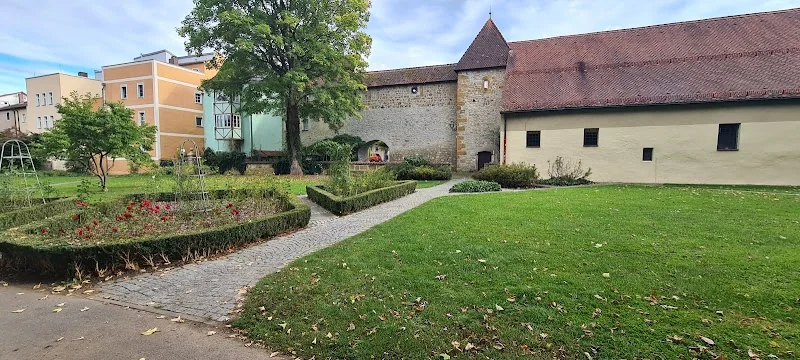
If you are looking for the English Garden in Amberg, you won't end up in Munich, but in a unique urban green space on the edge of the old town. The place is registered as a park in Amberg, located near the Vilstor and Maxplatz, and is part of an urbanistically important green ring around the city moat. This location makes it interesting for many people: it is not an isolated city park, but a link between the historic city wall, Vils, herb meadow, and the paths through the old town. The city of Amberg and its specialized departments have described the area for years as part of larger plans around “Living by the Vils,” which aim to reorganize and enhance the public space by the water. This makes the English Garden a place where recreation, movement, and urban landscape come together closely. ([mapcarta.com](https://mapcarta.com/de/W316254689))
For search intentions behind terms like “parking,” “photos,” “restaurant,” or “air sound mile,” it is important to note: The English Garden in Amberg is not a classic event venue with ticket logic or seating plans, but a freely accessible urban green area with a direct connection to the daily life of the city center. The surroundings are characterized by short paths, historical sightlines, and proximity to gastronomy and parking options. Those looking for a quiet break between the old town, Vils, and the adjacent green spaces will find a very urban yet relaxed setting here. This is precisely what makes this place appealing: it is visibly intertwined with the city while simultaneously serving as a counterpoint to the dense old town activity. ([mapcarta.com](https://mapcarta.com/de/W316254689))
Location and Orientation: Where is the English Garden in Amberg?
Orientation at the English Garden is pleasantly simple for visitors if they know the main reference points. The park is located in Amberg in close proximity to Vilstor and Maxplatz, where the old town, city wall, and green space meet particularly closely. This is not only clearly visible on maps but can also be found in urban documents: In the planning for the “Living by the Vils” project, the English Garden is described as part of the green structures in and around the city moat, serving as an element of the old town ring that spatially and landscape-wise accompanies the city wall. Those walking in the city center can quickly reach the area on foot and almost automatically move into a space where historical substance and newly designed open spaces merge. ([mapcarta.com](https://mapcarta.com/de/W316254689))
This location is of great importance for the cityscape. Amberg describes itself as a city where old and new naturally intertwine, while also emphasizing the nature along the Vils as an attractive local recreation area with diverse flora and fauna. The English Garden fits perfectly into this picture because it does not cut off the backdrop of the old town but rather expands it. From an urban planning perspective, it acts as a green buffer zone between busy paths, the city wall, and watercourses. For visitors, this means: even a short stay here can feel like a small change in perspective. You are still in the middle of the city, but perceive differently how the historic core city is framed by greenery and water. This is particularly interesting for people who want to experience Amberg not just as a shopping or cultural city but also as a city with clearly readable open spaces. ([tourismus.amberg.de](https://tourismus.amberg.de/))
The direct context also helps with orientation. Mapcarta locates the English Garden near the Vilstor and the Maxplatz park; at the same time, the map names nearby places such as the school church, St. Martin, and other central points of the old town. This results in a very compact urban quarter where attractions, footpaths, and recreational areas are closely situated. So, if you are looking for an address for a meeting point, a walk, or a quiet starting point for city exploration, you are in the right place. The location makes the English Garden attractive not only as a park but also as a practical orientation point for everything that converges in the old town and at the city moat. ([mapcarta.com](https://mapcarta.com/de/W316254689))
Parking at the English Garden: Herb Meadow, Parking Deck, and Arrival
When it comes to “parking,” the English Garden in Amberg is closely linked to the Herb Meadow. The city of Amberg explicitly lists the Herb Meadow parking deck in its vehicle parking system and currently indicates 281 parking spaces there. Additionally, the area is mentioned as a zone where mobile parking is possible, and monthly and annual parking permits are available for the Herb Meadow. So, if you are arriving by car and want to park as close to the city center as possible, you will find a very clear and officially regulated solution here. This is a practical advantage, especially for visitors who want to combine a visit to the English Garden with a stroll through the old town, an appointment in the city center, or a short stay by the Vils. ([amberg.de](https://amberg.de/parken?utm_source=openai))
The proximity to the Herb Meadow parking deck is also important because the entire area around the English Garden, city moat, and Vils steps is intended as a cohesive recreational landscape. The Water Management Office describes the Vils steps as a generous, linear riverbank area that stretches from the Herb Meadow to the city wall, spatially integrating the English Garden. So, if you park there, you won't end up in an isolated parking lot, but at a starting point from which you can quickly access the green corridor, the water, or further towards the old town. This proximity of parking lot, footpath, and green space is a central part of accessibility. It also explains why Amberg is often said to have a good connection between the city center, public spaces, and the banks of the Vils. ([wwa-wen.bayern.de](https://www.wwa-wen.bayern.de/projekte/hws_amberg/vilsstufen/index.htm))
In practice, this means: those visiting the English Garden should not only look for a parking space but also consider the entire arrival logic of the surroundings. Parking at the Herb Meadow leads to an area that is already understood today and even more so in future urban planning as a gateway to the green and water areas. The city of Amberg mentions in its development concept the enhancement of the eastern green ring between the English Garden and Nabburger Torplatz, as well as the redesign of the Herb Meadow and the English Garden. These plans show that arriving by car does not end at the edge of a traffic corridor but transitions into an enhanced pedestrian and recreational network. For visitors, this is ideal if they prefer short paths, clear orientation, and a direct transition into the city center. ([buergerinfo.amberg.de](https://buergerinfo.amberg.de/getfile.asp?id=129755&type=do&utm_source=openai))
Herb Meadow, City Moat, and Vils Steps: the Green Environment
The English Garden in Amberg is best understood when viewed not as a single point but as part of a green system. The official planning refers to public green spaces in the area of the city moat, namely the Herb Meadow, English Garden, and Rose Garden as interconnected areas. The Water Management Office describes the Vils steps as a connection between the Herb Meadow and the English Garden, creating a generous riverbank area that opens the city wall to the water. From this perspective, the English Garden is not a closed landscape park but a transitional space between the city, wall, and river. This is what makes it interesting for walks: you are not just moving through a park but through a sequence of urban and landscape spaces that complement each other. ([wwa-wen.bayern.de](https://www.wwa-wen.bayern.de/projekte/hws_amberg/vilsstufen/index.htm))
The tourist classification of Amberg supports this image. The city describes the nature along the Vils as an attractive local recreation area with diverse flora and fauna. At the same time, it is evident from current and past planning documents that the areas around the city moat have been treated as important urban green spaces for years. The “Living by the Vils” project picks up on this quality by conceptualizing the space not just as a green area but as an urban experience space. For visitors, this means: a stay in the English Garden is less about major attractions and more about slow perception. You experience slopes, paths, sightlines, and transitions between water, wall, and tree greenery. This is a typical Amberg urban green experience that clearly differs from a purely decorative facility. ([tourismus.amberg.de](https://tourismus.amberg.de/))
Additionally, the special character of the Vils steps is noteworthy. They are intended to widen the area under the Pfalzgrafen Bridge, improve visibility, and facilitate access to the water. This not only creates more quality of stay but also makes the connection between the Herb Meadow, city moat, and English Garden spatially tangible. In urban planning, this section is therefore described as an important building block in the connection between land and city. For visitors, this results in a coherent overall picture: the English Garden is not only “green” but part of a consciously designed urban backdrop where water, seating, banks, and paths are considered together. Anyone wanting to get to know Amberg as a historic river city should not just pass through this area but consciously walk through it. ([wwa-wen.bayern.de](https://www.wwa-wen.bayern.de/projekte/hws_amberg/vilsstufen/index.htm))
Rossini, Gastronomy, and Short Breaks at the Park's Edge
The English Garden also includes gastronomy in Amberg, and very close by. The city marketing overview mentions Rossini, Restaurant & Ice Café, located at Mühlgasse/English Garden 1. This address also appears in other municipal documents as a fixed reference point at the park's edge. This is practical for visitors because it provides not only a green space but also a nearby dining option. Those wanting to take a break after a walk do not have to leave the area but can continue their stay in the immediate surroundings. This combination of park and gastronomy is a clear advantage, especially for families, city visitors, or people using the space as a meeting point. ([stadtmarketing-amberg.de](https://www.stadtmarketing-amberg.de/fileadmin/Dateien/Projekte/Amberger_Stadtgeld/AM_STADTGELD_Faltblatt_DinA7_12S_2025_01_INNENkomp.pdf))
The city planning also addresses the gastronomic component. In the documents for “Living by the Vils” and for the public open spaces in the city moat, it is repeatedly emphasized that seating, access to the banks, and lively edge areas are important to keep the public space attractive. This is exactly where it becomes clear why a café or restaurant at the English Garden makes sense: it extends the duration of stay and turns a short walk into a real stop. For search queries like “restaurant” or “beer garden,” the immediate surroundings are therefore crucial. Although the English Garden itself is not a classic beer garden address like large landscape parks in other cities, the proximity to Rossini and other gastronomic offerings in the old town creates an environment that is very suitable for a break after a walk. ([stadtmarketing-amberg.de](https://www.stadtmarketing-amberg.de/fileadmin/Dateien/Projekte/Amberger_Stadtgeld/AM_STADTGELD_Faltblatt_DinA7_12S_2025_01_INNENkomp.pdf))
The importance of such break spots is also evident in that Amberg understands its gastronomy as part of the urban experience. The tourism website explicitly refers to high-quality gastronomy that accompanies guests in the city. In combination with the English Garden, this creates a low threshold for visiting: you can stop by, take a walk through the Green Ring, sit down, have something to eat or drink, and then continue into the old town. For SEO-relevant terms like “English Garden restaurant,” “English Garden beer garden,” and “English Garden Rossini,” this is the correct, fact-based classification. The place does not stand for a single large offering but for the good interlinking of green space and urban supply. ([tourismus.amberg.de](https://tourismus.amberg.de/?utm_source=openai))
Walks, Photos, and Events in the English Garden
For search queries like “photos” or “walk,” the English Garden in Amberg is particularly interesting due to its location. The immediate proximity to Vilstor, city wall, Vils, and Maxplatz creates a backdrop that allows for many perspectives: historical walls, water, greenery, and paths are closely situated. The city of Amberg describes the nature along the Vils as a local recreation area with diverse flora and fauna; while this is not an explicit list of photo spots for the English Garden, it provides a clear basis for the assumption that the area is perceived as a quiet and inspiring urban space. Those who are out and about here experience mainly changing sightlines between the old town, banks, and green areas. This makes the place particularly attractive for short stays with a camera, phone, or simply with some time. ([tourismus.amberg.de](https://tourismus.amberg.de/))
When it comes to events, the air sound mile is particularly interesting, organized by the city of Amberg and the North Bavarian Music Association. The city states that the mile stretches from the English Garden through the city moat to the multifunctional square; in another announcement, it is added that the music route starts at the playground near the ice café Rossini and then leads through several stations in the city moat. This means that the English Garden is not only a quiet place to stay but also part of the urban event axis. This fits well with the urban function of the area: it is open, permeable, and linked to the city center, allowing temporary events to activate the space without overwhelming it. ([amberg.de](https://amberg.de/luftklangmeile?utm_source=openai))
That the English Garden in Amberg is not a classic event arena but an open urban space is more of an advantage than a disadvantage. The use remains flexible: on normal days, a place for paths and breaks, during events, a section in a larger route, and during city visits, a connecting element between the old town and the water area. The urban planning also emphasizes this openness by treating the area as part of the eastern green ring and as a structural and landscape link. So, if you are looking for a place that is photogenic, quiet, and yet urban lively, you will find in the English Garden a very good example of modern city center qualities in a historic environment. ([buergerinfo.amberg.de](https://buergerinfo.amberg.de/getfile.asp?id=129755&type=do&utm_source=openai))
History, Planning, and Features of the English Garden
The uniqueness of the English Garden in Amberg lies less in spectacular individual buildings than in its urban planning role. The available official documents show that the area has been integrated into concepts for urban development for years. In the documents for “Living by the Vils” and in the integrated urban development concept, the English Garden, the Herb Meadow, and the city moat are explicitly treated as part of the surrounding green structures. This means: the place did not arise by chance but is part of a long-term perceived ensemble of old town, wall, and river. This type of embedding is important because it explains why the English Garden functions not only as a park but also as an urban building block with a high identity-forming effect. ([buergerinfo.amberg.de](https://buergerinfo.amberg.de/getfile.asp?id=129755&type=do&utm_source=openai))
In this context, the connection between path design and quality of stay is also crucial. The Water Management Office describes the Vils steps as a section that opens the space between the Herb Meadow and the English Garden, enhances the riverbank, and creates access to the water. Such measures not only change the use but also the perception of a place. From a narrow, rather functional zone, it becomes an urban open space system designed for movement, sight relationships, and stay. When the city of Amberg mentions in its concepts the enhancement of the green ring between the English Garden and Nabburger Torplatz, it shows exactly this logic: the English Garden is part of a cityscape that wants to bring together historical substance and new open space quality. ([wwa-wen.bayern.de](https://www.wwa-wen.bayern.de/projekte/hws_amberg/vilsstufen/index.htm))
The most important feature for visitors is therefore the mix of proximity and tranquility. The English Garden is centrally located but not loud; it is urban but not dense; it is part of an old town but not merely a backdrop. In connection with parking options at the Herb Meadow, gastronomic offerings at the edge, and the role as a route for events, a place emerges that functions well in everyday life as well as on special occasions. Anyone wanting to understand Amberg beyond its historical sights should pay particular attention to this area. Here it becomes visible how a city connects its water, walls, and green spaces into a readable whole. This is precisely the quality of the English Garden in Amberg. ([amberg.de](https://amberg.de/parken?utm_source=openai))
Sources:
- City of Amberg - Vehicle Parking
- Water Management Office Weiden i.d.Opf. - Section Vils Steps
- City of Amberg - Air Sound Mile in the City Moat
- City of Amberg - Integrated Urban Development Concept
- City Marketing Amberg - Gastronomy Overview / City Money
- Tourist Information Amberg - Official Tourism Website
Mehr anzeigenWeniger anzeigen
English Garden Amberg | Parking & Location
If you are looking for the English Garden in Amberg, you won't end up in Munich, but in a unique urban green space on the edge of the old town. The place is registered as a park in Amberg, located near the Vilstor and Maxplatz, and is part of an urbanistically important green ring around the city moat. This location makes it interesting for many people: it is not an isolated city park, but a link between the historic city wall, Vils, herb meadow, and the paths through the old town. The city of Amberg and its specialized departments have described the area for years as part of larger plans around “Living by the Vils,” which aim to reorganize and enhance the public space by the water. This makes the English Garden a place where recreation, movement, and urban landscape come together closely. ([mapcarta.com](https://mapcarta.com/de/W316254689))
For search intentions behind terms like “parking,” “photos,” “restaurant,” or “air sound mile,” it is important to note: The English Garden in Amberg is not a classic event venue with ticket logic or seating plans, but a freely accessible urban green area with a direct connection to the daily life of the city center. The surroundings are characterized by short paths, historical sightlines, and proximity to gastronomy and parking options. Those looking for a quiet break between the old town, Vils, and the adjacent green spaces will find a very urban yet relaxed setting here. This is precisely what makes this place appealing: it is visibly intertwined with the city while simultaneously serving as a counterpoint to the dense old town activity. ([mapcarta.com](https://mapcarta.com/de/W316254689))
Location and Orientation: Where is the English Garden in Amberg?
Orientation at the English Garden is pleasantly simple for visitors if they know the main reference points. The park is located in Amberg in close proximity to Vilstor and Maxplatz, where the old town, city wall, and green space meet particularly closely. This is not only clearly visible on maps but can also be found in urban documents: In the planning for the “Living by the Vils” project, the English Garden is described as part of the green structures in and around the city moat, serving as an element of the old town ring that spatially and landscape-wise accompanies the city wall. Those walking in the city center can quickly reach the area on foot and almost automatically move into a space where historical substance and newly designed open spaces merge. ([mapcarta.com](https://mapcarta.com/de/W316254689))
This location is of great importance for the cityscape. Amberg describes itself as a city where old and new naturally intertwine, while also emphasizing the nature along the Vils as an attractive local recreation area with diverse flora and fauna. The English Garden fits perfectly into this picture because it does not cut off the backdrop of the old town but rather expands it. From an urban planning perspective, it acts as a green buffer zone between busy paths, the city wall, and watercourses. For visitors, this means: even a short stay here can feel like a small change in perspective. You are still in the middle of the city, but perceive differently how the historic core city is framed by greenery and water. This is particularly interesting for people who want to experience Amberg not just as a shopping or cultural city but also as a city with clearly readable open spaces. ([tourismus.amberg.de](https://tourismus.amberg.de/))
The direct context also helps with orientation. Mapcarta locates the English Garden near the Vilstor and the Maxplatz park; at the same time, the map names nearby places such as the school church, St. Martin, and other central points of the old town. This results in a very compact urban quarter where attractions, footpaths, and recreational areas are closely situated. So, if you are looking for an address for a meeting point, a walk, or a quiet starting point for city exploration, you are in the right place. The location makes the English Garden attractive not only as a park but also as a practical orientation point for everything that converges in the old town and at the city moat. ([mapcarta.com](https://mapcarta.com/de/W316254689))
Parking at the English Garden: Herb Meadow, Parking Deck, and Arrival
When it comes to “parking,” the English Garden in Amberg is closely linked to the Herb Meadow. The city of Amberg explicitly lists the Herb Meadow parking deck in its vehicle parking system and currently indicates 281 parking spaces there. Additionally, the area is mentioned as a zone where mobile parking is possible, and monthly and annual parking permits are available for the Herb Meadow. So, if you are arriving by car and want to park as close to the city center as possible, you will find a very clear and officially regulated solution here. This is a practical advantage, especially for visitors who want to combine a visit to the English Garden with a stroll through the old town, an appointment in the city center, or a short stay by the Vils. ([amberg.de](https://amberg.de/parken?utm_source=openai))
The proximity to the Herb Meadow parking deck is also important because the entire area around the English Garden, city moat, and Vils steps is intended as a cohesive recreational landscape. The Water Management Office describes the Vils steps as a generous, linear riverbank area that stretches from the Herb Meadow to the city wall, spatially integrating the English Garden. So, if you park there, you won't end up in an isolated parking lot, but at a starting point from which you can quickly access the green corridor, the water, or further towards the old town. This proximity of parking lot, footpath, and green space is a central part of accessibility. It also explains why Amberg is often said to have a good connection between the city center, public spaces, and the banks of the Vils. ([wwa-wen.bayern.de](https://www.wwa-wen.bayern.de/projekte/hws_amberg/vilsstufen/index.htm))
In practice, this means: those visiting the English Garden should not only look for a parking space but also consider the entire arrival logic of the surroundings. Parking at the Herb Meadow leads to an area that is already understood today and even more so in future urban planning as a gateway to the green and water areas. The city of Amberg mentions in its development concept the enhancement of the eastern green ring between the English Garden and Nabburger Torplatz, as well as the redesign of the Herb Meadow and the English Garden. These plans show that arriving by car does not end at the edge of a traffic corridor but transitions into an enhanced pedestrian and recreational network. For visitors, this is ideal if they prefer short paths, clear orientation, and a direct transition into the city center. ([buergerinfo.amberg.de](https://buergerinfo.amberg.de/getfile.asp?id=129755&type=do&utm_source=openai))
Herb Meadow, City Moat, and Vils Steps: the Green Environment
The English Garden in Amberg is best understood when viewed not as a single point but as part of a green system. The official planning refers to public green spaces in the area of the city moat, namely the Herb Meadow, English Garden, and Rose Garden as interconnected areas. The Water Management Office describes the Vils steps as a connection between the Herb Meadow and the English Garden, creating a generous riverbank area that opens the city wall to the water. From this perspective, the English Garden is not a closed landscape park but a transitional space between the city, wall, and river. This is what makes it interesting for walks: you are not just moving through a park but through a sequence of urban and landscape spaces that complement each other. ([wwa-wen.bayern.de](https://www.wwa-wen.bayern.de/projekte/hws_amberg/vilsstufen/index.htm))
The tourist classification of Amberg supports this image. The city describes the nature along the Vils as an attractive local recreation area with diverse flora and fauna. At the same time, it is evident from current and past planning documents that the areas around the city moat have been treated as important urban green spaces for years. The “Living by the Vils” project picks up on this quality by conceptualizing the space not just as a green area but as an urban experience space. For visitors, this means: a stay in the English Garden is less about major attractions and more about slow perception. You experience slopes, paths, sightlines, and transitions between water, wall, and tree greenery. This is a typical Amberg urban green experience that clearly differs from a purely decorative facility. ([tourismus.amberg.de](https://tourismus.amberg.de/))
Additionally, the special character of the Vils steps is noteworthy. They are intended to widen the area under the Pfalzgrafen Bridge, improve visibility, and facilitate access to the water. This not only creates more quality of stay but also makes the connection between the Herb Meadow, city moat, and English Garden spatially tangible. In urban planning, this section is therefore described as an important building block in the connection between land and city. For visitors, this results in a coherent overall picture: the English Garden is not only “green” but part of a consciously designed urban backdrop where water, seating, banks, and paths are considered together. Anyone wanting to get to know Amberg as a historic river city should not just pass through this area but consciously walk through it. ([wwa-wen.bayern.de](https://www.wwa-wen.bayern.de/projekte/hws_amberg/vilsstufen/index.htm))
Rossini, Gastronomy, and Short Breaks at the Park's Edge
The English Garden also includes gastronomy in Amberg, and very close by. The city marketing overview mentions Rossini, Restaurant & Ice Café, located at Mühlgasse/English Garden 1. This address also appears in other municipal documents as a fixed reference point at the park's edge. This is practical for visitors because it provides not only a green space but also a nearby dining option. Those wanting to take a break after a walk do not have to leave the area but can continue their stay in the immediate surroundings. This combination of park and gastronomy is a clear advantage, especially for families, city visitors, or people using the space as a meeting point. ([stadtmarketing-amberg.de](https://www.stadtmarketing-amberg.de/fileadmin/Dateien/Projekte/Amberger_Stadtgeld/AM_STADTGELD_Faltblatt_DinA7_12S_2025_01_INNENkomp.pdf))
The city planning also addresses the gastronomic component. In the documents for “Living by the Vils” and for the public open spaces in the city moat, it is repeatedly emphasized that seating, access to the banks, and lively edge areas are important to keep the public space attractive. This is exactly where it becomes clear why a café or restaurant at the English Garden makes sense: it extends the duration of stay and turns a short walk into a real stop. For search queries like “restaurant” or “beer garden,” the immediate surroundings are therefore crucial. Although the English Garden itself is not a classic beer garden address like large landscape parks in other cities, the proximity to Rossini and other gastronomic offerings in the old town creates an environment that is very suitable for a break after a walk. ([stadtmarketing-amberg.de](https://www.stadtmarketing-amberg.de/fileadmin/Dateien/Projekte/Amberger_Stadtgeld/AM_STADTGELD_Faltblatt_DinA7_12S_2025_01_INNENkomp.pdf))
The importance of such break spots is also evident in that Amberg understands its gastronomy as part of the urban experience. The tourism website explicitly refers to high-quality gastronomy that accompanies guests in the city. In combination with the English Garden, this creates a low threshold for visiting: you can stop by, take a walk through the Green Ring, sit down, have something to eat or drink, and then continue into the old town. For SEO-relevant terms like “English Garden restaurant,” “English Garden beer garden,” and “English Garden Rossini,” this is the correct, fact-based classification. The place does not stand for a single large offering but for the good interlinking of green space and urban supply. ([tourismus.amberg.de](https://tourismus.amberg.de/?utm_source=openai))
Walks, Photos, and Events in the English Garden
For search queries like “photos” or “walk,” the English Garden in Amberg is particularly interesting due to its location. The immediate proximity to Vilstor, city wall, Vils, and Maxplatz creates a backdrop that allows for many perspectives: historical walls, water, greenery, and paths are closely situated. The city of Amberg describes the nature along the Vils as a local recreation area with diverse flora and fauna; while this is not an explicit list of photo spots for the English Garden, it provides a clear basis for the assumption that the area is perceived as a quiet and inspiring urban space. Those who are out and about here experience mainly changing sightlines between the old town, banks, and green areas. This makes the place particularly attractive for short stays with a camera, phone, or simply with some time. ([tourismus.amberg.de](https://tourismus.amberg.de/))
When it comes to events, the air sound mile is particularly interesting, organized by the city of Amberg and the North Bavarian Music Association. The city states that the mile stretches from the English Garden through the city moat to the multifunctional square; in another announcement, it is added that the music route starts at the playground near the ice café Rossini and then leads through several stations in the city moat. This means that the English Garden is not only a quiet place to stay but also part of the urban event axis. This fits well with the urban function of the area: it is open, permeable, and linked to the city center, allowing temporary events to activate the space without overwhelming it. ([amberg.de](https://amberg.de/luftklangmeile?utm_source=openai))
That the English Garden in Amberg is not a classic event arena but an open urban space is more of an advantage than a disadvantage. The use remains flexible: on normal days, a place for paths and breaks, during events, a section in a larger route, and during city visits, a connecting element between the old town and the water area. The urban planning also emphasizes this openness by treating the area as part of the eastern green ring and as a structural and landscape link. So, if you are looking for a place that is photogenic, quiet, and yet urban lively, you will find in the English Garden a very good example of modern city center qualities in a historic environment. ([buergerinfo.amberg.de](https://buergerinfo.amberg.de/getfile.asp?id=129755&type=do&utm_source=openai))
History, Planning, and Features of the English Garden
The uniqueness of the English Garden in Amberg lies less in spectacular individual buildings than in its urban planning role. The available official documents show that the area has been integrated into concepts for urban development for years. In the documents for “Living by the Vils” and in the integrated urban development concept, the English Garden, the Herb Meadow, and the city moat are explicitly treated as part of the surrounding green structures. This means: the place did not arise by chance but is part of a long-term perceived ensemble of old town, wall, and river. This type of embedding is important because it explains why the English Garden functions not only as a park but also as an urban building block with a high identity-forming effect. ([buergerinfo.amberg.de](https://buergerinfo.amberg.de/getfile.asp?id=129755&type=do&utm_source=openai))
In this context, the connection between path design and quality of stay is also crucial. The Water Management Office describes the Vils steps as a section that opens the space between the Herb Meadow and the English Garden, enhances the riverbank, and creates access to the water. Such measures not only change the use but also the perception of a place. From a narrow, rather functional zone, it becomes an urban open space system designed for movement, sight relationships, and stay. When the city of Amberg mentions in its concepts the enhancement of the green ring between the English Garden and Nabburger Torplatz, it shows exactly this logic: the English Garden is part of a cityscape that wants to bring together historical substance and new open space quality. ([wwa-wen.bayern.de](https://www.wwa-wen.bayern.de/projekte/hws_amberg/vilsstufen/index.htm))
The most important feature for visitors is therefore the mix of proximity and tranquility. The English Garden is centrally located but not loud; it is urban but not dense; it is part of an old town but not merely a backdrop. In connection with parking options at the Herb Meadow, gastronomic offerings at the edge, and the role as a route for events, a place emerges that functions well in everyday life as well as on special occasions. Anyone wanting to understand Amberg beyond its historical sights should pay particular attention to this area. Here it becomes visible how a city connects its water, walls, and green spaces into a readable whole. This is precisely the quality of the English Garden in Amberg. ([amberg.de](https://amberg.de/parken?utm_source=openai))
Sources:
- City of Amberg - Vehicle Parking
- Water Management Office Weiden i.d.Opf. - Section Vils Steps
- City of Amberg - Air Sound Mile in the City Moat
- City of Amberg - Integrated Urban Development Concept
- City Marketing Amberg - Gastronomy Overview / City Money
- Tourist Information Amberg - Official Tourism Website
English Garden Amberg | Parking & Location
If you are looking for the English Garden in Amberg, you won't end up in Munich, but in a unique urban green space on the edge of the old town. The place is registered as a park in Amberg, located near the Vilstor and Maxplatz, and is part of an urbanistically important green ring around the city moat. This location makes it interesting for many people: it is not an isolated city park, but a link between the historic city wall, Vils, herb meadow, and the paths through the old town. The city of Amberg and its specialized departments have described the area for years as part of larger plans around “Living by the Vils,” which aim to reorganize and enhance the public space by the water. This makes the English Garden a place where recreation, movement, and urban landscape come together closely. ([mapcarta.com](https://mapcarta.com/de/W316254689))
For search intentions behind terms like “parking,” “photos,” “restaurant,” or “air sound mile,” it is important to note: The English Garden in Amberg is not a classic event venue with ticket logic or seating plans, but a freely accessible urban green area with a direct connection to the daily life of the city center. The surroundings are characterized by short paths, historical sightlines, and proximity to gastronomy and parking options. Those looking for a quiet break between the old town, Vils, and the adjacent green spaces will find a very urban yet relaxed setting here. This is precisely what makes this place appealing: it is visibly intertwined with the city while simultaneously serving as a counterpoint to the dense old town activity. ([mapcarta.com](https://mapcarta.com/de/W316254689))
Location and Orientation: Where is the English Garden in Amberg?
Orientation at the English Garden is pleasantly simple for visitors if they know the main reference points. The park is located in Amberg in close proximity to Vilstor and Maxplatz, where the old town, city wall, and green space meet particularly closely. This is not only clearly visible on maps but can also be found in urban documents: In the planning for the “Living by the Vils” project, the English Garden is described as part of the green structures in and around the city moat, serving as an element of the old town ring that spatially and landscape-wise accompanies the city wall. Those walking in the city center can quickly reach the area on foot and almost automatically move into a space where historical substance and newly designed open spaces merge. ([mapcarta.com](https://mapcarta.com/de/W316254689))
This location is of great importance for the cityscape. Amberg describes itself as a city where old and new naturally intertwine, while also emphasizing the nature along the Vils as an attractive local recreation area with diverse flora and fauna. The English Garden fits perfectly into this picture because it does not cut off the backdrop of the old town but rather expands it. From an urban planning perspective, it acts as a green buffer zone between busy paths, the city wall, and watercourses. For visitors, this means: even a short stay here can feel like a small change in perspective. You are still in the middle of the city, but perceive differently how the historic core city is framed by greenery and water. This is particularly interesting for people who want to experience Amberg not just as a shopping or cultural city but also as a city with clearly readable open spaces. ([tourismus.amberg.de](https://tourismus.amberg.de/))
The direct context also helps with orientation. Mapcarta locates the English Garden near the Vilstor and the Maxplatz park; at the same time, the map names nearby places such as the school church, St. Martin, and other central points of the old town. This results in a very compact urban quarter where attractions, footpaths, and recreational areas are closely situated. So, if you are looking for an address for a meeting point, a walk, or a quiet starting point for city exploration, you are in the right place. The location makes the English Garden attractive not only as a park but also as a practical orientation point for everything that converges in the old town and at the city moat. ([mapcarta.com](https://mapcarta.com/de/W316254689))
Parking at the English Garden: Herb Meadow, Parking Deck, and Arrival
When it comes to “parking,” the English Garden in Amberg is closely linked to the Herb Meadow. The city of Amberg explicitly lists the Herb Meadow parking deck in its vehicle parking system and currently indicates 281 parking spaces there. Additionally, the area is mentioned as a zone where mobile parking is possible, and monthly and annual parking permits are available for the Herb Meadow. So, if you are arriving by car and want to park as close to the city center as possible, you will find a very clear and officially regulated solution here. This is a practical advantage, especially for visitors who want to combine a visit to the English Garden with a stroll through the old town, an appointment in the city center, or a short stay by the Vils. ([amberg.de](https://amberg.de/parken?utm_source=openai))
The proximity to the Herb Meadow parking deck is also important because the entire area around the English Garden, city moat, and Vils steps is intended as a cohesive recreational landscape. The Water Management Office describes the Vils steps as a generous, linear riverbank area that stretches from the Herb Meadow to the city wall, spatially integrating the English Garden. So, if you park there, you won't end up in an isolated parking lot, but at a starting point from which you can quickly access the green corridor, the water, or further towards the old town. This proximity of parking lot, footpath, and green space is a central part of accessibility. It also explains why Amberg is often said to have a good connection between the city center, public spaces, and the banks of the Vils. ([wwa-wen.bayern.de](https://www.wwa-wen.bayern.de/projekte/hws_amberg/vilsstufen/index.htm))
In practice, this means: those visiting the English Garden should not only look for a parking space but also consider the entire arrival logic of the surroundings. Parking at the Herb Meadow leads to an area that is already understood today and even more so in future urban planning as a gateway to the green and water areas. The city of Amberg mentions in its development concept the enhancement of the eastern green ring between the English Garden and Nabburger Torplatz, as well as the redesign of the Herb Meadow and the English Garden. These plans show that arriving by car does not end at the edge of a traffic corridor but transitions into an enhanced pedestrian and recreational network. For visitors, this is ideal if they prefer short paths, clear orientation, and a direct transition into the city center. ([buergerinfo.amberg.de](https://buergerinfo.amberg.de/getfile.asp?id=129755&type=do&utm_source=openai))
Herb Meadow, City Moat, and Vils Steps: the Green Environment
The English Garden in Amberg is best understood when viewed not as a single point but as part of a green system. The official planning refers to public green spaces in the area of the city moat, namely the Herb Meadow, English Garden, and Rose Garden as interconnected areas. The Water Management Office describes the Vils steps as a connection between the Herb Meadow and the English Garden, creating a generous riverbank area that opens the city wall to the water. From this perspective, the English Garden is not a closed landscape park but a transitional space between the city, wall, and river. This is what makes it interesting for walks: you are not just moving through a park but through a sequence of urban and landscape spaces that complement each other. ([wwa-wen.bayern.de](https://www.wwa-wen.bayern.de/projekte/hws_amberg/vilsstufen/index.htm))
The tourist classification of Amberg supports this image. The city describes the nature along the Vils as an attractive local recreation area with diverse flora and fauna. At the same time, it is evident from current and past planning documents that the areas around the city moat have been treated as important urban green spaces for years. The “Living by the Vils” project picks up on this quality by conceptualizing the space not just as a green area but as an urban experience space. For visitors, this means: a stay in the English Garden is less about major attractions and more about slow perception. You experience slopes, paths, sightlines, and transitions between water, wall, and tree greenery. This is a typical Amberg urban green experience that clearly differs from a purely decorative facility. ([tourismus.amberg.de](https://tourismus.amberg.de/))
Additionally, the special character of the Vils steps is noteworthy. They are intended to widen the area under the Pfalzgrafen Bridge, improve visibility, and facilitate access to the water. This not only creates more quality of stay but also makes the connection between the Herb Meadow, city moat, and English Garden spatially tangible. In urban planning, this section is therefore described as an important building block in the connection between land and city. For visitors, this results in a coherent overall picture: the English Garden is not only “green” but part of a consciously designed urban backdrop where water, seating, banks, and paths are considered together. Anyone wanting to get to know Amberg as a historic river city should not just pass through this area but consciously walk through it. ([wwa-wen.bayern.de](https://www.wwa-wen.bayern.de/projekte/hws_amberg/vilsstufen/index.htm))
Rossini, Gastronomy, and Short Breaks at the Park's Edge
The English Garden also includes gastronomy in Amberg, and very close by. The city marketing overview mentions Rossini, Restaurant & Ice Café, located at Mühlgasse/English Garden 1. This address also appears in other municipal documents as a fixed reference point at the park's edge. This is practical for visitors because it provides not only a green space but also a nearby dining option. Those wanting to take a break after a walk do not have to leave the area but can continue their stay in the immediate surroundings. This combination of park and gastronomy is a clear advantage, especially for families, city visitors, or people using the space as a meeting point. ([stadtmarketing-amberg.de](https://www.stadtmarketing-amberg.de/fileadmin/Dateien/Projekte/Amberger_Stadtgeld/AM_STADTGELD_Faltblatt_DinA7_12S_2025_01_INNENkomp.pdf))
The city planning also addresses the gastronomic component. In the documents for “Living by the Vils” and for the public open spaces in the city moat, it is repeatedly emphasized that seating, access to the banks, and lively edge areas are important to keep the public space attractive. This is exactly where it becomes clear why a café or restaurant at the English Garden makes sense: it extends the duration of stay and turns a short walk into a real stop. For search queries like “restaurant” or “beer garden,” the immediate surroundings are therefore crucial. Although the English Garden itself is not a classic beer garden address like large landscape parks in other cities, the proximity to Rossini and other gastronomic offerings in the old town creates an environment that is very suitable for a break after a walk. ([stadtmarketing-amberg.de](https://www.stadtmarketing-amberg.de/fileadmin/Dateien/Projekte/Amberger_Stadtgeld/AM_STADTGELD_Faltblatt_DinA7_12S_2025_01_INNENkomp.pdf))
The importance of such break spots is also evident in that Amberg understands its gastronomy as part of the urban experience. The tourism website explicitly refers to high-quality gastronomy that accompanies guests in the city. In combination with the English Garden, this creates a low threshold for visiting: you can stop by, take a walk through the Green Ring, sit down, have something to eat or drink, and then continue into the old town. For SEO-relevant terms like “English Garden restaurant,” “English Garden beer garden,” and “English Garden Rossini,” this is the correct, fact-based classification. The place does not stand for a single large offering but for the good interlinking of green space and urban supply. ([tourismus.amberg.de](https://tourismus.amberg.de/?utm_source=openai))
Walks, Photos, and Events in the English Garden
For search queries like “photos” or “walk,” the English Garden in Amberg is particularly interesting due to its location. The immediate proximity to Vilstor, city wall, Vils, and Maxplatz creates a backdrop that allows for many perspectives: historical walls, water, greenery, and paths are closely situated. The city of Amberg describes the nature along the Vils as a local recreation area with diverse flora and fauna; while this is not an explicit list of photo spots for the English Garden, it provides a clear basis for the assumption that the area is perceived as a quiet and inspiring urban space. Those who are out and about here experience mainly changing sightlines between the old town, banks, and green areas. This makes the place particularly attractive for short stays with a camera, phone, or simply with some time. ([tourismus.amberg.de](https://tourismus.amberg.de/))
When it comes to events, the air sound mile is particularly interesting, organized by the city of Amberg and the North Bavarian Music Association. The city states that the mile stretches from the English Garden through the city moat to the multifunctional square; in another announcement, it is added that the music route starts at the playground near the ice café Rossini and then leads through several stations in the city moat. This means that the English Garden is not only a quiet place to stay but also part of the urban event axis. This fits well with the urban function of the area: it is open, permeable, and linked to the city center, allowing temporary events to activate the space without overwhelming it. ([amberg.de](https://amberg.de/luftklangmeile?utm_source=openai))
That the English Garden in Amberg is not a classic event arena but an open urban space is more of an advantage than a disadvantage. The use remains flexible: on normal days, a place for paths and breaks, during events, a section in a larger route, and during city visits, a connecting element between the old town and the water area. The urban planning also emphasizes this openness by treating the area as part of the eastern green ring and as a structural and landscape link. So, if you are looking for a place that is photogenic, quiet, and yet urban lively, you will find in the English Garden a very good example of modern city center qualities in a historic environment. ([buergerinfo.amberg.de](https://buergerinfo.amberg.de/getfile.asp?id=129755&type=do&utm_source=openai))
History, Planning, and Features of the English Garden
The uniqueness of the English Garden in Amberg lies less in spectacular individual buildings than in its urban planning role. The available official documents show that the area has been integrated into concepts for urban development for years. In the documents for “Living by the Vils” and in the integrated urban development concept, the English Garden, the Herb Meadow, and the city moat are explicitly treated as part of the surrounding green structures. This means: the place did not arise by chance but is part of a long-term perceived ensemble of old town, wall, and river. This type of embedding is important because it explains why the English Garden functions not only as a park but also as an urban building block with a high identity-forming effect. ([buergerinfo.amberg.de](https://buergerinfo.amberg.de/getfile.asp?id=129755&type=do&utm_source=openai))
In this context, the connection between path design and quality of stay is also crucial. The Water Management Office describes the Vils steps as a section that opens the space between the Herb Meadow and the English Garden, enhances the riverbank, and creates access to the water. Such measures not only change the use but also the perception of a place. From a narrow, rather functional zone, it becomes an urban open space system designed for movement, sight relationships, and stay. When the city of Amberg mentions in its concepts the enhancement of the green ring between the English Garden and Nabburger Torplatz, it shows exactly this logic: the English Garden is part of a cityscape that wants to bring together historical substance and new open space quality. ([wwa-wen.bayern.de](https://www.wwa-wen.bayern.de/projekte/hws_amberg/vilsstufen/index.htm))
The most important feature for visitors is therefore the mix of proximity and tranquility. The English Garden is centrally located but not loud; it is urban but not dense; it is part of an old town but not merely a backdrop. In connection with parking options at the Herb Meadow, gastronomic offerings at the edge, and the role as a route for events, a place emerges that functions well in everyday life as well as on special occasions. Anyone wanting to understand Amberg beyond its historical sights should pay particular attention to this area. Here it becomes visible how a city connects its water, walls, and green spaces into a readable whole. This is precisely the quality of the English Garden in Amberg. ([amberg.de](https://amberg.de/parken?utm_source=openai))
Sources:
- City of Amberg - Vehicle Parking
- Water Management Office Weiden i.d.Opf. - Section Vils Steps
- City of Amberg - Air Sound Mile in the City Moat
- City of Amberg - Integrated Urban Development Concept
- City Marketing Amberg - Gastronomy Overview / City Money
- Tourist Information Amberg - Official Tourism Website
Upcoming Events
Dance Pavilion: Salsa in Amberg
Salsa under the open sky in Amberg: free, lively, and full of summer energy. The Dance Pavilion brings Latin American flair and participation mood. #Amberg #Salsa #DancePavilion

Dance Pavilion - Salsa Rueda
Amberg Dances Again Outdoors: The Amberg Dance Pavilion Brings Salsa, Summer Feeling, and Open Dance Culture to the English Garden. Free, lively, captivating. #AmbergDances
Dance Pavilion Salsa in Amberg
Salsa, summer, and free dance moments in Amberg: The Dance Pavilion invites you to the English Garden on 30.07.2026 from 19:00. Free, open, exhilarating. #Amberg #Salsa #DancePavilion
Dance Pavilion in Amberg: Salsa Under the Open Sky
Latin American rhythms, summer air, and open dance joy: The Amberg Dance Pavilion turns the English Garden into a stage. Free on 30.07.2026. #Amberg #Salsa
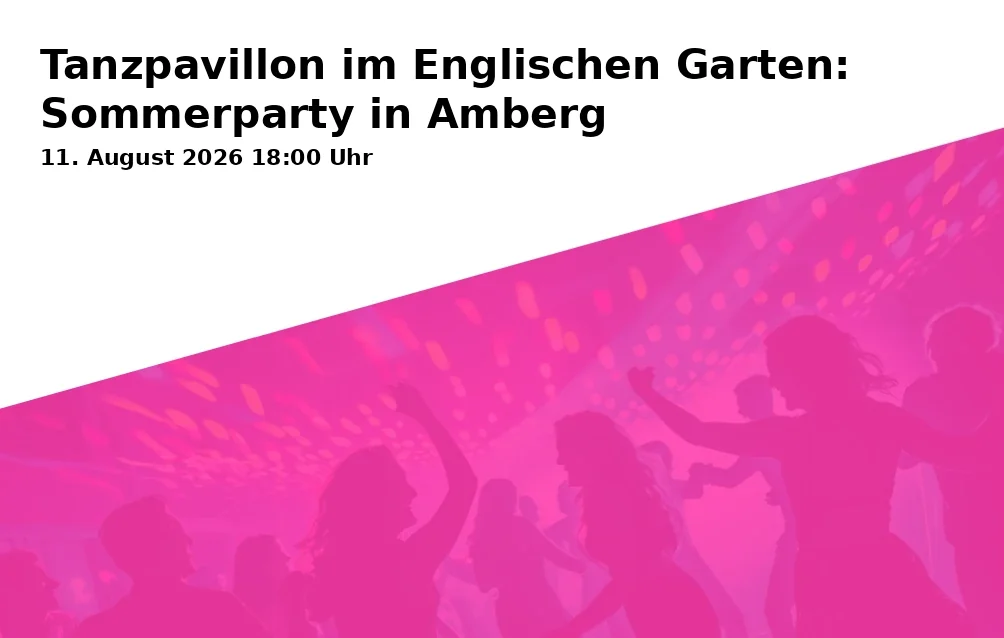
Dance Pavilion in the English Garden: Summer Party in Amberg
Open-air dance feeling in the English Garden Amberg: free, lively, and full of summer energy. On 11.08.2026, it's about participating, watching, and enjoying. #Amberg #DancePavilion
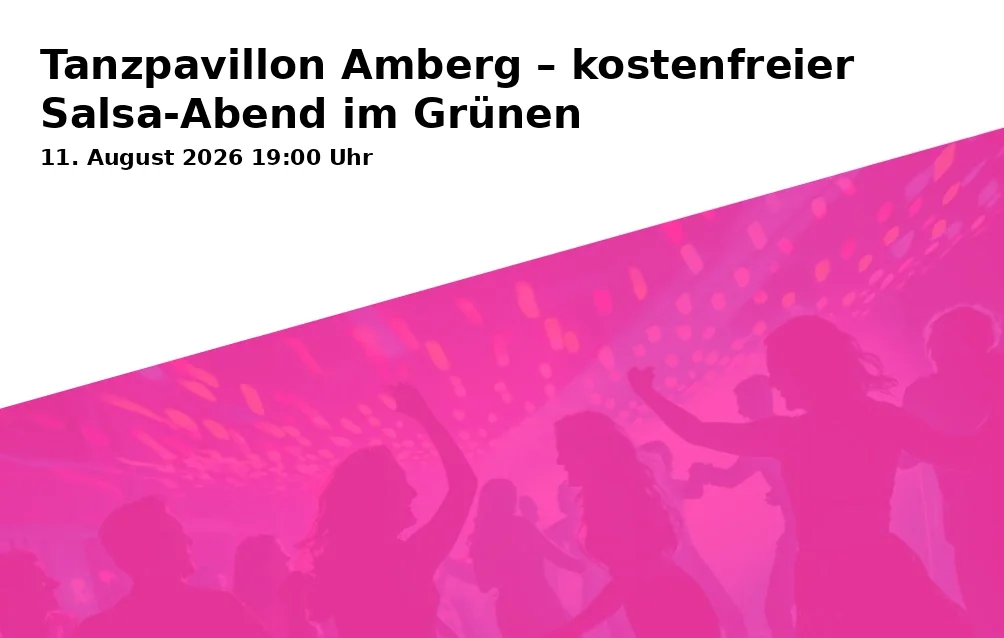
Dance Pavilion Amberg – Free Salsa Evening in the Park
Summer evening, Salsa, and real dance floor vibe in Amberg: The Dance Pavilion brings movement, music, and open festival vibes together. #Amberg #Salsa

Dance Pavilion - Salsa Rueda & Rueda de Casino
Amberg summer evening with Salsa Rueda at the Dance Pavilion: free, open, full of dance energy and open-air feeling. Mark your calendar now! #Amberg #Salsa
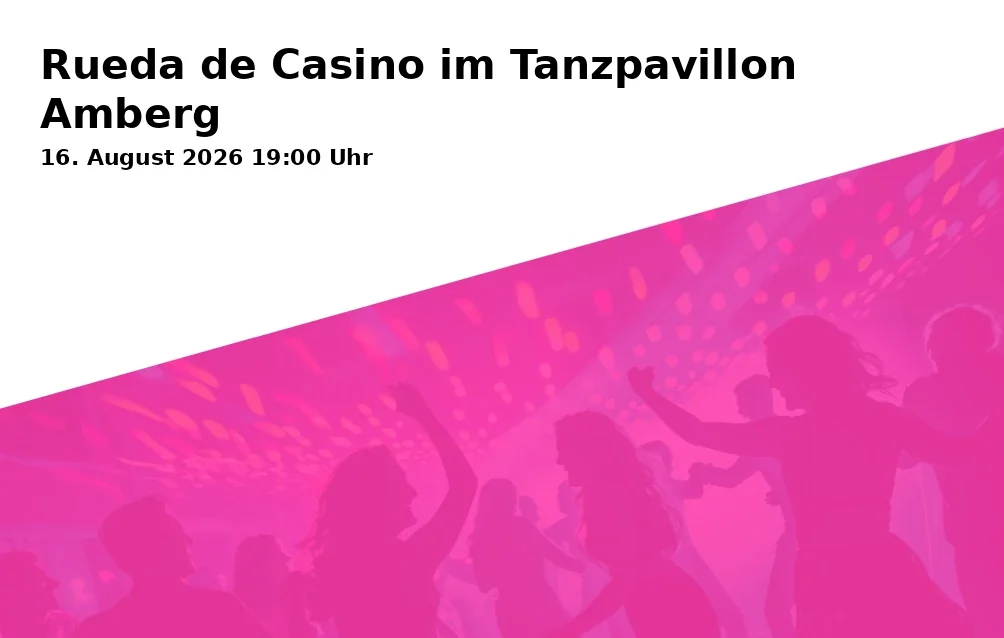
Rueda de Casino at the Amberg Dance Pavilion
Summer, salsa, and pure circular movement: Rueda de Casino at the Amberg Dance Pavilion brings open-air energy to the English Garden. 16.08.2026, 7 PM, free entry. #Amberg #Salsa #DancePavilion

Salsa Rueda at the Dance Pavilion Amberg
Salsa, circle, and summer feeling in Amberg: The Dance Pavilion brings Latin American energy under the open sky. 08/20/2026, free admission. #AmbergDances
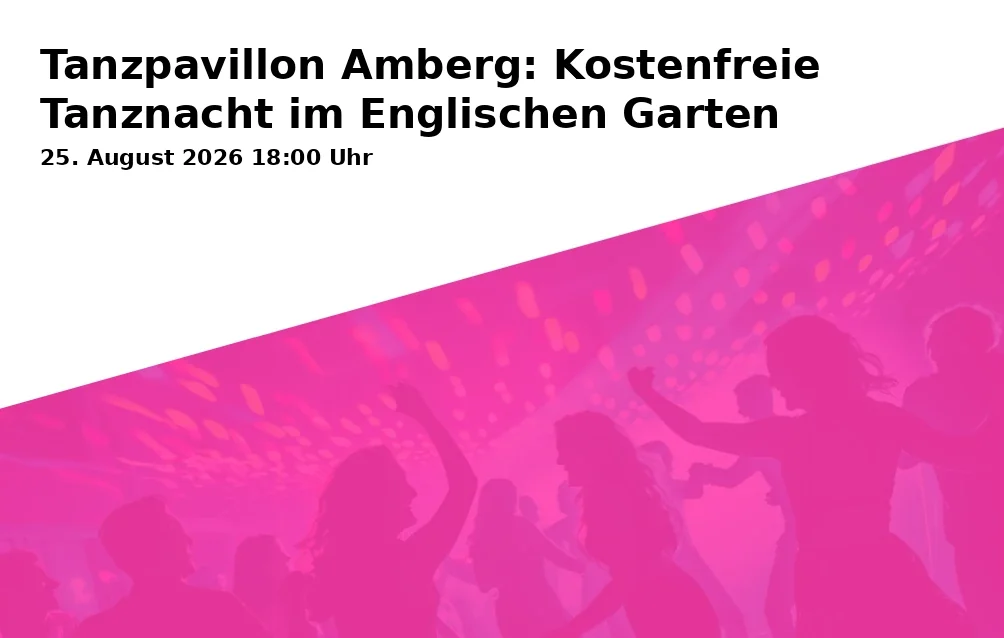
Dance Pavilion Amberg: Free Dance Night in the English Garden
Free, open, summery: The Amberg Dance Pavilion brings dance culture to the English Garden. On 25.08.2026 from 18:00. #Amberg #DancePavilion
Frequently Asked Questions
Reviews
No reviews found