
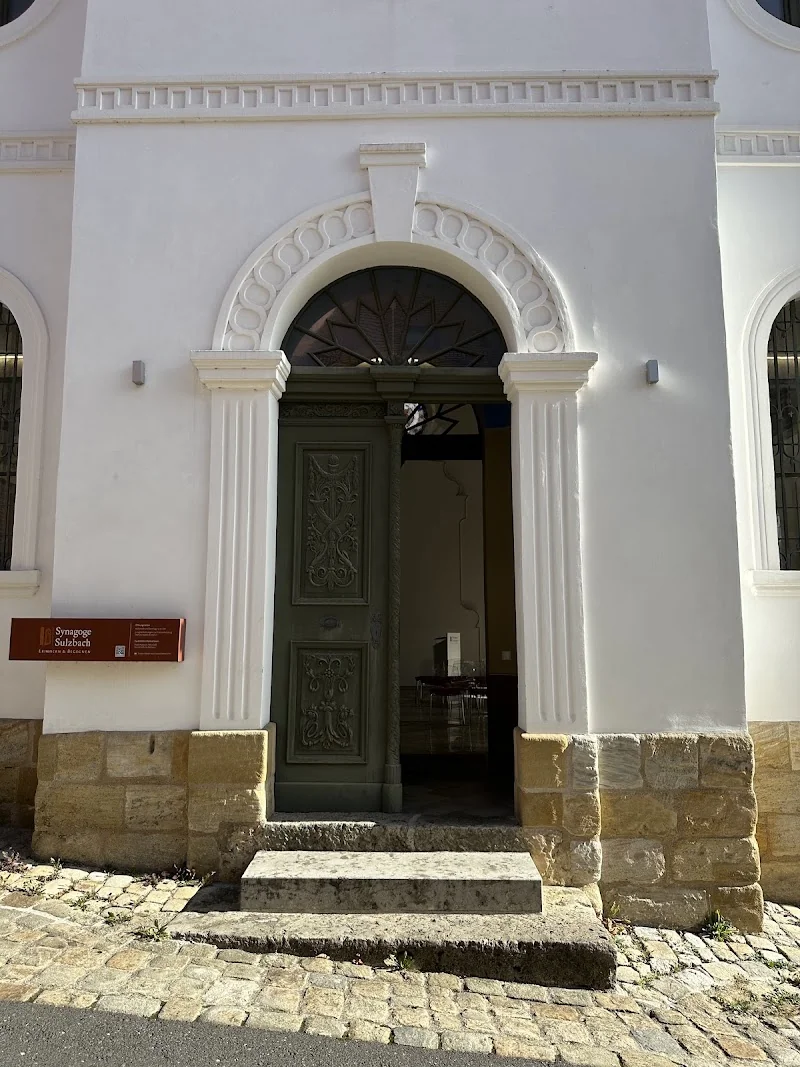
Synagogenstraße 9, Sulzbach-Rosenberg
Synagogenstraße 9, 92237 Sulzbach-Rosenberg, Germany
Former Synagogue Sulzbach | History & Events
The Former Synagogue Sulzbach in Sulzbach-Rosenberg is much more than a historical building. It is a place where Jewish history, regional memory culture, and contemporary event practices come together in a special way. Those searching for the former synagogue Sulzbach Rosenberg, synagogue Sulzbach, old synagogue Sulzbach-Rosenberg, or even for photos and events will find a house with clear historical depth and at the same time with vibrant cultural everyday life. The synagogue was rebuilt after the city fire of 1822 and was consecrated on August 31, 1827. Since the comprehensive renovation by the city and its renewed use from 2013, it has been accessible as a municipal memorial and meeting place. This connection of authentic building substance, museum presentation, and public use makes the location so attractive for visitors, concert guests, and those interested in cultural history. ([suro.city](https://www.suro.city/freizeit-und-gaeste/sehenswertes/synagoge/))
History of the Former Synagogue Sulzbach
The history of the synagogue is closely linked to the Jewish community in Sulzbach and the development of the city itself. The current synagogue was built after the devastating city fire of 1822 and consecrated in 1827. It was considered one of the most beautiful synagogues in Bavaria. However, by the 1920s, no services could take place there anymore because the necessary number of at least ten male community members was no longer present. After the dissolution of the Jewish community in 1936, the city acquired the building for a compensation payment to use it as a local museum. This step preserved the synagogue from destruction during the Reich Pogrom Night in 1938. After World War II, the building changed hands, was sold in 1950, and was remodeled several times from 1954 onwards for use as residential and storage space. Despite these interventions, much of the original substance has been preserved. ([suro.city](https://www.suro.city/freizeit-und-gaeste/sehenswertes/synagoge/))
Particularly important for today's understanding of the location is the phase of reclamation and restoration. The city of Sulzbach-Rosenberg reacquired the property in 2008 and had it fundamentally renovated until 2013. The restoration of the historical interior, the space-defining dome, and the exterior facades with meander friezes and corner pilasters made the synagogue once again an impressive testimony to Jewish sacred art. The current use as a memorial and meeting place is therefore not just a secondary use, but a consciously maintained cultural and historical task. For visitors, this means: Those who enter the Former Synagogue Sulzbach do not experience a neutral exhibition space, but a place where architectural history, Jewish community history, and urban memory come together in a very dense form. This also explains why the location is so often combined in search queries with terms like history, synagogue, Sulzbach-Rosenberg, and exhibition. ([suro.city](https://www.suro.city/freizeit-und-gaeste/sehenswertes/synagoge/))
Photos, Interior, and Architecture
Those searching for Former Synagogue Sulzbach photos are usually interested not only in exterior views but especially in the special spatial impression. This is where the building showcases its greatest strength. The official tourist information documents the interior with a color scheme that is based on the design from 1827: whitewashed walls and gray marble columns define the appearance. In the entrance area, the last room design from 1869 has also been restored. Additionally, the Bima and the Torah ark, depicted in outline, make the former prayer room easily readable even without a complete reconstruction. This creates a space for visitors that combines historical authenticity with careful mediation. The official site also offers image material and a virtual tour, so the special character of the synagogue can be well understood even before a visit. ([suro.city](https://www.suro.city/freizeit-und-gaeste/sehenswertes/synagoge/))
The exterior architecture is also remarkable and provides many of the impressions associated with the Former Synagogue Sulzbach. A traditional wedding stone has been uncovered on the outer wall, which plays a role in Jewish customs. In Orthodox Judaism, women pray separately from men, which is why access to the women's gallery is located in the courtyard. These architectural details are not decorative coincidences but direct indications of the historical use of the building. At the same time, they emphasize how carefully the renovation was carried out. For this reason, the synagogue is frequently associated in search queries with terms like photos, interior, architecture, hall, and special features. For visitors, the place is not only a learning space but also a very photogenic, light-filled place that is repeatedly highlighted in reviews for its atmosphere, acoustics, and carefully restored condition. ([suro.city](https://www.suro.city/freizeit-und-gaeste/sehenswertes/synagoge/))
Exhibition on the Jewish Community and Printing History
A central part of the visit is the exhibition on the Jewish community of Sulzbach. On the ground floor, the architectural history of the synagogue and the elements of the Jewish house of prayer are documented with old photos. This is important because the location functions not only as a monument but also as a declared place of learning. The content is structured so that visitors can trace the development of the building, its religious significance, and its later transformation. On the former women's gallery, there is a separate section on the Jewish printing history in Sulzbach. This is where it becomes clear why the Former Synagogue Sulzbach is relevant for those interested in cultural history far beyond the city limits: it connects religious history, city history, and printing history in one building. ([suro.city](https://www.suro.city/freizeit-und-gaeste/sehenswertes/synagoge/))
The official tourist information describes this printing history very vividly. As early as 1669, a Hebrew printing press was promoted in Sulzbach, and over nearly 200 years, Talmud editions, holiday prayer books, Pentateuch editions, and numerous Siddurim were produced there. The Hebrew book printing experienced a particularly strong upswing with the Viennese family Fraenkel, who came to Sulzbach in 1673. Between 1719 and 1766, Fraenkel published 167 editions of religious Jewish literature, including well-known calendars from Sulzbach. These facts explain why the synagogue should not be viewed in isolation. It is part of a larger story of Jewish life and scholarship in the city. Thus, those who visit the location discover not only a beautiful space but also an exhibition that makes the spiritual and cultural heritage of the region visible. This is exactly what makes search terms like exhibition, history, synagogue Sulzbach, and old synagogue so relevant. ([suro.city](https://www.suro.city/freizeit-und-gaeste/sehenswertes/synagoge/))
Opening Hours, Admission, and Tours
For the practical planning of a visit, the current opening hours are crucial. The tourist information states that it is open on Sundays from 2:00 PM to 5:00 PM and points out that short-term changes are communicated via social media; museums in Bavaria additionally list Wednesdays from 2:00 PM to 5:00 PM as opening hours. This means: If you want to visit the Former Synagogue Sulzbach, it is advisable to check the official site shortly before the appointment. This is particularly useful because many guests search for opening hours, admission, and tours, and the synagogue is not open daily like an ordinary museum. Especially at a memorial and meeting place, visits are often tied to fixed time windows, which makes planning a bit more important. However, the visit rewards this planning with a very clear historical framework and a compact, focused tour. ([suro.city](https://www.suro.city/freizeit-und-gaeste/sehenswertes/synagoge/))
Reliable information is also available regarding admission prices. Adults pay 5 euros, reduced admission costs 3 euros, and children up to 16 years are free. Public tours take place on the last Sunday of each month at 2 PM. Group tours are possible by appointment, and the admission ticket also entitles a one-time visit to the Sulzbach-Rosenberg City Museum. This is an attractive package for cultural travelers as it allows for the combination of two historical sites in one visit. This is why the FAQ questions about tickets, admission, tours, or opening hours have very concrete answers. Those planning a visit can thus expect a relatively clear price level and can be assured that the place is not only documented but also conveyed. The combination of exhibition, guided access, and complementary museum visit makes the Former Synagogue Sulzbach a particularly well-prepared historical station. ([suro.city](https://www.suro.city/freizeit-und-gaeste/sehenswertes/synagoge/))
Directions and Parking in Sulzbach-Rosenberg
The Former Synagogue is located at Synagogenstraße 9 in Sulzbach-Rosenberg, in an area that is well connected to the historic old town and the urban center. Those searching for directions, parking, or parking spaces will find a comprehensive overview for the entire city area on the official site of the city of Sulzbach-Rosenberg. For visitors, it is particularly relevant that there are sufficient P&R parking spaces available at the city festival square between Sulzbach and Rosenberg. From there, public transport can be used, which can be practical for a visit without a car. Additionally, the city lists several parking options for the old town area, including the castle garage at Luitpoldplatz with 220 spaces. There are also free as well as paid parking spaces with different time limits. ([suro.city](https://www.suro.city/buergerservice/wichtige-informationen/parken/))
For guests of the synagogue, it is also interesting that the city designates several parking areas for people with disabilities, including locations in the old town and explicitly also in Synagogenstraße. The parking page also lists additional spaces in the surrounding streets and points out that around 70 more parking spaces are available without special arrangements. This shows that the journey is overall well-planned, although one should allow some time depending on the day of the week and occupancy. For search queries regarding parking, directions, and parking spaces, it is clear: The synagogue is not located in a closed event parking garage but is embedded in a historically grown city center with several municipal parking solutions. Those who combine the visit with a walk through the old town benefit additionally from the compact structure of the city center. ([suro.city](https://www.suro.city/buergerservice/wichtige-informationen/parken/))
Events, Concerts, and Memorial Dates
The Former Synagogue Sulzbach is not only used as a museum site but also as a stage for concerts, memorial events, and cultural encounters. This is already evident from the type of publicly visible events. An example is the concert of the Flute Ladies, another is the flute concert Sounds from Silence; additionally, the location was listed as a venue for Orchestra Mondo. Such entries demonstrate that the synagogue is now perceived as a special concert hall, whose atmosphere is well-suited for chamber music, ensembles, and smaller cultural formats. Reviews regularly describe the space as light-filled, acoustically very successful, and lovingly restored. For the search intention behind terms like events, concert, program, or concert hall, this is particularly important, as the synagogue is not only a historical memorial site but also a place for vibrant contemporary culture. ([d.hey.at](https://www.d.hey.at/events/573390?utm_source=openai))
Memorial dates also play a central role in the usage concept. An article from Onetz reports on a special memorial event on November 9, 2023, on the anniversary of the Reich Pogrom Night. It becomes clear that the city consciously uses the synagogue as a place of remembrance and public dialogue. This fits very well with the historical significance of the building, as the synagogue survived the Nazi era, was later renovated, and is now reopened as a meeting place. This dual role as a memorial and cultural site makes it equally exciting for visitor groups, school classes, music audiences, and historically interested travelers. Those searching for the topics program 2025, concert in Sulzbach-Rosenberg, or former synagogue Sulzbach event will encounter a place that is firmly anchored in the city's cultural work while preserving a strong historical identity. ([onetz.de](https://www.onetz.de/oberpfalz/sulzbach-rosenberg/erinnerung-reichspogromnacht-mehr-buerger-sulzbacher-synagoge-kommen-id4459647.html))
Sources:
Mehr anzeigenWeniger anzeigen
Former Synagogue Sulzbach | History & Events
The Former Synagogue Sulzbach in Sulzbach-Rosenberg is much more than a historical building. It is a place where Jewish history, regional memory culture, and contemporary event practices come together in a special way. Those searching for the former synagogue Sulzbach Rosenberg, synagogue Sulzbach, old synagogue Sulzbach-Rosenberg, or even for photos and events will find a house with clear historical depth and at the same time with vibrant cultural everyday life. The synagogue was rebuilt after the city fire of 1822 and was consecrated on August 31, 1827. Since the comprehensive renovation by the city and its renewed use from 2013, it has been accessible as a municipal memorial and meeting place. This connection of authentic building substance, museum presentation, and public use makes the location so attractive for visitors, concert guests, and those interested in cultural history. ([suro.city](https://www.suro.city/freizeit-und-gaeste/sehenswertes/synagoge/))
History of the Former Synagogue Sulzbach
The history of the synagogue is closely linked to the Jewish community in Sulzbach and the development of the city itself. The current synagogue was built after the devastating city fire of 1822 and consecrated in 1827. It was considered one of the most beautiful synagogues in Bavaria. However, by the 1920s, no services could take place there anymore because the necessary number of at least ten male community members was no longer present. After the dissolution of the Jewish community in 1936, the city acquired the building for a compensation payment to use it as a local museum. This step preserved the synagogue from destruction during the Reich Pogrom Night in 1938. After World War II, the building changed hands, was sold in 1950, and was remodeled several times from 1954 onwards for use as residential and storage space. Despite these interventions, much of the original substance has been preserved. ([suro.city](https://www.suro.city/freizeit-und-gaeste/sehenswertes/synagoge/))
Particularly important for today's understanding of the location is the phase of reclamation and restoration. The city of Sulzbach-Rosenberg reacquired the property in 2008 and had it fundamentally renovated until 2013. The restoration of the historical interior, the space-defining dome, and the exterior facades with meander friezes and corner pilasters made the synagogue once again an impressive testimony to Jewish sacred art. The current use as a memorial and meeting place is therefore not just a secondary use, but a consciously maintained cultural and historical task. For visitors, this means: Those who enter the Former Synagogue Sulzbach do not experience a neutral exhibition space, but a place where architectural history, Jewish community history, and urban memory come together in a very dense form. This also explains why the location is so often combined in search queries with terms like history, synagogue, Sulzbach-Rosenberg, and exhibition. ([suro.city](https://www.suro.city/freizeit-und-gaeste/sehenswertes/synagoge/))
Photos, Interior, and Architecture
Those searching for Former Synagogue Sulzbach photos are usually interested not only in exterior views but especially in the special spatial impression. This is where the building showcases its greatest strength. The official tourist information documents the interior with a color scheme that is based on the design from 1827: whitewashed walls and gray marble columns define the appearance. In the entrance area, the last room design from 1869 has also been restored. Additionally, the Bima and the Torah ark, depicted in outline, make the former prayer room easily readable even without a complete reconstruction. This creates a space for visitors that combines historical authenticity with careful mediation. The official site also offers image material and a virtual tour, so the special character of the synagogue can be well understood even before a visit. ([suro.city](https://www.suro.city/freizeit-und-gaeste/sehenswertes/synagoge/))
The exterior architecture is also remarkable and provides many of the impressions associated with the Former Synagogue Sulzbach. A traditional wedding stone has been uncovered on the outer wall, which plays a role in Jewish customs. In Orthodox Judaism, women pray separately from men, which is why access to the women's gallery is located in the courtyard. These architectural details are not decorative coincidences but direct indications of the historical use of the building. At the same time, they emphasize how carefully the renovation was carried out. For this reason, the synagogue is frequently associated in search queries with terms like photos, interior, architecture, hall, and special features. For visitors, the place is not only a learning space but also a very photogenic, light-filled place that is repeatedly highlighted in reviews for its atmosphere, acoustics, and carefully restored condition. ([suro.city](https://www.suro.city/freizeit-und-gaeste/sehenswertes/synagoge/))
Exhibition on the Jewish Community and Printing History
A central part of the visit is the exhibition on the Jewish community of Sulzbach. On the ground floor, the architectural history of the synagogue and the elements of the Jewish house of prayer are documented with old photos. This is important because the location functions not only as a monument but also as a declared place of learning. The content is structured so that visitors can trace the development of the building, its religious significance, and its later transformation. On the former women's gallery, there is a separate section on the Jewish printing history in Sulzbach. This is where it becomes clear why the Former Synagogue Sulzbach is relevant for those interested in cultural history far beyond the city limits: it connects religious history, city history, and printing history in one building. ([suro.city](https://www.suro.city/freizeit-und-gaeste/sehenswertes/synagoge/))
The official tourist information describes this printing history very vividly. As early as 1669, a Hebrew printing press was promoted in Sulzbach, and over nearly 200 years, Talmud editions, holiday prayer books, Pentateuch editions, and numerous Siddurim were produced there. The Hebrew book printing experienced a particularly strong upswing with the Viennese family Fraenkel, who came to Sulzbach in 1673. Between 1719 and 1766, Fraenkel published 167 editions of religious Jewish literature, including well-known calendars from Sulzbach. These facts explain why the synagogue should not be viewed in isolation. It is part of a larger story of Jewish life and scholarship in the city. Thus, those who visit the location discover not only a beautiful space but also an exhibition that makes the spiritual and cultural heritage of the region visible. This is exactly what makes search terms like exhibition, history, synagogue Sulzbach, and old synagogue so relevant. ([suro.city](https://www.suro.city/freizeit-und-gaeste/sehenswertes/synagoge/))
Opening Hours, Admission, and Tours
For the practical planning of a visit, the current opening hours are crucial. The tourist information states that it is open on Sundays from 2:00 PM to 5:00 PM and points out that short-term changes are communicated via social media; museums in Bavaria additionally list Wednesdays from 2:00 PM to 5:00 PM as opening hours. This means: If you want to visit the Former Synagogue Sulzbach, it is advisable to check the official site shortly before the appointment. This is particularly useful because many guests search for opening hours, admission, and tours, and the synagogue is not open daily like an ordinary museum. Especially at a memorial and meeting place, visits are often tied to fixed time windows, which makes planning a bit more important. However, the visit rewards this planning with a very clear historical framework and a compact, focused tour. ([suro.city](https://www.suro.city/freizeit-und-gaeste/sehenswertes/synagoge/))
Reliable information is also available regarding admission prices. Adults pay 5 euros, reduced admission costs 3 euros, and children up to 16 years are free. Public tours take place on the last Sunday of each month at 2 PM. Group tours are possible by appointment, and the admission ticket also entitles a one-time visit to the Sulzbach-Rosenberg City Museum. This is an attractive package for cultural travelers as it allows for the combination of two historical sites in one visit. This is why the FAQ questions about tickets, admission, tours, or opening hours have very concrete answers. Those planning a visit can thus expect a relatively clear price level and can be assured that the place is not only documented but also conveyed. The combination of exhibition, guided access, and complementary museum visit makes the Former Synagogue Sulzbach a particularly well-prepared historical station. ([suro.city](https://www.suro.city/freizeit-und-gaeste/sehenswertes/synagoge/))
Directions and Parking in Sulzbach-Rosenberg
The Former Synagogue is located at Synagogenstraße 9 in Sulzbach-Rosenberg, in an area that is well connected to the historic old town and the urban center. Those searching for directions, parking, or parking spaces will find a comprehensive overview for the entire city area on the official site of the city of Sulzbach-Rosenberg. For visitors, it is particularly relevant that there are sufficient P&R parking spaces available at the city festival square between Sulzbach and Rosenberg. From there, public transport can be used, which can be practical for a visit without a car. Additionally, the city lists several parking options for the old town area, including the castle garage at Luitpoldplatz with 220 spaces. There are also free as well as paid parking spaces with different time limits. ([suro.city](https://www.suro.city/buergerservice/wichtige-informationen/parken/))
For guests of the synagogue, it is also interesting that the city designates several parking areas for people with disabilities, including locations in the old town and explicitly also in Synagogenstraße. The parking page also lists additional spaces in the surrounding streets and points out that around 70 more parking spaces are available without special arrangements. This shows that the journey is overall well-planned, although one should allow some time depending on the day of the week and occupancy. For search queries regarding parking, directions, and parking spaces, it is clear: The synagogue is not located in a closed event parking garage but is embedded in a historically grown city center with several municipal parking solutions. Those who combine the visit with a walk through the old town benefit additionally from the compact structure of the city center. ([suro.city](https://www.suro.city/buergerservice/wichtige-informationen/parken/))
Events, Concerts, and Memorial Dates
The Former Synagogue Sulzbach is not only used as a museum site but also as a stage for concerts, memorial events, and cultural encounters. This is already evident from the type of publicly visible events. An example is the concert of the Flute Ladies, another is the flute concert Sounds from Silence; additionally, the location was listed as a venue for Orchestra Mondo. Such entries demonstrate that the synagogue is now perceived as a special concert hall, whose atmosphere is well-suited for chamber music, ensembles, and smaller cultural formats. Reviews regularly describe the space as light-filled, acoustically very successful, and lovingly restored. For the search intention behind terms like events, concert, program, or concert hall, this is particularly important, as the synagogue is not only a historical memorial site but also a place for vibrant contemporary culture. ([d.hey.at](https://www.d.hey.at/events/573390?utm_source=openai))
Memorial dates also play a central role in the usage concept. An article from Onetz reports on a special memorial event on November 9, 2023, on the anniversary of the Reich Pogrom Night. It becomes clear that the city consciously uses the synagogue as a place of remembrance and public dialogue. This fits very well with the historical significance of the building, as the synagogue survived the Nazi era, was later renovated, and is now reopened as a meeting place. This dual role as a memorial and cultural site makes it equally exciting for visitor groups, school classes, music audiences, and historically interested travelers. Those searching for the topics program 2025, concert in Sulzbach-Rosenberg, or former synagogue Sulzbach event will encounter a place that is firmly anchored in the city's cultural work while preserving a strong historical identity. ([onetz.de](https://www.onetz.de/oberpfalz/sulzbach-rosenberg/erinnerung-reichspogromnacht-mehr-buerger-sulzbacher-synagoge-kommen-id4459647.html))
Sources:
Former Synagogue Sulzbach | History & Events
The Former Synagogue Sulzbach in Sulzbach-Rosenberg is much more than a historical building. It is a place where Jewish history, regional memory culture, and contemporary event practices come together in a special way. Those searching for the former synagogue Sulzbach Rosenberg, synagogue Sulzbach, old synagogue Sulzbach-Rosenberg, or even for photos and events will find a house with clear historical depth and at the same time with vibrant cultural everyday life. The synagogue was rebuilt after the city fire of 1822 and was consecrated on August 31, 1827. Since the comprehensive renovation by the city and its renewed use from 2013, it has been accessible as a municipal memorial and meeting place. This connection of authentic building substance, museum presentation, and public use makes the location so attractive for visitors, concert guests, and those interested in cultural history. ([suro.city](https://www.suro.city/freizeit-und-gaeste/sehenswertes/synagoge/))
History of the Former Synagogue Sulzbach
The history of the synagogue is closely linked to the Jewish community in Sulzbach and the development of the city itself. The current synagogue was built after the devastating city fire of 1822 and consecrated in 1827. It was considered one of the most beautiful synagogues in Bavaria. However, by the 1920s, no services could take place there anymore because the necessary number of at least ten male community members was no longer present. After the dissolution of the Jewish community in 1936, the city acquired the building for a compensation payment to use it as a local museum. This step preserved the synagogue from destruction during the Reich Pogrom Night in 1938. After World War II, the building changed hands, was sold in 1950, and was remodeled several times from 1954 onwards for use as residential and storage space. Despite these interventions, much of the original substance has been preserved. ([suro.city](https://www.suro.city/freizeit-und-gaeste/sehenswertes/synagoge/))
Particularly important for today's understanding of the location is the phase of reclamation and restoration. The city of Sulzbach-Rosenberg reacquired the property in 2008 and had it fundamentally renovated until 2013. The restoration of the historical interior, the space-defining dome, and the exterior facades with meander friezes and corner pilasters made the synagogue once again an impressive testimony to Jewish sacred art. The current use as a memorial and meeting place is therefore not just a secondary use, but a consciously maintained cultural and historical task. For visitors, this means: Those who enter the Former Synagogue Sulzbach do not experience a neutral exhibition space, but a place where architectural history, Jewish community history, and urban memory come together in a very dense form. This also explains why the location is so often combined in search queries with terms like history, synagogue, Sulzbach-Rosenberg, and exhibition. ([suro.city](https://www.suro.city/freizeit-und-gaeste/sehenswertes/synagoge/))
Photos, Interior, and Architecture
Those searching for Former Synagogue Sulzbach photos are usually interested not only in exterior views but especially in the special spatial impression. This is where the building showcases its greatest strength. The official tourist information documents the interior with a color scheme that is based on the design from 1827: whitewashed walls and gray marble columns define the appearance. In the entrance area, the last room design from 1869 has also been restored. Additionally, the Bima and the Torah ark, depicted in outline, make the former prayer room easily readable even without a complete reconstruction. This creates a space for visitors that combines historical authenticity with careful mediation. The official site also offers image material and a virtual tour, so the special character of the synagogue can be well understood even before a visit. ([suro.city](https://www.suro.city/freizeit-und-gaeste/sehenswertes/synagoge/))
The exterior architecture is also remarkable and provides many of the impressions associated with the Former Synagogue Sulzbach. A traditional wedding stone has been uncovered on the outer wall, which plays a role in Jewish customs. In Orthodox Judaism, women pray separately from men, which is why access to the women's gallery is located in the courtyard. These architectural details are not decorative coincidences but direct indications of the historical use of the building. At the same time, they emphasize how carefully the renovation was carried out. For this reason, the synagogue is frequently associated in search queries with terms like photos, interior, architecture, hall, and special features. For visitors, the place is not only a learning space but also a very photogenic, light-filled place that is repeatedly highlighted in reviews for its atmosphere, acoustics, and carefully restored condition. ([suro.city](https://www.suro.city/freizeit-und-gaeste/sehenswertes/synagoge/))
Exhibition on the Jewish Community and Printing History
A central part of the visit is the exhibition on the Jewish community of Sulzbach. On the ground floor, the architectural history of the synagogue and the elements of the Jewish house of prayer are documented with old photos. This is important because the location functions not only as a monument but also as a declared place of learning. The content is structured so that visitors can trace the development of the building, its religious significance, and its later transformation. On the former women's gallery, there is a separate section on the Jewish printing history in Sulzbach. This is where it becomes clear why the Former Synagogue Sulzbach is relevant for those interested in cultural history far beyond the city limits: it connects religious history, city history, and printing history in one building. ([suro.city](https://www.suro.city/freizeit-und-gaeste/sehenswertes/synagoge/))
The official tourist information describes this printing history very vividly. As early as 1669, a Hebrew printing press was promoted in Sulzbach, and over nearly 200 years, Talmud editions, holiday prayer books, Pentateuch editions, and numerous Siddurim were produced there. The Hebrew book printing experienced a particularly strong upswing with the Viennese family Fraenkel, who came to Sulzbach in 1673. Between 1719 and 1766, Fraenkel published 167 editions of religious Jewish literature, including well-known calendars from Sulzbach. These facts explain why the synagogue should not be viewed in isolation. It is part of a larger story of Jewish life and scholarship in the city. Thus, those who visit the location discover not only a beautiful space but also an exhibition that makes the spiritual and cultural heritage of the region visible. This is exactly what makes search terms like exhibition, history, synagogue Sulzbach, and old synagogue so relevant. ([suro.city](https://www.suro.city/freizeit-und-gaeste/sehenswertes/synagoge/))
Opening Hours, Admission, and Tours
For the practical planning of a visit, the current opening hours are crucial. The tourist information states that it is open on Sundays from 2:00 PM to 5:00 PM and points out that short-term changes are communicated via social media; museums in Bavaria additionally list Wednesdays from 2:00 PM to 5:00 PM as opening hours. This means: If you want to visit the Former Synagogue Sulzbach, it is advisable to check the official site shortly before the appointment. This is particularly useful because many guests search for opening hours, admission, and tours, and the synagogue is not open daily like an ordinary museum. Especially at a memorial and meeting place, visits are often tied to fixed time windows, which makes planning a bit more important. However, the visit rewards this planning with a very clear historical framework and a compact, focused tour. ([suro.city](https://www.suro.city/freizeit-und-gaeste/sehenswertes/synagoge/))
Reliable information is also available regarding admission prices. Adults pay 5 euros, reduced admission costs 3 euros, and children up to 16 years are free. Public tours take place on the last Sunday of each month at 2 PM. Group tours are possible by appointment, and the admission ticket also entitles a one-time visit to the Sulzbach-Rosenberg City Museum. This is an attractive package for cultural travelers as it allows for the combination of two historical sites in one visit. This is why the FAQ questions about tickets, admission, tours, or opening hours have very concrete answers. Those planning a visit can thus expect a relatively clear price level and can be assured that the place is not only documented but also conveyed. The combination of exhibition, guided access, and complementary museum visit makes the Former Synagogue Sulzbach a particularly well-prepared historical station. ([suro.city](https://www.suro.city/freizeit-und-gaeste/sehenswertes/synagoge/))
Directions and Parking in Sulzbach-Rosenberg
The Former Synagogue is located at Synagogenstraße 9 in Sulzbach-Rosenberg, in an area that is well connected to the historic old town and the urban center. Those searching for directions, parking, or parking spaces will find a comprehensive overview for the entire city area on the official site of the city of Sulzbach-Rosenberg. For visitors, it is particularly relevant that there are sufficient P&R parking spaces available at the city festival square between Sulzbach and Rosenberg. From there, public transport can be used, which can be practical for a visit without a car. Additionally, the city lists several parking options for the old town area, including the castle garage at Luitpoldplatz with 220 spaces. There are also free as well as paid parking spaces with different time limits. ([suro.city](https://www.suro.city/buergerservice/wichtige-informationen/parken/))
For guests of the synagogue, it is also interesting that the city designates several parking areas for people with disabilities, including locations in the old town and explicitly also in Synagogenstraße. The parking page also lists additional spaces in the surrounding streets and points out that around 70 more parking spaces are available without special arrangements. This shows that the journey is overall well-planned, although one should allow some time depending on the day of the week and occupancy. For search queries regarding parking, directions, and parking spaces, it is clear: The synagogue is not located in a closed event parking garage but is embedded in a historically grown city center with several municipal parking solutions. Those who combine the visit with a walk through the old town benefit additionally from the compact structure of the city center. ([suro.city](https://www.suro.city/buergerservice/wichtige-informationen/parken/))
Events, Concerts, and Memorial Dates
The Former Synagogue Sulzbach is not only used as a museum site but also as a stage for concerts, memorial events, and cultural encounters. This is already evident from the type of publicly visible events. An example is the concert of the Flute Ladies, another is the flute concert Sounds from Silence; additionally, the location was listed as a venue for Orchestra Mondo. Such entries demonstrate that the synagogue is now perceived as a special concert hall, whose atmosphere is well-suited for chamber music, ensembles, and smaller cultural formats. Reviews regularly describe the space as light-filled, acoustically very successful, and lovingly restored. For the search intention behind terms like events, concert, program, or concert hall, this is particularly important, as the synagogue is not only a historical memorial site but also a place for vibrant contemporary culture. ([d.hey.at](https://www.d.hey.at/events/573390?utm_source=openai))
Memorial dates also play a central role in the usage concept. An article from Onetz reports on a special memorial event on November 9, 2023, on the anniversary of the Reich Pogrom Night. It becomes clear that the city consciously uses the synagogue as a place of remembrance and public dialogue. This fits very well with the historical significance of the building, as the synagogue survived the Nazi era, was later renovated, and is now reopened as a meeting place. This dual role as a memorial and cultural site makes it equally exciting for visitor groups, school classes, music audiences, and historically interested travelers. Those searching for the topics program 2025, concert in Sulzbach-Rosenberg, or former synagogue Sulzbach event will encounter a place that is firmly anchored in the city's cultural work while preserving a strong historical identity. ([onetz.de](https://www.onetz.de/oberpfalz/sulzbach-rosenberg/erinnerung-reichspogromnacht-mehr-buerger-sulzbacher-synagoge-kommen-id4459647.html))
Sources:
Upcoming Events
No events found
Frequently Asked Questions
Reviews
Manfred Beham
2. October 2023
The elaborately and lovingly renovated building offers an interesting exhibition and a spacious, light-filled auditorium.
Helmut Eckstein
19. April 2025
Beautifully restored. A delight for concertgoers; we saw the recorder ladies. A truly special ensemble, superb!
Brigitte Goegercin
10. May 2023
The acoustics and the building are fantastic! 👍
Ariana Burstein
14. June 2024
Gerd Geismann
12. May 2023