
Kirchenthumbach
91281 Kirchenthumbach, Deutschland
Mountain Church Maria Zell | Pilgrimage Church & Mountain Festival
The Mountain Church Maria Zell is much more than a small chapel on the hillside for Kirchenthumbach. It is a historic pilgrimage site, a visible sign of Marian devotion, and a place where landscape, Baroque architecture, and lived piety come together in a small space. Those who reach the hill west of the village first experience the quiet linden trees and the special location above the valley. Inside, there awaits a church that emerged from a concrete need and a vow, and remains vibrant today during services, pilgrimages, weddings, and the mountain festival. ([pfarreikirchenthumbach.de](https://www.pfarreikirchenthumbach.de/kirchen/bergkirche/))
History and Origin of the Pilgrimage Church Maria Zell
The origin of the Mountain Church is closely linked to a story that continues to live on in Kirchenthumbach to this day. In October 1714, the tailor Friedrich Eisenhut, born in Kirchenthumbach, is said to have been attacked by robbers on his way from Vienna to Graz. In his despair, he called upon the Mother of God Mary and promised to have the image of the Gracious Mother from Maria Zell in Styria painted and placed in a chapel to be built in Kirchenthumbach. According to tradition, the attack ended without harm to him, as the robbers fled in panic. From this vow developed the place that later became the Mountain Church, and this connection of threat, gratitude, and Marian devotion shapes the memory to this day. ([pfarreikirchenthumbach.de](https://www.pfarreikirchenthumbach.de/kirchen/bergkirche/))
The construction history of the current sanctuary began with the small chapel of 1714. This first chapel now serves as a sacristy according to the parish and is thus literally integrated into the later church building. The foundation stone for the elegant Mountain Church was laid in 1753, and the consecration took place in 1760. On September 10, 1760, the permission for celebration was also granted in Regensburg, but not generally for Sundays and holidays, rather with a narrow liturgical exception. Even these early dates show that the church not only fulfilled a private vow but soon grew into a regulated ecclesiastical and pilgrimage-related life. Thus, the present Mountain Church is the result of a development that led from a small votive chapel to a respected pilgrimage site. ([pfarreikirchenthumbach.de](https://www.pfarreikirchenthumbach.de/kirchen/bergkirche/))
This development is of great significance for the local history of Kirchenthumbach. The Mountain Church quickly became a much-visited and valued pilgrimage church, and it remained important even when circumstances changed. Such churches are often more than monuments: They preserve the memory of how much people place hope in religious signs during difficult moments. In Kirchenthumbach, this hope is associated with Maria Zell, thus with a pilgrimage idea that refers to the famous image of grace in Styria. The fact that the Mountain Church is still valued today is therefore not only due to its architecture but also to its origin story, which speaks of gratitude, trust, and a concrete, narrated rescue. ([pfarreikirchenthumbach.de](https://www.pfarreikirchenthumbach.de/kirchen/bergkirche/))
Architecture, Rococo Altar, and Furnishing Details
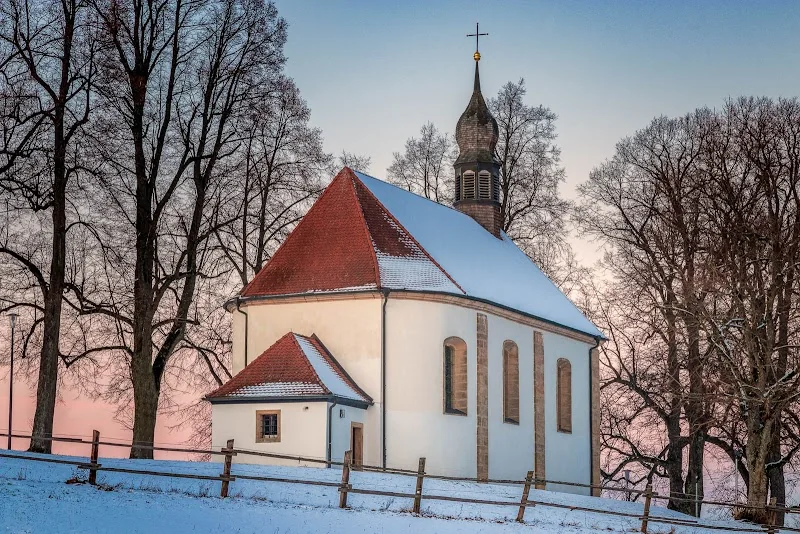
Architecturally, the Mountain Church also possesses a clear presence. The monument list describes it as the Catholic pilgrimage church Maria Zell, as a hall church with a gable roof, a rounded choir on the side, and a bell tower with an onion dome; furthermore, the sacristy from 1714 belongs to the complex. This concise technical description fits well with the effect on site: The church does not appear overloaded but precisely ordered, clearly proportioned, and committed to the Baroque sense of space. The Baroque facade with its four round windows and the figure of the Mother of God embedded in the masonry already appears from the outside as an invitation to raise one's gaze and engage with the interior. This is part of its charm: It is small enough for devotion yet rich enough to allow new details to be discovered with each visit. ([pfarreikirchenthumbach.de](https://www.pfarreikirchenthumbach.de/kirchen/bergkirche/))
Inside, the Rococo altar dominates, into which the replica of the Mother of God from Maria Zell is integrated. Additionally, there are the pulpit and two confessionals in Rococo style, giving the interior an astonishingly cohesive historical character. The altar is flanked by statues of Saint George and Saint Florian. These figures complement the Marian focus of the space with two very well-known patron saints that play an important role in popular piety. The interplay of altar, pulpit, and confessionals makes it clear that the church was intended for liturgy and confession as well as for personal devotion. The space is thus not only beautiful but also functionally oriented towards prayer, proclamation, and reconciliation. ([pfarreikirchenthumbach.de](https://www.pfarreikirchenthumbach.de/kirchen/bergkirche/))
Especially impressive are the ceiling paintings and pictorial programs in the nave. Two large paintings depict the events of the year 1714 and the consecration of 1760. Fourteen additional images express the veneration of the Mother of God through symbols from the Litany of Loreto. In the back of the church, there are also statues of Saint Therese of Lisieux and the Immaculate Mother of God. This furnishing shows that the Mountain Church is not just a Rococo building with pretty decorations but a deliberately narrative space. The images explain the origin and meaning of the place, binding personal rescue narratives, Marian devotion, and church consecration into a shared visual memory. The renovations of 1958 as well as those in 1996 and 1997 are also part of this story of care and preservation. ([pfarreikirchenthumbach.de](https://www.pfarreikirchenthumbach.de/kirchen/bergkirche/))
Mountain Festival, Pilgrimage, and Candlelight Procession
The Mountain Church lives on today not only from its history but also from regularly celebrated traditions. Particularly important is the annual Mountain Festival, which, according to the parish, takes place in early September. The services in the morning and the evening candlelight procession with sermon and Marian celebration go hand in hand. For the people of Kirchenthumbach and many pilgrims from outside, this day is a fixed part of the church year. Additionally, a plenary indulgence can be gained on this day. The church is thus not only visited on this date but experienced liturgically intensified: Stations of the Cross, worship service, Marian devotion, and procession together form a complete picture that particularly highlights the character of the pilgrimage church. ([pfarreikirchenthumbach.de](https://www.pfarreikirchenthumbach.de/kirchen/bergkirche/))
The specific processes of the Mountain Festival show how lively this tradition is. The official parish website describes that on Wednesday, the Stations of the Cross are prayed on the way to the Mountain Church, on Thursday a Taizé prayer takes place, and on Friday a mass is celebrated in the Mountain Church. In 2023, the evening mass on Saturday as well as the festive service on Sunday were held for the first time outdoors in front of the Mountain Church. Many helpers decorated the Mountain Church and provided seating outdoors, while the newly formed duo Taktvoll took care of the musical arrangement. In the evening, the community processed in a solemn candlelight procession from the parish church to the Mountain Church, concluding with a Marian celebration. ([pfarreikirchenthumbach.de](https://www.pfarreikirchenthumbach.de/))
This very mix makes the Mountain Festival so interesting for visitors. It is not just a church event for insiders but a festival that brings together social bonds, music, prayer, and remembrance work. That believers from Kirchenthumbach and the surrounding area experience these days as self-evident and important is also related to the special atmosphere of the place. The Mountain Church provides a setting for such celebrations that feels neither anonymous nor monumental. Instead, a close, communal space emerges where tradition and present connect. Those who experience the Mountain Festival feel that the Mountain Church is not a museum but an active place of faith and encounter. ([pfarreikirchenthumbach.de](https://www.pfarreikirchenthumbach.de/kirchen/bergkirche/))
Stations of the Cross and Linden Avenue on the Mountain
The path to the Mountain Church is itself part of the experience. The parish describes the church as located west of Kirchenthumbach on a hill, commonly referred to as the mountain. The Stations of the Cross leading up the mountain were established in 1853, and the Linden Avenue, which shapes the ascent to this day, was expanded starting in 1765. This historical connection of path, liturgy, and landscape is typical for pilgrimage sites but is particularly vividly preserved in Kirchenthumbach. The way up is not just a practical access but a spiritual movement: One approaches the church step by step, accompanied by stations, trees, and a visible incline that deliberately highlights the destination. ([pfarreikirchenthumbach.de](https://www.pfarreikirchenthumbach.de/kirchen/bergkirche/))
The linden trees are not merely decorative accessories. According to the parish, powerful linden trees surround the church, and they are under nature protection. This protects the site environmentally and keeps it as an ensemble of building, path, and row of trees. Such trees give a pilgrimage site character because they make shade, seasons, and duration visible. In spring, they appear bright and open, in summer dense and protective, in autumn golden-brown, and in winter almost sketch-like. Especially for a church whose history is so closely linked to vows, rescue, and gratitude, this natural image fits well: It reinforces the impression that the ascent to the church is not arbitrary but has grown. ([pfarreikirchenthumbach.de](https://www.pfarreikirchenthumbach.de/kirchen/bergkirche/))
Therefore, those who visit the Mountain Church do not just experience a single building but a small pilgrimage landscape. The Stations of the Cross, the Linden Avenue, and the hill itself together form a path system that makes the function of the church understandable. One does not simply arrive at a place but goes through an atmosphere that prepares for gathering and calm even before entering the space. This is a significant appeal for religiously interested travelers, hikers, and people from the region. The site appears both historical and alive because it does not exist detached from its surroundings. The landscape tells along, and that is why the way to the Mountain Church remains memorable. ([pfarreikirchenthumbach.de](https://www.pfarreikirchenthumbach.de/kirchen/bergkirche/))
Wedding Church and Personal Devotion
The Mountain Church Maria Zell is also very popular as a wedding church, according to the parish. This is easily understandable, as its size, location, and historical character create a setting that feels festive yet personal. Unlike large, monumental churches with vast spaces, the Mountain Church conveys intimacy. One does not feel lost in the space but experiences the furnishings directly. This is a strong argument for couples who desire a clear religious framework and an intimate, special environment. The connection of pilgrimage history, Marian image, and well-maintained interior makes the place a festive yet not distant backdrop for the most important day in the lives of many people. ([pfarreikirchenthumbach.de](https://www.pfarreikirchenthumbach.de/kirchen/bergkirche/))
Beyond weddings, the Mountain Church is a place of personal devotion. The parish states very clearly that many prayers from troubled hearts have ascended to God in this church and that people have repeatedly found strength and trust here. Such words are not just pious clichés but expressions of a long ecclesiastical experience. A pilgrimage church is credible especially when it possesses not only historical form but also lived presence. In Kirchenthumbach, this seems particularly evident: The church is described as valued and loved, and its closeness to the Mother of God is felt. This makes it a place where quiet visits, candles, gratitude, and petitions have their place. ([pfarreikirchenthumbach.de](https://www.pfarreikirchenthumbach.de/kirchen/bergkirche/))
The renovations of 1958 as well as those in 1996 and 1997 also show that the place has not been left to itself. It has been cared for, renewed, and preserved in its inner and outer qualities. This is important for visitors as it enhances the impression of a living monument. The Mountain Church is not an abandoned memorial space but a building supported by the community. This care creates the special atmosphere: Those who arrive here feel that history is not only preserved but also taken responsibility for. Thus, the Mountain Church connects private devotion, communal celebration, and monument-appropriate preservation in a rarely clear form. ([pfarreikirchenthumbach.de](https://www.pfarreikirchenthumbach.de/kirchen/bergkirche/))
Significance for Kirchenthumbach Today
For Kirchenthumbach, the Mountain Church remains an identity-forming place. It belongs to the parish of the Assumption of Mary and is not on the edge of community life but right in the middle of it. This is evident in the regularly published dates, the participation of many believers, and the way the Mountain Church is mentioned as a matter of course in parish reports. The church is thus more than a monument of past piety. It is part of an ongoing religious year, a place with mountain festivals, Taizé prayers, processions, and weddings. Especially in rural areas, such a place is often an important social center because it connects people across generations and creates shared memories. ([pfarreikirchenthumbach.de](https://www.pfarreikirchenthumbach.de/))
The historical narrative also resonates to this day. The story of Friedrich Eisenhut, the image of grace from Maria Zell in Styria, the first chapel, the later new construction, and the artistic embellishment make the Mountain Church a place where local and regional connections come together. Kirchenthumbach remains not only a place with a beautiful church but also a place with a clearly narrated pilgrimage tradition. The interpretation of the site as a valued and beloved Mountain Church is therefore fitting: Those who come here encounter an ensemble that does not separate faith, art, nature, and community but brings them together. This unity is precisely what makes it appealing for visitors. ([pfarreikirchenthumbach.de](https://www.pfarreikirchenthumbach.de/kirchen/bergkirche/))
Those who want to get to know the Mountain Church Maria Zell should not only understand it as a destination but as an experience of path, space, and history. The ascent via the Stations of the Cross and the Linden Avenue, the view of the facade, the tranquility inside, and the lively festivals in September together show why this place has retained significance for so long. The Mountain Church is small but substantial: It tells of a vow, Baroque architecture, Marian piety, and a community that continues to care for its special place to this day. This is precisely where its sustainable radiance lies. ([pfarreikirchenthumbach.de](https://www.pfarreikirchenthumbach.de/kirchen/bergkirche/))
Sources:
Mehr anzeigenWeniger anzeigen
Mountain Church Maria Zell | Pilgrimage Church & Mountain Festival
The Mountain Church Maria Zell is much more than a small chapel on the hillside for Kirchenthumbach. It is a historic pilgrimage site, a visible sign of Marian devotion, and a place where landscape, Baroque architecture, and lived piety come together in a small space. Those who reach the hill west of the village first experience the quiet linden trees and the special location above the valley. Inside, there awaits a church that emerged from a concrete need and a vow, and remains vibrant today during services, pilgrimages, weddings, and the mountain festival. ([pfarreikirchenthumbach.de](https://www.pfarreikirchenthumbach.de/kirchen/bergkirche/))
History and Origin of the Pilgrimage Church Maria Zell
The origin of the Mountain Church is closely linked to a story that continues to live on in Kirchenthumbach to this day. In October 1714, the tailor Friedrich Eisenhut, born in Kirchenthumbach, is said to have been attacked by robbers on his way from Vienna to Graz. In his despair, he called upon the Mother of God Mary and promised to have the image of the Gracious Mother from Maria Zell in Styria painted and placed in a chapel to be built in Kirchenthumbach. According to tradition, the attack ended without harm to him, as the robbers fled in panic. From this vow developed the place that later became the Mountain Church, and this connection of threat, gratitude, and Marian devotion shapes the memory to this day. ([pfarreikirchenthumbach.de](https://www.pfarreikirchenthumbach.de/kirchen/bergkirche/))
The construction history of the current sanctuary began with the small chapel of 1714. This first chapel now serves as a sacristy according to the parish and is thus literally integrated into the later church building. The foundation stone for the elegant Mountain Church was laid in 1753, and the consecration took place in 1760. On September 10, 1760, the permission for celebration was also granted in Regensburg, but not generally for Sundays and holidays, rather with a narrow liturgical exception. Even these early dates show that the church not only fulfilled a private vow but soon grew into a regulated ecclesiastical and pilgrimage-related life. Thus, the present Mountain Church is the result of a development that led from a small votive chapel to a respected pilgrimage site. ([pfarreikirchenthumbach.de](https://www.pfarreikirchenthumbach.de/kirchen/bergkirche/))
This development is of great significance for the local history of Kirchenthumbach. The Mountain Church quickly became a much-visited and valued pilgrimage church, and it remained important even when circumstances changed. Such churches are often more than monuments: They preserve the memory of how much people place hope in religious signs during difficult moments. In Kirchenthumbach, this hope is associated with Maria Zell, thus with a pilgrimage idea that refers to the famous image of grace in Styria. The fact that the Mountain Church is still valued today is therefore not only due to its architecture but also to its origin story, which speaks of gratitude, trust, and a concrete, narrated rescue. ([pfarreikirchenthumbach.de](https://www.pfarreikirchenthumbach.de/kirchen/bergkirche/))
Architecture, Rococo Altar, and Furnishing Details
Architecturally, the Mountain Church also possesses a clear presence. The monument list describes it as the Catholic pilgrimage church Maria Zell, as a hall church with a gable roof, a rounded choir on the side, and a bell tower with an onion dome; furthermore, the sacristy from 1714 belongs to the complex. This concise technical description fits well with the effect on site: The church does not appear overloaded but precisely ordered, clearly proportioned, and committed to the Baroque sense of space. The Baroque facade with its four round windows and the figure of the Mother of God embedded in the masonry already appears from the outside as an invitation to raise one's gaze and engage with the interior. This is part of its charm: It is small enough for devotion yet rich enough to allow new details to be discovered with each visit. ([pfarreikirchenthumbach.de](https://www.pfarreikirchenthumbach.de/kirchen/bergkirche/))
Inside, the Rococo altar dominates, into which the replica of the Mother of God from Maria Zell is integrated. Additionally, there are the pulpit and two confessionals in Rococo style, giving the interior an astonishingly cohesive historical character. The altar is flanked by statues of Saint George and Saint Florian. These figures complement the Marian focus of the space with two very well-known patron saints that play an important role in popular piety. The interplay of altar, pulpit, and confessionals makes it clear that the church was intended for liturgy and confession as well as for personal devotion. The space is thus not only beautiful but also functionally oriented towards prayer, proclamation, and reconciliation. ([pfarreikirchenthumbach.de](https://www.pfarreikirchenthumbach.de/kirchen/bergkirche/))
Especially impressive are the ceiling paintings and pictorial programs in the nave. Two large paintings depict the events of the year 1714 and the consecration of 1760. Fourteen additional images express the veneration of the Mother of God through symbols from the Litany of Loreto. In the back of the church, there are also statues of Saint Therese of Lisieux and the Immaculate Mother of God. This furnishing shows that the Mountain Church is not just a Rococo building with pretty decorations but a deliberately narrative space. The images explain the origin and meaning of the place, binding personal rescue narratives, Marian devotion, and church consecration into a shared visual memory. The renovations of 1958 as well as those in 1996 and 1997 are also part of this story of care and preservation. ([pfarreikirchenthumbach.de](https://www.pfarreikirchenthumbach.de/kirchen/bergkirche/))
Mountain Festival, Pilgrimage, and Candlelight Procession
The Mountain Church lives on today not only from its history but also from regularly celebrated traditions. Particularly important is the annual Mountain Festival, which, according to the parish, takes place in early September. The services in the morning and the evening candlelight procession with sermon and Marian celebration go hand in hand. For the people of Kirchenthumbach and many pilgrims from outside, this day is a fixed part of the church year. Additionally, a plenary indulgence can be gained on this day. The church is thus not only visited on this date but experienced liturgically intensified: Stations of the Cross, worship service, Marian devotion, and procession together form a complete picture that particularly highlights the character of the pilgrimage church. ([pfarreikirchenthumbach.de](https://www.pfarreikirchenthumbach.de/kirchen/bergkirche/))
The specific processes of the Mountain Festival show how lively this tradition is. The official parish website describes that on Wednesday, the Stations of the Cross are prayed on the way to the Mountain Church, on Thursday a Taizé prayer takes place, and on Friday a mass is celebrated in the Mountain Church. In 2023, the evening mass on Saturday as well as the festive service on Sunday were held for the first time outdoors in front of the Mountain Church. Many helpers decorated the Mountain Church and provided seating outdoors, while the newly formed duo Taktvoll took care of the musical arrangement. In the evening, the community processed in a solemn candlelight procession from the parish church to the Mountain Church, concluding with a Marian celebration. ([pfarreikirchenthumbach.de](https://www.pfarreikirchenthumbach.de/))
This very mix makes the Mountain Festival so interesting for visitors. It is not just a church event for insiders but a festival that brings together social bonds, music, prayer, and remembrance work. That believers from Kirchenthumbach and the surrounding area experience these days as self-evident and important is also related to the special atmosphere of the place. The Mountain Church provides a setting for such celebrations that feels neither anonymous nor monumental. Instead, a close, communal space emerges where tradition and present connect. Those who experience the Mountain Festival feel that the Mountain Church is not a museum but an active place of faith and encounter. ([pfarreikirchenthumbach.de](https://www.pfarreikirchenthumbach.de/kirchen/bergkirche/))
Stations of the Cross and Linden Avenue on the Mountain
The path to the Mountain Church is itself part of the experience. The parish describes the church as located west of Kirchenthumbach on a hill, commonly referred to as the mountain. The Stations of the Cross leading up the mountain were established in 1853, and the Linden Avenue, which shapes the ascent to this day, was expanded starting in 1765. This historical connection of path, liturgy, and landscape is typical for pilgrimage sites but is particularly vividly preserved in Kirchenthumbach. The way up is not just a practical access but a spiritual movement: One approaches the church step by step, accompanied by stations, trees, and a visible incline that deliberately highlights the destination. ([pfarreikirchenthumbach.de](https://www.pfarreikirchenthumbach.de/kirchen/bergkirche/))
The linden trees are not merely decorative accessories. According to the parish, powerful linden trees surround the church, and they are under nature protection. This protects the site environmentally and keeps it as an ensemble of building, path, and row of trees. Such trees give a pilgrimage site character because they make shade, seasons, and duration visible. In spring, they appear bright and open, in summer dense and protective, in autumn golden-brown, and in winter almost sketch-like. Especially for a church whose history is so closely linked to vows, rescue, and gratitude, this natural image fits well: It reinforces the impression that the ascent to the church is not arbitrary but has grown. ([pfarreikirchenthumbach.de](https://www.pfarreikirchenthumbach.de/kirchen/bergkirche/))
Therefore, those who visit the Mountain Church do not just experience a single building but a small pilgrimage landscape. The Stations of the Cross, the Linden Avenue, and the hill itself together form a path system that makes the function of the church understandable. One does not simply arrive at a place but goes through an atmosphere that prepares for gathering and calm even before entering the space. This is a significant appeal for religiously interested travelers, hikers, and people from the region. The site appears both historical and alive because it does not exist detached from its surroundings. The landscape tells along, and that is why the way to the Mountain Church remains memorable. ([pfarreikirchenthumbach.de](https://www.pfarreikirchenthumbach.de/kirchen/bergkirche/))
Wedding Church and Personal Devotion
The Mountain Church Maria Zell is also very popular as a wedding church, according to the parish. This is easily understandable, as its size, location, and historical character create a setting that feels festive yet personal. Unlike large, monumental churches with vast spaces, the Mountain Church conveys intimacy. One does not feel lost in the space but experiences the furnishings directly. This is a strong argument for couples who desire a clear religious framework and an intimate, special environment. The connection of pilgrimage history, Marian image, and well-maintained interior makes the place a festive yet not distant backdrop for the most important day in the lives of many people. ([pfarreikirchenthumbach.de](https://www.pfarreikirchenthumbach.de/kirchen/bergkirche/))
Beyond weddings, the Mountain Church is a place of personal devotion. The parish states very clearly that many prayers from troubled hearts have ascended to God in this church and that people have repeatedly found strength and trust here. Such words are not just pious clichés but expressions of a long ecclesiastical experience. A pilgrimage church is credible especially when it possesses not only historical form but also lived presence. In Kirchenthumbach, this seems particularly evident: The church is described as valued and loved, and its closeness to the Mother of God is felt. This makes it a place where quiet visits, candles, gratitude, and petitions have their place. ([pfarreikirchenthumbach.de](https://www.pfarreikirchenthumbach.de/kirchen/bergkirche/))
The renovations of 1958 as well as those in 1996 and 1997 also show that the place has not been left to itself. It has been cared for, renewed, and preserved in its inner and outer qualities. This is important for visitors as it enhances the impression of a living monument. The Mountain Church is not an abandoned memorial space but a building supported by the community. This care creates the special atmosphere: Those who arrive here feel that history is not only preserved but also taken responsibility for. Thus, the Mountain Church connects private devotion, communal celebration, and monument-appropriate preservation in a rarely clear form. ([pfarreikirchenthumbach.de](https://www.pfarreikirchenthumbach.de/kirchen/bergkirche/))
Significance for Kirchenthumbach Today
For Kirchenthumbach, the Mountain Church remains an identity-forming place. It belongs to the parish of the Assumption of Mary and is not on the edge of community life but right in the middle of it. This is evident in the regularly published dates, the participation of many believers, and the way the Mountain Church is mentioned as a matter of course in parish reports. The church is thus more than a monument of past piety. It is part of an ongoing religious year, a place with mountain festivals, Taizé prayers, processions, and weddings. Especially in rural areas, such a place is often an important social center because it connects people across generations and creates shared memories. ([pfarreikirchenthumbach.de](https://www.pfarreikirchenthumbach.de/))
The historical narrative also resonates to this day. The story of Friedrich Eisenhut, the image of grace from Maria Zell in Styria, the first chapel, the later new construction, and the artistic embellishment make the Mountain Church a place where local and regional connections come together. Kirchenthumbach remains not only a place with a beautiful church but also a place with a clearly narrated pilgrimage tradition. The interpretation of the site as a valued and beloved Mountain Church is therefore fitting: Those who come here encounter an ensemble that does not separate faith, art, nature, and community but brings them together. This unity is precisely what makes it appealing for visitors. ([pfarreikirchenthumbach.de](https://www.pfarreikirchenthumbach.de/kirchen/bergkirche/))
Those who want to get to know the Mountain Church Maria Zell should not only understand it as a destination but as an experience of path, space, and history. The ascent via the Stations of the Cross and the Linden Avenue, the view of the facade, the tranquility inside, and the lively festivals in September together show why this place has retained significance for so long. The Mountain Church is small but substantial: It tells of a vow, Baroque architecture, Marian piety, and a community that continues to care for its special place to this day. This is precisely where its sustainable radiance lies. ([pfarreikirchenthumbach.de](https://www.pfarreikirchenthumbach.de/kirchen/bergkirche/))
Sources:
Upcoming Events
No events found
Frequently Asked Questions
Reviews
Marco Reinhard
22. January 2020
A very beautiful church, but unfortunately it was closed when I passed by. I would have loved to go inside.
Wernäh Schleck
6. March 2025
A lovely little church located on the mountain, often used for weddings. It's also a nice spot with a great view of all of Kirchenthumbach where you can find some peace.
Michael Weith
12. August 2025
A charming little mountain church for peaceful services on warm Sundays throughout the year.
Jens-Uwe Fuchs
10. August 2021
We didn't go inside the building. This was our parking spot for the bike tour.
Cornelia Kißler
24. February 2019
Beautiful little church.