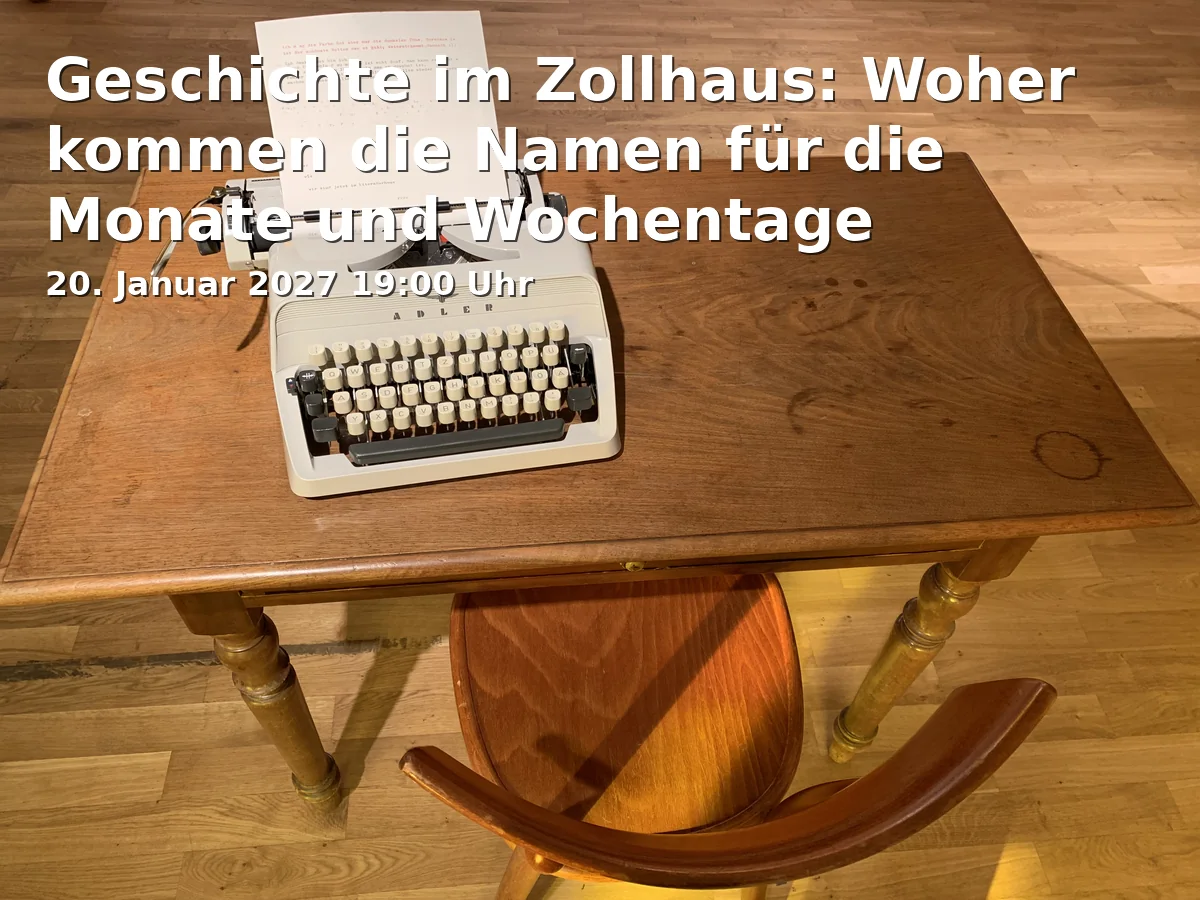
History in the Customs House: Where Months and Days of the Week Get Their Names
Date and Time
Location
About this Event
Mood
Venue Type
When Calendar Words Tell History
Saturday and Sams, Tuesday and Service, Sunday and Sun: The familiar names of our days of the week and months carry astonishing stories within them. The lecture at the Pflasterzollhaus invites you to follow linguistic traces, mythological references, and cultural-historical developments.
Between Sams, Sun, and Ancient Deities
Paul Maar's playful Sams story provides a charming starting point for the question of whether Saturday really has something to do with Sams. The evening leads from such sound associations to the historical origins of our time concepts. The focus is on gods, celestial bodies, and the transmission of ancient naming systems.
The Days of the Week as Mirrors of Cultural History
The names of the days of the week refer to a long development that spans from Babylonian ideas through the Roman world to the Germanic language area. Sun, moon, and planets were associated with deities and shaped the designations that resonate in different languages to this day. Thursday, Friday, Tuesday, and Saturday each open their own chapters of language and religious history.
Why September Actually Means the Seventh Month
The names of the months also preserve historical layers. September originally means the seventh month, even though it is currently in ninth place on the calendar. The lecture explains how shifts in the Roman calendar led to these apparent contradictions and why February remains the shortest month of the year to this day.
Language Art, Knowledge, and Literary Atmosphere
The event combines popular-scientific cultural history with the joy of attentive listening. In the reading atmosphere of the historical Pflasterzollhaus, words become time capsules: Each syllable refers to myths, customs, astronomical observations, and societal concepts of order. This makes the evening an engaging literary experience for language enthusiasts, families, and anyone who wants to rediscover everyday terms.
Conclusion: An Evening for Curious Word and History Friends
Visitors can expect an entertaining and educational journey through the origins of the names of the months and days of the week. Those who want to experience language as a living archive of cultural memory will find a special evening full of surprising connections at the Pflasterzollhaus. Experience the history of our calendar words live in Sulzbach-Rosenberg.
Official Channels of Amberg-Sulzbacher Land:
- Instagram: no official profile found
- Facebook: https://www.facebook.com/AmbergSulzbacherLand/
- Website: https://amberg-sulzbacher-land.de/
- Publisher: no official profile found