
Miles Davis
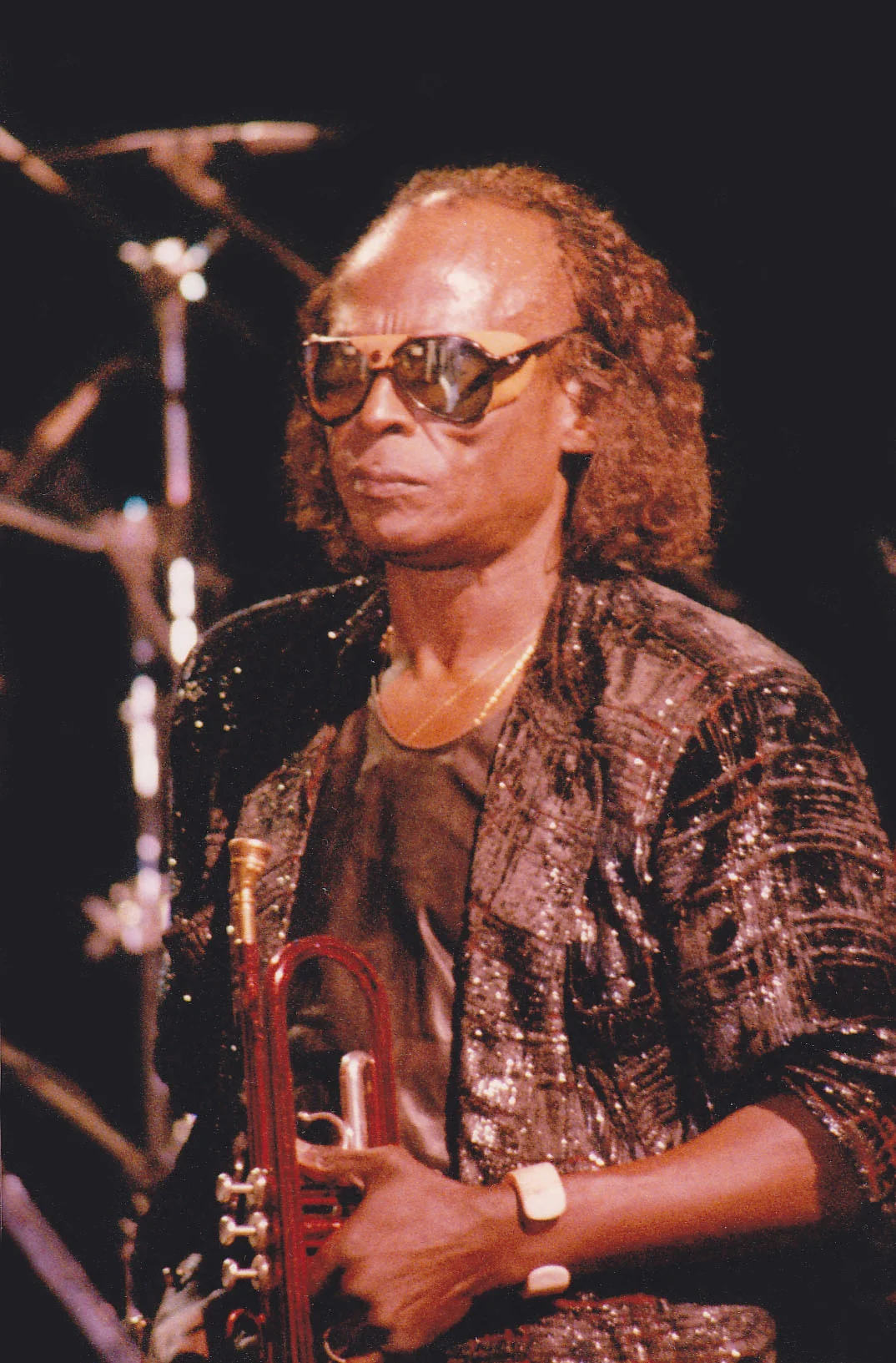
Image from Wikipedia
Image from Wikipedia
Miles Davis – Icon of Jazz, Architect of Sound
The visionary who rewrote jazz history – from bebop to cool to the electric revolution
Miles Dewey Davis III (May 26, 1926 – September 28, 1991) is regarded as one of the most influential jazz musicians of the 20th century. As a trumpeter, composer, and bandleader, he stylistically shaped the development of bebop, cool jazz, hard bop, modal concepts, and jazz rock/fusion. His musical career spanned nearly five decades, during which Davis set standards with infallible sense of form, sonic elegance, and radical artistic development – always balancing improvisational freedom and precise production. ([de.wikipedia.org](https://de.wikipedia.org/wiki/Miles_Davis?utm_source=openai))
Early Years: From the Midwest to New York's Avant-Garde
Born in Alton, Illinois, Miles Davis grew up in East St. Louis and, as a musically curious teenager, moved to New York, where he connected with the scene around Dizzy Gillespie and Charlie Parker. As a sideman in Parker's quintet, he learned to condense melodic lines and use the trumpet as a narrative voice. His artistic development is already apparent here: a tonal understanding that balances velvety depth with sharp attack, accompanied by a focused stage presence. ([de.wikipedia.org](https://de.wikipedia.org/wiki/Miles_Davis?utm_source=openai))
Cool Jazz and "Birth of the Cool": Sound as Architecture
With the legendary nonet recordings, later canonized as "Birth of the Cool," Davis focused on transparent arrangements, subtle dynamics, and chamber-like color in the late 1940s and early 1950s. Composition and arrangement merge here into a new sound architecture of jazz – cool, elegant, modern. This phase marks Davis' claim to think of improvisation and production as two sides of the same idea: form becomes the carrier of freedom. ([jazzecho.de](https://www.jazzecho.de/miles-davis/biografie?utm_source=openai))
Prestige Years, the First Great Quintet, and the Rise at Columbia
In the mid-1950s, Davis formed his first great quintet with John Coltrane, Red Garland, Paul Chambers, and Philly Joe Jones. The albums for Prestige and later Columbia showcase a band on the rise: powerful hard bop, economical phrasing, singular sound. Reissues like “Miles: The New Miles Davis Quintet” still remind us of this phase, in which Davis' tone is heard as the signature of a new mainstream jazz. ([jazzecho.de](https://www.jazzecho.de/miles-davis/biografie?utm_source=openai))
"Kind of Blue" and the Modal Turning Point
In 1959, Davis recorded "Kind of Blue" – a masterpiece of modal jazz and to this day the best-selling jazz album. The reduction of harmonic changes created space for melodic ideas and breathing improvisation. Critics and listeners have celebrated the album for decades as an entry point and reference; its reception connects musical innovation with popular appeal. The work is regarded as the epitome of elegance: a quiet yet forward-looking resounding statement. ([en.wikipedia.org](https://en.wikipedia.org/wiki/Kind_of_Blue?utm_source=openai))
Gil Evans, Orchestral Colors, and Concert Hall
Collaboration with arranger Gil Evans opened the door for Davis to orchestral forms: "Miles Ahead," "Porgy & Bess," and "Sketches of Spain" shifted the drama of jazz to the concert hall without sacrificing improvisational essence. Live at Carnegie Hall, Davis combined quintet and orchestral sound into tableaux full of tension, air, and space – a dialogue of timbre and timing. ([en.wikipedia.org](https://en.wikipedia.org/wiki/Miles_Davis_at_Carnegie_Hall?utm_source=openai))
Electric Years: Studio as Laboratory, Groove as Grammar
From the late 1960s onwards, Davis transformed jazz with "In a Silent Way" and "Bitches Brew." Electric orchestrations, groove loops, collage aesthetics, and open forms made production a compositional tool. The "Electric Years" showcase Davis as an architect of sound: longer takes, edit-based structures, and an ensemble thinking that transforms rock, funk, and avant-garde into organic improvisational landscapes. ([milesdavis.com](https://www.milesdavis.com/))
Retreat and Comeback: Sound of the 1980s
After a health-related hiatus (1975–1980), Davis returned with a fresh sound. Pop references, synthesizers, drum machines, and song-oriented arrangements characterize his later work – without losing improvisational immediacy. "Tutu" and "Amandla" combined a new urban elegance with a characteristic tone – muted, laconic, lyrical. Contemporary retrospectives honor this era as style-defining for jazz, pop, and fusion. ([elbphilharmonie.de](https://www.elbphilharmonie.de/en/press/miles-davis?utm_source=openai))
Discography, Awards, and Canon
The discography of Miles Davis is a chronicle of modern jazz: from "Birth of the Cool," "'Round About Midnight," "Milestones," "Kind of Blue," and "Sketches of Spain" to "In a Silent Way," "Bitches Brew," "On the Corner," "Star People," and "Tutu." His recordings have won numerous awards; Davis received a Lifetime Achievement Award from the Recording Academy, multiple GRAMMYs, and numerous entries into the GRAMMY Hall of Fame. In 2006, he was inducted into the Rock & Roll Hall of Fame – as a jazz musician whose influence extends far beyond genre boundaries. ([grammy.com](https://www.grammy.com/artists/miles-davis/11305?utm_source=openai))
Current Projects, Reissues, and the Century: 2024–2026
The legacy remains vibrant: In 2024, Sony Music released “Miles in France 1963 & 1964: The Bootleg Series, Vol. 8” – four hours of previously unreleased live recordings that also achieved chart resonance. Simultaneously, “The Complete Live at the Plugged Nickel 1965” was reissued as an extensive 10LP/8CD set – a window into the work of the Second Great Quintet. For the 100th birthday in 2026, the estate is curating international activities and collaborations, including contemporary tributes like Laufey’s “Blue In Green.” These projects mark how vital Davis’ catalog sounds in the present and future. ([de.wikipedia.org](https://de.wikipedia.org/wiki/Miles_in_France_1963_%26_1964%3A_The_Bootleg_Series%2C_Vol._8?utm_source=openai))
Style, Sound, Influence: A School of Economy
Musically, Davis stands for an economy of expression: melodic reduction, concise phrases, consciously placed pauses. His compositions and arrangements conceive form as an open framework – from the cool nonet to the electric super-ensemble. Historically, music history places him as a shaper of entire jazz eras; style-analytically, his work demonstrates how tone, timbre, and space define the drama of improvisation. His students – from John Coltrane to Herbie Hancock – have in turn influenced the discography of modern jazz. ([britannica.com](https://www.britannica.com/biography/Miles-Davis?utm_source=openai))
Voices of the Fans
Fan reactions clearly demonstrate: Miles Davis captivates people worldwide. On Instagram, a listener raves: “This trumpet tells stories – timeless and directly to the heart.” On YouTube, it says: “One of the most significant artists of our time – every listen reveals new details.” On Facebook, a listener writes: “From Kind of Blue to Tutu – Miles has been part of my life.”
Positioning for Music Lovers and Seekers
For those looking to explore Davis' work along the artistic development, one begins with the classic phase (“’Round About Midnight,” “Milestones,” “Kind of Blue”), continues to Evans' orchestral soundscapes, and ends in the electric era, where production, composition, and improvisation merge. For sound aesthetes, the discography opens a laboratory of form: from the modal space to groove as a dramatic engine. For the stage, Davis remains a benchmark – his ensemble school continues to shape jazz quartets, big bands, and genre hybrids today. ([milesdavis.com](https://www.milesdavis.com/))
Conclusion
Miles Davis is more than a jazz legend: He is an artistic principle – curiosity, courage, a sense of form. His discography tells the story of the 20th century in sound: from chamber musical coolness through modal expansiveness to electric utopia. To understand the power of improvised music, one should listen to Davis – attentively, repeatedly, loudly and softly. Experience his music live in the present: in curated concert programs, reissues, film, and video projects that carry his legacy to the stage and into the ears of the next generation. ([elbphilharmonie.de](https://www.elbphilharmonie.de/de/presse/miles-davis?utm_source=openai))
Official Channels of Miles Davis:
- Instagram: https://www.instagram.com/milesdavis/
- Facebook: https://www.facebook.com/MilesDavis
- YouTube: https://www.youtube.com/channel/UC1ZS17c0DlqUjsXZK3K_bgA
- Spotify: https://open.spotify.com/artist/0kbYTNQb4Pb1rPbbaF0pT4
- TikTok: No official profile found
Sources:
- Miles Davis Official Site – News, Releases, Timeline
- Legacy Recordings – Miles Davis (Sony Music)
- Encyclopaedia Britannica – Miles Davis
- JazzEcho (Universal) – Official Biography
- Elbphilharmonie – Miles Davis Centennial Projects
- Wikipedia (DE) – Miles Davis
- Wikipedia (EN) – Miles Davis
- Wikipedia – Kind of Blue
- Wikipedia (DE) – Kind of Blue
- Rock & Roll Hall of Fame – Miles Davis (Induction 2006)
- GRAMMY.com – Miles Davis Awards & Hall of Fame
- Wikipedia (DE) – The Bootleg Series Vol. 8 (2024)
- WELT – Image Series on the Career
- Facebook – Official Account
- Instagram – Official Account
- YouTube – Official Channel
- Spotify – Official Artist Profile
Upcoming Events
Pangea
Miles-Davis-100th Anniversary-Week – auxburg jamsession
Wednesday Night Session: Miles Davis Works
Miles-Davis-100th Anniversary-Week – Listening-Bar
Jazz Ahead: Miles Davis and Friends Live in Blaubeuren