Maxjoseph
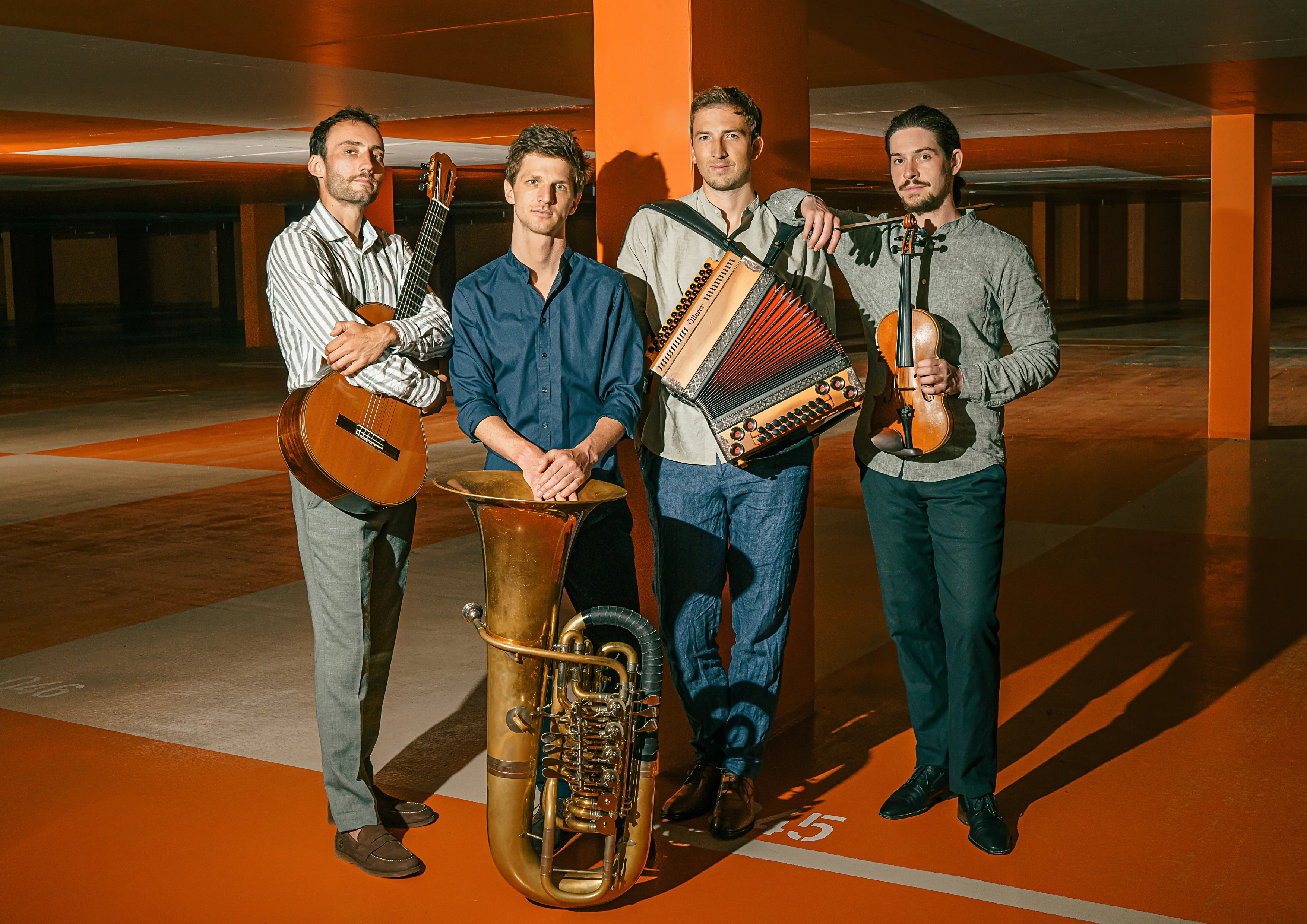
Image from Wikipedia
Image from Wikipedia
Maxjoseph – New Folk Music from Munich between Chamber Music, Jazz, and World Sound
Four Virtuosos, One Unmistakable Sound: How Maxjoseph Reinvents Folk Music Today
Maxjoseph represents a musical career that combines traditional sound worlds of the Alpine region with modern artistic development. Since their formation in 2017 in Munich, the ensemble has shaped a chamber music language with accordion, violin, guitar, and tuba, in which jazz improvisation, classical forms, and world music colors intertwine organically. The stage is their laboratory – a vibrant acoustic sound emerges without large amplifiers, driven by precise interplay, smart arrangements, and lively stage presence. Those who thought folk music was well-defined will experience an eloquent rebuttal with Maxjoseph: Elegance instead of pandemonium, lightness instead of kitsch – yet with captivating energy.
Origin and Formation: Munich as a Hub of Ideas
The ensemble formed in Munich – a city where folk music, classical music, and jazz have historically been close together. The musicians met in this environment, found a shared artistic vision, and began developing their own compositions and arrangements in 2017. The collective principle shapes their working method: Maxjoseph operates democratically, without a bandleader, thus sharpening their collective signature. From the beginning, they have sought a style that does not quote folk music but transforms it – with a sense of melody, timbre, and dramatic arcs.
Musical Signature: Chamber Music Meets Jazz and Alpine Idioms
At the center is the rare but coherent instrumentation of accordion, violin, guitar, and tuba. This combination creates timbres ranging from drones, fine pizzicato, vocal lines, to warm bass foundations. Composition and arrangement at Maxjoseph arise from the ensemble sound: Melodies breathe, counterpoints unfold the harmony, and rhythmic figures remain buoyant. Improvisations – especially live – open the form, while the production safeguards its chamber music precision. The style connects with New Folk Music and Third-Stream traditions but remains distinctly its own: music that intertwines the familiar with the unfamiliar and consciously dissolves sound clichés.
Career Stations 2017–2026: From Debut to "NAU"
Since 2017, the quartet has performed at festivals, chamber music series, and urban stages across Bavaria, Austria, and Northern Germany. Media attention came early through contributions to BR formats; in 2024, the Abendschau presented the ensemble and its idea of contemporary folk music. In the 2024/25 concert season, presentations took the ensemble to venues like Bergson Kunstkraftwerk Munich and prestigious series, where the blend of chamber music finesse and jazzy spontaneity sharpened their live profile. The 2025/26 season followed with additional performances in German-speaking regions, including summer and festival slots that highlighted the new program "NAU" and special Christmas formats ("Auszeit").
Discography: From "Neue Welt" to "Tabula Rasa" to "NAU"
The discography of Maxjoseph documents a consistent, audible evolution. The debut "Neue Welt" (January 31, 2021) outlines the starting point: a panorama of alpine motifs, urban elegance, and intricate jazz harmonies – a sound signature that already focuses on original compositions, melodic clarity, and rhythmic finesse. With "Tabula Rasa" (October 8, 2023), form and texture become bolder: pointed miniatures, refined ostinati, unexpected harmonic twists, and cinematic moods ("Likai Jodler") showcase compositional craftsmanship and dramatic curiosity. The culmination is marked by "NAU" (January 17, 2025, ℗ 2024 Likai Records): 13 tracks – including "Nau," "Amour Fou," "Zmoal," "Martial," "Samt," "Netz," "Nocturne," "Pes Solis," "Verano Walzer," "Al Maha," "Pampas," "Guggenmosi," and "Carillon" – form a suite that densely integrates folk music elements with a chamber music approach enlivened by subtle jazz gestures. Each piece possesses a clear sonic idea: "Al Maha" condenses oriental-sounding colors into a light dance, "Pampas" breathes wistful expansiveness, and "Guggenmosi" combines archaic figurework with danceable drive.
Production and Sound Aesthetics: Acoustics, Dynamics, Detail
The albums maintain an acoustic production aesthetic that allows space for the ensemble concept. The tuba is depicted not merely as bass but as a breathing melodic carrier; the guitar oscillates between percussive pulse and harmonic shimmer; the accordion effortlessly shifts from drone textures to articulated melodies; and the violin remains present as a singing voice. The arrangement employs classical techniques – imitation, counterpoint, dynamic terracing – while embedding improvisational windows. This production highlights intricate articulation and allows for organic expansion live, without undermining the compositional form.
Stage Presence: Live as a Dramatic Space
On stage, the four musicians display a remarkable presence: communicative yet never overly accommodating; virtuosic but always serving the ensemble's sound. Improvisations crystallize from thematic work; tempo transitions and micro-dynamics are precisely modeled. A tension arc emerges that resembles a chamber concert while preserving the immediacy of folk music. Programs like "NAU" frame the pieces with brief, meaningful introductions – a curated narrative that immerses the audience in themes, topographies, and cultural references (from Oman to the Allgäu clay pit) without disturbing the musical flow.
Critical Resonance and Contextualization
The music press and cultural reporting recognize Maxjoseph as an ensemble that seeks the renewal of folk music not through volume and effects but through form, sound culture, and intelligent wit. Reviews highlight the "wonderfully unique" blend of classical, jazz, and folk music, the democratic ensemble culture, and the cliché-free, charming lightness. Perspectives from professionals and festival texts emphasize the chamber music delicacy with which the quartet shapes a contemporary yet deeply rooted "New Folk Music" – music that appeals to both connoisseurs of classical forms and listeners curious about boundary crossings.
Current Projects 2024–2026: "NAU" Live, Media Presence, and Festival Routes
In 2024, Bavarian Radio presented the ensemble in the Abendschau – a showcase for the connection of tradition and the present. In 2025, "NAU" premiered, accompanied by release concerts and invitations to concert series from Bavaria to Northern Germany and Austria. The repertoire is flexibly curated: alongside the core program "NAU," Maxjoseph realizes special formats like "Auszeit" during the Advent and Christmas season that associate music with literature. For 2025/26, seasonal brochures, festival programs, and cultural venues announce further performances – an indication of how firmly the band has established itself in the Central European concert landscape.
Cultural Influence: New Folk Music as an Attitude
The cultural value of Maxjoseph lies in its stance: folk music as an open system that considers composition, arrangement, and improvisation as equals. This understanding creates a connection to the music history of the 20th century – from Third Stream to contemporary chamber music – while remaining regionally discernible. The mix of craftsmanship, curious sound exploration, and narrative imagination makes the ensemble a relevant player in contemporary music from Bavaria. For the scene of "New Folk Music," this means: less fusion gesture, more compositional substance; less folklore postcard, more musical poetry.
Voices of the Fans
Fan reactions clearly show that Maxjoseph captivates audiences worldwide. On Facebook, one visitor writes: "Finally, folk music that touches and surprises – refined, intelligent, danceable." Another comment praises the stage presence: "Four heads, one breath – never heard such precise, lively ensemble playing." A third conclusion sums up the live impression: "Chamber music in the best sense – intimate, dynamic, full of colors."
Conclusion: Why You Should Listen to and Experience Maxjoseph Live
Maxjoseph shows how the present can sound when tradition becomes a resource, not a constraint. The discography – from "Neue Welt" to "Tabula Rasa" to "NAU" – demonstrates a consistent artistic evolution. Professionally, composition, arrangement, and production convince; live, the quartet unfolds a magnetic energy. Anyone wishing to experience the transformation of folk music into a contemporary chamber music narrative cannot miss Maxjoseph. Listen, discover – and best of all: experience live.
Official Channels of Maxjoseph:
- Instagram: No official profile found
- Facebook: https://www.facebook.com/maxjosephband
- YouTube: No official profile found
- Spotify: No official profile found
- TikTok: No official profile found
Sources:
- MAXJOSEPH – Official Website
- Apple Music – Album "NAU" (2025)
- Apple Music – Album "Neue Welt" (2021)
- Amazon Music – Track "Netz" (NAU, 2025)
- Amazon Music – Track "Guggenmosi" (NAU, 2025)
- Amazon Music – Track "Akrato" (Tabula Rasa, 2023)
- BR Abendschau – Feature on Maxjoseph (February 14, 2024)
- Süddeutsche Zeitung – "New Music from Maxjoseph" (April 11, 2025)
- volXmusik.de – Concert report "Bairischer Geigentag" (June 24, 2025)
- Allegro Vivo – Artist Profile for Maxjoseph
- HEY.Bayern – Event Announcement "Maxjoseph – NAU" (May 22, 2025)
- Merkur – "New Album Released: Maxjoseph" (April 10, 2025)
- Maxhaus Düsseldorf – Concert Announcement "NAU" (September 25, 2025)
- Bergson Kunstkraftwerk Munich – Concert Format "Auszeit"
- Facebook – Official Page of the Ensemble
- Wikipedia: Image and text source
Upcoming Events
Schlossgarten Concerts 2026 with Ensemble Maxjoseph
Erlangen Castle Garden Concerts: Maxjoseph with The Lightest is the Heaviest
MaxJoseph Band: New Folk Music in the Castle Courtyard
Maxjoseph Band: New Folk Music at Schloss Seefeld
MaxJoseph Band
Maxjoseph – NAU at Amerang Castle
Culture on Steps: Concert with Maxjoseph
REWAG-Classics in the Park 2026
MAXJOSEPH |NAU| Tour in Dießen am Ammersee