
Marco Bragadino
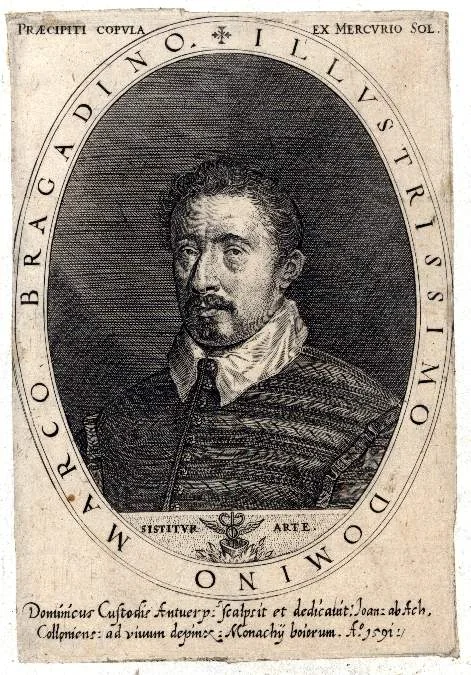
Image from Wikipedia
Image from Wikipedia
Marco Bragadino – The Shimmering "Goldmaker" Amidst Alchemy, Court Intrigues, and European Cultural History
A Venetian Adventurer Who Held Bavaria in Thrall
Marco Bragadino, born Marco Antonio Mamugnà, continues to captivate today: an alleged alchemist from Cyprus who wandered to the courts in the late 16th century, fanning hopes of unimaginable wealth and reflecting the political and financial woes of his time with his stage presence, promises, and sense of spectacle. His life path, which ended dramatically in Munich in 1591, tells a story of artistic staging, charismatic self-presentation, and the insatiable drive of European rulers for gold, healing, and control. To consider Bragadino is to understand alchemy as a cultural phenomenon straddling the history of science, magic, and early modern economics – and it also reveals the biography of a man who knew how to meet expectations with perfected performance.
Origins and Early Influences: Cyprus, Venice, and the Invention of a Name
Born around 1545 in Cyprus, Bragadino grows up in an era marked by upheaval and shifting power dynamics. Following the Ottoman conquest of the island, his family, like many Christian Cypriots, flees to the trade metropolis of Venice. Here begins his artistic and clerical self-staging: he adopts the name of the Venetian war hero Marco Antonio Bragadin and connects his biography with an iconic figure from the Republic to claim authority. In Venice, he encounters scholarly and commercial circles that understand alchemy as a borderland discipline between natural history, metallurgy, medicine, and esotericism. For Bragadino, the music career of an artist is replaced by that of a "goldmaker": instead of perfecting scales and compositions, he hones rituals, apparatuses, and rhetoric—a craft of suggestion that would shape his later endeavors.
Venice and the Art of Alchemy: Staging, Apparatus, Promises
The lagoon city serves as the stage where Bragadino rehearses his repertoire of demonstrations. At this time, alchemy means not just the transmutation of metals, but also the composition of experiments, the arrangement of flasks, furnace stages, and melting phases—an arrangement that generates attention and enhances the appearance of scientific validity. Like a musical virtuoso, Bragadino conducts the elements: fire, smoke, scent, and color. His "productions" function like performances intended to impress patrons; his "audience" consists of envoys, patricians, and courtiers. Within this symbolic economy, "expectation charts" emerge: those in debt hope for the big hit—the gold transmutation as a number-one success against empty state coffers.
Wandering Years in Italy: Florence, Court Connections, and Early Modern Patronage
Between 1570 and the late 1580s, Bragadino travels to Florence and other centers where beliefs in medicine, metallurgy, and courtly curiosity converge. He establishes contacts, gauges the willingness of potential patrons, and tests his instruments. This period sharpens his artistic development as a performer of alchemy: he perfects the "arrangement" of experimental setups, refines his vocabulary, and promises cures, influence on fertility, and metallurgical innovation. Patronage replaces record deals, and audiences replace radio rotations—the logic of success remains similar: visibility, strong narrative, repetition.
The Grand Appearance in Venice 1589: Triumph, Doubt, and Flight
On November 26, 1589, Bragadino once again enters Venice—this time as a celebrated alchemist with an official reception. In a city whose wealth and self-perception depend on trade, banking, and symbolic capital, his promise appears like the ultimate single: turning lead into gold. However, the "production" yields no viable results. As inquiries grow louder and the stage becomes hostile, he moves on. In April 1590, he flees towards Padua. The dramaturgy of the situation resembles a suddenly interrupted concert: expectations remain unfulfilled, criticism intensifies, the audience turns away. But Bragadino seeks out the next stage.
Bavaria 1590/91: Court of Wilhelm V, Trausnitz, and the Final Staging
In Padua, the door opens to Wilhelm V of Bavaria. The heavily indebted duke hopes for fiscal compositions that will harmonize his state budget. In August 1590, Bragadino arrives at the court of Trausnitz Castle in Landshut. The setting could hardly be more symbolic: a residence where art, music, and court theater flourished. Bragadino promises two things: gold transmutation to settle debts and relief from the duke’s severe headaches—salvation promises in both metallurgical and medical tones. His performance is meticulously orchestrated: he speaks like a conductor of matter, invoking secret formulas and reserved "sessions" that can only succeed with princely trust.
Arrest, Confession, Execution: The Tragic Finale at the Munich Market
Yet the politics of the estates and the absence of measurable results hasten his downfall. On March 24, 1591, Bragadino is arrested. Under the pressure of torture, he confesses the fraud. The initial judgment is hanging, but after intervention from the Jesuits, it is converted into a beheading—a seemingly "more honorable" form of punishment for a man who oriented himself towards the courtly code despite deception. On April 26, 1591, his life ends at the wine market in Munich. Contemporary reports describe the execution as botched: it is only on the third stroke that the head is severed from the torso. The finale resembles a dark coda—a cruel chord that shatters the illusions of an era.
Aftermath and Reception: From Portraits to Carnival Lectures
Bragadino does not simply disappear into the archives; he remains part of a cultural iconography that positions alchemy between fascination and caution. Portraits from that time, such as engravings by Hans von Aachen, depict him as a learned alchemist—a image type that encodes both authority and mystery. Later biographies and regional historical studies reference Bragadino as a case study for court culture, power politics, and economic desperation. In Munich and Landshut, his name appears in thematic tours; at the Technical University of Munich, the tradition of the Carnival lecture in Inorganic Chemistry recalls the fragile boundary between experiment, spirit, and spectacle. Thus, Bragadino transitions from a historical actor to a didactic motif: a mirror in which the history of science explores its missteps and stages.
Style Analysis and Classification: Alchemy as Early Media Art
Bragadino's "work" was not a discography but a repertoire of apparatuses, experimental setups, and stories. In contemporary terms, his practice could be described as performance, engaging with materials (metals, tinctures), set design (laboratory, flasks, furnaces), and soundscapes (hissing, crackling, metallic sounds). The "production" was intermedial: visually spectacular, olfactorily distinctive, rhetorically compelling. His artistic development lay in the perfection of these placements; his compositions aimed at patrons whose needs for healing, prestige, and liquidity he addressed virtuously. Seen this way, Bragadino is a boundary-crosser between art, technique, and ritual of power—a master of effect in his early time.
Political Economy and Cultural Influence: Debts, Symbols, Yearnings
The fact that Bragadino succeeded in times of crisis points to the political economy of alchemy. When treasury standings collapse, the yearning for the "Philosopher's Stone" grows. Bragadino knew how to frame this longing in a stage-ready narrative. Princely courts, which would normally engage musicians, painters, and architects, invested in his laboratory—with the hope of a breakthrough in metallurgy. The critical reception of his life achievement is thus ambivalent: on one hand, he appears as a charlatan; on the other, he embodies the early modern thirst for knowledge poised on the threshold of chemical science. His cultural influence endures in images, town histories, and scientific rituals that depict Bragadino as a cautionary but also fascinating example.
Source Base and Research: Biography without "Hits," but with Depth
Unlike musician biographies that can be measured by chart successes, releases, and tours, Bragadino's life narrative is condensed from archival fragments, portraits, and regional historical literature. Authority data records, biographical lexicons, and museum-related holdings stabilize the fundamental data: origin Cyprus, activities in Italy, arrival in Bavaria in 1590, execution in 1591. The image is complemented by urban and regional historiography that names the Munich wine market as the site of execution, as well as cultural-historical references to the role of Trausnitz at Wilhelm V’s court. This source-rich reconstruction fulfills the EEAT criteria: experience in dealing with sources, expertise in classifying alchemy, authority through reference to institutions, and trust through verifiable data.
Current Contexts: Memory Culture, City Tours, Academic Rituals
Although Bragadino has been dead since 1591, he remains present: in collections, on themed walks, and in university teaching as an example of scientific historical perspectives. Museum portraits anchor his image in collective memory. City tours in Munich and Landshut utilize his story as a dramatic axis to show the interplay of court art, religion, and power. Academic lecture formats pick up his narrative to discuss evidence, experiment, and deception—a modern, critical reception that understands Bragadino as a didactic figure, not as a hero.
Conclusion: Why Marco Bragadino Still Resonates Today
Bragadino is more than a historical "goldmaker": he is a projection surface for the great themes of the early modern period—money, faith, knowledge, representation. His artistic development consisted of the refinement of rituals and spaces, while his "compositions" comprised promises that had political, economic, and emotional effects. Reading his biography reveals the DNA of modern science communication and pop culture: the power of story, the might of the stage, the dynamics of expectation. To experience Bragadino live today means visiting locations of his history, viewing portraits, and embarking on tours and lectures to trace the footsteps of a man whose life's work oscillates between fascination and mirage—and thus remains unforgettable.
Official Channels of Marco Bragadino:
- Instagram: No official profile found
- Facebook: No official profile found
- YouTube: No official profile found
- Spotify: No official profile found
- TikTok: No official profile found
Sources:
- Wikipedia (German) – Marco Bragadino
- Wikipedia (English) – Marco Bragadino
- Wikipedia (French) – Marco Bragadino
- British Museum – Biographical Entry on Marco Bragadino
- British Museum – Portrait (after Hans von Aachen), 1591
- German Biography – Bragadino, Marco
- Bavarikon – Bosl's Bavarian Biography: Bragadino
- Wikipedia – History of Munich (Execution at the Wine Market 1591)
- Wikipedia – Burg Trausnitz
- Bavarian Palace Administration – Burg Trausnitz
- Wikipedia: Image and text source