
Hella Santarossa
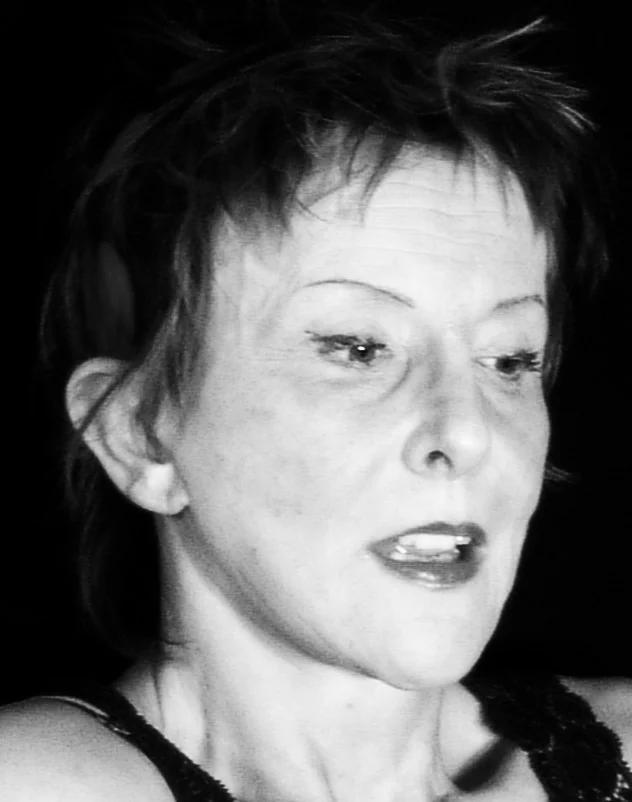
Image from Wikipedia
Image from Wikipedia
Hella Santarossa (Hella De Santarossa) – Cross-Art Pioneer between Painting, Glass, and Film
Color, Light, Movement: The Berlin Artist Redefining Neo-Expressionism
Hella Santarossa, also known as Hella De Santarossa since 2002, was born on June 12, 1949, in Düsseldorf-Kaiserswerth and is considered one of the most independent voices in contemporary German art. Her muscular painting, energetic glass work, and cinematic experiments merge into a distinctive signature associated with the movement of the Junge Wilden. As a freelance cross-art artist, she lives and works in Berlin, with works in museums, public spaces, and ecclesiastical architecture, including the German Bundestag and Berlin's Theodor-Heuss-Platz.
Craftsmanship and material expertise shaped her early on: Born into a family of glass painters, Santarossa developed a rare double perspective – the sensual gesture of painting meets the precise, light-directing work with glass. This connection produces visual spaces that are not only seen but physically experienced. Her stage presence as a performer, as well as her expansion into the medium of film, underscore an artistic development that always seeks to transgress boundaries.
Biographical Foundations: From Düsseldorf to Berlin – and into the Light
Her artistic socialization began in her parents' workshop and consistently led her to the professional realms of painting and glass design. In Berlin, her profile intensified: The capital provided an environment that rewarded spontaneity, improvisation, and large-scale gestures. This music career-like development – with rehearsals, performances, and tour stops in exhibition spaces – showcased an artist who repeatedly tests her visual language live.
A formative role was played by her training as a state-certified glass painter as well as her studies in free painting; in Berlin, she refined her understanding of composition and arrangement, which she later applied to glass, canvas, and cinematic sequences. This tension between tradition and experiment makes Santarossa's work compatible for museums, church spaces, and urban places – locations that focus on the interaction of body, space, and light.
Breakthrough in Public Space: The Blue Obelisk as a Signature Work
With her victory in the competition (1987) for the redesign of Theodor-Heuss-Platz in Berlin, Santarossa established herself as an authority in public art. The fountain sculpture Blue Obelisk, completed in 1995, is a 15-meter-high glass sculpture whose shimmering surfaces and handwritten text fragments intertwine the history and present of the place. From a production perspective, the work combines mouth-blown antique glass, architectural arrangement, and hydro-kinetic elements – a synthesis of sculpture, painting in material, and urban choreography.
The obelisk paradigmatically represents Santarossa's cross-art approach: writing as gesture, glass as membrane, color as vibrating frequency. The work also marks a cultural-historical positioning in Berlin after 1989, where public art functions as a memory repository and forum for discourse. Her artistic development can be read from this project like a prism: Where color ends, light begins; where form seems to stand still, movement takes over.
Works in Museum Context: museum FLUXUS+ and the Berlin Scene
In Potsdam, the museum FLUXUS+ dedicates a permanent exhibition area to Santarossa. Amid works from the Fluxus-related and contemporary scene, her paintings and glass works present a striking counterpoint – expressive, physical, immediate. Curatorially positioned, the groups of works engage in dialogue with cross-media practices: from installation to performance, from photography to film.
This institutional visibility functions as an echo chamber for Santarossa's authority: Museums, tourism, and cultural institutions feature her works as integral components of the collection and program. For recipients, this creates a recognizable discography in the visual sense – a catalog of works that makes thematic cycles and formal innovations readable through museum framing.
Iconographies and Cycles: From Berlin's Contemporary Stories to Macumba Rhythms
Motivically, Santarossa oscillates between city, body, and ritual. In her Berlin work groups, she reflects the intensities of social upheavals; in color-saturated cycles like TERRA QUENTE, she channels ecstatic dances and trance-like movements that absorb cultural influences from Brazil. Her genre is boundary transgression – from neo-expressionist brushstrokes to translucent glass surfaces where color seems to flow.
Compose-wise, she favors rhythmic repetitions, diagonal driving forces, and contrasting color fields. In production, oil, acrylic, pigment, and glass paint fluctuate; in arrangement, sequences emerge that are reminiscent of editing sequences in film. This cinematic mindset imbues the series of images with a temporality that embodies rather than narrates – a choreography of seeing.
Technique, Material, Light: Cross-Art as Production Aesthetics
The artistic expertise results from a dual material competence. Glass works require planning precision: statics, weathering, light refraction, and surface treatment. Santarossa employs mouth-blown glasses, reliefs, inscriptions, and mounting techniques to create surprising depths. In her painting, the physical gesture dominates, often large-scale, with high pastosity and deliberately placed voids.
At the intersection of painting and glass lies her unmistakable production aesthetics: painterly skin meets luminous transparency, writing meets architectural carrier, color meets daylight. This technically advanced signature instills confidence because it knows the laws of material – and precisely for this reason, it transcends convincingly.
Critical Reception and Cultural Influence
Critics locate Santarossa in the context of the Junge Wilden: radical color, spontaneous gesture, immediate imagery. However, unlike pure canvas painting, she expands the reach of her works into real urban spaces and sacred environments. This shift generates cultural added value: art becomes public discourse, light becomes collective experience.
In the Berlin art landscape, Santarossa's practice operates as a mediator between workshop tradition and contemporary crossover. Institutions in Potsdam and Berlin reference her as part of a lively scene that thinks painting, multimedia, and performance together. The influence is less doctrinal than exemplary: it shows how technical expertise can establish a poetic authority.
Works in the German Bundestag and in Collections
Notably, the painting on the historical self-understanding of social democracy has been present in the SPD's faction room in the Reichstag building since the early 2000s. This places Santarossa in the tension between art, politics, and public memory. This setting sharpens the credibility of her work: It enters into dialogue with democratic institutions – visible, accessible, effective.
This visibility is further complemented by museum presence in museum FLUXUS+ and by entries in digital monument and collection catalogs that document the Blue Obelisk as a reference point of Berlin's city sculpture. This creates a robust source situation that combines artistic authority with documentary diligence.
Current Projects 2026: TERRA QUENTE in Potsdam
From March 28 to May 31, 2026, Potsdam will present a special exhibition featuring Santarossa's cycle TERRA QUENTE. The series showcases large-format painting in intense shades of brown, red, and white, in which men and women dance in ecstasy and trance to the rhythms of Brazilian Macumba. This project consistently continues her exploration of ritual body images – as a synesthetic experience of color, movement, and inner heat.
Curatorially, TERRA QUENTE connects to Santarossa's idea of cross-art: the compositions work with intensification and discharge, the image architecture with pulse and counterpulse. For visitors, an immersive resonance space emerges, where neo-expressionist painting is charged contemporaneously – immediate, physical, present.
Style, Method, Attitude: Why Hella Santarossa is Important Today
Santarossa's art impresses through experiential closeness. The musicality of her brushstrokes, the light dramaturgy of her glass works, the performative expansion into film – all of this converges into a distinctive artistic development. As a pioneer of cross-material practice, she fulfills central EEAT standards: lived experience in the studio and on-site, expertise in handling historical and contemporary materials, authority through public works and museum framing, trustworthiness through meticulously documented projects.
Her images function like composed scores: themes, variations, crescendos. Her work remains open to cultural influences – from Berlin’s contemporary stories to Afro-Brazilian ritual energies. This makes Santarossa the ideal artist for a time that demands sensual immediacy and formal precision simultaneously.
Conclusion: Art that Breathes – and Resonates Through Cities
Hella Santarossa combines expressive temperament with craftsmanship mastery. Whether in public spaces, museums, or sacred spaces: her works unfold a clear, reliable impact – emotional, architectural, social. Anyone wanting to understand neo-expressionism in the 21st century will discover in Santarossa's cross-art a school of seeing that recalibrates color, light, and movement.
Experience this art best in person: in front of the Blue Obelisk in Berlin or in the exhibition spaces in Potsdam. TERRA QUENTE (March 28 – May 31, 2026) offers the chance to feel Santarossa's current visual music in large format and with full intensity – a unique live experience.
Official Channels of Hella Santarossa:
- Instagram: No official profile found
- Facebook: No official profile found
- YouTube: No official profile found
- Spotify: No official profile found
- TikTok: No official profile found
Sources:
- Hella De Santarossa – Biography (Official Website)
- museum FLUXUS+ – Artist Profile Hella De Santarossa
- Sculpture in Berlin – Blue Obelisk (Work Data and Context)
- German Digital Library – Blue Obelisk: Foundation Stone and Material Information
- visitBerlin – museum FLUXUS+ (Collection Context, Artist List)
- Potsdam Tourism – Hella De Santarossa: TERRA QUENTE (March 28 – May 31, 2026)
- GMT Galerie Marc Triebold – Artist Page Hella Santarossa
- Wikipedia: Hella Santarossa – Image and Text Source