
Helena Antonia
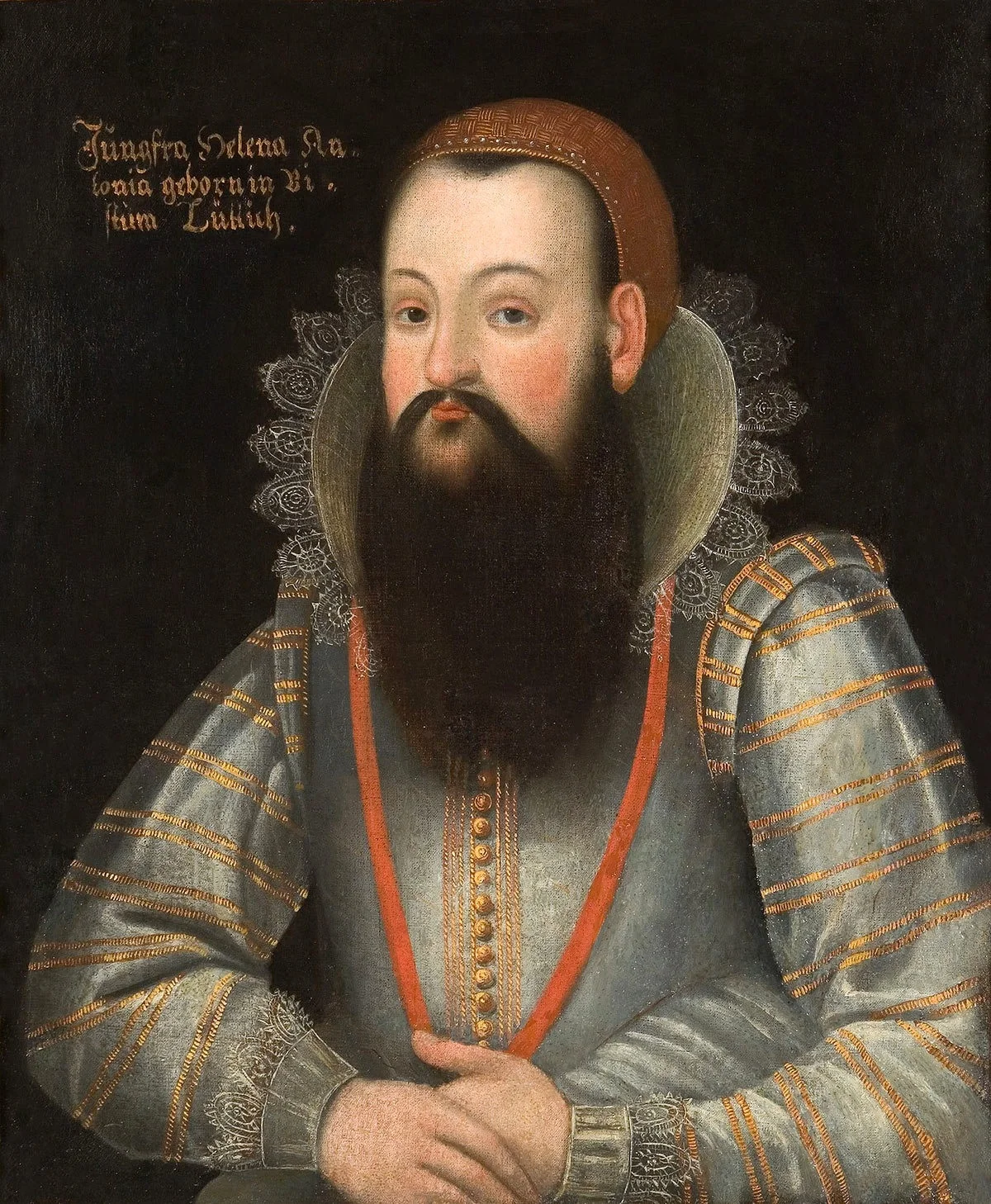
Image from Wikipedia
Image from Wikipedia
Helena Antonia – Icon of the Early Modern Period between Court Culture, Body History, and Image Tradition
From Bearded Wonder to Historical Mirror: The Fascinating Story of Helena Antonia
Helena Antonia, described in contemporary sources as a bearded court dwarf, embodies like few other historical figures the tension between early modern court culture, scholarly curiosity, and the often voyeuristic fascination with "extraordinary" bodies. There are differing accounts of her lifespan: some sources state 1550–1595, while others place her biography between 1579 and "after 1621." What remains undisputed is that she hailed from the Liège area, lived at times at the Habsburg court, and became the subject of intense artistic and cultural historical attention due to her unusual appearance – referred to in the sources as hirsutism or hypertrichosis.
As a member of the Habsburg court, Helena Antonia connected the musical culture, festivity practices, and representative ceremonies of that era with a striking, individualized stage presence. In portraits, prints, and collection inventories, she appears to us as a "wonder" of nature, as a court lady-in-waiting, as a confidante of influential archduchesses – and as a projection surface for artistic development from the late Renaissance to the early Baroque.
Early Years in Liège: Background and Influence of the Court
Helena Antonia's trail leads to Liège, a city that, in the 16th century, formed a hub between the Netherlands, the Rhineland, and the Holy Roman Empire, thanks to its ecclesiastical power structure, trade network, and educational system. From this urban, culturally rich world, she entered Habsburg circles, where court discipline, etiquette, and representation dictated daily life. Her artistic development and public perception, therefore, took shape inseparably in an environment of festive music, courtly ballets, masquerades, and visual arts, which defined the tone of the times.
The court music career may not strictly apply to Helena Antonia; however, her life unfolded within a sound landscape where chapels, consorts, and court musicians prepared the stage for power and splendor. In such representative contexts, she contributed – like other courtiers – to the theatrical intensification of court life: as a lady-in-waiting, as a companion to high-ranking princesses, as part of an environment in which social roles and artistic representation intertwine.
At the Habsburg Court: Archduchesses, Etiquette, and the Social Role of a Lady-in-Waiting
Helena Antonia's proximity to significant Habsburg women is documented, including Maria of Spain, who entered the imperial history as Empress, as well as Archduchess Margarete of Austria. As a lady-in-waiting to Constanze of Austria – later Queen of Poland – she entered a sphere where court travels, marriage alliances, diplomatic receptions, and ceremonies dictated the calendar. Such stations not only mark biographical milestones but also underscore her artistic and social visibility: the courtly stage demanded presence, role awareness, and sovereignty.
In this environment, with her individual characteristics, Helena Antonia became no marginal phenomenon, but rather part of a system that made difference visible while simultaneously shaping it. Court culture operated as a sort of "gallery of living signs" – a space where clothing, gesture, demeanor, and, not least, physicality contributed to the staging of political and cultural order. Her artistic presence did not lie in composing or performing music, but in the performative participation in court programs, whose dramaturgy structured everyday life.
Medical Condition, Perception, and Medical Interpretation: Hirsutism/Hypertrichosis
Historical research describes Helena Antonia's appearance using terms such as hirsutism or hypertrichosis. In an era where early modern natural history, wonder rooms, and scholarly collections systematically rendered the "extraordinary" visible and classifiable, her image came into focus. The depiction of her facial and body hair served as medical observation, moral commentary, and artistic composition simultaneously – an interface where the history of knowledge and image practice merge.
The categorization follows the logic of the time, where curiosities, supposed "monsters," and deviations from the norm fueled discourse on nature, theology, and order. From today's perspective, engaging with Helena Antonia offers a critical reflection: on the gaze of power, on the body as a bearer of cultural significance, and on the boundaries between medical description, sensationalism, and artistic autonomy.
Iconography and Image Tradition: Paintings, Prints, and Museum Collections
The portraits of Helena Antonia are among the most striking testimonies of early modern portrait culture. A work in the collection of a major museum in Munich illustrates how painters utilized composition, lighting, and costume iconography to articulate presence and status. The representation connected with precious fabrics, lace, and jewelry stages social role and individuality in the tension between gaze economy and court protocol.
Further visual evidence is preserved through prints and later reproductions. A so-called "souvenir print" links the courtly aura with the emerging popularity of single-sheet prints, which disseminated portraits of notable individuals. A significant Polish museum also preserves a painting, dated based on stylistic features and historical notes to the time after 1621. Together, a dense transregional network emerges: from Graz and Munich to Wrocław and in collections that shape the European image canon of the early modern period.
Court, Kunstkammer, and Canon: How Art History Shapes Value and Perception
The career paths of early modern courtiers are often reflected in inventories and flows of gifts. Indications of collection movements – such as the transmission of a portrait to related courts – illustrate how portraits became ambassadors of personal relationships. In art and wonder chambers, such representations ranked alongside natural historical objects, automatons, stones, and scientific instruments. In this way, Helena Antonia became part of a curated world order, where art functioned as a medium of knowledge.
Her artistic "reception" in the narrower sense draws from these documents: from inventories, legends, accompanying inscriptions, and from art historical research that decodes imagery, arrangement, and costume studies. Stylistic analyses – such as the cut of collars and bodices, the distinction of fabrics, or the format of courtly half-figure portraits – assign the paintings to schools and workshops and relate Helena Antonia's image to contemporaneous representation strategies.
Style, Composition, and Representation: A Stage for Identity
The portraits of Helena Antonia are not only documents but also aesthetically argumentative images. Composition and arrangement guide the gaze to the face, framing it with lace collars, bonnets, and jewelry, thereby countering a potential stigma: from the perceived "deviation" arises a striking, self-assured appearance. Artistic technical details – from the sheen of satin to the brightness contrast of skin and textile to the meticulously depicted accessory iconography – anchor the portrait within the canon of courtly images.
At the same time, the physiognomy marks a discursive space: art negotiates what a society understands as "beautiful," "worthy," or "representative." The portrayal of Helena Antonia questions these categories, places them in tension with one another, and claims a place in the representative visual memory of the period. Thus, the portrait becomes a stage for artistic development – and a narrative about visibility.
Cultural Influence: Body, Norm, and the Long History of the Gaze
Helena Antonia's cultural influence lies in the dense transmission of her image and in the ongoing debate about body norms. Her presence in museum collections, research texts, and digital catalogs illustrates how a courtly biography becomes a touchstone for questions of art and the history of knowledge. In contemporary discussions about inclusion, body politics, and representation, she serves as a historical reference: an early example of how artistic production extends influence beyond normative ideals of beauty.
The fact that differing lifespan data circulate in reputable sources is less a contradiction than a symptom of early modern transmission: portraits, prints, and inventories do not always date synchronously, while travels and court changes remain poorly documented. Research fills these gaps by combining image comparison, archival work, and material analyses – reinterpreting Helena Antonia in the dialogue between art history, medical history, and cultural studies.
Source Situation, Research, and the Question of the Timeline
Research points to a portrait in the context of Munich collections, a painting located post-1621 in Wrocław, as well as printed "souvenir" sheets. A Czech study on a painting in Velké Losiny Castle emphasizes the international dispersion of the visual testimonies. The German- and English-language encyclopedia entries (including Wikipedia) reflect the findings of divergent data – 1550–1595 versus 1579–after 1621 – and call for careful correlation of context, iconography, and changes in ownership.
It is precisely these tensions that make Helena Antonia a key figure in European court culture: her story unfolds at the intersection of gallery and scholarly room, of etiquette and empiricism. This gives her resonance in the present: as a historical person who expands the category of "artist" because she has become a persistently influential image through portrait art, collection politics, and courtly staging.
Conclusion: Why Helena Antonia Resonates Today
Helena Antonia fascinates because her biography makes visible the edges of the ordinary and because her images pose questions to us: Who defines norms? How do images shape societal concepts? And how can artistic authority be envisioned beyond flawless ideals? As a historical protagonist with undeniable stage presence, she stands for artistic development that operates through the power of portraiture and the persistence of memory.
Anyone who understands art as a resonance space for humanity will find in Helena Antonia a moving example. Her depictions challenge empathy, precise observation, and respect for biographical complexity. A museum visit before her images – whether in Munich, Wrocław, or in the form of historical prints – makes the aesthetic, social, and knowledge historical dimensions immediately experiential. Seeking this encounter is worthwhile.
Official Channels of Helena Antonia:
- Instagram: No official profile found
- Facebook: No official profile found
- YouTube: No official profile found
- Spotify: No official profile found
- TikTok: No official profile found
Sources:
- Wikipedia (de) – Helena Antonia
- Bavarian National Museum – Portrait of Helena Antonia Galeckha from Liège
- Google Arts & Culture – Portrait of the Bearded Helena Antonia (National Museum Wrocław)
- The John and Mable Ringling Museum of Art – Souvenir Print of Helena Antonia
- Wikimedia Commons – Helena Antonia, 17th-century portrait (National Museum Wrocław)
- The fascination with a woman affected by hirsutism: Portrait of Helena Antonia (Velké Losiny Castle)
- Archduchess Maria of Inner Austria (1551–1608) – Between Habsburg and Wittelsbach
- Wikipedia: Image and text source