
Heinrich Schütz
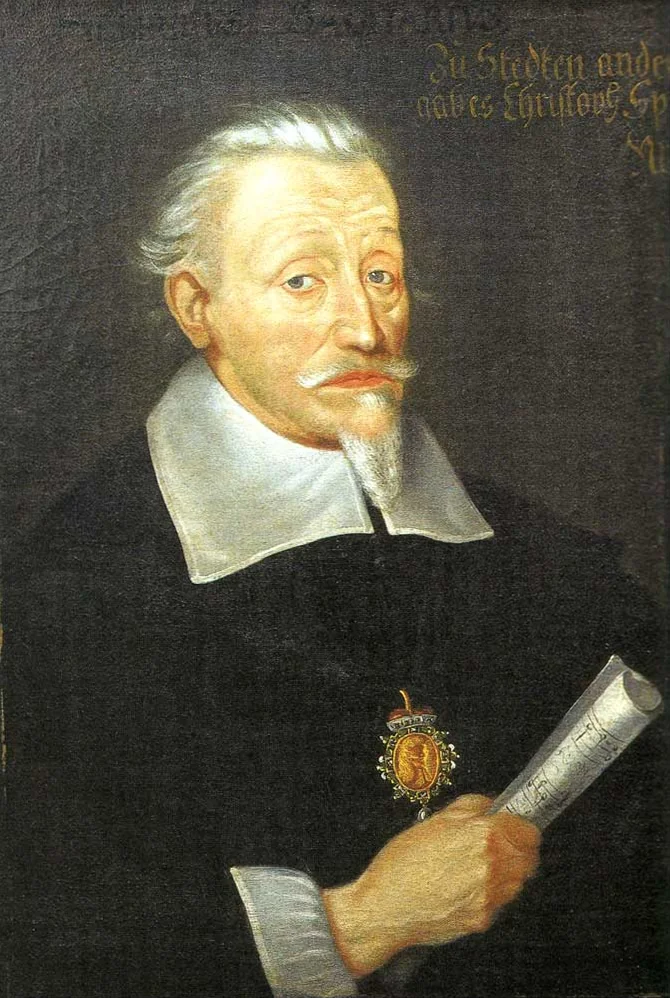
Image from Wikipedia
Image from Wikipedia
Heinrich Schütz – Architect of German Baroque Music
Between War and Sound: The Life's Work of the First Great German Composer
Heinrich Schütz (1585–1672) shaped the musical culture between the Late Renaissance and the High Baroque as the most significant German composer of the early Baroque period. Hailing from Bad Köstritz, he developed a unique language of sound in Dresden, blending Italian concert tradition, Protestant text culture, and dramatic rhetoric. His musical career, which spanned over six decades, documents an artistic evolution that continually sought expression, comfort, and representation despite wars, plagues, and societal upheaval. For music lovers and choral practice, Schütz remains a benchmark for text declamation, vocal polyphony, and affect-conscious sound direction to this day.
Childhood, Support, and Early Influences
Growing up in Weißenfels, Schütz's musical talent was discovered in 1599 by the art-loving Landgrave Moritz of Hesse-Kassel. The support from the landgrave not only enabled a solid education at the Kassel court school but also paved the way to Italy – where the European avant-garde of the time was forming. His early years already displayed the scope of his artistic ambition: from the humanistic school context to courtly practice, from German song culture to Italian madrigal tradition. This dual perspective – rooted in home and international curiosity – remained a common thread throughout his career.
Venice and the School of Sound Architecture
The study years from 1609 to 1612 with the legendary Giovanni Gabrieli at St. Mark's Basilica sharpened Schütz's compositional expertise: polychorality, spatial sound, concerto principles, and the sovereign leadership of the basso continuo became the cornerstones of his style. With the collection of madrigals Il primo libro di Madrigali (1611), he first emerged in Italian – a statement of closeness to the avant-garde of that time. In Venice, he learned the sound dramaturgy of space, the art of expression through antiphony and motivic condensation; his later works systematically transformed these impulses into German-language, Protestant vocal music of unprecedented plasticity.
Dresden: Court Chapel, Representation, and Artistic Responsibility
Beginning in 1614, Schütz worked in Dresden, becoming court conductor in 1621. His stage presence as a musical director encompassed liturgical duties, court festive culture, and political representation. He was responsible for the artistic development of the court chapel, balanced singers and instrumental ensembles, and established a composition and performance practice that oscillated between splendid polychorality and intimate sacred concert. At a time when music communicated power, grandeur, and piety equally, Schütz became a central voice in Saxon cultural policy – and the formative ear of an entire era.
Composing in the Shadow of the Thirty Years' War
The Thirty Years' War (starting in 1618) changed sound spaces, resources, and audiences. Schütz responded with a wise reduction of forces, without losing expressive power: from necessity arose the Kleine geistliche Konzerte (1636/1639) as masterpieces of text interpretation with minimal instrumentation. At the same time, he maintained a full ceremonial sound whenever circumstances allowed. This dual production line – intimate confession and representative brilliance – makes his discography so rich to this day: it reflects the breadth of Baroque production under extreme living conditions.
Main Works: From the Psalms of David to Musikalische Exequien
With the Psalms of David (1619), Schütz set a precocious stylistic exclamation mark: double-choral architecture, clear articulation of biblical texts, and sonorous monumentality. The Cantiones sacrae (1625) cultivate a learned, motet-like style, while the three volumes of Symphoniae sacrae (1629, 1647, 1650) nurture the concerto principle with soloists, choir, and obligato instruments. The Musikalischen Exequien (1636) connect liturgical depths with an artfully crafted structure, an early "funeral music" of exemplary coherence. Late works like the Weihnachtshistorie (1664) and the Passions after Luke, Matthew, and John (around 1664–1666) condense narrative power and contemplative intimacy.
Second Stay in Italy and the Art of Stylistic Integration
A return visit to Venice from 1628 to 1629 brought Schütz into contact with the theatrically charged stylistics of Monteverdi. However, rather than imitating, he integrated scenic impulses into German text declamation: recitative mobility, affect-conscious harmony, and instrumental color merged with the Luther Bible into a distinctive language of sound. This growth enhanced the stage effectiveness of his sacred music – not as opera, but as dramatic proclamation that emotionally fills the liturgical space.
Later Years in Weißenfels: Condensation, Passion, and Legacy
In his later years, Schütz primarily lived in Weißenfels; there he produced central contributions to the Passion narrative in German. Particularly striking is the so-called Schwanengesang (1671) – the complete setting of Psalm 119, supplemented by Psalm 100 and a German Magnificat – which summarizes his compositional ethos: proximity to the text, contrapuntal mastery, and a spirituality that does without external pomp. The retreat from court representation allowed room for concentrated sound theology, which would shape generations of church musicians.
Discography, Editions, and Performance Practice
Schütz’s work survives in an impressive tradition of editions and recordings. Critical complete editions – such as those by Bärenreiter – provide the works in modern notation and form the basis for historically informed performances. Extensive box editions (including Brilliant Classics, Sony, Carus) have made his oeuvre widely accessible, from magnificent multi-choral works to intimately arranged sacred concerts. Recent reference recordings – such as the Weihnachtshistorie – demonstrate how alive his music remains in today's sound discourse: sonically transparent, textually comprehensible, rhetorically pointed, and stylistically aligned with historical interpretation.
Style and Technique: Text Interpretation, Affect Rhetoric, and Basso Continuo
Schütz's compositional profile rests on three pillars: first, precise text interpretation – syllable rhythm, prosody, and semantic accents steer melody and harmony; second, affect rhetoric – dissonances, sequences, and pauses serve the emotional portrayal; third, the basso continuo – as a foundational harmonic backbone that allows flexibility in instrumentation and sound color. In his arrangements, Schütz balances voices and instruments so that the semantic guiding line always remains audible. His art of "speaking music" transforms every line of biblical prose into a dramatic event.
Artistic Development in the Reflection of the Repertoire
From Italian madrigals to German church music, Schütz's artistic development does not proceed as a break, but as a conscious translation. Early on, he practiced polychoral design and sound splendor, during the war he refined chamber-music transparency, and later concentrated on the word. This historical classification shows: Schütz is more than a "forerunner of Bach." He is a distinctive innovator who shifts genre boundaries, connects stylistic schools, and permanently shapes the choral culture of Central Europe.
Reception and Cultural Influence
Even contemporaries honored Schütz as the "father of our modern music." Later, his work occasionally fell into oblivion until the choral movements of the 19th century and the musicological research of the 20th century reestablished his significance. Today, festivals, research institutions, and museums – such as the Schütz houses in Bad Köstritz and Weißenfels – ensure the lively maintenance of his oeuvre. International ensembles of early music regularly feature his works in their programs; competitions and prizes underscore the relevance of his compositional language that extends to the present day.
Why Heinrich Schütz Inspires the Present
In times when music is increasingly perceived as a meaningful language, Schütz's sound discourse appears strikingly modern. His works combine contemplative depth with dramatic immediacy; they are "speaking music" that fosters community and addresses individual experience. Whether a solemn double-choral Psalm word, a concise solo concert, or a narrative history: Schütz's art teaches listening as a cultural technique – precise, empathetic, sensual.
Conclusion: A Master of Voice – and Soul Spaces
Heinrich Schütz remains fascinating because he combines musical architecture with spiritual clarity. His stage presence as a court conductor, his compositional skill between motet, madrigal, and concert, his ability to transform words into sound – all of this makes him a fixed star in European music history. Whoever experiences his music live sees how much sound opens spaces: for comfort, orientation, and community. Attend concerts with Schütz programs, discover new recordings, listen closely – and experience how this music directly touches across centuries.
Official Channels of Heinrich Schütz:
- Instagram: No official profile found
- Facebook: No official profile found
- YouTube: No official profile found
- Spotify: No official profile found
- TikTok: No official profile found
Sources:
- Wikipedia – Heinrich Schütz
- Bärenreiter Verlag – Heinrich Schütz (Edition, Work Overview)
- German Digital Library – Heinrich Schütz: the first German composer
- SWR Culture – Vox Luminis sings Schütz’s Weihnachtshistorie (Review, 28.11.2024)
- Heinrich-Schütz-Haus Weißenfels – Annual Review 2025
- Heinrich Schütz Music Festival 2025 – Complete Program
- Carus – Heinrich Schütz Complete Recording: Concordance
- Brilliant Classics – Heinrich Schütz Edition (Booklet)
- Wikipedia: Image and Text Source
Upcoming Events
Johannes Passion by Heinrich Schütz
Music for the Hour of Death - Good Friday at Martins Church
Heinrich Schütz Festival 2026 Kassel
Heinrich-Schütz-Fest 2026 Kassel
Köstritzer Soiree with Musical and Culinary Delights
Köstritzer Soiree: Music and Culinary Delights around Schütz