How Amberg Is Changing: City Wall, Old Town, Culture
How Amberg Can Change – New Cultural Venues and Ideas (Outlook)
This article describes exclusively planned and possible developments in Amberg for the coming years – with a focus on culture, the old town, and urban space.
Context: Why Looking Ahead Is Important for Amberg
In the coming years, Amberg can adjust several levers at once: historical substance can be made more accessible, new cultural formats can create additional reasons to visit, and central areas can be further developed so that everyday life, living, and encounters interact more closely. It is crucial that changes are not seen as a break, but as further development within the existing fabric.
Two topics are at the center, which can particularly shape urban development: a long-term concept around the city wall and the future use and design of the area around the Bürgerspital. These major themes are complemented by smaller, flexible formats such as temporary pop-up uses and networked cultural projects in the city and surrounding area.
Amberg City Wall: A Future Circular Path Between History, Light, and Culture
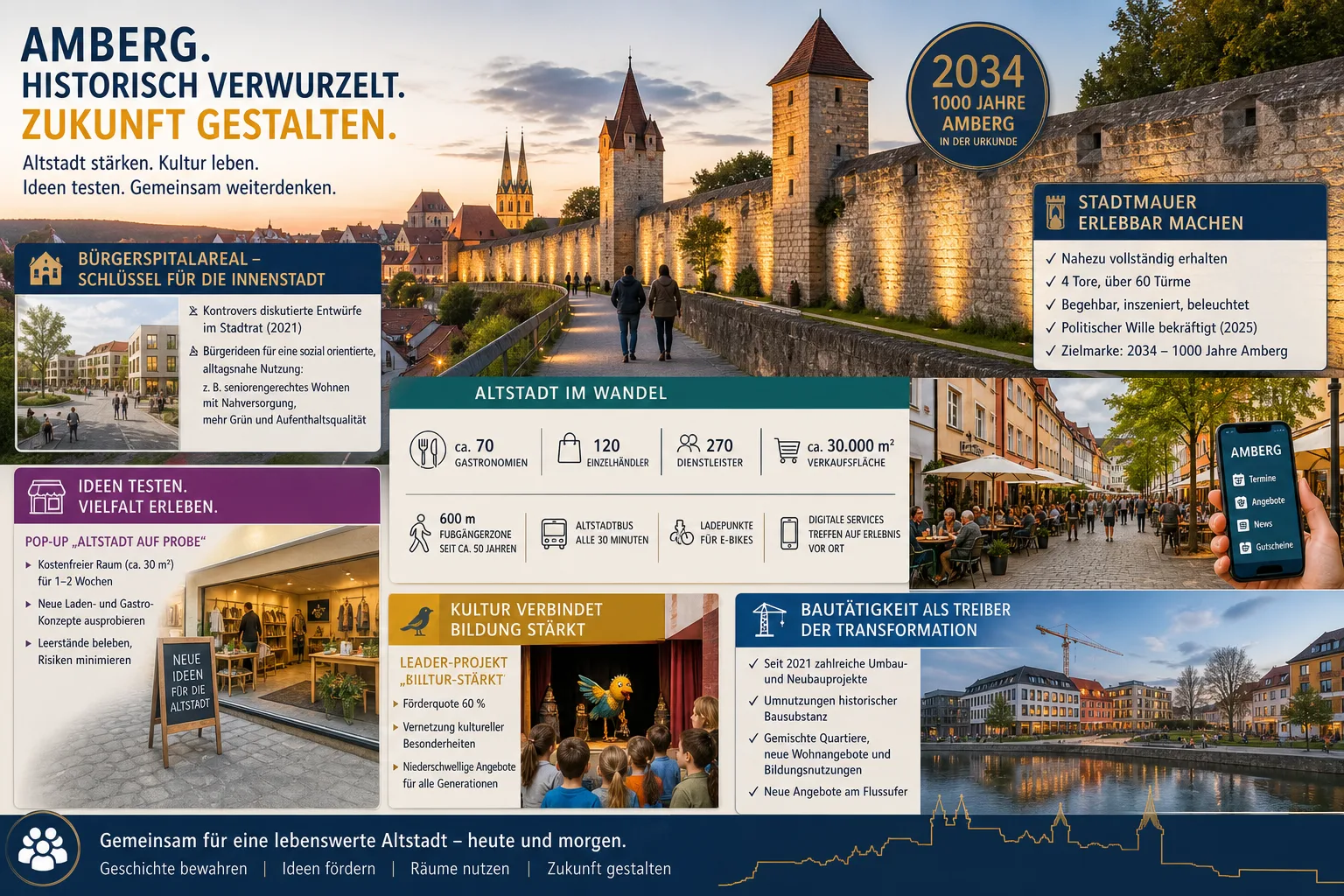
For the coming years, it is conceivable that the Amberg city wall will become more experienceable as a coherent urban space: through improved routing, clearly readable entrances, selective places to linger, and subtle, monument-sensitive lighting. The goal can be not to "stage" the historical structure, but to open it up so that it becomes usable in everyday life.
If such a development is consistently implemented, the city wall can fulfill several functions at once in the future: as a quiet walking path, as a learning place for city history, and as a framework for smaller outdoor cultural formats. At the same time, a clear timeline and action plan can help reliably steer implementation, even when funding programs change or budgets fluctuate.
For visitors, this could create a clearer, more recognizable profile: a circular walk that structures Amberg's old town, provides orientation, and increases the quality of stay. For the city community, the wall can thus become an everyday open space that is not only "viewable" but usable.
Old Town in Transition: Future Everyday Life with Digital Services and More Culture
The old town can continue to develop in the coming years towards a mixed urban space: shopping and gastronomy remain important, but will likely be increasingly complemented by low-threshold cultural offerings, better places to linger, and digital service modules. Possible examples include more online appointment bookings, reservations via messaging services, or hybrid offerings that combine on-site visits and digital pre-information.
Mobility components can also play a greater role in the future – such as clearly visible information on city center connections, more accessible route chains, and offers that make staying without a car easier. If such elements interact with smart public space design, the old town can function as a "practical" place and at the same time become more attractive as an experience space.
Continuous dialogue is important for acceptance and quality: visualizations, concept sketches, and participation formats can help in the future to make variants understandable and to incorporate feedback early, before decisions are finalized.
“Old Town on Trial”: Experimental Spaces as a Tool for the Coming Years
Temporary usage formats such as “Old Town on Trial” can remain a central lever in the coming years to test new ideas with low risk. The principle is simple: a space for a limited time lowers entry barriers and enables founders, creatives, or cultural actors to try out an offer under real city center conditions.
If such pop-up phases are systematically evaluated, practical added value can result: the city can better recognize which concepts attract audiences, which gaps in offerings exist, and which framework conditions (opening hours, visibility, cooperation) are necessary for sustainable settlements.
For visitors, the format can make the old town appear “new” more often in the future – not through major renovations, but through changing content that provides reasons for repeated visits.
Bürgerspital: A Possible Key Location for Living, Services, and Encounters
In the coming years, the Bürgerspital area can become one of the decisive building blocks of city center development. Depending on which uses are prioritized there in the future, the “feel” of the old town can change: Will the area be more of a place to pass through or a place where people deliberately stay? Will it mainly provide living space, mainly services, or a mix with social and cultural functions?
A future-proof approach can be to bring together several needs: everyday-oriented offers, well-usable open spaces, an appropriate scale in the historical environment, and spaces that enable encounters. Especially for central areas, visualizations and drafts will likely play a key role in the next planning steps – not as “advertising images,” but as a basis for decisions that allow non-experts to assess impact, proportions, and route relationships.
If the next steps are communicated transparently and participation opportunities are clearly structured, the area can build trust in the long term: not only the result counts, but also the traceability of how it comes about.
Construction Projects and Cultural Networking: New Places, New Connections
In parallel with individual key areas, further conversions and construction projects can change the cityscape in the coming years: historical buildings can receive new functions, city center uses can be more strongly mixed, and routes to attractive urban spaces (for example along waterways) can be improved. It is crucial that projects are not thought of in isolation, but as a network of paths, squares, and uses.
Additional momentum can arise from networked cultural projects that make offerings in the city and surrounding area more visible. LEADER funding is often used in rural regions to initiate cooperation, cultural, and regional development projects. For Amberg, such a network principle can be particularly effective in the coming years if culture is designed as an everyday offer: small-scale, easily accessible, and with a low entry threshold for people who otherwise rarely attend cultural events.
In the long term, stability arises above all when cooperation between cultural workers, institutions, associations, and administration is consolidated – regardless of individual funding periods.
How Amberg Could Feel in the Future: Between History and New Beginnings
In the coming years, Amberg can develop a profile consisting of several well-coordinated building blocks: a more experienceable city wall as an identity-forming circular path, an old town that connects everyday life and culture more strongly, flexible pop-up formats as an engine of innovation, and a Bürgerspital area that can bring new quality to the city center as a mixed urban component.
Whether this direction will succeed will depend mainly on three factors: the quality of planning, reliability in implementation, and transparency towards the city community. If this combination succeeds, Amberg in the future does not have to “change at any cost,” but can remain recognizably Amberg – and at the same time noticeably gain: in usability, quality of stay, and cultural diversity.
Sources & Further Information
- LEADER in Bavaria — Information on funding approach, project types, and regional development (accessed 2026-10-28)
- Bavarian State Ministry for Housing, Building and Transport — Basics on urban development, building, and planning approaches (accessed 2026-10-28)
- Bavarian State Office for Monument Protection (BLfD) — Notes on monument protection and dealing with historical building substance (accessed 2026-10-28)