Street Music & Concerts in Amberg: Music in the City
Street Music & Spontaneous Concerts in Amberg: Where You Can Experience Live Music Outdoors in the Coming Months
When guitars, voices, or small ensembles suddenly spread out between the marketplace and side streets in Amberg's old town on warm afternoons, a special city experience is created: low-threshold culture that feels almost accidental – and yet reliably recurs. This guide explains where you are most likely to encounter street music and pop-up performances in the future, how the “Stage-in-Everyday-Life” principle works, and how to plan your visit to catch as many musical moments as possible.
Status: October 2026 (Outlook on upcoming dates and typical time windows; specific programs may change.)
Summer in Amberg: When the Old Town Becomes a Stage
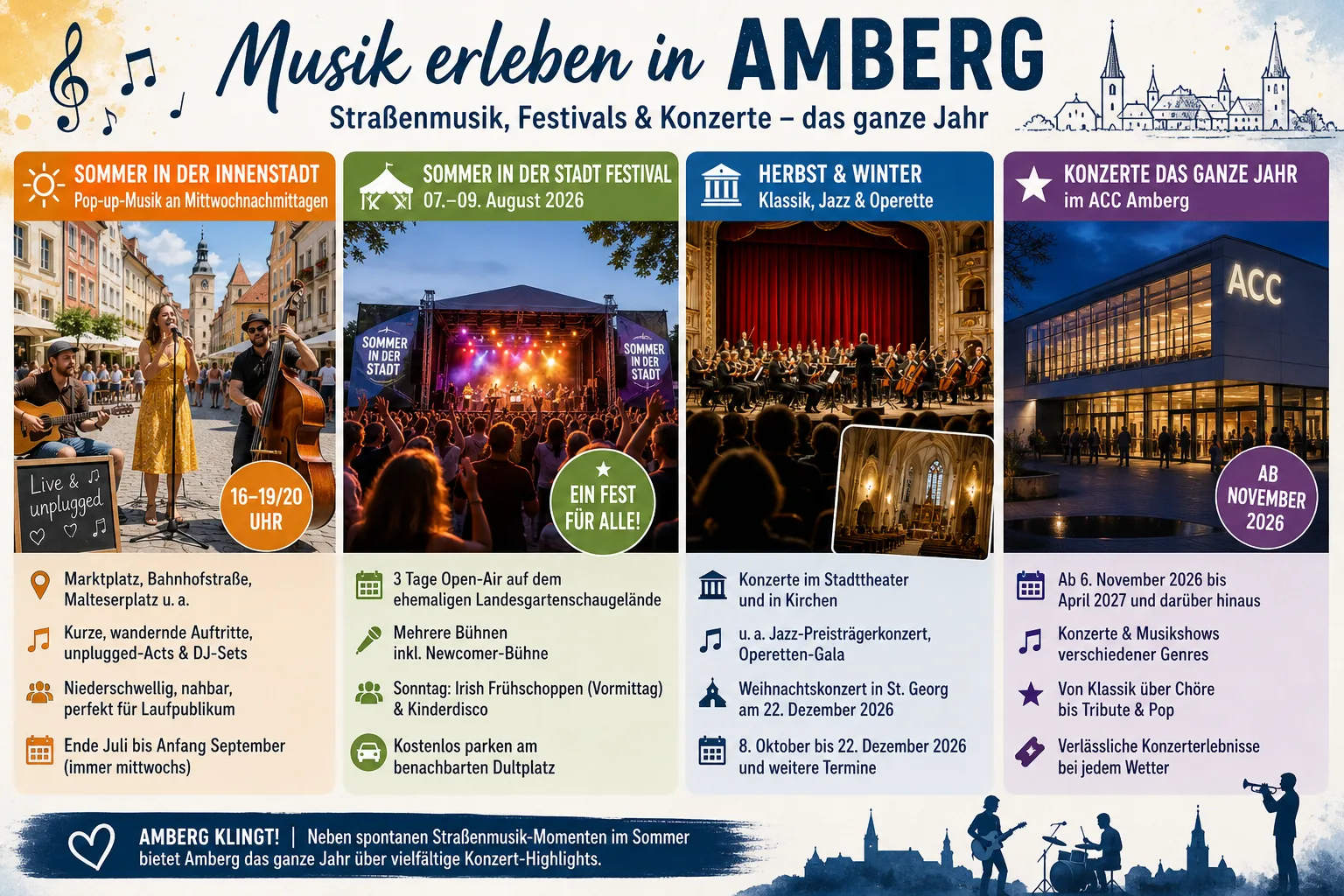
In the coming summer months, the likelihood is highest of encountering street music or short pop-up sets in Amberg's city center. Typical time windows are late afternoon to early evening, when shopping and after-work crowds overlap and squares and walkways are well frequented.
Particularly suitable for a “music walk” are central, open areas such as the marketplace, Bahnhofstraße, and Malteserplatz. Here, small acts can unfold acoustically without the need for a large stage: you pause briefly, listen to a song, move on – or stay longer if the atmosphere and weather are right.
Important for visitors: Even though many performances seem spontaneous, such series are often coordinated in practice with the city, organizers, and local stakeholders (e.g., regarding volume, duration, locations). This interplay ensures that the format remains lively but can reliably function in the everyday life of the city center.
“Luftklangmeile”: The Concept Behind the Coincidence
A “Luftklangmeile” simply describes a route through the city center where music appears at several points simultaneously or in succession: small spots instead of a central main stage. For the audience, this has two advantages:
- Low threshold: No ticket, no admission situation, no need to “arrive properly”.
- Movement instead of a frontal situation: You can stroll from place to place and spontaneously decide where to stop.
For local and regional musicians, this model is attractive because it creates visibility and at the same time allows short set formats. For the city, it is a means to increase the quality of stay without over-shaping the character of a historic urban space.
Open-Air Weekends: When Amberg Sounds “Bigger”
In addition to the decentralized city center moments, there are also formats in Amberg that will function more like a classic open-air festival in the future: several stages, longer playing times, a more pronounced event character. Such weekends are particularly suitable if you want to experience many acts “bundled” – often including family-friendly program parts during the day.
It is practical that large open spaces and easily accessible areas (e.g., around event and parking areas) can make arrival easier. If you are coming from outside, it is worth checking early:
- whether parking options are designated and which public transport connections are recommended,
- whether there are day and evening programs (e.g., family offers in the afternoon),
- what rules apply to bringing drinks, bags, and seating.
In terms of content, this often creates a bridge: those who discover acts in a small city center set will later experience similar styles in a more professionally curated setting – only with a larger stage, clear playing times, and a more planned dramaturgy.
From Summer to the Halls: Concert Evenings in Autumn and Winter (Outlook)
When the weather becomes more changeable, live music in Amberg typically shifts more to venues such as theater and church spaces as well as event centers. For the coming autumn and winter months, this means: more plannable evenings with fixed start times, seating, and complete programs (classical, choir/orchestra, jazz formats, or show productions – depending on the schedule).
If you specifically want to plan a concert evening, the best starting point is usually the official event calendar of the city or the respective venues. There you will also find information on accessibility, admission times, and ticket categories.
What Street Music Can Achieve in a City (Realistically Classified)
1) Quality of Stay – Without Ticket, Without Barriers
Short live moments in public spaces can “slow down” routes: squares become places to stay, not just passageways. Especially in a historic old town, music often acts as a gentle counterpoint – provided volume and time windows are appropriately chosen.
2) Revitalizing the City Center – An Impulse, Not a Cure-All
Cultural offerings can increase the duration of visits and create additional reasons to come to the city center. At the same time, the effect strongly depends on framework factors (weather, overall offering, gastronomy, accessibility). Street music is therefore more of an impulse generator than a sole problem solver for frequency issues.
3) Community – Because Everyone Becomes Part of the Audience by Chance
The greatest value often lies in the social mix: children pause briefly, working people listen to a song on their way home, tourists get an authentic city feeling – without fear of thresholds and without a “cultural dress code”.
4) Opportunities for Musicians – Visibility and Learning Space
Those who regularly play at small spots train stage presence, repertoire, and audience contact. In cities with several format levels (pop-up series, open-air days, hall programs), a comprehensible development chain can emerge from this.
Practical Orientation: How to Increase Your Chances of Live Music
- Choose suitable time windows: Performances are most likely on warm days in the late afternoon to early evening, when many people are out in the old town.
- Go “place-oriented”: Open squares and wide walkways (e.g., around central city axes) are acoustically and logistically most suitable.
- Plan flexibly: Pop-up formats can shift at short notice (weather, technology, permits). An alternative is to plan a café or museum visit in parallel.
- Listen respectfully: Keep passageways clear, be mindful of residents, and support artists – if possible – fairly (e.g., by tipping or following official channels).
- For families: Early evening is usually the most relaxed atmosphere; hearing protection for small children can be useful at amplified spots.
Notes on Rules, Consideration, and Safety
Street music in public spaces in Germany is often regulated by municipal requirements (e.g., special use, noise protection, time windows). For Amberg: When in doubt, rely on the information from the city, organizers, and on-site signage. If you want to play music yourself, inform yourself in advance about required permits, permitted locations, and volume limits.
Health & Safety: Usual recommendations apply for larger crowds (keep escape routes clear, watch children, drink enough in hot weather). This article does not replace official information.