Discover Open Mic & Poetry Slam in Amberg
Open Mic & Poetry Slam in Amberg: How to Find Upcoming Stages, Tickets, and Performance Opportunities
A practical overview for Amberg: How Poetry Slam and Open Mic work, where to reliably find future dates, and how to prepare well as a performer or audience member.
Poetry Slam & Open Mic: What to Expect
When spoken word art becomes visible in a city, it often happens through two formats: Poetry Slam (with clear rules and often competition) and Open Mic (open, low-threshold, usually without competition). Both formats are ideal for hearing new voices—or performing for the first time yourself.
Poetry Slam (Typical Basic Rules)
- Own Texts: Self-written texts are performed (poetry, prose, spoken word, storytelling, etc.).
- Time Limit: Performance time is limited so that many contributions fit into one evening.
- Audience Decision: The audience often decides by applause or points who advances or wins.
Open Mic (Typical Procedure)
- Open Slots: Performances after prior registration or spontaneously on site (depending on the event).
- More Genres: Poetry, comedy, music, short stories—depending on the concept.
- Focus on Atmosphere: Respectful setting, short sets, lots of room for experimentation.
Important: Each event series may interpret rules slightly differently. Therefore, always read the respective organizer's notes for new dates (time limit, registration deadline, language, technical possibilities).
Finding Upcoming Dates in Amberg: The Most Reliable Ways
Since poetry slam and open mic evenings in smaller cities are often organized on a project basis (festival, theme night, cooperation), the best strategy is: combine several information sources and check early.
1) Official Cultural Programs & City Channels
For upcoming dates in Amberg, official cultural and event programs are usually the first point of contact—especially for events held in public institutions or as part of a city program.
2) Venues with Suitable Stages
For future spoken word evenings, these types of places are especially worthwhile (depending on program planning):
- Library (indoors/outdoors, often with cultural program and thematic proximity to writing)
- Theater or Cultural Center (weather-independent, well equipped technically)
- Cafés, youth centers, club rooms (for small, regular open mic formats)
3) Regional Calendars & Ticket Portals as Supplement
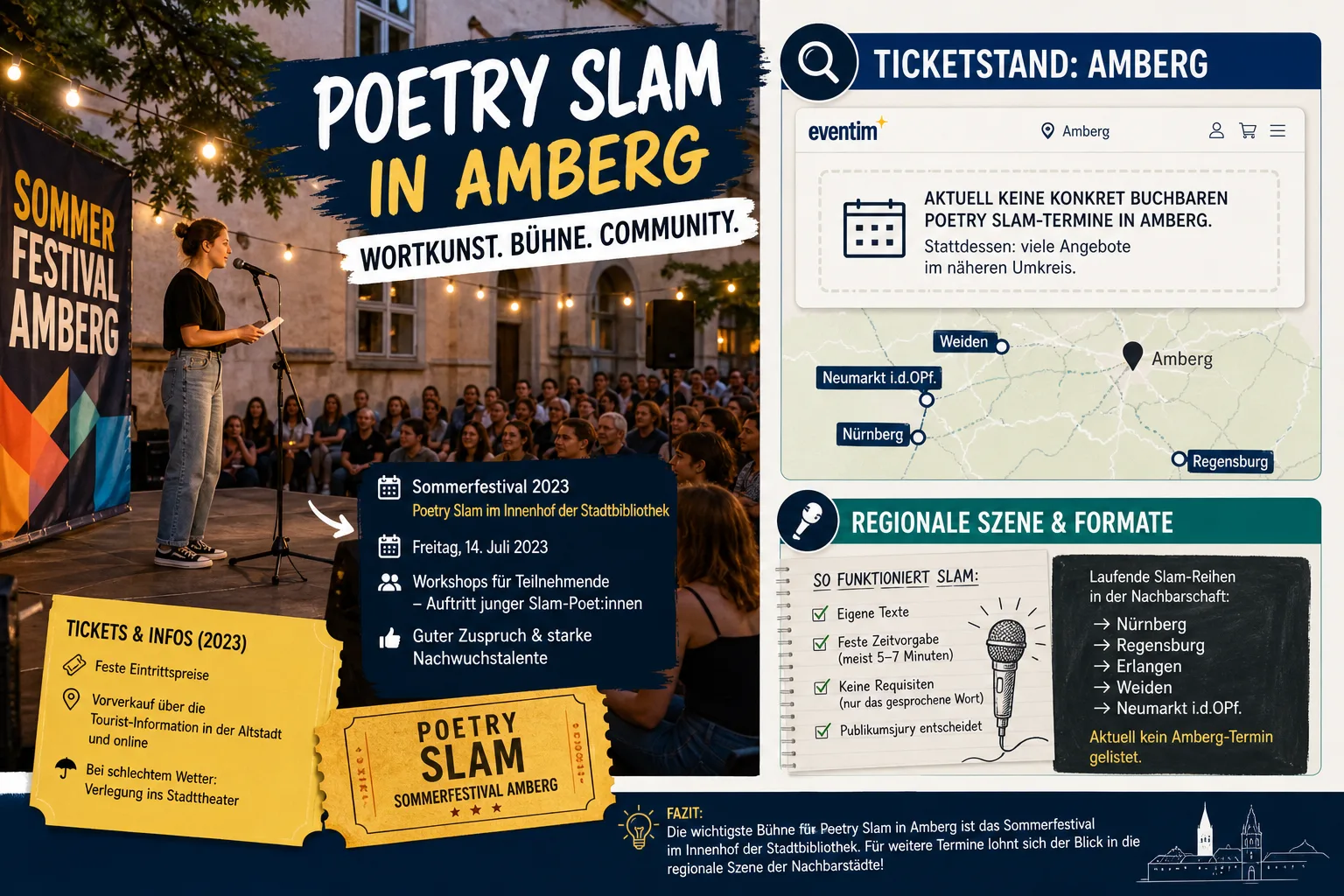
Large ticket portals are practical if a series is actively maintained there. For smaller or newly emerging formats, dates are often first published via local calendars, social media, or newsletters. Therefore, use ticket portals as a supplement—not as the sole source.
4) Scene Networks in the Area
In the region, performance opportunities often arise through networks: hosts, recurring series in neighboring cities, collaborations between organizers. Those who follow these channels often hear first about new dates in Amberg or guest performances within reach.
Summer Festival & Library: Why Festival Formats Are Important for the Future
For Amberg, festival and themed formats are a particularly realistic framework in which poetry slam and open mic can continue to be visible in the future: They bring together audience, communication, and infrastructure—and lower the risk for new series.
Especially in combination with workshops (writing, performance, stage presence), a coherent path from idea to performance emerges: Participants develop texts, receive feedback, and can then perform in a protected, well-moderated setting.
If an organizer also communicates transparently for upcoming editions—about admission, advance sales, entry times, rules, and a bad weather alternative—it builds trust and increases the chance that an evening will return in the long term.
Tickets, Registration, Procedure: How to Plan Your Evening
So that you are not surprised at future events, these checkpoints help—whether slam, reading stage, or open mic:
- Advance Sale vs. Box Office: Check if tickets are limited and whether you can get them online or on site.
- Admission & Start: Many formats start on time; arriving early is worthwhile (seating, registration for slots, tech check).
- Registration to Perform: Is there a form, an email address, or a list on site? How many slots are given out?
- Time Limit & Content: Find out about minute limits, prop rules, and whether music/playback is allowed.
- Accessibility: Check if there is information about access, seating, hearing support, or toilets.
Note on Currency: Ticket and program information can change at short notice (e.g., due to weather, technology, or illness). Shortly before the event, rely on the most recently published information from the organizer.
Tips for Performers: Your Path to the Microphone
Do you want to perform at an upcoming open mic or poetry slam in Amberg (or within reach)? These steps will help you become performance-ready quickly—without overwhelming yourself.
1) Write for the Stage (Not Just for Paper)
- Make it speakable: Short sentences, clear images, build in pauses.
- A strong start: The first 20–30 seconds decide whether the audience is "in."
- A clear arc: Punchline, turning point, or emotional climax—something that carries.
2) Try the Time Limit Realistically
Time your text out loud (not just in your head). Plan buffers for laughter, applause, or slip-ups. If you're just over the limit, cut consistently rather than rush.
3) Use Workshops, Writing Groups, and Feedback
If workshops or coaching are offered in upcoming cultural programs, they are the fastest way to gain confidence on stage: you learn structure, performance, and how to deal with stage fright—and meet people who will later help run events themselves.
4) Contacts in the Region Are Leverage
If there is currently no suitable date for you in Amberg: perform at series in the surrounding area, talk to hosts, and build a small "performance biography." This makes it easier to get a stage in Amberg later or help shape one.
5) If You Want to Start an Open Mic Yourself: Simple, Clear, Repeatable
Many series start small. For a sustainable format, three things are crucial: a fixed rhythm (e.g., every 6–8 weeks), a transparent set of rules (slots, time limit, registration), and appreciative moderation. This builds trust—and from that, regularity.
Tips for the Audience: How to Support a Scene
A spoken word stage grows not only through performers, but through an audience that returns. If you want there to be more slam and open mic evenings in Amberg in the future, you can help concretely:
- Secure tickets early (if advance sales are running)—this signals demand.
- Listen respectfully: Especially at open stages, first-time performances are common.
- Give feedback: Short, friendly feedback after the performance or to the organizer helps enormously.
- Recommend to others: Personal recommendations bring new people into the room—more important than any algorithm.
Outlook: How the Spoken Word Stage in Amberg Can Develop in the Coming Years
For the coming years, three development paths are especially realistic in Amberg:
- Festival slots become more regular: Spoken word becomes a recurring part of city programs.
- New small series emerge: Cafés, clubs, or youth culture focus on low-threshold open mic evenings.
- Regional networking strengthens Amberg: Guests from the surrounding area bring know-how, hosting, and audience cycles.
If organizers plan transparently, performers support each other, and audiences show up reliably, individual highlights can gradually become a stable, recognizable spoken word stage in Amberg.
Sources
- Wikipedia: “Poetry Slam” — Overview of format, rules, and history (accessed 2026-07-08)
- Encyclopaedia Britannica: “Poetry slam” — Classification of the format (accessed 2026-07-08)