Flea Markets in Amberg: Dates & Flea Market Guide
Flea Markets in Amberg: Dates, Locations & Treasures (Preview of Upcoming Events)
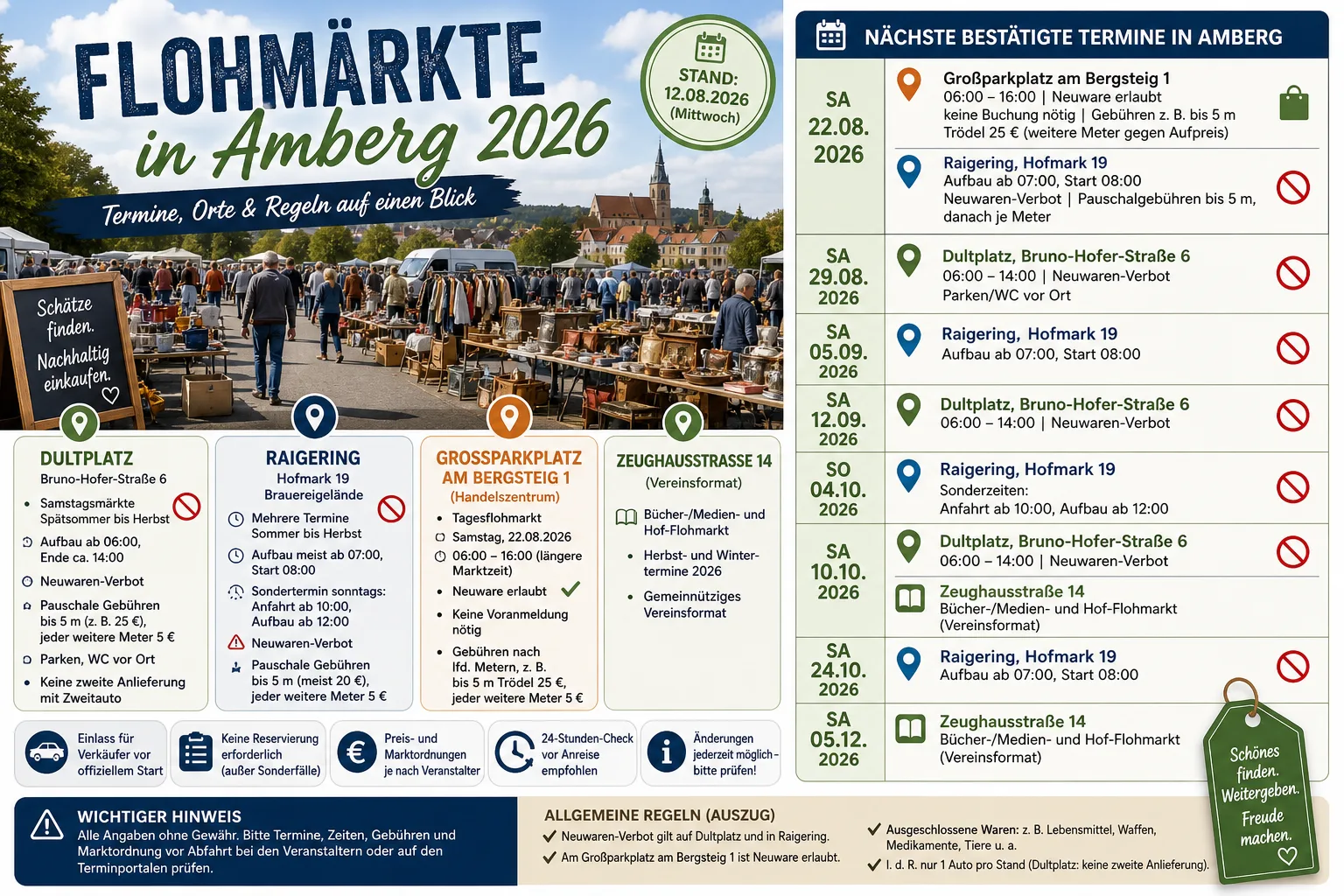
If you want to go treasure hunting in Amberg in the coming weeks and months, you will find several recurring flea market locations: from the classic flea market with a ban on new goods to the large parking lot market, where new goods may also be permitted. This overview helps you plan upcoming flea market visits, understand the rules, and organize your day on site stress-free.
Locations in Amberg: Character, Rules, Directions
In Amberg, flea and jumble markets are typically held at several clearly distinguishable places. The following overview describes the common profiles so you can choose the right market for your next visit.
Dultplatz (Bruno-Hofer-Straße): Classic Flea Market
The Dultplatz (Bruno-Hofer-Straße) is the first address for many visitors when looking for a classic flea market. The focus is on used items such as clothing, household goods, toys, books, vinyl, and collectibles.
- Typical market focus: mostly used goods
- Important rule: depending on the market rules, new goods may be prohibited
- Practical tip: Coming early is worthwhile if you are specifically looking for rarities; coming later is suitable if you want to browse at your leisure.
This location is particularly interesting for sellers if you want to offer household clearances, children's items, or attic finds and prefer a "flea market flair".
Raigering (Hofmark 19): Flea Market in a Brewery Setting
In Raigering (Hofmark 19), flea or jumble markets are also held depending on the organizer. The character is often more neighborhood-oriented and focused on used goods.
- Typical market focus: flea/secondhand
- Rules: New goods may not be permitted—depending on the specific market rules
- Planning: Pay particular attention to the announced times (Saturday dates and special dates may vary).
If you are coming from outside, this market can be planned well for a half-day trip—ideally after checking the official organizer information for dates.
Large Parking Lot Bergsteig 1 (Shopping Center/Kaufland): Large Day Market
At the Large Parking Lot Bergsteig 1 (Shopping Center/Kaufland), flea market days are often larger and more geared towards walk-in customers. Depending on the organizer, new goods may also be offered here in addition to secondhand items.
- Typical market focus: mix of flea market and (partly) new goods
- For visitors: large selection, "market" atmosphere, good chance for everyday bargains
- For sellers: suitable if you also want to offer new or as-new goods (if allowed by the rules)
If you are looking exclusively for classic flea market goods without dealer new goods, Dultplatz or Raigering are often better choices. If you want variety, the parking lot market is often the right choice.
Zeughausstraße 14: Club and Themed Flea Markets (e.g. Books/Media)
At Zeughausstraße 14, depending on the organization, smaller, often volunteer-run flea market formats take place, including book and media sales or courtyard flea markets. These dates are particularly suitable for those specifically looking for reading material, games, or media.
- Strengths: manageable, thematic, often family-friendly
- Special feature: Proceeds may (depending on the club) benefit club activities
- Planning: Spaces and opening times are usually more tightly scheduled than at large markets—getting information in advance is worthwhile.
Market Rules & Practical Tips (Visiting & Selling)
New Goods vs. Flea Market: This Decides Your Booth and Product Planning
The most important decision for sellers is the question: Are new goods allowed? Some markets deliberately see themselves as flea markets and exclude new goods, others allow both. Read the market rules in advance and sort your boxes accordingly so there are no discussions at the entrance.
Booth Length, Fees, and Vehicle at the Booth
The conditions (booth length, price per meter or flat rate, car at the booth) depend on the organizer. Therefore, do not rely on general experience, but refer to the current information for the specific market day.
- Plan booth size realistically: Better to present clearly than to stack boxes.
- Bring change: Small bills and coins make sales talks easier.
- Clearly label prices: This saves time and builds trust.
Setup, Admission & Daily Routine
Many flea markets start early. For sellers, this means: allow enough time for arrival, instructions, and setup. For visitors: If you are looking for specific items (e.g. vinyl, tools, collectibles), you often benefit from an early tour; if you want to browse at your leisure, come later.
Regardless of location, a quick date check the day before is advisable, as changes due to weather or organization are possible.
Packing List for a Relaxed Flea Market Day
- Cash (small bills), optionally a pouch for coins
- Weatherproof clothing (sun/rain), comfortable shoes
- Bag or backpack for spontaneous finds
- For sellers: tablecloth, tape, pen, price tags, possibly foil/tarp
Safety, Fairness & Legal Basics
Flea markets thrive on fair deals. These principles help avoid misunderstandings:
- Clearly state item condition: For electronics (e.g. record players), test on site if possible.
- Note private sales: Different warranty rules often apply to private sales than in retail. Clarify before buying whether returns are possible (usually not).
- Respect house and market rules: Admission, setup zones, emergency routes, and waste rules are binding.
Note: This article serves as a guide for upcoming flea market visits and is not legal advice. Official rules can be found in the publications of the respective organizer as well as in the relevant legal foundations.