Experience Citizens' Assemblies in Amberg & City Politics
Experience Citizens' Assemblies & City Politics in Amberg: What to Expect at the Next Dates
7 min readLaura Müller
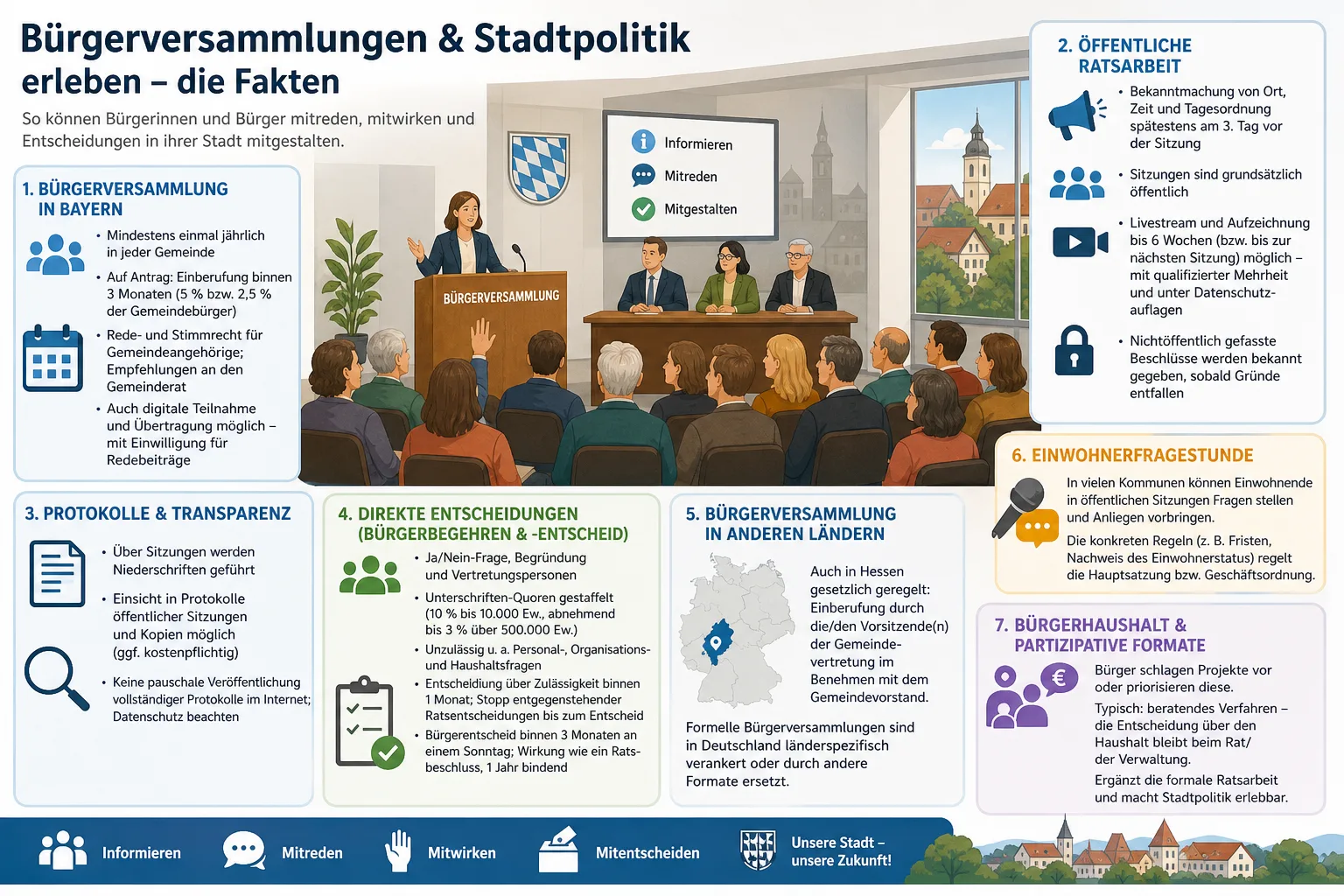
If you want to have your say in Amberg in the future, you will be able to use several public formats for this: citizens' assemblies, public city council meetings, question times, and—in certain cases—citizens' petitions and referendums. This guide looks ahead: at the next opportunities, at typical procedures, and at the steps you can take to prepare.
The Next Citizens' Assembly: Procedure, Rights, Impact
At the next citizens' assembly, as a resident of Amberg, you will usually be informed early about the date, location, and topics. This will allow you to plan in good time whether you want to participate, prepare questions, or bring up concerns.
What You Can Expect at Future Dates
- Public Announcement: The city will publish the date in advance so that interested parties can register or prepare.
- Speaking and Question Rights: Usually, questions and contributions will be possible; the specific moderation will be carried out by the meeting leadership.
- Documentation: Results and suggestions can subsequently be fed into the municipal advisory processes.
Practical Look Ahead: If you have a topic you would like to address at a future citizens' assembly, it is best to formulate it briefly and solution-oriented. This will allow the administration and politics to classify your concern more quickly.
The Next Public City Council Meeting: How to Follow Debates Live
At the next public city council meeting, you will be able to follow decision-making processes "in the original sound": motions, contributions, votes, and justifications. In Bavaria, the public nature of meetings is provided as a principle; non-public consultation will only take place in the future for legitimate reasons (e.g., personnel matters or certain contract details).
What You Should Check Before the Meeting Day
- Agenda: It will be announced in advance. This allows you to specifically decide which items are relevant to you.
- Meeting Documents: If published, they will help you better classify backgrounds (variants, cost frameworks, statements).
- Broadcasts: If the city offers livestreams or time-limited recordings in the future, you will be able to follow debates even without being present in the meeting room. Data protection and personal rights will regularly need to be taken into account.
How to Use the Meeting as a Citizen: Even if you usually will not "join the discussion," by listening, taking notes, and asking targeted follow-up questions (e.g., in question times or via official contact channels), you can better influence future decisions.
After the Meetings: Minutes, Resolutions, Data Protection
After upcoming citizens' assemblies and public city council meetings, for many questions it will depend on what exactly was decided, what justifications were given, and what next steps will follow. For this, minutes/records and resolutions will play a central role.
What You Can Expect in the Future
- Minutes of Meetings: Meetings will be recorded in minutes.
- Access to Public Parts: For public meetings, rights of access will be considered; in individual cases, copies may also be provided.
- Data Protection: Even in public proceedings, personal data must be protected. Therefore, it may happen in the future that not every detail appears in online publications, even though resolutions are made transparent.
Practical Tip: If you want to understand after a future meeting why a variant was chosen, note the exact designation of the agenda item. This will allow inquiries to the administration or council information system to be assigned much more quickly.
When a Topic Becomes Ripe for Decision: Citizens' Petition & Referendum
If, in the coming years, a municipal topic emerges for which a binding directional decision by the citizenry is sought, a citizens' petition may be the next step. If it is deemed admissible and subsequently leads to a referendum, the result will generally have the effect of a city council resolution.
Which Requirements You Should Plan For
- Clear Question: The petition will require a clear yes/no question.
- Justification & Authorized Representatives: A comprehensible justification and named persons for representation will be required.
- Quorum & Admissibility Check: There will be a signature quorum; the city council will check admissibility.
- Exclusions of Topics: Certain matters will continue to be excluded in the future (e.g., parts of budget law or personnel matters).
Important for Planning: Anyone considering a citizens' petition for the future should plan for legal advice early (e.g., through specialist offices/municipal law) to avoid formal errors. At the same time, objective communication will help make the topic understandable for as many people in Amberg as possible.
Question Time, Citizens' Budget & New Participation Formats: What Might Soon Be Possible
In addition to citizens' assemblies and meetings, further ways to bring up concerns may be available in Amberg in the future. Which formats are actually used will depend on statutes, rules of procedure, and political decisions—and can continue to develop.
Formats You Can Watch Out for in the Future
- Residents' Question Time: In or around public meetings, there may be set time windows in which residents can ask questions (often with rules on speaking time, registration, and responsibility).
- Citizens' Budget/Participatory Budget: If such a procedure is offered, proposals from the citizenry will be collected, evaluated, and included in the consideration for upcoming budget years (usually advisory).
- Dialogue Formats: City walks, workshop discussions, planning dialogues, or online participation may be used in the future, especially for larger projects.
This Is How These Formats Gain Impact: The more concretely a proposal is formulated (location, goal, benefit, possible side effects), the better it will fit into administrative processes and political decision-making logic.
Checklist: How to Prepare for Upcoming Dates
- Date and Topic Monitoring: Regularly check the city's announcements, the council information system (if offered), and the official channels of the City of Amberg.
- Sharpen Your Question: Write down your concern in 1–2 clear sentences. Add: "What should be decided?" and "By when?"
- Bring Evidence: Bring—if available—photos, measurement points, maps, or reliable observations (e.g., danger spots at certain times). This will make discussions more objective.
- Check Responsibility: Clarify in advance whether your topic can be solved municipally (city) or is rather state/supra-local (district, state, federal). This way you will end up in the right forum.
- Follow Up After the Date: Track when a point comes back on the agenda and ask about the status of the procedure.
Classification: This article serves as your future orientation in municipal procedures and does not replace individual legal advice. The respective valid legal texts, statutes, and announcements will always be decisive.